
Voyage Management Software Market Report Scope & Overview:
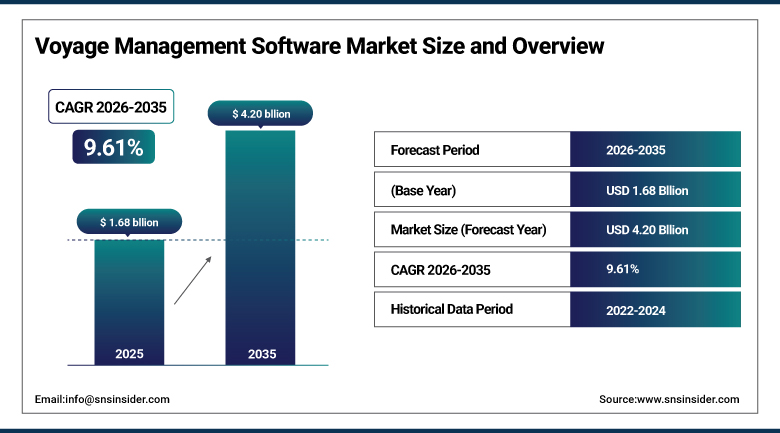
The Voyage Management Software Market was valued at USD 1.68 Billion in 2025 and is expected to reach USD 4.20 Billion by 2035, growing at a CAGR of 9.61% from 2026 to 2035.
The Voyage Management Software Market is growing due to rising digitalization in the maritime industry, the high demand for fleet optimization, and increased regulatory standards with respect to environmental and maritime safety. The use of voyage management software helps shipping companies in terms of route planning, better fuel efficiency, meeting regulatory requirements, and better visibility of operations. Other factors responsible for market growth include the rapid expansion of global sea-borne transport, rising incorporation of technologies such as AI, IoT, and cloud analytics, and investments in smart ports.
According to the International Maritime Organization (IMO), around 90% of global trade is carried by sea, driving shipping companies to adopt digital voyage planning, fuel optimization, and compliance management solutions.
Market Size and Forecast:
-
Market Size in 2026E: USD 1.84 Billion
-
Market Size by 2035: USD 4.20 Billion
-
CAGR: 9.61% from 2026 to 2035
-
Fastest Growing Region: Asia Pacific
-
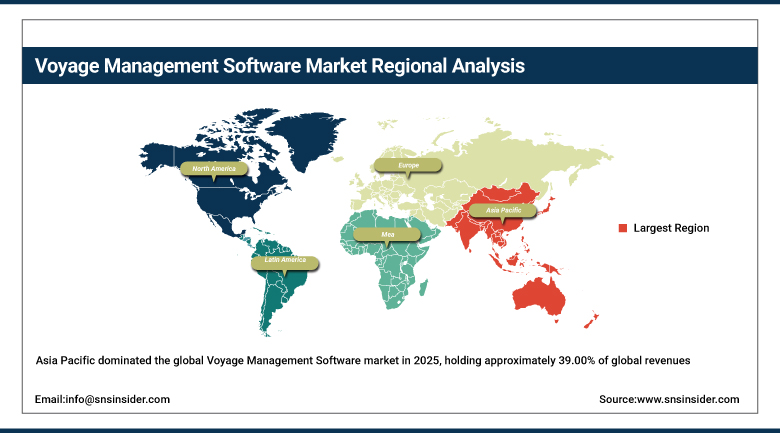
Largest Region: Asia Pacific
To Get more information Voyage Management Software Market - Request Free Sample Report
Voyage Management Software Market Trends:
-
Rising adoption of digital maritime solutions driving demand for voyage management software to optimize voyage planning, fleet operations, and fuel efficiency
-
Growing integration of AI, IoT, and real-time weather and ocean data enabling intelligent route optimization and enhanced navigational decision-making
-
Increasing focus on regulatory compliance, emissions reduction, and ESG initiatives encouraging deployment of software for environmental and operational performance monitoring
-
Expanding adoption of cloud-based voyage management platforms providing centralized fleet visibility, remote collaboration, and real-time operational insights across shipping networks
-
Continuous advancements in predictive analytics, automation, and digital twin technologies improving voyage safety, operational efficiency, and cost optimization for maritime operators
The U.S. Voyage Management Software Market Outlook:
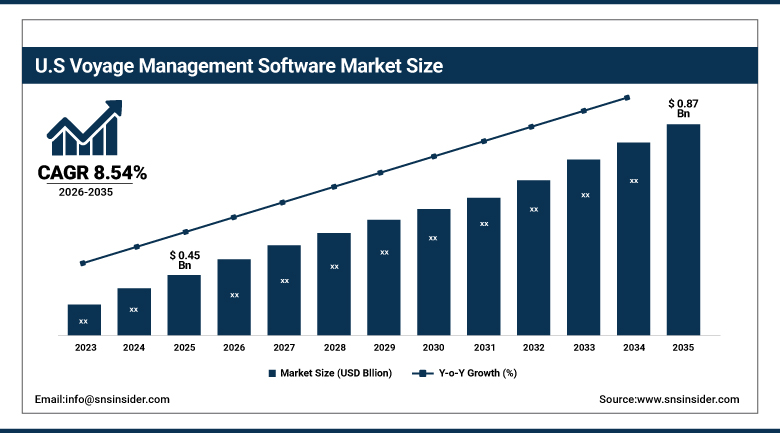
The U.S. Voyage Management Software Market was valued at approximately USD 0.45 Billion in 2025 and is expected to reach approximately USD 0.87 Billion by 2033, growing at a CAGR of approximately 8.54%.
The United States is a significant voyage management software market within the North American region, driven by the domestic presence of major shipping companies including Kirby Corporation, Crowley Maritime, and U.S. Navy and Coast Guard vessel management requirements, the headquarters of Veson Nautical whose IMOS platform is the leading enterprise voyage management solution deployed across tanker, bulk carrier, and container ship commercial fleets globally, and the growing demand for voyage optimisation and CII compliance monitoring at U.S.-flagged and U.S.-operated vessels whose IMO regulatory obligations create platform adoption incentives.
Veson Nautical's Shipfix acquisition and IMOS platform development investments sustain the domestic technology leadership that positions U.S. voyage management software providers competitively in global shipping company procurement decisions.
Voyage Management Software Market Segment Analysis:
-
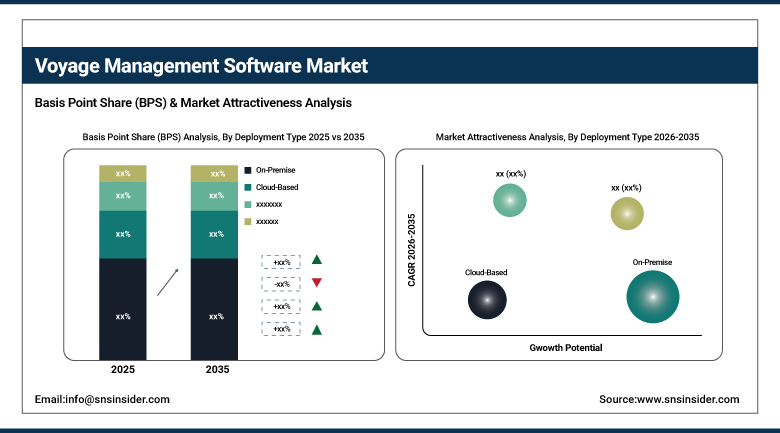
By Deployment Type, On-Premise segment dominated the Voyage Management Software Market in 2025 with 58.42% share; Cloud-Based segment is the fastest growing segment.
-
By Software Type, Fleet Management segment dominated the market in 2025 with 34% share; Route Optimization segment is the fastest growing segment.
-
By Application, Commercial Shipping segment dominated the Voyage Management Software Market in 2025 with 49% share; Offshore Operations segment is the fastest growing segment.
-
By End User, Shipping Companies segment dominated the market in 2025 with 52% share; Offshore Service Providers segment is the fastest growing segment.
By Deployment Type, On-Premise segment dominates the Voyage Management Software Market, Cloud-Based segment expected to grow fastest
The On-Premise segment dominated the Voyage Management Software Market in 2025 because of its capacity to offer enhanced control over operational data, better cybersecurity measures, and easy integration with current enterprise systems. Major players operating in the shipping industry prefer On-Premise deployment owing to strict regulations and constant need to maintain software performance. The segment also offers customizability and robust performance in critical situations. Growing focus on security and development of IT infrastructure within the maritime sector has boosted the market position of this segment.
The Cloud-Based segment is the fastest growing in the Voyage Management Software Market because of growing preference for scalable, flexible and economical solutions. Cloud-based software enables real-time fleet monitoring, remote access capabilities, automatic updates of software and collaborative working between the ships and shore-side operations. Growing digitalization in the maritime industry, preference towards making decisions based on data analysis and increasing adoption of Artificial Intelligence and IoT technologies are contributing to growing demand.
By Software Type, Fleet Management segment dominates the Voyage Management Software Market, Route Optimization segment expected to grow fastest
The Fleet Management segment dominated the Voyage Management Software Market in 2025 owing to its important function of tracking vessel performance, fuel consumption, maintenance schedule, and compliance. There has been an increasing need for shipping companies to use fleet management software in order to increase their efficiency, minimize costs, and increase visibility of their fleets by using real-time data. This has contributed greatly to the increased demand for this segment. Moreover, advances in technology and maritime digitalization will continue to contribute to the dominance of the segment.
The Route Optimization segment is the fastest growing owing to the rising demand for efficient and cost-effective voyage planning solutions. Using route optimization software enables operators to plan optimal sailing routes taking into consideration weather conditions, port congestion, fuel consumption, and vessel performance. The soaring price of fuel, stringent emission standards, and the growing concerns regarding the reduction of emissions have resulted in rapid uptake.
By Application, Commercial Shipping segment dominates the Voyage Management Software Market, Offshore Operations segment expected to grow fastest
The Commercial Shipping segment dominated the Voyage Management Software Market in 2025 owing to the large amount of cargo transport that takes place across the globe along with increased digitalization in the shipping industry. Voyage management software allows commercial shipping organizations to plan routes effectively, track performance of vessels, minimize fuel usage, and adhere to regulations. Increased international trade, container shipping activity, and the need for efficient operations are factors that are supporting the segment’s dominance in the market.
The Offshore Operations segment is the fastest growing in the Voyage Management Software Market due to the increasing activity in offshore energy exploration, marine construction, and offshore support. Offshore operators need better voyage management solutions in order to plan movement of vessels, maintain safety, and optimize logistics in difficult marine environments. Increased investments in offshore wind power generation, offshore oil and gas exploration, and marine construction are expected to drive the growth of this segment.
By End User, Shipping Companies segment dominates the Voyage Management Software Market, Offshore Service Providers segment expected to grow fastest
The Shipping Companies segment dominated the Voyage Management Software Market in 2025 owing to the rising adoption of digital solutions for fleet operations, voyage planning, fuel management, and compliance with regulations. Voyage management software is used by shipping companies to boost operational efficiency, lower transportation costs, and enhance decision-making based on real-time data analysis. Increasing global maritime trade, larger commercial fleets, and rising focus on sustainability in shipping have been aiding in driving demand. Ongoing investments in maritime digitalization have added to the dominance of the segment.
The Offshore Service Providers segment is the fastest growing owing to rising demand for solutions for managing vessels that perform activities in the offshore segment. Voyage management software is useful for offshore service providers to improve scheduling, fleet management, safety, and efficiency in the offshore environment. Rising investments in offshore wind farms, oil and gas exploration, and marine construction projects are aiding in driving the demand.
Regional Analysis:
|
Region |
Major Country |
Share within Region, 2025 (%) |
|---|---|---|
|
North America |
United States |
84.73% |
|
Europe |
Norway |
28.47% |
|
Asia Pacific |
China |
32.96% |
|
Middle East & Africa |
UAE |
22.84% |
|
Latin America |
Brazil |
43.84% |
North America Voyage Management Software Market Insights
North America held approximately 18.00% of global Voyage Management Software revenues in 2025. The United States accounts for approximately 84.73% of regional revenue at USD 0.45 Billion through the domestic headquarters of Veson Nautical and other platform providers, the commercial shipping and offshore energy sectors' fleet management requirements, and the U.S. Navy and Coast Guard's vessel management software procurement. Canada contributes supplementary North American demand through its offshore energy sector and Great Lakes shipping operations.
Europe Voyage Management Software Market Insights
Europe held approximately 28.00% of global Voyage Management Software revenues in 2025 through the concentration of major global shipping companies in Greece, Norway, Denmark, and Germany whose combined fleet ownership creates the world's most commercially significant concentrated voyage management software customer base. Norway leads European revenues at approximately 28.47% of the regional total through the domestic headquarters of StormGeo, BASS Software, Dataloy Systems, and Nautisk whose combined product portfolios serve both Norwegian shipping companies and global customers through their technical expertise. Greece's position as the world's largest ship-owning nation by tonnage creates the single largest national voyage management software customer concentration.
Asia Pacific Voyage Management Software Market Insights
Asia Pacific dominated the global Voyage Management Software market in 2025, holding approximately 39.00% of global revenues at USD 279.11 Million, driven by China's position as the world's largest shipbuilding nation creating the largest regional fleet growth, the concentration of Asia-based shipping companies operating tanker, bulk carrier, and container ship fleets whose combined voyage management procurement creates the largest regional customer concentration, and the regional maritime digitisation investment supported by government digital economy programmes. China accounts for approximately 32.96% of Asia Pacific revenues through its large commercial fleet and smart port integration initiatives. Japan and South Korea contribute meaningful regional demand through their shipping companies and shipbuilding sectors.
Get Customized Report as per Your Business Requirement - Enquiry Now
MEA & Latin America Voyage Management Software Market Insights
Middle East and Latin America represent growing Voyage Management Software markets where energy sector shipping and international trade volumes are creating software adoption. The UAE leads MEA revenues at approximately 22.84% of the regional total through its position as a maritime logistics hub, the Gulf's oil and gas shipping industry fleet management requirements, and the Abu Dhabi Ports and DP World operations creating port management software integration demand. Brazil leads Latin American revenues at approximately 43.84% of the regional total through its Petrobras offshore tanker fleet, iron ore and agricultural bulk carrier operations, and the growing domestic shipping industry's digitisation investment.
Market Dynamics:
Growth Drivers: IMO emissions regulations and AI-powered voyage optimization are driving voyage management software adoption globally
The maritime industry's regulatory transition toward carbon intensity management, where IMO's CII framework requires annual carbon intensity rating calculation and flag state submission with commercial consequences for poorly-rated vessels including charterer contractual penalties and port state control enhanced inspection risk, creates a data collection and reporting obligation that voyage management software fulfils as an embedded function of its voyage execution monitoring capability.
Each vessel subject to CII regulation represents a voyage management software adoption demand unit whose compliance obligation creates platform adoption motivation independent of the commercial efficiency value proposition that has historically driven voluntary adoption. AI voyage optimisation's documented fuel savings of 5 to 15 percent at current bunker fuel prices of USD 600 to USD 750 per tonne creates annualised fuel cost savings of USD 300,000 to USD 1,500,000 per vessel depending on vessel size and route, sustaining payback periods below 12 months at reasonable platform subscription pricing.
Restraints: Legacy system integration and limited crew digital skills delay software deployment across maritime organizations
Maritime industry's historically conservative technology adoption culture, whose operational risk management priorities sustain manual process redundancy alongside new digital systems during transition periods that extend implementation timelines, creates deployment completion delays that differ from the rapid SaaS onboarding typical of other enterprise software categories.
The bridge team's digital literacy variability, where veteran officers' operational experience is not matched by comfort with complex software interfaces whose navigation during voyage execution creates distraction risk that maritime safety culture appropriately treats as a genuine concern, creates user adoption friction that requires substantial change management investment alongside technical implementation. Integration of voyage management software with onboard vessel monitoring systems, engine management interfaces, and electronic chart display systems whose proprietary data formats and vendor-specific connectivity requirements create bespoke integration work for each vessel class, extending implementation scope beyond the platform configuration that shore-side deployment requires.
Opportunities: Autonomous vessel management and affordable satellite connectivity create new voyage software growth opportunities
The progressive regulatory approval and commercial deployment of autonomous vessel operations, beginning with remotely operated vessels on defined coastal routes and advancing toward open-sea autonomous navigation whose regulatory framework is under development at IMO through the Maritime Autonomous Surface Ships framework, creates a new voyage management software category whose mission planning, sensor data integration, regulatory compliance logging, and shore-based monitoring functions require purpose-built software architecture distinct from human-operated vessel voyage management. Low-Earth orbit satellite constellation deployment by Starlink Maritime, OneWeb, and Intelsat's ViaSat merger creating sub-USD 1,000 monthly unlimited data maritime internet plans enables always-on cloud connectivity for deep-sea vessels previously limited to low-bandwidth satellite communication whose data volume constraints prevented cloud-based voyage management platform connectivity during ocean passages.
Recent Developments:
-
2025: Voyage management software adoption expanded to over 8,500 vessels globally, with cloud-based deployments reaching 2,100 vessels, representing accelerating SaaS adoption among small and mid-sized operators, and EU ETS maritime extension created compliance reporting requirements that reinforced voyage management software adoption across European and European-trading fleets.
-
2023: Veson Nautical acquired Shipfix to enhance AI-enabled maritime data capabilities integrating freight market intelligence within IMOS platform, and Lloyd's Register integrated multiple digital maritime platforms under OneOceanLR creating comprehensive navigation, compliance, and voyage management ecosystem.
-
2023: Chevron deployed the BOSS Voyage Optimization Suite across its tanker fleet through Blue Water Trade Winds partnership, and Alba Tankers partnered with Seaber.io for AI-powered voyage optimisation for chemical and oil tankers, demonstrating energy sector fleet adoption of AI voyage management.
Voyage Management Software Market Key Players are:
-
DNV
-
Wärtsilä
-
ABB Marine & Ports
-
Kongsberg Digital
-
NAVTOR
-
Veson Nautical
-
BASS Software
-
SpecTec (Volaris Group)
-
Dataloy Systems
-
OrbitMI
-
Q88
-
ShipNet
-
MarineTraffic
-
Orolia Maritime
-
Sertica (RINA Digital Solutions)
-
Hanseaticsoft
-
Helm Operations
-
NAPA Ltd.
Voyage Management Software Market Report Scope:
| Report Attributes | Details |
|---|---|
| Market Size in 2025 | USD 1.68 Billion |
| Market Size by 2035 | USD 4.20 Billion |
| CAGR | CAGR of 9.61% From 2026 to 2035 |
| Base Year | 2025 |
| Forecast Period | 2026-2035 |
| Historical Data | 2022-2024 |
| Report Scope & Coverage | Market Size, Segments Analysis, Competitive Landscape, Regional Analysis, DROC & SWOT Analysis, Forecast Outlook |
| Key Segments | • By Deployment Type (On-Premise, Cloud-Based) • By Software Type (Fleet Management, Route Optimization, Crew Management, Compliance & Reporting, Others) • By Application (Commercial Shipping, Cruise & Passenger, Defense & Naval, Offshore Operations, Others) • By End-User (Shipping Companies, Port Authorities, Cruise Operators, Offshore Service Providers, Others) |
| Regional Analysis/Coverage | North America (US, Canada), Europe (Germany, UK, France, Italy, Spain, Russia, Poland, Rest of Europe), Asia Pacific (China, India, Japan, South Korea, Australia, ASEAN Countries, Rest of Asia Pacific), Middle East & Africa (UAE, Saudi Arabia, Qatar, South Africa, Rest of Middle East & Africa), Latin America (Brazil, Argentina, Mexico, Colombia, Rest of Latin America). |
| Company Profiles | DNV, Wärtsilä, ABB Marine & Ports, Kongsberg Digital, StormGeo, NAVTOR, Veson Nautical, BASS Software, SpecTec (Volaris Group), Dataloy Systems, OrbitMI, Q88, ShipNet, MarineTraffic, Marorka, Orolia Maritime, Sertica (RINA Digital Solutions), Hanseaticsoft, Helm Operations, NAPA Ltd. |
Frequently Asked Questions
The Voyage Management Software Market is expected to grow at a CAGR of 9.61% from 2026 to 2035.
The Voyage Management Software Market was valued at USD 1.68 Billion in 2025.
IMO regulations, AI voyage optimization, cloud SaaS adoption, port integration, and satellite connectivity are driving voyage management software market growth.
The Commercial Shipping segment dominated the Voyage Management Software Market.
Asia Pacific dominated the Voyage Management Software Market in 2025.
