
Cloud System Management Software Market Report Scope & Overview:
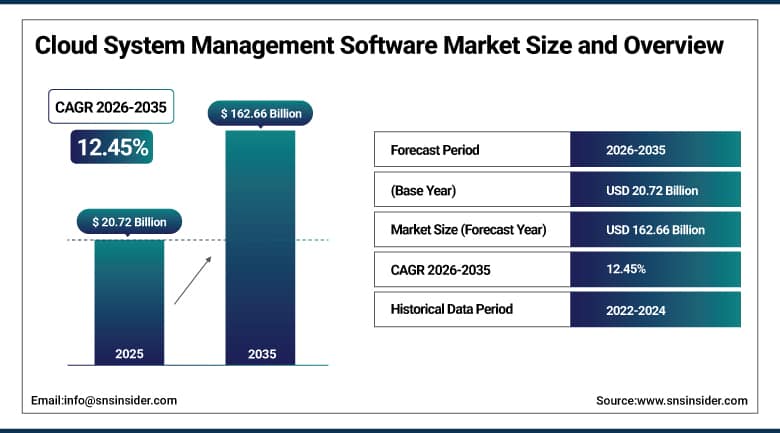
The Cloud System Management Software Market was valued at USD 20.72 billion in 2025 and is expected to reach USD 162.66 billion by 2035, growing at a CAGR of 12.45% from 2026–2035.
The cloud system management software is growing at a fast pace in the global market because of the increased adoption of cloud system, increased usage of hybrid IT infrastructures, and the rising demand for automation in IT operations. The integration of IT Operations Management (ITOM), IT Service Management (ITSM), and IT automation tools has become an important requirement for all enterprises. There has been significant growth in the market due to the increased preference for multi-cloud system and the deployment of SaaS-based solutions. Increased adoption of AI-powered IT operations, IaC, and observability is contributing to the improved performance of system applications.
The development of cloud-based system management technologies is propelled by AI-powered IT operations, hybrid cloud orchestration, and Infrastructure-as-Code practices. Automated and real-time monitoring contribute to higher efficiency and lower rates of downtime in businesses. In the Asia-Pacific region (APAC), trends of digital transformation and cloud-native applications adoption are developing quickly. With advanced cloud technology, operational efficiency can be increased by 20%-40%, and downtime can be reduced by up to 50%.
To Get More Information On Cloud System Management Software Market - Request Free Sample Report
Cloud System Management Software Market Trends
-
-
Increasing adoption of infrastructure-as-code (IaC) is automating cloud provisioning and reducing configuration errors. This improves deployment speed and operational efficiency.
-
Growing use of observability tools is enhancing real-time monitoring through logs, metrics, and traces. This enables faster issue detection and system optimization.
-
Rising shift toward hybrid and multi-cloud environments is increasing demand for unified management platforms. This improves workload control across multiple cloud providers.
-
Increasing adoption of zero-trust security models is strengthening cloud system protection frameworks. This ensures continuous verification and reduced security risks.
-
Expansion of cloud-native technologies and Kubernetes is improving scalability and application deployment efficiency. This supports better resource utilization in cloud system.
-
Growing adoption of AIOps is enabling predictive monitoring and automated incident management. This reduces downtime and improves system reliability.
-
U.S. Cloud System Management Software Market Size Outlook
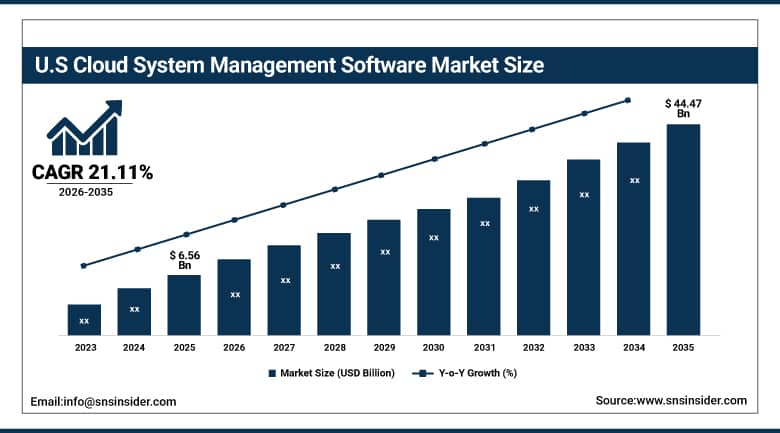
The U.S. Cloud System Management Software Market was valued at USD 6.56 billion in 2025 and is expected to reach around USD 44.47 billion by 2035, growing at a CAGR of 21.11% from 2026–2035.
The U.S. cloud system management software market is growing rapidly due to the rising need for scalable IT processes and hybrid cloud system management within corporations. The factors fueling the growth of the market include growing adoption of ITOM, ITSM, and cloud automation platforms by enterprises. Growth in digital transformation, multi-cloud, and enterprise cloud migration is driving the increased need for cloud system management software.
The U.S. cloud system management software market is witnessing strong growth driven by AI-driven IT operations (AIOps) and infrastructure-as-code (IaC) adoption, with 89% of organizations already using IaC practices in some form according to cloud engineering surveys. Observability and cloud monitoring demand is increasing as about 45% of enterprises actively deploy AIOps and automation-driven cloud management platforms to improve operational efficiency.
Cloud System Management Software Market Segment Analysis
-
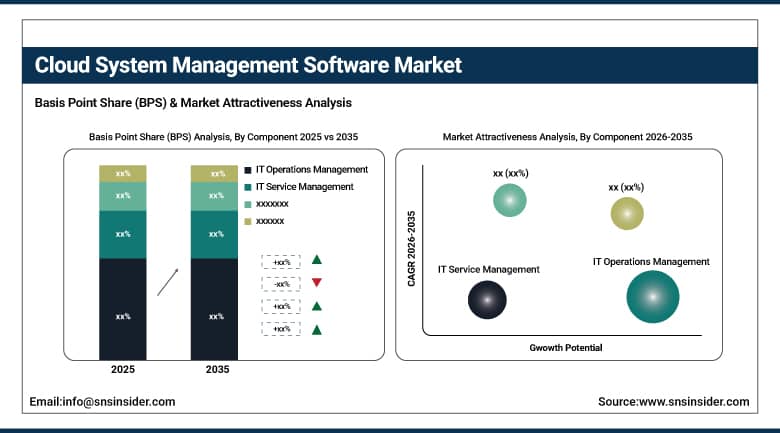
By Component, IT operations management dominated the cloud system management software market with 44.32% share in 2025; while IT automation and configuration management is the fastest growing segment with CAGR of 26.92% during 2026 to 2035.
-
By Organisation Size, large enterprises dominated the cloud system management software market with 64.41% share in 2025; while small and medium enterprises is the fastest growing segment with CAGR of 11.61% during 2026 to 2035.
-
By Deployment Model, public cloud dominated the cloud system management software market with 52.37% share in 2025; while hybrid cloud is the fastest growing segment with CAGR of 28.15% during 2026 to 2035.
-
By End-user Industry, IT and telecommunications dominated the cloud system management software market with 26.46% share in 2025; while banking, financial services and insurance is the fastest growing segment with CAGR of 26.59% during 2026 to 2035.
By Component, IT operations management dominated the cloud system management software market, while IT automation and configuration management is the fastest growing segment.
The IT Operations Management segment will continue to remain dominant in the cloud system management software market during the forecast period 2026-2035. It is highly attributed to the significance of the segment in monitoring and optimizing infrastructure performance, managing workloads, and providing system reliability. Enterprises rely extensively on ITOM solutions for incident management, workload balancing, and overall performance management. The increasing complexity in cloud infrastructure and the growing importance of operational efficiency among enterprises will help drive its dominance over the forecast period.
IT Automation & Configuration Management segment is projected to register the fastest CAGR from 2026–2035. Growth in this segment can be attributed to the rising implementation of DevOps practices and infrastructure-as-code (IaC). Enterprises have started prioritizing IT operations that are agile and scalable in their operations. They require solutions that ensure zero manual intervention, faster deployments, and reduced configuration errors in their cloud environment.
By Organisation Size, large enterprises dominated the cloud system management software market, while small and medium enterprises is the fastest growing segment.
The Large Enterprises segment holds the dominated share in the cloud system management software market with respect to revenue. The reason behind this is that large enterprises have vast IT infrastructure and cloud computing system in place. They need advanced IT Operations Management Software, IT Service Management software, and automation software to deal with hybrid and multi-cloud environments. They can afford to spend huge IT budgets and undergo extensive digital transformation programs for their business.
On the other hand, the Small & Medium Enterprises segment is anticipated to register the fastest CAGR during the forecast period. The reasons behind this trend are that small and medium enterprises are opting for affordable cloud-based services and SaaS applications. They are quickly shifting towards the concept of digital transformation by outsourcing IT processes to cut down on costs. Furthermore, the availability of subscription-based tools and increased automation are adding fuel to this trend.
By Deployment Model, public cloud dominated the cloud system management software market, while hybrid cloud is the fastest growing segment.
Public Cloud segment captured the dominated revenue share in the cloud system management software market during 2025 owing to its scalability, cost-effectiveness, and fast deployment capabilities. The segment enjoys widespread acceptance due to the ease of implementation and cost-effectiveness among other factors. Adoption of cloud management software on a SaaS platform has increased due to growing digital transformation efforts across the globe.
Hybrid Cloud segment will witness the fastest CAGR during the forecast period owing to growing demand for flexible and secure IT infrastructure among organizations. Organizations are turning towards the hybrid cloud system management software market to manage workloads in accordance with data security regulations. With rising multi-cloud trends and the adoption of cloud management software integrated with artificial intelligence, organizations are adopting the technology rapidly.
By End-user Industry, IT and telecommunications dominated the cloud system management software market, while banking, financial services and insurance is the fastest growing segment.
The IT & Telecommunications segment emerged as the dominated market participant in terms of market share owing to the extensive use of complex IT system and consistent network expansion. The IT & Telecommunications industry needs robust cloud system management software in order to monitor, automate, and optimize network performance. Heavy reliance on data center services, cloud-enabled solutions, and customer base makes demand for IT operations and service management solutions extremely high.
The Banking, Financial Services & Insurance (BFSI) is forecasted to register the fastest CAGR between 2026 and 2035 owing to growing digital transformation and fast adoption of cloud solutions in BFSI. This industry demands extremely high levels of security, scalability, and compliance of cloud infrastructure services. High adoption of artificial intelligence-enabled analytics, fraud detection system, and hybrid clouds is fuelling demand for cloud system management software solutions.
Regional Insights
|
Region |
Major Country |
Share within Region, 2025(%) |
|---|---|---|
|
North America |
United States |
82.35% |
|
Europe |
Germany |
24.38% |
|
Asia Pacific |
China |
33.72% |
|
Middle East & Africa |
UAE |
7.84% |
|
Latin America |
Brazil |
11.29% |
North America Cloud System Management Software Market Insights
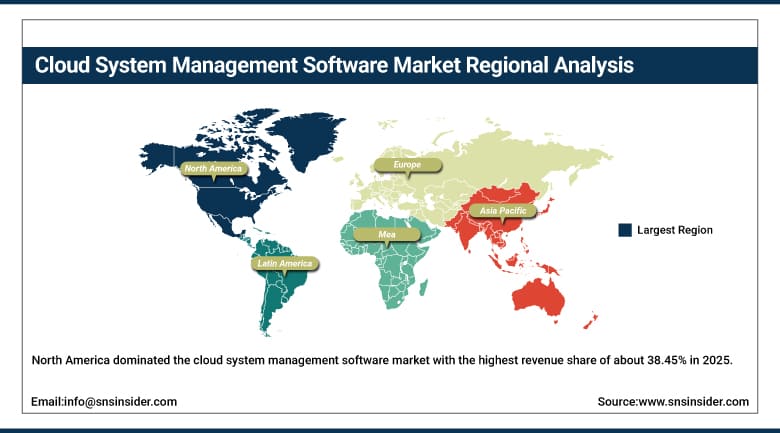
North America dominated the cloud system management software market with the highest revenue share of about 38.45% in 2025 due to strong enterprise cloud adoption and advanced IT infrastructure. The region benefits from high usage of hybrid cloud environments, AIOps platforms, and enterprise automation tools across large organizations in the United States and Canada. Strong presence of leading technology providers and cloud service vendors is further supporting market expansion steadily. Rising focus on digital transformation cloud optimization and cybersecurity integration is accelerating demand across industries.
In accordance with reports from industry sources like the Flexera State of the Cloud Report, the use of hybrid cloud solutions is quite common in North America, where more than 70 percent of companies utilize hybrid clouds. There has been growing adoption of AIOps in the US and Canada for enhancing automation and incident management.
Get Customized Report as Per Your Business Requirement - Enquiry Now
Europe Cloud System Management Software Market Insights
Europe was among the leading contributors to revenues in the market of cloud system management software in 2025 owing to the presence of robust regulations and widespread digital adoption in enterprises. The European region can leverage its strength in the form of rising use of cloud computing in various industries including IT BFSI and manufacturing in countries such as Germany France the United Kingdom and others.
According to the European Commission, more than 60% of companies in Europe are utilizing multi-cloud and hybrid cloud services. Due to GDPR compliance and the need for strict data management, there is robust uptake of IT service management (ITSM) and infrastructure operation management (ITOM) software. There has been an increased focus by about 50%+ firms on cloud automation and observability tools.
Asia Pacific Cloud System Management Software Market Insights
Asia Pacific holds about 24.81% revenue share in 2025 and is expected to grow at the fastest CAGR due to rapid digital transformation and expanding IT infrastructure. Growth is driven by increasing cloud adoption across enterprises in China India Japan and Southeast Asia. Rising demand for scalable IT operations and cloud-native applications is accelerating the adoption of advanced cloud system management platforms significantly. Government support for digital economy initiatives is further boosting market expansion.
According to reports, 60% of businesses in the Asia Pacific region are implementing hybrid cloud technology and IT operations that are automated. The increased utilization of AIOps, infrastructure-as-code (IaC), and cloud orchestration is resulting in improved performance of system. With the rapid expansion of digital ecosystem and extensive cloud usage by SMEs, more than 50% in China, Japan, and Southeast Asia, the need for cloud system management software solutions has been on the rise in the Asia Pacific region.
Middle East & Africa and Latin America Cloud System Management Software Market Insights
The Middle East & Africa and the Latin American regions together represent a relatively small yet gradually expanding portion of the revenues of the cloud system management software industry in the year 2025, attributed to rising digitization and adoption of cloud solutions by enterprises in the respective regions. Countries including UAE, Saudi Arabia, South Africa, Brazil, and Mexico have been making efforts towards infrastructure upgrade, IT automation, and digital governance initiatives. Demand for scalable cloud solutions in governments, BFSI, telecommunication, and manufacturing organizations is expected to boost the market's consistent growth prospects.
According to research, the adoption of cloud computing in the UAE and Brazil is on the rise owing to successful governance policies that governments have implemented. It is predicted that the Middle East and Africa will have reached a valuation of USD 1.60 billion while Latin America will reach a valuation of USD 1.85 billion in 2025. Around 50 percent of businesses are using hybrid cloud solutions because of the increased need for scalability.
Growth Drivers: AI-driven automation and hybrid cloud adoption accelerating enterprise cloud system management demand globally
The fast adoption of AIOps and IaC technologies has led to increased efficiency in managing cloud system in enterprises. The use of automation in monitoring, predicting, and automatically correcting errors helps to decrease downtime and increase productivity. The growth of hybrid and multi-cloud computing environments is contributing further towards the requirement for cloud system management platforms. Enterprises are aiming at having unified views into distributed infrastructure, resulting in high demand for IT operations management, IT service management, and orchestration solutions.
The implementation of AI-powered IT Operations (AIOps) and Infrastructure as Code (IaC) technologies is optimizing cloud system, where about 45% of businesses have adopted AIOps tools. The application of automation in monitoring, analytics, and self-healing tools helps reduce downtimes by up to 40% and improves productivity. Almost 70% of businesses across the globe operate hybrid and multi-cloud system, which has increased their need for integrated cloud management system.
Restraints: High complexity of multi-cloud integration limiting seamless enterprise cloud system management adoption
The increasing complexities of the multi-cloud and hybrid cloud models have become a major concern for organizations due to the challenges posed by their operations. The integration of legacy IT infrastructures with the new cloud technologies involves high technical expertise and higher cost. Companies are facing problems in implementing inter-operability within various cloud providers. Shortage of cloud experts and the need for compliance have further complicated the process of adopting the new system.
Opportunities: Growth of edge computing and cloud-native ecosystem expanding long-term market potential
The quick growth in edge computing, IoT ecosystem, and cloud-native applications is driving up the need for cloud system management services that will help organizations handle such growth effectively. Organizations are moving away from legacy system and embracing more real-time data processing capabilities and decentralization. The increased uptake of DevOps methodologies, Kubernetes, and microservices continues to drive market growth. Digital transformation initiatives by governments coupled with growing SMEs cloud uptake present long-term opportunities.
The usage of edge computing, IoT, and increasing cloud native has created a growing need for cloud management services since over 60% of firms are now using edge computing technology or hybrid system. There is also an increase in the demand for real-time processing, easy scalability through DevOps, K8S, and microservices, and long-term government digital programs and SME cloud usage.
Recent Developments
-
-
2026: Microsoft enhanced Azure Arc and Azure Monitor capabilities, strengthening hybrid cloud system management, improving AI-driven IT operations (AIOps), and enabling unified infrastructure visibility across enterprise environments.
-
2026: Amazon Web Services (AWS) upgraded AWS System Manager and cloud observability tools, improving automated workload management, incident response, and hybrid cloud orchestration across large-scale enterprise deployments.
-
2025: Google Cloud advanced its Operations Suite with deeper AI integration, improving real-time monitoring, log analytics, and automated incident resolution for multi-cloud and cloud-native environments.
-
2024: IBM strengthened hybrid cloud management through Red Hat OpenShift and IBM Cloud Pak for AIOps, enhancing automation, workload optimization, and enterprise IT operations efficiency globally.
-
Cloud System Management Software Market Key Players
-
Microsoft
-
Amazon Web Services (AWS)
-
Google Cloud
-
IBM
-
Oracle
-
ServiceNow
-
Cisco System
-
Hewlett Packard Enterprise (HPE)
-
BMC Software
-
Datadog
-
Dynatrace
-
New Relic
-
Atlassian
-
SolarWinds
-
PagerDuty
-
Broadcom
-
Red Hat
-
Splunk
-
HashiCorp
-
Snow Software
Cloud System Management Software Market Report Scope:
| Report Attributes | Details |
|---|---|
| Market Size in 2025 | USD 20.72 Billion |
| Market Size by 2035 | USD 162.66 Billion |
| CAGR | CAGR of 12.45% From 2026 to 2035 |
| Base Year | 2025 |
| Forecast Period | 2026-2035 |
| Historical Data | 2022-2024 |
| Report Scope & Coverage | Market Size, Segments Analysis, Competitive Landscape, Regional Analysis, DROC & SWOT Analysis, Forecast Outlook |
| Key Segments | • By Component (IT Operations Management, IT Service Management, IT Automation and Configuration Management) • By Organisation Size (Large Enterprises, Small and Medium Enterprises) • By Deployment Model (Public Cloud, Private Cloud, Hybrid Cloud) • By End-user Industry (IT and Telecommunications, Banking, Financial Services and Insurance, Healthcare and Life Sciences, Manufacturing, Retail and Consumer Services, Transport and Logistics, Media and Entertainment, Government and Public Sector) |
| Regional Analysis/Coverage | North America (US, Canada), Europe (Germany, UK, France, Italy, Spain, Russia, Poland, Rest of Europe), Asia Pacific (China, India, Japan, South Korea, Australia, ASEAN Countries, Rest of Asia Pacific), Middle East & Africa (UAE, Saudi Arabia, Qatar, South Africa, Rest of Middle East & Africa), Latin America (Brazil, Argentina, Mexico, Colombia, Rest of Latin America). |
| Company Profiles | Microsoft, Amazon Web Services (AWS), Google Cloud, IBM, Oracle, ServiceNow, Cisco Systems, Hewlett Packard Enterprise (HPE), BMC Software, Datadog, Dynatrace, New Relic, Atlassian, SolarWinds, PagerDuty, Broadcom, Red Hat, Splunk, HashiCorp, Snow Software |

Frequently Asked Questions
The cloud system management software market is expected to grow at a CAGR of 12.45% from 2026 to 2035.
The cloud system management software market was valued at USD 20.72 billion in 2025.
Rising adoption of hybrid cloud, AIOps, and IaC, along with demand for automation, observability, and multi-cloud management, is driving global market growth.
The IT Operations Management segment dominated the market in 2025 due to its role in monitoring, optimizing infrastructure performance, and ensuring reliability across complex cloud environments.
North America dominated the market in 2025 due to strong enterprise cloud adoption, advanced IT infrastructure, and high use of hybrid cloud and AIOps solutions.
