
Drilling Software Market Report Scope & Overview:
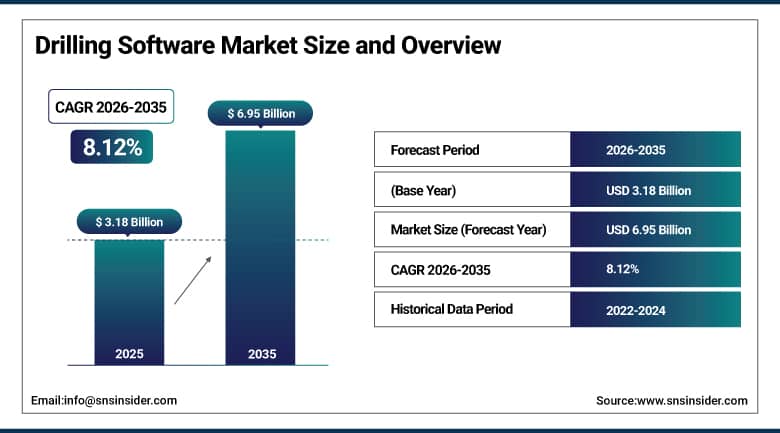
The Drilling Software Market was valued at USD 3.18 Billion in 2025 and is expected to reach USD 6.95 Billion by 2035, growing at a CAGR of 8.12% from 2026–2035.
The increasing demand for digitalization and automation in the oil and gas industry will also help drive the drilling software market since organizations utilize the services of drilling software technology in ensuring efficiency, low downtime, and fewer drilling cycles despite the nature of the wellbeing either offshore or onshore. Through the utilization of well planning and real-time monitoring technologies, it will be easier to avoid any errors and make the correct decisions when it comes to drilling.
In December 2024, Schlumberger launched Neuro autonomous geosteering, an AI-driven solution that dynamically responds to subsurface complexities, optimizing drilling efficiency and well performance.
To Get More Information On Drilling Software Market - Request Free Sample Report
Drilling Software Market Trends:
-
Increasing adoption of automation and digital tools is transforming global drilling operations across onshore and offshore projects.
-
Real-time monitoring and predictive analytics are improving accuracy and reducing operational errors during drilling.
-
Cloud-based solutions are enabling remote collaboration and scalable drilling software deployment across distributed teams.
-
AI-driven drilling software is enhancing hazard detection and predictive maintenance capabilities for complex wells.
-
Rising demand for offshore and deepwater drilling is fueling advanced software adoption among major operators.
U.S. Drilling Software Market Outlook:
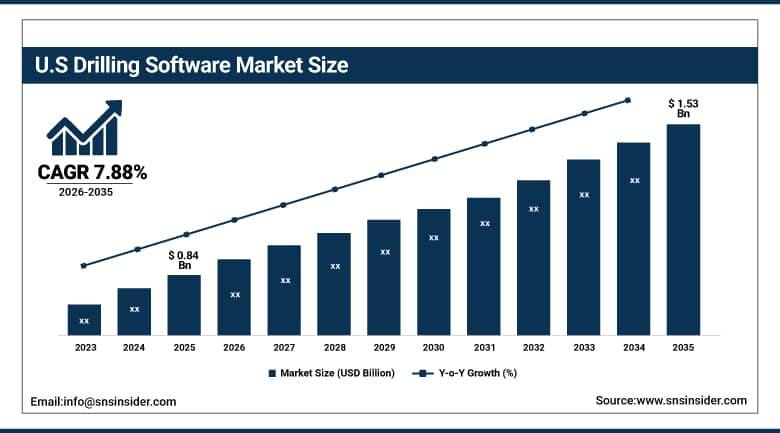
The U.S. Drilling Software Market size was USD 0.84 Billion in 2025 and is expected to reach USD 1.53 Billion by 2035, growing at a CAGR of 7.88% from 2026 to 2035, supported by sustained shale and Gulf of Mexico drilling activity.
The United States holds monopoly power in drilling software due to early adoption of new technologies like automation, real-time monitoring, prediction and analysis, and cloud technology that improve efficiency, increase safety, and optimize operations. Real-time monitoring, cloud technology, and AI-geosteering help increase efficiency, reduce nonproductive times, and make drilling more accurate on land and offshore; real-time monitoring and automation can help reduce nonproductive time by 15% to 25%.
In July 2025, Halliburton launched LOGIX automated geosteering, integrating machine learning and advanced geological insights to optimize well placement and maximize reservoir contact.
Drilling Software Market Segment Analysis:
-
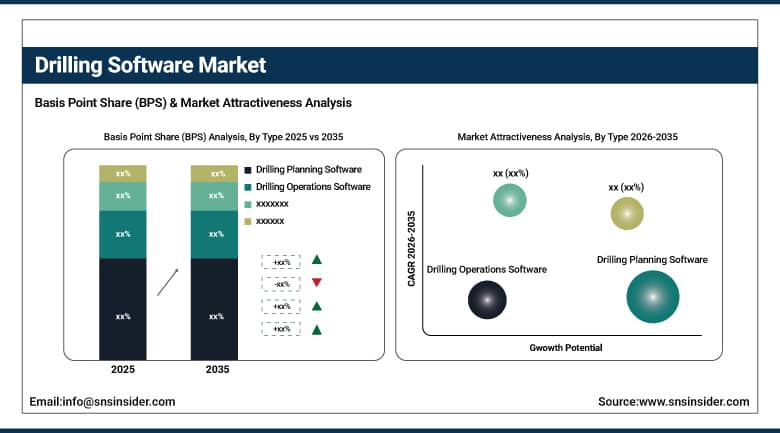
By Type, Drilling Planning Software led the market with a 60.30% share in 2025 through capabilities to optimize well planning and resource allocation, while Drilling Operations Software is the fastest-growing segment with a CAGR of 8.5%.
-
By Deployment Type, On-Premises Deployment led the market with a 55.02% share in 2025 through higher data security and regulatory compliance, while Cloud-Based Solutions is the fastest-growing segment with a CAGR of 9.20%.
-
By End-User, Oil & Gas Companies held the largest share at 65.34% in 2025 through extensive upstream operations, while Service Providers is the fastest-growing segment with a CAGR of 9.08% through rising outsourcing demand.
By Type, drilling planning software dominates, drilling operations software grows fastest
Drilling Planning Software is anticipated to be the leading segment within the drilling software market due to its capacity to improve well planning and resource allocation effectively. It allows companies to streamline operations and minimize mistakes, which makes drilling planning software an indispensable tool for the upstream production of oil and gas products. This particular segment is predicted to capture a market share of 60.30% by 2025 owing to its significance as an initial drilling software utilized by companies during their digitalization process.
The drilling operations software sub-segment witnesses the highest rate of growth, estimated at 8.5% CAGR, owing to the growing adoption of technologies such as real-time monitoring, predictive analytics, and decision automation in drilling operations. Precision, shorter project schedules, and savings are expected to be some of the major factors driving the growth of this sub-segment during the next few years, as drilling companies adopt software solutions for operational purposes that complement planning software with information in the execution phase of the entire well life cycle.
By Deployment Type, on-premises dominates, cloud-based grows fastest
The On-Premises Deployment segment will hold the largest market share of 55.02% in the drilling software market in 2025 due to higher data security, better control over data regarding the process, and greater ease of integration with current enterprise software solutions. Big oil and gas companies are inclined towards using On-Premises Deployment due to their preference for stability and regulatory compliance.
Cloud-Based Solutions represent the fastest-growing segment, with a CAGR of 9.20%, due to rising demand for remote monitoring, real-time collaboration, and scalable software solutions. Cloud deployment enables minimal upfront investment for companies launching advanced drilling tools while also increasing flexibility, accessibility, and operational efficiency, with increasing digital transformation of the oil and gas industry driving demand and expansion of cloud-based solutions across the forecast period, particularly among independent operators seeking enterprise-grade capability without large in-house IT infrastructure investment.
By End-User, oil & gas companies dominate, service providers grow fastest
The Oil & Gas Companies segment accounts for the maximum market share in the drilling software market at 65.34% in 2025 owing to the wide range of upstream activities carried out by oil and gas companies that lead to drilling of oil wells and higher usage of software in order to plan and drill accurately and minimize downtime.
Service Providers is the rapidly growing segment with a CAGR of 9.08%, due to rising outsourcing of drilling operations and digitalization of plug and abandonment operations to handle multiple customers. With increasing adoption of third-party service providers leveraging cloud and AI-driven software, this segment will continue to grow rapidly at the global level as operators increasingly outsource specialized drilling software expertise rather than maintaining its in-house, particularly for smaller well counts that cannot justify dedicated internal software teams.
Regional Analysis:
|
Region |
Major Country |
Share within Region, 2025 (%) |
|---|---|---|
|
North America |
United States |
82.5% |
|
Asia Pacific |
China |
44.8% |
|
Europe |
Germany |
22.4% |
|
Middle East & Africa |
UAE |
22.8% |
|
Latin America |
Brazil |
43.8% |
North America Drilling Software Market Insights
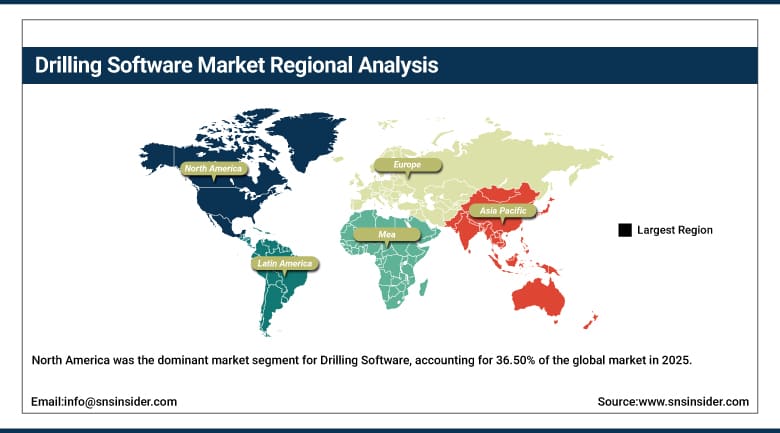
North America was the dominant market segment for Drilling Software, accounting for 36.50% of the global market in 2025. The reason is that this region possesses mature oil and gas infrastructure, extensive exploration operations, and is one of the earliest adopters of digital technologies. Leading companies in this sector rely heavily on real-time monitoring, predictive analysis, and automated drilling systems.
Significant investments in deepwater and shale drilling projects, coupled with a central focus on cost efficiency and sustainability, trigger market growth. The cloud-based options and artificial intelligence used by local operators turn North America into one of the central leaders in the drilling software segment, with the U.S. dominating through early adoption of advanced technologies driving efficiency, safety, and operational optimization.
Get Customized Report as Per Your Business Requirement - Enquiry Now
Asia Pacific Drilling Software Market Insights
The Asia-Pacific region is the fastest growing region in terms of the drilling software market, with an expected CAGR of 9.10% growth because of high energy demand and increased offshore/onshore drilling operations. Remote monitoring of operations, collaborative work, and predictive analysis can all be done using cloud computing and artificial intelligence in drilling software solutions.
China and India propel rapid growth in the region, fueled by rising exploration activities, increasing adoption of digital and AI-enabled drilling solutions, and growing demand for operational efficiency. Increasing emphasis on digital transformation in the oil and gas sector paired with advancements in complex drilling environments is pushing the pace of software adoption, making Asia-Pacific an upcoming promising region for the drilling software market globally.
Europe Drilling Software Market Insights
The consistent growth seen in the Europe drilling software market is a result of an increase in the use of automation and digital technologies in drilling processes. The increasing trend in organizations that are adopting digital and automated solutions such as real-time monitoring, predictive analytics, and cloud-native solutions allows for better planning of drilling processes, efficient operation, and reduced non-productive time among other factors. The market in Germany and the U.K., which makes up for the Europe market, grows because of the adoption of advanced digital solutions and automation technology.
Increased emphasis on cost reduction, safety, and sustainability across upstream oil and gas operations also drives more software usage. Investments in deepwater and complex drilling projects are creating an impetus for development of advanced software solutions that enable accurate planning, workflow optimization, and data-driven decision-making, making Europe a leader in the global drilling software market, particularly for technically demanding North Sea and Norwegian Continental Shelf drilling programmes.
MEA & Latin America Drilling Software Market Insights
The Latin America and Middle East and Africa drilling software market is witnessing gradual growth, due to improving upstream oil and gas investments alongside growing adoption of advanced drilling technologies. Across these regions, companies are using real-time monitoring, predictive analytics, and automated equipment to boost operational efficiency, minimize non-productive time, and increase drilling precision.
With an increase in demand for cost optimization, safety, and resource management, adoption of cloud-based and artificial intelligence software is on the rise across both regions. There is rising demand for advanced application software for digital transformation as well as data-driven decision-making in exploration of challenging drilling locations such as deepwater and remote sites.
Market Dynamics:
Growth Drivers: Oil and gas digitalization and automation revolutionizing drilling operations for enhanced efficiency
Among the factors influencing the growth in demand in the Drilling Software Market, the advancement in digitalization and automation in the oil and gas sector is one of them. To improve the efficiency of the wells and reduce downtime, the use of drilling software with real-time monitoring and analysis in addition to decision-making through automation learning can be done by the companies. This will enable them to avoid errors in drilling. Moreover, drilling software reduces the duration of projects because they are becoming increasingly complex.
The world is striving to be cost efficient and productive in upstream operations, which is driving companies to adopt software solutions that effectively manage resources, reduce operational costs, and improve drilling success ratio, further enhancing market growth. Rising demand for offshore and deepwater drilling fuels advanced software adoption, as more complex drilling environments require sophisticated planning and operations tools capable of integrating subsurface geological data with real-time operational telemetry.
Restraints: High implementation costs challenging adoption among small and medium drilling operators
Although there are many benefits attached to the drilling software, the high cost incurred in acquiring and operating this software becomes a significant limiting factor in the industry. Licensing and maintenance of the software as well as the upgrading of facilities and training of personnel become quite expensive for small and medium-sized organizations. The cost involved in acquiring such drilling software becomes a significant limiting factor since the budget for these firms is smaller compared to that of big international oil companies.
The need to pay a hefty price upfront creates acceptance challenges for smaller operators and restricts market growth in capital-constrained economies, even though the operational benefits of these software solutions are evident. This cost barrier particularly affects independent operators and service companies whose capital budgets cannot absorb significant upfront software licensing and integration expenditure, often pushing these smaller players toward delayed adoption cycles or simplified software tiers with reduced functionality.
Opportunities: Cloud-based AI solutions unlocking new growth opportunities across drilling operations
Cloud-based and AI-powered drilling software presents a huge market opportunity. Using the cloud, the deployment can be done through remote monitoring, collaborative efforts, and scalable services that provide the seamless deployment of sophisticated tools while requiring little investment. AI and machine learning can aid in enhancing predictability, resulting in proportional and accurate detection of hazards, well optimization, and decision-making process, where AI and machine learning based software have been known to enhance hazard detection and well optimization accuracy by 30% to 35%.
The growing focus on digital transformation in the oil and gas industry and the upsurge in demand for offshore and deepwater drilling support the overall growth strategy for the software solution market, which offers innovative, cost-effective, and intelligent solutions to tackle operational challenges and sustainability objectives. Each operator transitioning toward managed cloud-based platforms reduces upfront capital requirements while gaining access to continuously updated AI capability, creating a structural shift in how drilling software is procured and maintained across the industry.
Recent Developments:
-
2024: Schlumberger launched Neuro autonomous geosteering, an AI-driven solution that dynamically responds to subsurface complexities, optimizing drilling efficiency and well performance across complex drilling environments.
-
2025: Halliburton launched LOGIX automated geosteering, integrating machine learning and advanced geological insights to optimize well placement and maximize reservoir contact for operators.
-
2025: National Oilwell Varco introduced the ReedHycalog Evolve performance product line, a premium drill bit platform designed to enhance drilling efficiency in challenging environments.
Drilling Software Market Key Players are:
-
Schlumberger Limited
-
Halliburton Company
-
Baker Hughes Company
-
Weatherford International plc
-
National Oilwell Varco Inc. (NOV)
-
S&P Global (IHS Markit)
-
GE Oil & Gas (Baker Hughes)
-
Ikon Science Limited
-
Pason Systems Inc.
-
Peloton Computer Enterprises Ltd.
-
Petrolink International
-
Kongsberg Gruppen ASA
-
Cegal AS
-
Paradigm (Emerson Electric Co.)
-
Emerson Electric Co.
-
AGR Group ASA
-
Akita Drilling Ltd.
-
Digital Drilling Data Systems
-
Drillsoft Inc.
-
EPAM Systems Inc.
Drilling Software Market Report Scope:
| Report Attributes | Details |
|---|---|
| Market Size in 2025 | USD 3.18 Billion |
| Market Size by 2035 | USD 6.95 Billion |
| CAGR | CAGR of 8.12% From 2026 to 2035 |
| Base Year | 2025 |
| Forecast Period | 2026-2035 |
| Historical Data | 2022-2024 |
| Report Scope & Coverage | Market Size, Segments Analysis, Competitive Landscape, Regional Analysis, DROC & SWOT Analysis, Forecast Outlook |
| Key Segments | • By Type (Drilling Planning Software, Drilling Operations Software) • By Deployment Type (On-Premises Deployment, Cloud-Based Solutions, Hybrid Deployment) • By Application (Onshore Drilling, Offshore Drilling, Exploratory Drilling, Production Drilling) • By End-User (Oil & Gas Companies, Mining Corporations, Geological Survey Organizations, Service Providers) |
| Regional Analysis/Coverage | North America (US, Canada), Europe (Germany, UK, France, Italy, Spain, Russia, Poland, Rest of Europe), Asia Pacific (China, India, Japan, South Korea, Australia, ASEAN Countries, Rest of Asia Pacific), Middle East & Africa (UAE, Saudi Arabia, Qatar, South Africa, Rest of Middle East & Africa), Latin America (Brazil, Argentina, Mexico, Colombia, Rest of Latin America). |
| Company Profiles | Schlumberger Limited, Halliburton Company, Baker Hughes Company, Weatherford International plc, National Oilwell Varco Inc. (NOV), S&P Global (IHS Markit), GE Oil & Gas (Baker Hughes), Ikon Science Limited, Pason Systems Inc., Peloton Computer Enterprises Ltd., Petrolink International, Kongsberg Gruppen ASA, Cegal AS, Paradigm (Emerson Electric Co.), Emerson Electric Co., AGR Group ASA, Akita Drilling Ltd., Digital Drilling Data Systems, Drillsoft Inc., EPAM Systems Inc |

Frequently Asked Questions
The Drilling Software Market is expected to grow at a CAGR of 8.12% from 2026 to 2035.
The Drilling Software Market was valued at USD 3.18 Billion in 2025.
Rising demand for oil and gas digitalization and automation, the need to maximize operational efficiencies and minimize non-productive time, and growing adoption of real-time monitoring and predictive analytics are the primary growth factors.
Drilling Planning Software led the market with a 60.30% share in 2025 through its capabilities to optimize well planning and resource allocation, while Drilling Operations Software is the fastest-growing segment.
North America held the largest share at 36.50% in 2025 through well-developed oil and gas infrastructure, while Asia-Pacific is the fastest-growing region at a 9.10% CAGR.
