
Event Industry Market Report Scope & Overview:
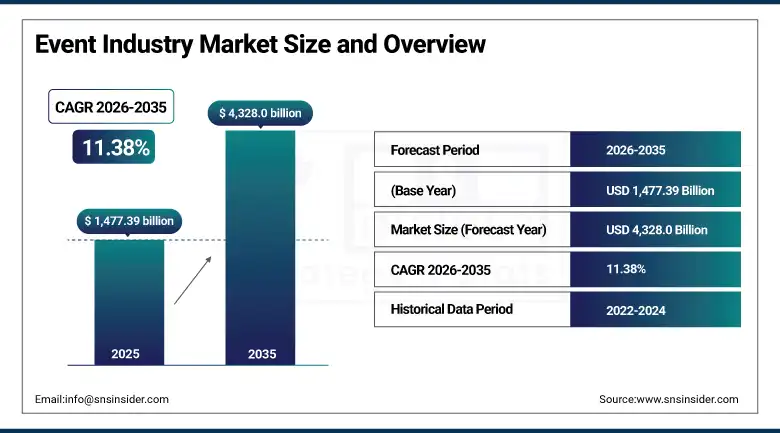
The event industry market was valued at USD 1,477.39 billion in 2025 and is expected to reach USD 4,328.0 billion by 2035, growing at a CAGR of 11.38% from 2026–2035.
The global event industry encompasses the design, planning, production, and execution of the full spectrum of human gatherings from the largest international trade exhibitions and stadium-scale music concerts through the intimate corporate leadership retreats and neighborhood community festivals that collectively represent one of the most economically significant and socially consequential service sectors in the global economy. The market is undergoing a fundamental structural transformation driven by the emergence and progressive maturation of hybrid event formats that combine physical attendance with digital participation through sophisticated live-streaming platforms, interactive virtual networking tools, and on-demand content replay capabilities that extend an event's audience reach, revenue potential, and post-event engagement far beyond the physical venue's capacity constraints. The COVID-19 pandemic's forced experimentation with fully virtual events demonstrated both the viability of digital event formats for knowledge-sharing and networking purposes and the irreplaceable value of in-person events for high-intensity relationship building, immersive brand experiences, and the serendipitous social connections. The resulting hybrid model is not a compromise between virtual and physical but a genuinely additive approach that serves the full spectrum of stakeholder preferences.
The Global Business Travel Association's 2025 industry survey confirmed that corporate event budgets reached their highest level since 2019 in 2025, as companies recovering from the relationship capital deficit accumulated during the pandemic years of reduced in-person interaction intensified investment in corporate events as a relationship maintenance and employee engagement strategy whose ROI evidence has strengthened through post-pandemic measurement of outcomes from resumed in-person versus virtual programmes delivery.
To Get more information On Event Industry Market - Request Free Sample Report
Event Industry Market Trends
-
Rapid proliferation of AI-powered event planning and management platforms that automate attendee personalization through AI-driven content and session recommendation engines, optimize venue logistics and scheduling through machine learning algorithms.
-
Growing adoption of immersive event experience technologies including augmented reality activation installations, virtual reality product demonstration environments, extended reality networking spaces, and spatial computing event platforms.
-
Increasing corporate sustainability requirements reshaping event planning decisions as major enterprise event buyers impose environmental performance metrics including carbon footprint per attendee, renewable energy sourcing, catering waste reduction, and single-use plastic elimination.
-
Rising importance of event data analytics platforms that capture, integrate, and analyze attendee behavior data from registration, session attendance, app engagement, networking meeting booking, and post-event survey responses into unified audience intelligence profiles.
-
Expanding music festival and live entertainment market driven by the post-pandemic live experience demand surge that has sustained above-historic-average ticket pricing across concerts, festivals, and sports events.
The U.S. Event Industry Market Outlook
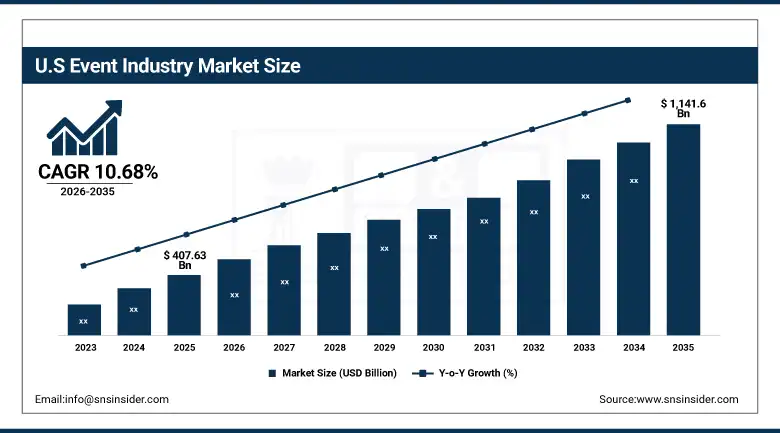
The U.S. Event Industry Market was valued at approximately USD 407.63 billion in 2025 and is expected to reach approximately USD 1,141.6 billion by 2035, growing at a CAGR of 10.68%.
The United States is the world's largest event industry market through the combination of the most commercially active corporate events sector encompassing product launches, sales kick-offs, user conferences, and channel partner events from the global headquarters of thousands of multinational corporations, the most developed live entertainment industry encompassing the world's most commercially successful music artists, sports leagues, and festival promoters, and the largest trade show and conference market where major exhibitions including CES, SXSW, NAB Show, and industry-specific trade events attract hundreds of thousands of attendees and exhibitors generating billions in direct economic activity annually. The events technology ecosystem is particularly concentrated in the United States, where Cvent, Eventbrite, Splash, and Bizzabo.
The U.S. Bureau of Economic Analysis's classification of arts, entertainment, and recreation as one of the fastest-growing service sectors in GDP contribution reflects the structural increase in consumer and business spending on live experiences that the events industry captures as its primary revenue base, providing macroeconomic validation of the industry's sustained growth trajectory that extends beyond cyclical recovery from pandemic disruption.
Event Industry Market Segment Analysis
-
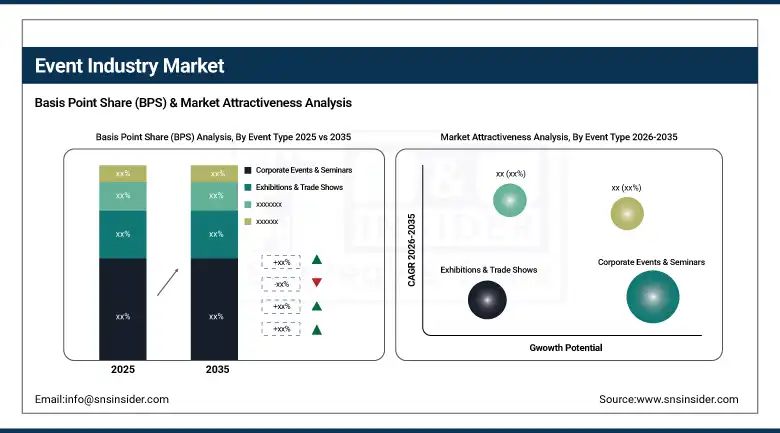
By Event Type, corporate events & seminars dominated with approximately 38.76% in 2025; music concerts are the fastest-growing type at a CAGR of 13.67%.
-
By Revenue Source, ticket sales held the largest share; sponsorship is growing rapidly.
-
By Mode, offline/physical events dominated with approximately 62.84% in 2025; hybrid events are the fastest-growing mode.
-
By Organizer Type, corporate organizers generated the largest revenue share; individual and NGO represent important volume segments within the overall market.
By Event Type, corporate events dominate, music concerts are expected to grow fastest
Corporate Events and Seminars retained the dominant event type position with approximately 38.76% of the event industry market in 2025, reflecting the fundamental commercial imperative for businesses to invest in face-to-face relationship development, knowledge sharing, and brand experience creation that cannot be replicated at equivalent quality through digital communication channels regardless of their cost efficiency advantages. Post-pandemic corporate events investment has intensified as organizations that reduced their event programmes during 2020 to 2022 experienced measurable deterioration in customer relationship strength, employee engagement metrics, and channel partner commitment that retrospectively validated the business case for event investment that some finance teams had questioned as an area of discretionary cost reduction.
Music Concerts are the fastest-growing event type at a CAGR of 13.67% through 2035, driven by the pandemic-era suppressed demand for live experiences, combined with a structural change in music industry economics where live performance revenue remains the primary source of artist commercial value. Taylor Swift's Eras Tour, Beyoncé's Renaissance World Tour, and Coldplay's Music of the Spheres World Tour collectively demonstrated in 2023 and 2024 that premium concert experiences could generate billions in economic activity and hundreds of millions in direct ticket revenue for individual artists whose global fan bases were willing to pay historically unprecedented prices for live performance access.
By Mode, offline/physical dominates, hybrid is expected to grow fastest
Offline and Physical Events retained the dominant mode position with approximately 62.84% of the event industry market in 2025. Physical events command premium pricing justified by the irreplaceable experiential value of full sensory immersion, immediate human feedback, and the social bonding that shared physical experience creates among attendees, sustaining the economics of high-quality in-person event production even as digital delivery costs continue to decline. The return of physical events to and above pre-pandemic attendance levels across virtually all event categories by 2024 provided empirical confirmation that digital event adoption during the pandemic years reflected constraint rather than preference for the majority of event participants.
Hybrid Events are the fastest-growing mode as the progressive maturation of hybrid event production technology and the establishment of audience expectations for simultaneous in-person and digital participation options are creating a new event delivery standard that maximises both the depth of engagement from physical attendees and the breadth of reach enabled by unlimited digital participation capacity.
Regional Analysis
|
Region |
Major Country |
Share within Region, 2025 (%) |
|---|---|---|
|
North America |
United States |
85.6% |
|
Europe |
United Kingdom |
24.3% |
|
Asia Pacific |
China |
38.7% |
|
Middle East & Africa |
UAE |
35.4% |
|
Latin America |
Brazil |
43.6% |
North America Event Industry Market Insights
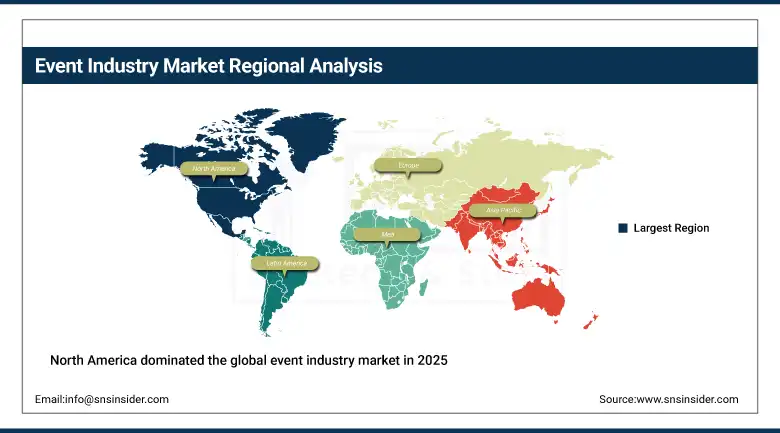
North America dominated the global event industry market in 2025, with the United States accounting for approximately 85.6% of North American revenues as the world's largest event market by total economic value. The region's market leadership reflects the concentration of global corporate headquarters generating consistent premium event investment, the world's most commercially developed live entertainment industry encompassing music, sports, and entertainment events, and the United States' position as the preferred destination for major international conferences and trade shows that attract global professional communities to venues in Las Vegas, New York, Chicago, San Francisco, and Orlando. Canada contributes approximately 14.4% of North American event revenues through its own corporate events market, the Montreal Jazz Festival, Toronto International Film Festival, and major sports events that sustain consistent event industry investment.
Get Customized Report as per Your Business Requirement - Enquiry Now
Europe Event Industry Market Insights
Europe is the world's second-largest event market and the leading region for international trade fair and exhibition activity, where Germany's Messe Frankfurt, Messe Düsseldorf, and Messe München operate some of the world's largest purpose-built exhibition centers hosting international trade shows that attract millions of professional visitors annually across automotive, technology, fashion, and industrial sectors. The United Kingdom accounts for approximately 24.3% of European event revenues through the combination of London's status as a premier global destination for corporate events, international conferences, and luxury social gatherings, the Glastonbury and Reading music festival traditions that generate enormous consumer events revenue, and the EXCEL London and NEC Birmingham exhibition centres that host major trade and consumer events. The European events technology landscape is increasingly sophisticated with strong adoption of hybrid event platforms, sustainability-certified event venues, and AI-powered attendee management systems.
Asia Pacific Event Industry Market Insights
Asia Pacific is the fastest-growing regional event market, driven by the rapid expansion of corporate events investment as multinational and domestic enterprise organizations across China, India, Japan, South Korea, Singapore, and the ASEAN economies grow their event programmes in response to post-pandemic recovery, regional market expansion strategies, and the growing recognition of experiential marketing effectiveness in Asian consumer markets where brand trust and relationship-based business culture make face-to-face event interaction particularly commercially valuable. China accounts for approximately 38.7% of Asia Pacific event revenues through its extraordinary trade fair and exhibition sector development, including the National Exhibition and Convention Center in Shanghai that has become one of the world's largest single-building exhibition facilities, combined with the rapid growth of domestic music festival culture, corporate conference investment, and luxury social events serving China's expanding upper-middle-class population.
MEA & Latin America Event Industry Market Insights
The Middle East and Africa and Latin America represent high-growth event markets where government investment in events infrastructure as an economic diversification and tourism strategy, rising consumer spending on entertainment experiences, and the commercial event aspirations of growing middle-class populations are collectively expanding event market scale rapidly from a smaller but fast-growing base. UAE leads MEA event revenues at approximately 35.4% of regional revenues through Abu Dhabi and Dubai's sustained investment in world-class event infrastructure including the Expo 2020 legacy facilities, ADNEC, and the Dubai World Trade Centre, combined with government event calendar programmes including Formula 1, tennis tournaments, and international conferences that maintain year-round event destination positioning. Brazil leads Latin American event revenues at approximately 43.6% of regional revenues through its massive carnival tradition, the Lollapalooza Brazil and Rock in Rio festivals that draw international audiences, and a growing corporate events market serving Brazil's large domestic business community.
Market Dynamics
Growth Drivers: Post-pandemic in-person experience demand surge sustained by irreplaceable live event value combined with corporate experiential marketing investment growth and hybrid format adoption expanding total addressable event revenue
The primary structural growth drivers for the event industry market are the sustained elevation of consumer and corporate willingness to invest in live experiences following the pandemic period's forced absence that demonstrated the unique social, emotional, and commercial value of in-person gatherings in ways that digital alternatives could not replicate, creating a demand intensity for high-quality events that has sustained above-historic pricing and attendance levels well into the post-restriction period and is being reinforced by each successive major event that confirms the appetite for live experience investment. The corporate experiential marketing industry's growing evidence base demonstrating superior ROI from event-based customer engagement relative to digital advertising in the era of ad-blocking, privacy regulation limiting digital targeting, and social media attention fragmentation is sustaining increases in corporate event budget allocation that are independent of the consumer live entertainment growth cycle. Hybrid event format adoption is simultaneously expanding total addressable revenue by adding digital registration, virtual sponsorship, and on-demand content licensing revenue streams to the physical event revenue base.
Restraints: Weather and force majeure risk creating event cancellation financial exposure, rising event production costs including venue hire, catering, and entertainment talent, and sustainability pressure creating compliance cost for event organizers
A significant restraint on the event industry market is the inherent financial exposure to weather disruption, infrastructure failures, geopolitical instability, public health events, and other force majeure conditions that can require event cancellation or postponement with significant financial consequence for organizers who have committed to non-refundable venue deposits, production contracts, and talent fees months or years in advance of the event date. Event cancellation insurance coverage, while increasingly comprehensive, does not fully eliminate the operational complexity and reputational damage associated with major event postponement or cancellation that affects tens of thousands of confirmed attendees and exhibitors who have made travel and accommodation commitments in reliance on the event's confirmed programmes.
Opportunities: AI-personalized event experience creating premium audience engagement at scale, destination event tourism growth, and emerging market event infrastructure investment
The application of AI to event personalization at scale, where machine learning recommendation engines can deliver individually customized session, speaker, networking meeting, and exhibition visit sequences to each attendee based on their professional profile, prior event engagement data, and stated interests, represents a major event experience quality improvement opportunity that increases attendee satisfaction, extends active event participation duration, and generates the measurable engagement metrics that sponsor and exhibitor clients increasingly require as evidence of event ROI. Destination events and leisure travel, where corporate events are combined with leisure experiences in aspirational locations that incentivize high attendance rates and generate strong social media content from attendee experiences, represent a growing event format segment that captures higher per-attendee revenue than commodity conference center events by combining the professional value of knowledge sharing and networking with the personal value of travel experience.
Recent Developments:
-
2026: Informa PLC expanded its hybrid event ecosystem, integrating AI-driven matchmaking tools and immersive virtual exhibition platforms to enhance global B2B conference engagement and sponsor monetization.
-
2026: Live Nation Entertainment scaled its global live event portfolio with advanced dynamic ticket pricing systems and AI-based audience demand forecasting to optimize stadium and festival revenue streams.
-
2026: Eventbrite upgraded its creator-focused event platform with AI-powered event discovery, automated marketing tools, and integrated payment systems supporting hybrid and small-scale event organizers worldwide.
Event Industry Market key players are
-
Informa PLC
-
Reed Exhibitions
-
Clarion Events
-
MCI Group
-
GL Events
-
Comexposium
-
Freeman Company
-
Live Nation Entertainment
-
Cvent
-
Eventbrite
-
Maritz Global Events
-
PRA Business Events
-
BCD Meetings & Events
-
Meetings & Incentives Worldwide
-
Opus Agency
-
GES
-
George P. Johnson Experience Marketing
-
Jack Morton Worldwide
-
XING Events
-
UBM
Event Industry Market Report Scope:
| Report Attributes | Details |
|---|---|
| Market Size in 2025 | USD 1,477.39 billion |
| Market Size by 2035 | USD 4,328.0 Billion |
| CAGR | CAGR of 11.38% From 2026 to 2035 |
| Base Year | 2025 |
| Forecast Period | 2026-2035 |
| Historical Data | 2022-2024 |
| Report Scope & Coverage | Market Size, Segments Analysis, Competitive Landscape, Regional Analysis, DROC & SWOT Analysis, Forecast Outlook |
| Key Segments | • By Event Type (Corporate Events & Seminars, Conferences, Exhibitions & Trade Shows, Music Concerts, Festivals, Sports Events, Private Parties, Others) • By Revenue Source (Ticket Sales, Sponsorship, Merchandise, Catering Services, Advertising & Promotion, Others) • By Organizer Type (Corporate, Government, NGO, Individual) • By Mode (Offline/Physical, Virtual, Hybrid) • By End User (Enterprises, Individuals, Educational Institutions, Sports Organizations, Others) |
| Regional Analysis/Coverage | North America (US, Canada), Europe (Germany, UK, France, Italy, Spain, Russia, Poland, Rest of Europe), Asia Pacific (China, India, Japan, South Korea, Australia, ASEAN Countries, Rest of Asia Pacific), Middle East & Africa (UAE, Saudi Arabia, Qatar, South Africa, Rest of Middle East & Africa), Latin America (Brazil, Argentina, Mexico, Colombia, Rest of Latin America). |
| Company Profiles | Informa PLC, Reed Exhibitions, Clarion Events, MCI Group, GL Events, Comexposium, Freeman Company, Live Nation Entertainment, Cvent, Eventbrite, Maritz Global Events, PRA Business Events, BCD Meetings & Events, Meetings & Incentives Worldwide (M&IW), Opus Agency, GES (Global Experience Specialists), George P. Johnson Experience Marketing (GPJ), Jack Morton Worldwide, XING Events, UBM (now Informa Markets) |
Frequently Asked Questions
North America dominated the event industry market in 2025.
Corporate events & seminars dominated with approximately 38.76% of revenues in 2025.
Post-pandemic in-person experience demand sustained by the irreplaceable value of live events combined with corporate experiential marketing investment growth.
The event industry market was valued at USD 1,477.39 billion in 2025.
The event industry market is expected to grow at a CAGR of 11.38% from 2026 to 2035.
