
AI in Electronics and Sensors Market Report Scope & Overview:
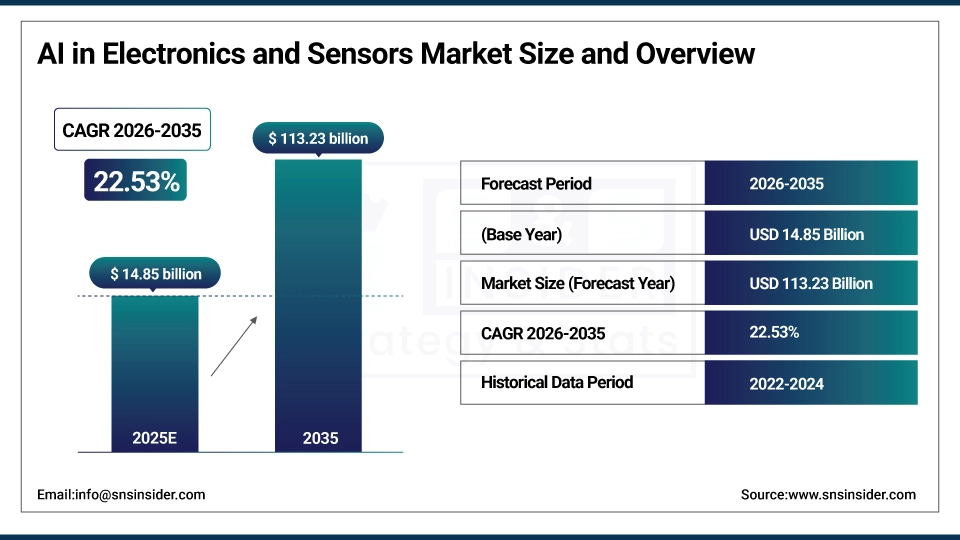
The AI in Electronics and Sensors Market size was valued at USD 14.85 Billion in 2025 and is projected to reach USD 113.23 Billion by 2035, growing at a CAGR of 22.53% during 2026–2035.
The AI in the Electronics and Sensors Market is growing at a rapid pace, and the demand for AI-based sensors is on the rise, owing to the increased adoption of intelligent sensing and data-driven decision-making in various industries. The accuracy and efficiency provided by AI-based sensors are contributing to the growth of the market, and the demand for AI-based sensors is growing in various applications, from industrial automation to consumer electronics and medical devices. The demand for real-time analytics, automation, and smart devices is driving the growth of the market for AI-based sensors, and the market is witnessing innovations in sensor technology and AI algorithms.
To Get more information on AI in Electronics and Sensors Market - Request Free Sample Report
AI in Electronics and Sensors Market Key Trends:
-
Increasing adoption of edge AI and hybrid AI platforms for real-time data processing and low-latency decision-making across automotive, industrial, and consumer electronics.
-
Rapid growth in autonomous vehicles and ADAS systems, driving demand for high-precision optical and MEMS sensors.
-
Rising deployment of AI-enabled healthcare devices and wearable sensors, enabling remote patient monitoring and smart diagnostics.
-
Expansion of industrial automation and smart manufacturing leveraging AI sensors for predictive maintenance, process optimization, and efficiency improvements.
-
Advancements in AI sensor technology, including low-power chips, hybrid cloud-edge solutions, and integrated modules, fueling innovation across automotive, industrial, and consumer electronics sectors.
U.S. AI in Electronics and Sensors Market Size Outlook
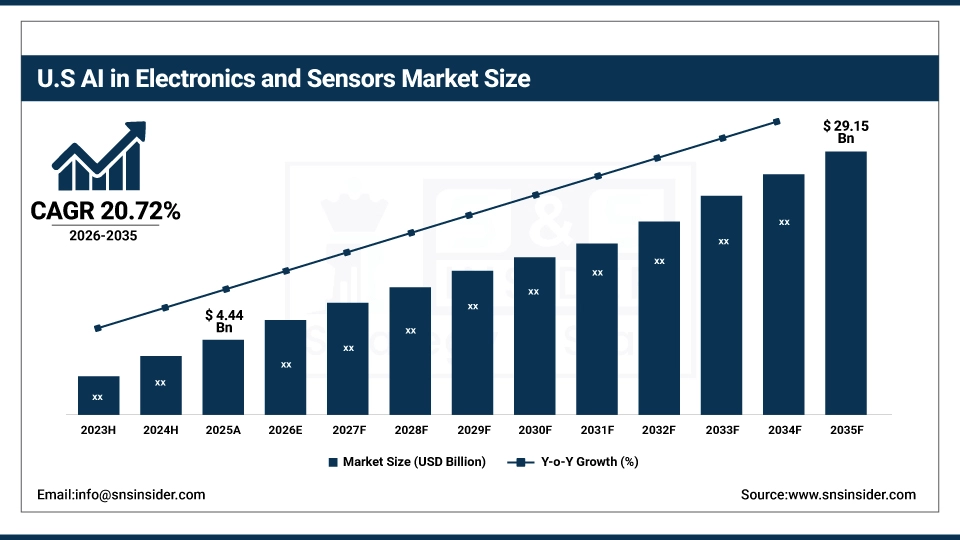
The U.S. AI in Electronics and Sensors Market is valued at USD 4.44 Billion in 2025 and is expected to reach USD 29.15 Billion in 2035, growing at a CAGR of 20.72% from 2026 to 2035. The U.S. AI in Electronics and Sensors Market is growing due to factors like autonomous vehicles, industrial automation, healthcare devices, IoT, edge computing, smart manufacturing, government initiatives, and advancements in sensor technology and AI.
AI in Electronics and Sensors Market Key Drivers:
-
Growing adoption of IoT devices, edge computing, and AI-enabled industrial automation drives demand for intelligent sensor systems.
The major driver of the growth of the AI in Electronics and Sensors market is the rising usage of AI-based sensors in automotive, healthcare, industrial, and consumer electronics segments. Organizations are investing significantly in AI chips, sensors, and analytics solutions to boost efficiency in operations, maintenance, and real-time analytics. The demand for self-driven cars, smart products, and AI-based industrial systems is also driving the market forward.
AI in Electronics and Sensors Market Key Restraints:
-
High implementation costs and complexity may limit adoption of advanced AI sensor systems.
Challenges for the market include the high capital investment required for AI-enabled hardware, software, and integrated systems, particularly for industrial-scale deployments. Additional factors include the need for skilled professionals to design, deploy, and maintain AI sensor networks, concerns about data privacy and cybersecurity, and compatibility issues with existing infrastructure, which may restrain adoption in small and mid-sized enterprises.
AI in Electronics and Sensors Market Key Opportunities:
-
Technological innovations, smart city initiatives, and growing automation create new growth avenues.
The opportunities exist in the areas like advanced optical, MEMS, and biosensors; low-power AI chips; edge AI; and hybrid cloud-edge technologies. The increasing growth in autonomous vehicles, wearable health care devices, industrial IoT, smart manufacturing, and other areas are creating opportunities for innovative AI sensor applications. The government and industrial initiatives in smart cities, Industry 4.0, and AI are creating significant business opportunities for new entrants and technology upgrades.
AI in Electronics and Sensors Market Segmentation Trends:
-
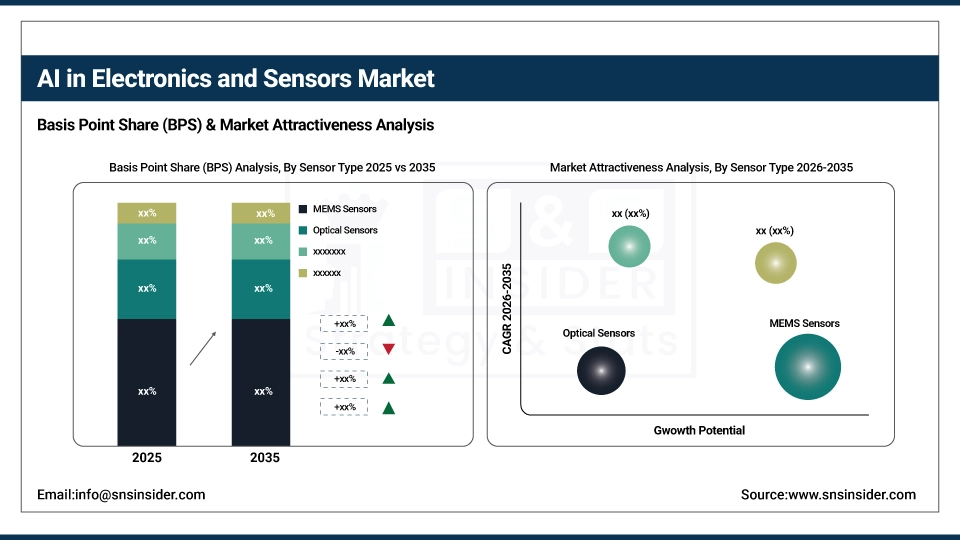
By Sensor Type: In 2025, MEMS Sensors dominated with 35% share; Optical Sensors fastest growing segment during 2026-2035
-
By Application: In 2025, Automotive dominated with 30% share; Healthcare & Medical Devices fastest growing segment during 2026-2035
-
By Component: In 2025, Hardware dominated with 50% share; Software fastest growing segment during 2026-2035
-
By Deployment: In 2025, Edge AI dominated with 55% share; Hybrid AI fastest growing segment during 2026-2035
By Sensor Type: MEMS Dominates, Optical Fastest-Growing
MEMS sensors lead the sensor type segment in the market, holding a share of approximately 35%, due to their precision, miniaturization, and widespread use in automotive, industrial, and consumer electronics. MEMS sensors are essential for motion detection, navigation, and industrial automation, making them the largest contributor to the market.
Optical sensors are growing at a faster rate than other sensors, mainly because of the increasing demand for optical sensors in autonomous vehicles, LiDAR, and robotics applications.
By Application: Automotive Dominates, Healthcare & Medical Devices Fastest-Growing
The market segment for automotive applications leads, accounting for 30% market share, owing to the high penetration of AI sensors used in ADAS, autonomous driving, vehicle monitoring, and safety systems. With AI sensors used for navigation systems, collision detection systems, and predictive maintenance systems, this market segment leads.
Healthcare & Medical Devices is the fastest-growing application segment, fueled by adoption of wearable sensors, remote patient monitoring, AI diagnostics, and smart medical devices. Rising demand for AI-enabled healthcare technologies accelerates growth in this segment.
By Component: Hardware Dominates, Software Fastest-Growing
Hardware leads the component segment in the market, holding a share of approximately 50%, as it includes AI chips, sensors, and integrated modules critical for automotive, industrial, and consumer electronics applications. Companies and industries depend on hardware for accurate data acquisition and processing, making it the largest contributor.
Software is the fastest-growing component due to the increasing need for AI algorithms, predictive analytics, automation, and monitoring platforms. Enhanced software capabilities drive performance and efficiency across applications, attracting growing investment.
By Deployment: Edge AI Dominates, Hybrid AI Fastest-Growing
Edge AI is in the leading position, taking a share of 55% due to its ability to process data locally, reduce latency, and enable real-time decision-making in industries like automotive, industrial, and IoT. Edge AI is a significant contributor in mission-critical applications and has the highest share.
The fastest-growing type is hybrid AI, which utilizes both cloud and edge computing for flexible and efficient AI solutions. Hybrid AI is used for distributed computing and analytics in a remote environment.
AI in Electronics and Sensors Market Regional Analysis:
North America AI in Electronics and Sensors Market Insights:
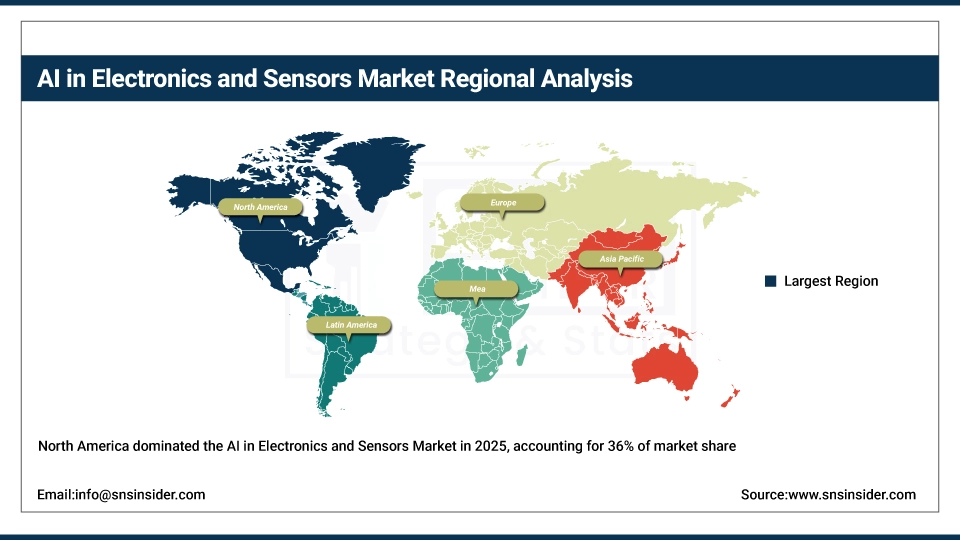
North America leads the market for AI in Electronics and Sensors, capturing a market share of around 36%. This is because of the high adoption rate of AI-based sensors in applications such as automobiles, industries, healthcare, and consumer electronics, owing to high R&D activity and presence of major players such as Intel, NVIDIA, and Texas Instruments.
Get Customized Report as per Your Business Requirement - Enquiry Now
Europe AI in Electronics and Sensors Market Insights:
Europe is an important market for AI in the "Electronics and Sensors" segment, owing to the strong demand for AI in the automotive, industrial automation, and healthcare segments in the region. The region is also growing because of the technological innovations, smart device penetration, and government initiatives in the European countries to implement Industry 4.0 and AI in the region.
Asia-Pacific AI in Electronics and Sensors Market Insights:
Asia-Pacific is the fastest-growing market in the AI in Electronics and Sensors Market, with a CAGR of around 26.31% during 2026-2035. The growth is fueled by the growing adoption of smart manufacturing, automotive, consumer, and AI-driven devices in countries such as China, Japan, South Korea, and India, and government initiatives in Industry 4.0 and smart cities.
Latin America AI in Electronics and Sensors Market Insights:
Latin America is an emerging market for AI in the field of ‘Electronics and Sensors,’ where the market is growing with the increasing adoption of industrial automation. Brazil and Mexico are the key contributors for this market with the gradual adoption of technology.
Middle East & Africa (MEA) AI in Electronics and Sensors Market Insights:
MEA is an emerging market for AI in the field of Electronics and Sensors. It is growing in terms of industrial automation, smart cities, and beginning IoT adoption. The UAE and Saudi Arabia are key contributors to regional AI demand in terms of government investments in technology and innovation.
AI in Electronics and Sensors Market Competitive Landscape:
Intel is a US-based company founded in 1968, specializing in semiconductor design, processors, AI chips, and sensor solutions. Intel develops AI-enabled sensors, edge computing platforms, and integrated electronics for automotive, industrial, healthcare, and consumer applications worldwide.
-
In March 2024, Intel launched new AI edge sensor modules and advanced processors for smart industrial automation and autonomous vehicle applications, enhancing real-time data processing and predictive maintenance capabilities.
NVIDIA is a US-based company founded in 1993, focusing on graphics processing units (GPUs), AI computing platforms, and AI-enabled sensor technologies. NVIDIA provides AI hardware and software solutions for automotive, healthcare, robotics, and smart devices globally.
-
In July 2024, NVIDIA deployed AI-driven sensor and computing platforms for autonomous vehicles and industrial automation systems, improving operational efficiency, safety, and real-time analytics.
Texas Instruments, or TI, is a company that was formed in 1930 and is based in the US, focusing on providing analog and embedded semiconductors, sensors, and AI technologies. Texas Instruments offers a range of sensor solutions, microcontrollers, and AI processing units for automotive, industrial, and consumer applications.
-
In October 2024, TI introduced AI-integrated sensor modules and low-power processing units for industrial monitoring and smart devices, enhancing precision, energy efficiency, and predictive maintenance.
AI in Electronics and Sensors Companies are:
-
Intel
-
NVIDIA
-
Texas Instruments
-
STMicroelectronics
-
Analog Devices
-
Qualcomm
-
Bosch Sensortec
-
NXP Semiconductors
-
Samsung Electronics
-
Sony Semiconductor Solutions
-
Honeywell
-
Siemens
-
ABB
-
Huawei
-
Hitachi
-
Omron Corporation
-
Mitsubishi Electric
-
Rockwell Automation
| Report Attributes | Details |
|---|---|
| Market Size in 2025 | USD 14.85 Billion |
| Market Size by 2035 | USD 113.23 Billion |
| CAGR | CAGR of 22.53% From 2026 to 2035 |
| Base Year | 2025 |
| Forecast Period | 2026-2035 |
| Historical Data | 2022-2024 |
| Report Scope & Coverage | Market Size, Segments Analysis, Competitive Landscape, Regional Analysis, DROC & SWOT Analysis, Forecast Outlook |
| Key Segments | • By Sensor Type: (Optical Sensors, MEMS Sensors, Temperature Sensors) • By Application: (Automotive, Healthcare & Medical Devices, Consumer Electronics) • By Component: (Hardware, Software, Modules/Integrated Systems) • By Deployment: (Edge AI, Cloud AI, Hybrid AI) |
| Regional Analysis/Coverage | North America (US, Canada), Europe (Germany, UK, France, Italy, Spain, Russia, Poland, Rest of Europe), Asia Pacific (China, India, Japan, South Korea, Australia, ASEAN Countries, Rest of Asia Pacific), Middle East & Africa (UAE, Saudi Arabia, Qatar, South Africa, Rest of Middle East & Africa), Latin America (Brazil, Argentina, Mexico, Colombia, Rest of Latin America). |
| Company Profiles | Intel, NVIDIA, Texas Instruments, STMicroelectronics, Infineon Technologies, Analog Devices, Qualcomm, Bosch Sensortec, NXP Semiconductors, Renesas Electronics, Samsung Electronics, Sony Semiconductor Solutions, Honeywell, Siemens, ABB, Huawei, Hitachi, Omron Corporation, Mitsubishi Electric, Rockwell Automation |

Frequently Asked Questions
The AI in Electronics and Sensors Market is expected to grow at a CAGR of 22.53% during 2026–2035.
The market was valued at USD 14.85 Billion in 2025 and is projected to reach USD 113.23 Billion by 2035.
The key drivers of the AI in Electronics and Sensors Market include growing IoT adoption, edge computing integration, industrial automation, automotive advancements, healthcare AI applications, precision sensor technology, and government smart city initiatives.
The Hardware (Sensors, AI Chips) segment dominated during the projected period.
North America dominated the AI in Electronics and Sensors Market in 2025.
