
Enhanced Geothermal Systems Market Report Scope and Overview:
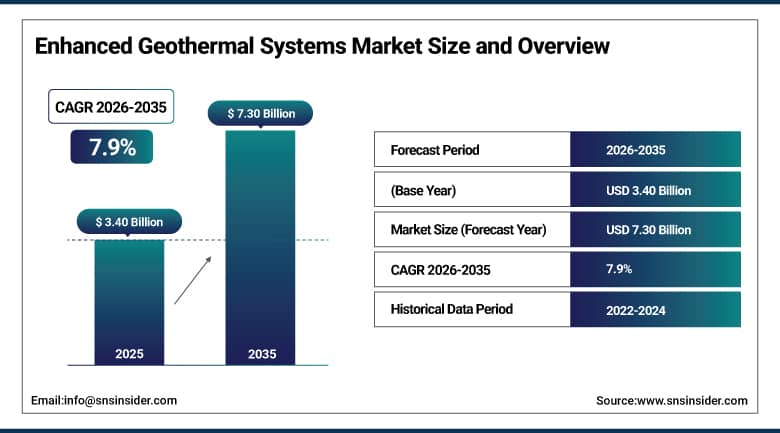
The Enhanced Geothermal Systems Market was valued at USD 3.40 Billion in 2025 and is projected to reach USD 7.30 Billion by 2035, registering a CAGR of 7.9% over 2026-2035.
The Enhanced Geothermal Systems Market represents the commercialization of shale-derived horizontal drilling and hydraulic stimulation techniques to unlock baseload, weather-independent power generation from hot dry rock formations previously considered uneconomical for conventional hydrothermal development. The market is segmented based on rising utility and hyperscale data center demand for firm, carbon-free baseload power, deployment of multi-lateral horizontal well stimulation techniques, manufacturing and drilling capacity at gigawatt-scale, and application across grid-scale electricity generation, industrial process heat, and district heating networks.
In April 2026, Quaise began preparatory work for a planned 50 MW superhot geothermal power plant in Oregon near Newberry Volcano. The project is designed around deep drilling and superhot-rock resources, representing a major step toward commercializing high-temperature geothermal systems beyond conventional resource limitations.
To Get More Information On Enhanced Geothermal Systems Market - Request Free Sample Report
Enhanced Geothermal Systems Market Trends
-
Hyperscale data center operators are increasingly signing long-term power purchase agreements directly with enhanced geothermal developers.
-
Oilfield-services drilling expertise is accelerating the transition from pilot-scale projects to multi-well commercial developments.
-
Growing adoption of multi-lateral horizontal well designs is materially reducing per-megawatt drilling and stimulation costs.
-
Expanding federal and state permitting reform continues shortening project timelines for hot dry rock developments.
-
Rising interest in hybrid power-and-heat configurations is broadening geothermal's addressable industrial and district heating market.
U.S. Enhanced Geothermal Systems Market Outlook
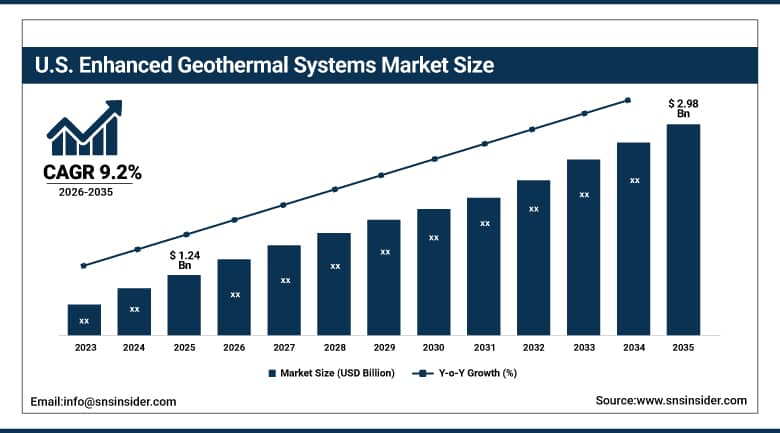
The U.S. Enhanced Geothermal Systems Market was valued at approximately USD 1.24 Billion in 2025 and is projected to reach approximately USD 2.98 Billion by 2035, registering a CAGR of approximately 9.2% from 2026 to 2035.
Demand in the U.S. has been largely driven by Department of Energy Enhanced Geothermal Shot cost-reduction targets, heavy investment in domestic horizontal drilling and stimulation capabilities adapted from shale operations, and high hyperscale technology company demand for firm, carbon-free baseload power to support data center growth. Deployment of commercial-scale projects in Nevada and Utah, together with growing utility interest in geothermal as a dispatchable complement to intermittent wind and solar, has reinforced the country's position as the leading market for both project development and drilling technology innovation.
In January 2026, Mazama Energy advanced its 15 MW high-temperature enhanced geothermal pilot in Oregon, demonstrating progress toward commercial-scale power generation from engineered geothermal resources. The project is supported by U.S. government funding and is among the leading U.S. efforts to demonstrate next-generation geothermal technology.
Enhanced Geothermal Systems Market Segment Analysis
-
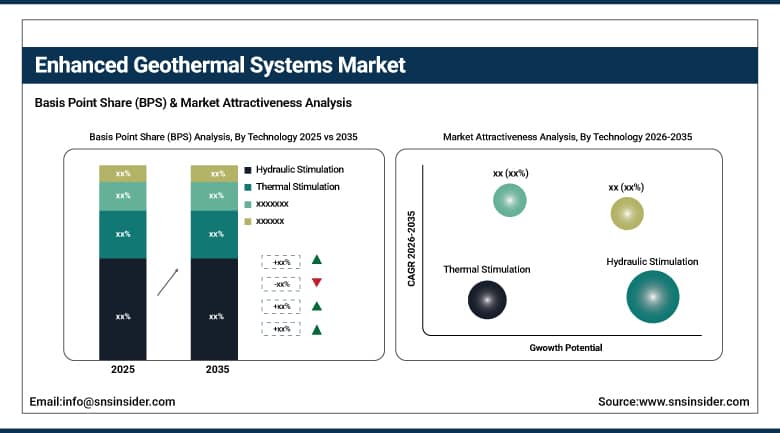
By Technology, Hydraulic Stimulation segment dominated the Enhanced Geothermal Systems Market in 2025 with 68% share; Thermal Stimulation segment is the fastest growing segment, registering a CAGR of 9.2% from 2026 to 2035.
-
By Well Configuration, Horizontal Wells segment dominated the market in 2025 with 61% share; Horizontal Wells segment is also the fastest growing segment, registering a CAGR of 8.6% from 2026 to 2035.
-
By Resource Temperature, High Temperature segment dominated the market in 2025 with 52% share; Medium Temperature segment is the fastest growing segment, registering a CAGR of 8.9% from 2026 to 2035.
-
By Application, Electricity Generation segment dominated the market in 2025 with 74% share; Hybrid Power-Heat segment is the fastest growing segment, registering a CAGR of 9.4% from 2026 to 2035.
-
By End User, Utilities segment dominated the market in 2025 with 49% share; Independent Power Producers segment is the fastest growing segment, registering a CAGR of 9.1% from 2026 to 2035.
By Technology, Hydraulic Stimulation Leads, While Thermal Stimulation Grows Fastest
The Hydraulic Stimulation technology held a commanding share in the Enhanced Geothermal Systems Market in 2025. It is currently the most commercially mature technique for improving the permeability of rock formations and creating the required fluid flow channels in low-permeable geothermal reservoirs. As a technology, it builds on years of experience gained in oil and gas drilling and hydraulic fracturing operations. Consequently, geothermal energy companies have the advantage of being able to utilize the available drilling techniques, pressure control and fracture monitoring technologies for geothermal reservoir engineering. This maturity of technology offers developers a relatively less risky route to stimulating reservoir volumes, improving well productivity and increasing the contact of circulating fluids with hot subsurface rocks.
Thermal Stimulation is the fastest growing segment of the Enhanced Geothermal Systems market due to rising interest in finding stimulation techniques which improve permeability but minimize reliance on fluid pressure injection. It exploits temperature differences and thermal stresses to create and/or increase fractures in subsurface formations. In this regard, developers, such as Quaise Energy have been actively researching ways of using thermal stimulation in a way that allows flexibility in difficult geological settings and mitigates induced seismicity issues of traditional hydraulic stimulation. Despite being at an early commercial maturity stage, Thermal Stimulation continues to gain traction due to research and technological experimentation.
By Well Configuration, Horizontal Wells Lead and Grow Fastest
Horizontal Wells held the leading configuration share in 2025 as extended wellbores, developers gain access to much more geothermal reservoir rock compared to conventional vertical wells. With horizontal wells, operators can create a greater contact area within geothermal reservoirs, offering many opportunities for fluid circulation within the stimulated zone and efficient heat recovery. Multistage stimulation is also possible, which means that different sections of the horizontal well can be stimulated independently creating a greater connectivity across the reservoir. Such configuration may be especially beneficial for EGS projects, where operators need to use costly drilling equipment, and every single well needs to extract as much heat as possible.
Horizontal Wells are also the fastest-growing configuration as operators and drilling contractors keep developing their capabilities related to long lateral wells, multilaterals, stimulation placement, downhole monitoring and reservoir management. Improvements in temperature and pressure monitoring in real time help operators to understand the behavior of fluids and find areas with increased potential for heat extraction. Fervo Energy, Sage Geosystems and Eavor Technologies companies are among those who work on advanced geothermal well architecture development to increase the contact and heat recovery from the geothermal reservoir.
By Resource Temperature, High Temperature Leads, While Medium Temperature Grows Fastest
High Temperature accounted for the biggest market share in 2025 due to the fact that high-temperature formations offer the best possibility for generating electric power efficiently and providing a bigger energy output per well produced. Higher temperature formations can provide the power conversion systems with more thermal energy which makes them more desirable in terms of commercial developments that aim at electricity generation on an industrial scale and lower levelized cost of electricity. The fast growth of the EGS market is associated with developers' attempts to demonstrate the economic feasibility of enhanced geothermal technology and to optimize the energy output of formations. High-temperature basins in regions such as Nevada and Utah have remained among the most promising sites for the development of EGS formations.
Medium Temperature are the fastest growing segment in the EGS market due to the advances in the geothermal power conversion technology which allows using moderately high-temperature formations as sources of commercially feasible power generation. Binary systems such as organic Rankine cycle technologies enable geothermal companies to use power conversion technologies for the production of electricity from formations that may not be hot enough to generate electric power through conventional steam-driven technologies. It increases the potential of geological formations that can be used in the development of enhanced geothermal systems.
By Application, Electricity Generation Leads, While Hybrid Power-Heat Grows Fastest
Electricity Generation dominated the application share in 2025 due to the rising need for stable, weather-proof, and environmentally friendly electricity which can supplement the rapid growth of intermittent renewable energy sources. The ability of EGS to produce uninterrupted electricity owing to its capability to access subsurface heat independent of sunlight and wind conditions makes it relevant in power systems in search of reliable clean electricity generation capacity. The segment is also witnessing the benefit of rising electricity demands in such sectors as data centers, high-tech manufacturing plants, and other energy-consuming industrial facilities. Long-term power purchase agreements and corporate procurement of clean energy will help developers see more transparency in their income.
Hybrid Power-Heat is the fastest-growing application as the developers try to get as much economic benefit from the use of geothermal resource as possible through a combination of electricity production with heat production. In hybrid power plants, geothermal energy can potentially be used to supply industrial process heat needs, district heating systems, agricultural processes, commercial properties, or any other heat application together with electricity generation. Hybrid systems allow developers to make better use of the same geothermal resource and become more energy efficient using the thermal energy which is usually not fully utilized after electricity production. Hybrid power plants are especially popular in those countries where industrial heat demand is considerable, and where the clients are ready to sign long-term off-take agreements for both types of energy.
By End User, Utilities Dominate, Independent Power Producers Grow Fastest
Utilities represented the dominant end-user segment in 2025 due to their vital importance in securing a consistent supply of electricity capacity and new generation capacity within regional electricity systems. Utilities have the distinct advantage of being able to enter long duration power purchase agreements and capacity planning as a regulatory framework along with offering relatively predictable demand for electricity. These factors are critical in relation to EGS projects, which involve significant costs related to deep drilling, reservoir stimulation, well drilling and building a power plant prior to its operation. The revenues generated from utility procurement may provide more stability and allow developers to finance capital-intensive geothermal projects.
Independent Power Producers are the fastest-growing end-user segment as geothermal developers are increasingly interested in capturing the commercial opportunity by developing outside the conventional framework of utility-based procurement process. IPPs will be able to react more rapidly to increasing demand for electricity and customize their power purchase agreement for the customers with big commercial and industrial loads requiring consistent supply of electricity. The model of IPPs will become even more relevant in the case of hyperscale data centers and technology companies looking for reliable, low carbon energy in the form of long term clean-power contracts as a response to growing energy consumption.
Regional Analysis:
|
Region |
Major Country |
Share within Region, 2025 (%) |
|---|---|---|
|
North America |
United States |
85.30% |
|
Europe |
Germany |
24.90% |
|
Asia Pacific |
Indonesia |
34.70% |
|
Middle East and Africa |
Kenya |
38.20% |
|
Latin America |
Mexico |
36.50% |
North America Enhanced Geothermal Systems Market Insights
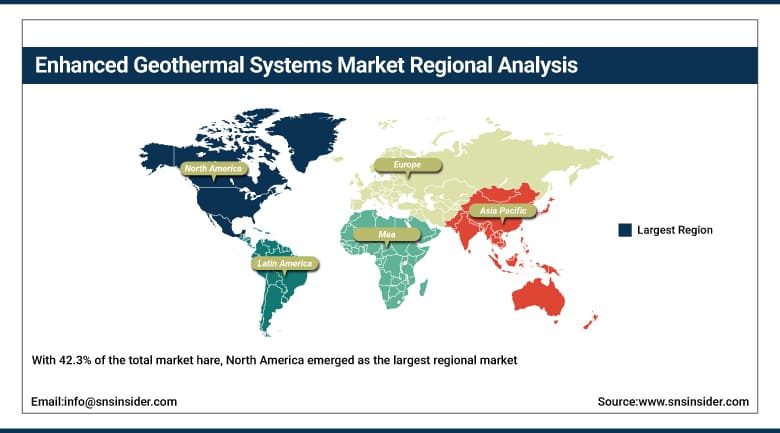
With 42.3% of the total market hare, North America emerged as the largest regional market in the Enhanced Geothermal Systems Market in 2025, on account of Department of Energy Enhanced Geothermal Shot funding aimed at reducing costs, well-established horizontal drilling capabilities transferred from the shale industry, and robust demand for reliable and carbon-free baseload power from hyperscale technology companies. Pipeline projects initially set up as a one-well pilot project have gradually evolved into multiple-well projects, underlining the status of North America as the largest accessible market in terms of drilling service, equipment, and power generation.
The U.S. emerged as the key country within the region owing to the extent of high-temperature resource base in Nevada and Utah, well-established oilfield services drilling capability, and active involvement from developers like Fervo Energy and Sage Geosystems. In addition, Canada accounted for a lesser share but increasing contribution to the regional market owing to initial stage of project development in Alberta using oil & gas drilling capabilities.
Get Customized Report as Per Your Business Requirement - Enquiry Now
Europe Enhanced Geothermal Systems Market Insights
The enhanced geothermal systems market in Europe accounted for a significant portion in 2025 due to the continent's aggressive carbon emission reduction policies under the EU Green Deal, rising geothermal interests as an indigenous energy source amid the risk of importing fossil fuels, and the regulatory push for decarbonization of district heating networks within urban areas. Growing lithium recovery interest from geothermal brine is expected to fuel the developer appetite within the sedimentary basins across the continent.
The market leader in Europe in terms of revenue generation was Germany with its Upper Rhine Graben geothermal resource and government drive for decarbonizing district heating networks. Other countries with contributions to the market were France and the United Kingdom where geothermal developers developed lithium and heat geothermal resources in Alsace, France.
Asia Pacific Enhanced Geothermal Systems Market Insights
The Asia-Pacific region is expected to be the fastest-growing region with CAGR of 8.8% in the Enhanced Geothermal Systems Market, driven by investments in fast grid decarbonization, high geothermal resources from the volcanic belt region, and renewable energy initiatives by governments in Indonesia, Japan, and Philippines. The increasing need for baseload power together with growing renewables targets in the region have ensured that it will outpace all other regions in terms of growth.
Indonesia is the leading country in the region, owing to its high volcanic belt region and geothermal development pipeline, with Star Energy Geothermal developing its stimulated wells in its current concessions. Japan was another contributor, with Mitsubishi Heavy Industries supplying binary cycle power conversion technology in geothermal projects in the country and abroad.
Middle East & Africa and Latin America Enhanced Geothermal Systems Market Insights
Middle East & Africa and Latin America witnessed stable growth in the Enhanced Geothermal Systems Market, due to the rising number of grids decarbonization initiatives, increasing investments in baseload power generation, and greater coordination between utilities from these regions and foreign drilling and geothermal systems suppliers. Validated, dispatchable renewable generation capacity requirement has become a feasible aim for utilities from these regions, which had traditionally been focused on the use of fossil fuels for baseload power production.
Kenya is the biggest market in MEA because of the availability of East African Rift geothermal resources and the further grid expansion of Kenya Electricity Generating Company. The biggest revenue generator in Latin America is Mexico due to the existence of its geothermal resource base and utilities' interest in stimulated well deployment for the extension of conventional fields.
Market Dynamics:
Growth Drivers: Hyperscale Baseload Power Demand and Shale-Derived Drilling Cost Reductions
The sector is fueled by the growing power requirements for baseload power needed to meet increasing hyperscale data center electricity needs, which cannot rely on intermittent renewable energy sources, such as wind and solar, and the quick transfer of cost efficiencies from the shale industry through drilling contractors' use of shale experience for geothermal wells and fast-developing government cost reduction initiatives, including the Department of Energy's Enhanced Geothermal Shot.
This trend is further supported by the formation of strategic alliances between oilfield-services giants and geothermal firms, who are increasingly using shale-trained drilling contractors to undertake geothermal projects. Venture and corporate investment in stimulation technology and binary cycle power generation is further bolstering access to financial capital, contributing to strong growth in the forecast period.
Restraints: High Upfront Drilling Cost and Induced Seismicity Risk
The high cost involved when drilling multi-lateral horizontal wells deep into the ground more than several kilometers is another major challenge because the economics of the project are highly dependent on the cost and geological uncertainties, which might not be well handled by small organizations unless their balance sheets are robust.
The other major challenge involves induced seismicity due to hydraulic stimulation of reservoirs. The fear from both the general public and the government in some jurisdictions where there have been incidents of felt seismicity in pilot projects has slowed down the permit process in those areas. It is clear that the trust deficit is an expensive one to build.
Opportunities: Lithium Co-Production and Expanding Hyperscale Offtake Demand
Lithium co-production from geothermal brines represents an actual business opportunity because developers in areas rich with resources, like the Salton Sea and Upper Rhine Graben, are considering combining power generation and critical mineral production from one single stream of wells. Companies that manage to create a competitive advantage in the field of direct lithium extraction will have an extra stream of income aside from selling electricity.
The other business opportunity arises in connection with an increasing need for baseload, emission-free electricity by hyperscale technology companies that are more and more often signing long-term PPAs for their data centers. This is why developers who are capable of developing commercial-scale plants quickly should be able to capitalize on this market trend.
Recent Developments:
-
2026: Fervo Energy announced expansion of its Cape Station project in Utah with additional horizontal well pads, targeting increased gigawatt-scale capacity under its long-term power purchase agreements with technology sector offtakers.
-
2026: Sage Geosystems commissioned its Gemini geothermal storage and power facility, combining enhanced geothermal generation with subsurface thermal energy storage to provide dispatchable capacity for grid balancing.
-
2026: Eavor Technologies advanced construction of its Eavor-Loop closed-loop geothermal project in Germany, targeting combined district heating and power supply for a regional industrial customer base.
Enhanced Geothermal Systems Market key players are:
-
Fervo Energy
-
AltaRock Energy, Inc.
-
Sage Geosystems Inc.
-
Eavor Technologies Inc.
-
Quaise Energy, Inc.
-
Mazama Energy, Inc.
-
GreenFire Energy Inc.
-
Baker Hughes Company
-
Halliburton Company
-
SLB (Schlumberger Limited)
-
Ormat Technologies, Inc.
-
Enel Green Power S.p.A.
-
Calpine Corporation
-
Chevron Corporation
-
Vulcan Energy Resources Ltd
-
Turboden S.p.A.
-
Mitsubishi Heavy Industries, Ltd.
-
Star Energy Geothermal
-
Sumitomo Corporation
-
Contact Energy Limited
Enhanced Geothermal Systems Market Report Scope:
| Report Attributes | Details |
|---|---|
| Market Size in 2025 | USD 3.40 Billion |
| Market Size by 2035 | USD 7.30 Billion |
| CAGR | 7.9% from 2026 to 2035 |
| Base Year | 2025 |
| Forecast Period | 2026-2035 |
| Historical Data | 2022-2024 |
| Report Scope & Coverage | Market Size, Segments Analysis, Competitive Landscape, Regional Analysis, DROC & SWOT Analysis, Forecast Outlook |
| Key Segments |
|
| Regional Analysis/Coverage | North America (US, Canada), Europe (Germany, UK, France, Italy, Spain, Russia, Poland, Rest of Europe), Asia Pacific (China, India, Japan, South Korea, Australia, ASEAN Countries, Rest of Asia Pacific), Middle East & Africa (UAE, Saudi Arabia, Qatar, South Africa, Rest of Middle East & Africa), Latin America (Brazil, Argentina, Mexico, Colombia, Rest of Latin America). |
| Company Profiles | Fervo Energy, AltaRock Energy, Inc., Sage Geosystems Inc., Eavor Technologies Inc., Quaise Energy, Inc., Mazama Energy, Inc., GreenFire Energy Inc., Baker Hughes Company, Halliburton Company, SLB (Schlumberger Limited), Ormat Technologies, Inc., Enel Green Power S.p.A., Calpine Corporation, Chevron Corporation, Vulcan, Energy Resources Ltd, Turboden S.p.A., Mitsubishi Heavy Industries, Ltd., Star Energy Geothermal, Sumitomo Corporation, and Contact Energy Limited. |

Frequently Asked Questions
Key players include Fervo Energy, AltaRock Energy, Inc., Sage Geosystems Inc., Eavor Technologies Inc., and Quaise Energy, Inc., among others.
Key opportunities include growing demand for clean baseload power, advancements in enhanced geothermal technologies, rising decarbonization investments, and increasing deployment potential beyond conventional geothermal regions.
The major growth factor is rising hyperscale data center demand for firm, carbon-free baseload power, rapid transfer of shale-derived horizontal drilling cost reductions, and growing federal cost-reduction targets for hot dry rock development.
The Hydraulic Stimulation segment dominated the Enhanced Geothermal Systems Market by technology, representing the largest share of revenue in 2025.
North America dominated the Enhanced Geothermal Systems Market in 2025, holding an estimated 42.3% share of total global market revenue.
