
Edge Vision Systems Market Report Scope and Overview:
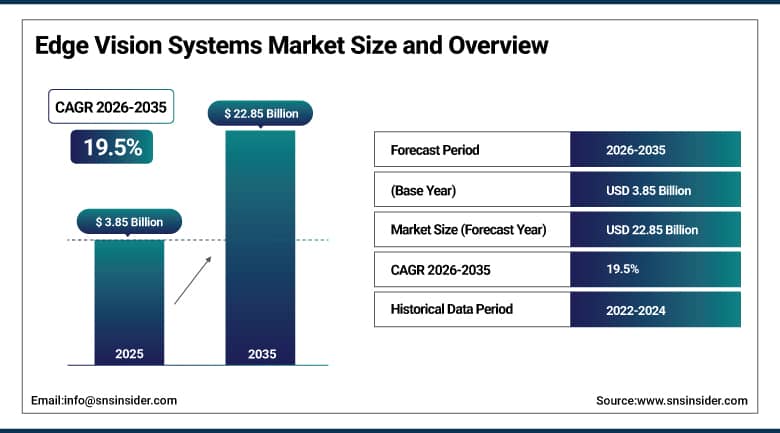
The Edge Vision Systems Market size was valued at USD 3.85 Billion in 2025 and is projected to reach USD 22.85 Billion by 2035, registering a CAGR of 19.5% from 2026 to 2035.
The Edge Vision Systems Market is revolutionizing real-time visual data processing by enabling cameras, sensors, and embedded processors to analyze images directly at the point of capture rather than relying on cloud-based computation. The market is characterized by rising adoption of GPU and neural processing unit-based vision processors for low-latency inference, growing deployment of edge vision systems in industrial quality inspection and autonomous vehicle applications, and expanding integration of on-device AI models that reduce bandwidth requirements and improve data privacy compliance. Significant growth is being witnessed in robotics guidance, retail analytics, and security surveillance applications, considering that manufacturers and system integrators are investing heavily in compact, energy-efficient vision systems capable of delivering real-time decision-making without dependence on continuous cloud connectivity.
Teledyne FLIR OEM announced its Boson+ IQ Development Kit throughout 2025, integrating advanced thermal imaging and edge AI processing capability for industrial inspection and autonomous system developers.
To Get More Information On Edge Vision Systems Market - Request Free Sample Report
Edge Vision Systems Market Trends
-
Growing adoption of GPU and neural processing unit-based vision processors continues enabling low-latency, on-device image inference.
-
Rising deployment of edge vision systems in industrial quality inspection continues expanding smart factory automation capability.
-
Increasing integration of on-device AI models continues reducing bandwidth requirements while improving data privacy compliance.
-
Expanding autonomous vehicle and ADAS adoption continues driving demand for real-time, low-latency edge vision processing capability.
-
Growing use of edge vision systems in retail analytics continues broadening adoption beyond traditional industrial applications.
U.S. Edge Vision Systems Market Size Outlook
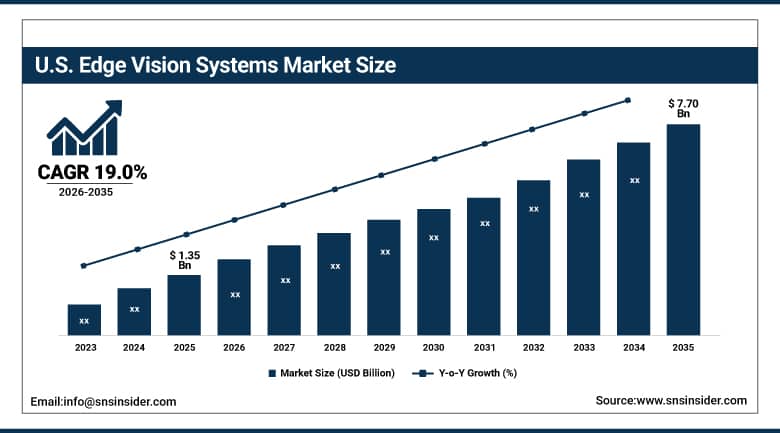
The U.S. Edge Vision Systems Market was valued at approximately USD 1.35 Billion in 2025 and is projected to reach approximately USD 7.70 Billion by 2035, registering a CAGR of approximately 19.0% from 2026 to 2035.
Demand across the United States continued to be shaped by early adoption of AI and machine learning technologies, sustained defense and security sector investment in thermal and optical imaging, and a deep concentration of leading edge AI processor and camera module developers. Rising deployment of GPU and neural processing unit-based vision systems by domestic industrial and automotive customers continued reinforcing the country's position as both the largest and one of the most innovation-driven markets tracked in this report. Growing adoption across autonomous vehicle development, robotics guidance, and retail analytics added further layers of sustained domestic demand well beyond the technology's original industrial inspection use case.
Ambarella introduced its CV72S edge AI vision system-on-chip throughout 2025, engineered to deliver improved neural network processing performance for automotive and robotics camera applications across U.S. and global customers.
Edge Vision Systems Market Segment Analysis
-
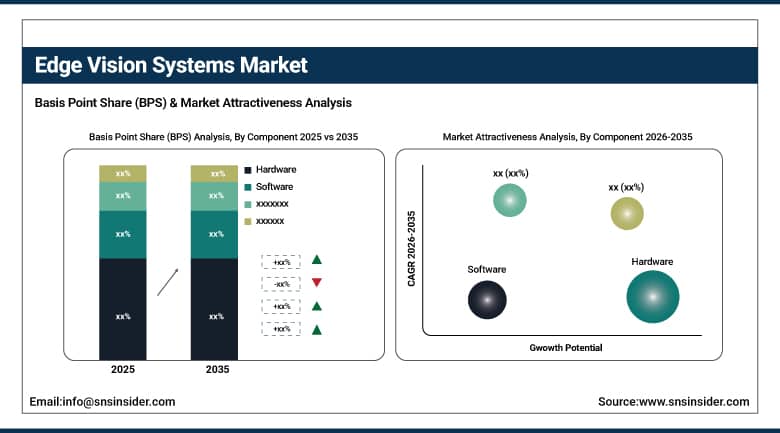
By Component, Hardware dominated the Edge Vision Systems Market with a 67.00% share in 2025, while Software is the fastest-growing segment with a CAGR of 21.40% from 2026–2035.
-
By Processor Type, GPU dominated the market with a 46.00% share in 2025, while ASIC/NPU is the fastest-growing segment with a CAGR of 22.80% from 2026–2035.
-
By Application, Industrial Automation & Quality Inspection dominated the market with a 33.00% share in 2025, while Autonomous Vehicles & ADAS is the fastest-growing segment with a CAGR of 23.60% from 2026–2035.
-
By End-User, Manufacturing dominated the market with a 36.00% share in 2025, while Automotive is the fastest-growing segment with a CAGR of 22.90% from 2026–2035.
By Component, Hardware Leads While Software Grows Fastest
The Hardware segment dominated the Edge Vision Systems Market in 2025 owing to sustained demand for cameras, sensors, and embedded processors forming the physical foundation of every deployed edge vision system. System integrators continue prioritizing hardware investment given its central role in enabling reliable, real-time image capture and processing. Continued growth in camera resolution and processor performance requirements has kept hardware the largest single revenue contributor within the component landscape tracked in this report.
The Software segment is the fastest growing in the Edge Vision Systems Market owing to accelerating investment in AI model optimization, on-device inference frameworks, and application-specific computer vision algorithms that differentiate edge vision system performance. Developers increasingly prioritize software innovation to extract greater accuracy and efficiency from existing hardware platforms. Growing demand for customizable, application-specific vision algorithms continues accelerating software segment growth across the industry.
By Processor Type, GPU Dominates While ASIC/NPU Records Fastest Growth
The GPU segment dominated the Edge Vision Systems Market in 2025 due to its proven capability to handle the parallel processing demands of modern image recognition and deep learning-based vision models. System designers continue relying on GPU-based processors for their broad software ecosystem support and proven performance across diverse vision applications. Sustained deployment of GPU-accelerated edge vision systems has kept this processor type the largest overall contributor to market revenue.
The ASIC/NPU segment is the fastest growing in the Edge Vision Systems Market owing to rising demand for purpose-built neural processing units that deliver superior power efficiency for battery-powered and thermally constrained edge deployments. Chip designers increasingly develop application-specific processors optimized for common vision workloads rather than general-purpose GPU computation. Growing emphasis on energy-efficient, cost-effective edge AI deployment continues accelerating demand for ASIC and NPU-based vision processors.
By Application, Industrial Automation Leads While Autonomous Vehicles Grow Fastest
The Industrial Automation & Quality Inspection segment dominated the Edge Vision Systems Market in 2025 due to sustained manufacturing demand for automated defect detection, dimensional measurement, and process control across smart factory initiatives. Manufacturers continue prioritizing edge vision deployment given the segment’s scale and recurring production line integration requirements. Sustained global manufacturing automation investment has kept this application the largest overall revenue contributor across the market.
The Autonomous Vehicles & ADAS segment is the fastest growing in the Edge Vision Systems Market owing to rapid growth in advanced driver assistance systems and autonomous driving development requiring real-time, low-latency visual perception capability. Automakers and tier-one suppliers increasingly demand edge vision systems capable of processing multiple camera feeds simultaneously without cloud dependency. Accelerating global autonomous vehicle development continues driving sustained growth in automotive-oriented edge vision system demand.
By End-User, Manufacturing Leads While Automotive Grows Fastest
The Manufacturing segment dominated the Edge Vision Systems Market in 2025 due to sustained demand for automated quality inspection and process monitoring across factories implementing Industry 4.0 initiatives. Manufacturers continue driving the majority of edge vision system procurement given their central role in production quality assurance programs. Continued global manufacturing automation investment has kept this end-user segment the largest overall contributor to market revenue.
The Automotive segment is the fastest growing in the Edge Vision Systems Market owing to expanding integration of edge vision systems into advanced driver assistance and autonomous driving platforms requiring reliable, low-latency visual perception. Automakers increasingly invest in edge vision capability to support increasingly sophisticated safety and autonomy features. Growing global vehicle electrification and autonomous driving investment continues accelerating growth in this end-user category.
Regional Analysis
|
Region |
Major Country |
Share within Region, 2025 (%) |
|---|---|---|
|
North America |
United States |
90.00% |
|
Europe |
Germany |
26.00% |
|
Asia Pacific |
China |
37.00% |
|
Middle East and Africa |
Israel |
28.50% |
|
Latin America |
Brazil |
29.00% |
North America Edge Vision Systems Market Insights
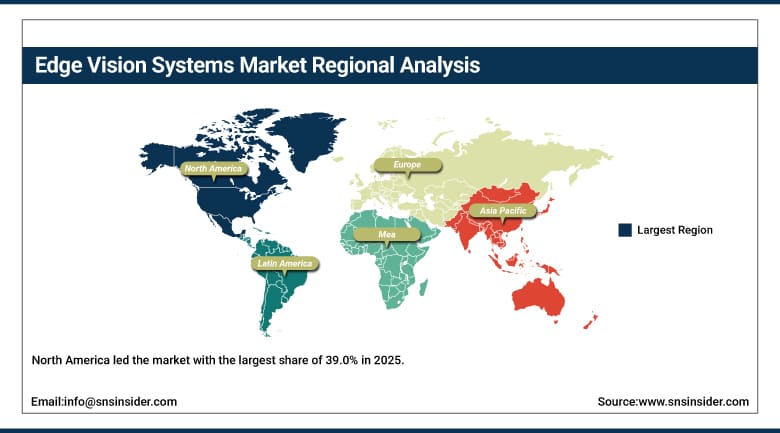
North America led the market with the largest share of 39.0% in 2025. Early adoption of AI and machine learning technologies, sustained defense and security sector investment in thermal and optical imaging, and a deep concentration of leading edge AI processor and camera module developers continued reinforcing the region’s dominant position. Growing deployment of GPU and neural processing unit-based vision systems across industrial, automotive, and security applications further strengthened North America’s standing as both the largest and one of the most innovation-driven markets tracked in this report, with continued defense and industrial automation investment expected to sustain regional demand through the forecast period.
The United States anchored by its deep concentration of leading edge AI processor and camera module developers and substantial defense and industrial automation investment. Canada added further regional demand through its own growing AI research ecosystem, and that combined strength kept the continent the largest addressable market for edge vision system vendors through the forecast period, with continued autonomous vehicle development expected to sustain regional demand well into the next decade.
Get Customized Report as Per Your Business Requirement - Enquiry Now
Europe Edge Vision Systems Market Insights
Europe held a meaningful share of global revenue, supported by strong automotive and industrial automation demand and continued expansion of domestic machine vision capability across the region’s major economies. Regulatory momentum around data sovereignty requirements under the EU AI Act continued favoring edge-based processing over cloud alternatives across the continent, while sustained automotive and industrial demand kept the region among the more resilient edge vision system markets tracked in this report.
Germany led demand of European revenue, supported by its substantial automotive sector and advanced industrial automation adoption. The UK and France contributed additional demand, and continued European investment in automotive electrification and smart manufacturing should keep regional demand for edge vision system technology climbing steadily through the forecast period.
Asia Pacific Edge Vision Systems Market Insights
Asia Pacific is advancing at the fastest pace among all regions, registering a CAGR of 22.0% from 2026 to 2035, driven by rapid manufacturing automation adoption, expanding automotive and electronics production, and growing government-backed investment in domestic AI processor capability across the region’s largest economies. That combination of manufacturing scale and genuine downstream demand across industrial, automotive, and retail applications kept the region’s growth trajectory well ahead of every other region tracked in this report, with smart manufacturing initiatives adding a further, sustained layer of demand.
China led the pack, supported by its substantial domestic electronics manufacturing base and rapid expansion of industrial automation and automotive production. Japan and South Korea contributed meaningful additional demand, with China’s expanding manufacturing ecosystem and Japan’s advanced robotics and vision technology capability both reinforcing the region’s position as the fastest-growing edge vision system market tracked in this report.
MEA and Latin America Edge Vision Systems Market Insights
The Middle East and Africa and Latin America both showed steady growth, driven by expanding industrial and security infrastructure investment, growing government focus on smart city initiatives, and rising demand for automated inspection and surveillance capability across both regions. As these markets continued building out modern industrial and security infrastructure, edge vision system technology proved a genuinely valuable enabler of increasingly capable, locally deployed automation and monitoring systems.
Israel led Middle East and Africa demand, supported by the country’s established technology and defense sector presence and substantial multinational research and development investment. Saudi Arabia and the UAE contributed further demand through large-scale smart city announcements. In Latin America, Brazil accounted for the largest share of regional revenue, with growing industrial and security infrastructure investment continuing to anchor regional demand for edge vision system technology.
Market Dynamics
Growth Drivers: Rising Real-Time AI Inference Demand and Industrial Automation Investment
The industry is driven by rising adoption of GPU and neural processing unit-based vision processors for low-latency inference, growing deployment of edge vision systems in industrial quality inspection and autonomous vehicle applications, expanding integration of on-device AI models, and increasing demand for bandwidth-efficient, privacy-compliant visual data processing. As manufacturers and automakers continue prioritizing real-time decision-making without cloud dependency, the need for expanded edge vision system adoption continues driving sustained investment across the industry.
Rising data sovereignty regulation continues reinforcing this driver, as enterprises increasingly favor on-device processing over cloud-based alternatives to comply with cross-border data transfer restrictions. Growing autonomous vehicle and robotics development continues defining a further layer of sustained demand, and that combination of regulatory pressure and automation investment is exactly what keeps overall demand climbing at such a steady, sustained pace.
Restraints: Limited On-Device Compute Resources and Thermal Constraints
The limited compute and memory resources available on power- and thermally-constrained edge devices continue posing a genuine restraint on faster market-wide expansion, particularly for applications requiring the most sophisticated deep learning models that exceed practical edge hardware capability. That constraint has kept certain highly complex vision workloads dependent on hybrid edge-cloud architectures rather than pure edge deployment.
Ongoing fragmentation across edge AI hardware platforms and software frameworks continues posing a further restraint, as developers face genuine integration hurdles when porting vision models across competing processor architectures and toolchains. Limited standardization in certain deployment scenarios keeps some edge vision system integration projects more administratively complicated than cloud-based deployment would otherwise require.
Opportunities: Autonomous Vehicle Expansion and Retail Analytics Adoption
Rising autonomous vehicle and ADAS development represents a genuinely significant opportunity, as automakers increasingly require real-time, low-latency visual perception capability that cloud-based processing cannot reliably deliver. Vendors positioned early in automotive-qualified edge vision system technology stand to capture meaningful share as this capability continues expanding from traditional industrial applications into broader autonomous mobility platforms.
Expanding retail analytics adoption offers a second substantial opportunity, as retailers increasingly deploy edge vision systems for inventory monitoring, customer behavior analysis, and loss prevention without transmitting sensitive video data to the cloud. Vendors with proven, privacy-compliant edge vision technology stand to capture meaningful share as global retail digitalization continues scaling across established and emerging markets alike.
Recent Developments:
-
2026: Cognex launched the In-Sight 6900 Vision Controller, powered by NVIDIA Jetson technology, enabling high-capacity AI processing at the edge for demanding industrial inspection applications.
-
2026: HCLTech unveiled VisionX 2.0, integrating computer vision, vision-language models, multimodal fusion, and edge-optimized generative AI for mission-critical industrial environments.
-
2024: Hailo Technologies expanded its Hailo-10 edge AI processor lineup, targeting integration into industrial vision systems and smart camera modules requiring high-efficiency on-device inference.
Edge Vision Systems Companies are:
-
Intel Corporation
-
NVIDIA Corporation
-
Qualcomm Incorporated
-
Cognex Corporation
-
OMRON Corporation
-
SICK AG
-
Basler AG
-
Stemmer Imaging AG
-
LMI Technologies Inc.
-
National Instruments Corporation (Emerson)
-
ADLINK Technology Inc.
-
Advantech Co., Ltd.
-
Synaptics Incorporated
-
Ambarella, Inc.
-
Hailo Technologies Ltd.
-
Lattice Semiconductor Corporation
-
Advanced Micro Devices, Inc. (AMD)
-
Alphabet Inc. (Google LLC)
Edge Vision Systems Market Report Scope:
| Report Attributes | Details |
|---|---|
| Market Size in 2025 | USD 3.85 Billion |
| Market Size by 2035 | USD 22.85 Billion |
| CAGR | CAGR of 19.5% From 2026 to 2035 |
| Base Year | 2025 |
| Forecast Period | 2026-2035 |
| Historical Data | 2022-2024 |
| Report Scope & Coverage | Market Size, Segments Analysis, Competitive Landscape, Regional Analysis, DROC & SWOT Analysis, Forecast Outlook |
| Key Segments | • By Component (Hardware, Software, Services) • By Processor Type (GPU, CPU, FPGA, ASIC/NPU, VPU) • By Application (Industrial Automation & Quality Inspection, Autonomous Vehicles & ADAS, Security & Surveillance, Retail Analytics, Robotics, Healthcare & Medical Imaging) • By End-User (Manufacturing, Automotive, Retail, Healthcare, Security & Defense, Others) |
| Regional Analysis/Coverage | North America (US, Canada), Europe (Germany, UK, France, Italy, Spain, Russia, Poland, Rest of Europe), Asia Pacific (China, India, Japan, South Korea, Australia, ASEAN Countries, Rest of Asia Pacific), Middle East & Africa (UAE, Saudi Arabia, Qatar, South Africa, Rest of Middle East & Africa), Latin America (Brazil, Argentina, Mexico, Colombia, Rest of Latin America). |
| Company Profiles | Teledyne Technologies Incorporated, Intel Corporation, NVIDIA Corporation, Qualcomm Incorporated, Cognex Corporation, Keyence Corporation, OMRON Corporation, SICK AG, Basler AG, Stemmer Imaging AG, LMI Technologies Inc., National Instruments Corporation (Emerson), ADLINK Technology Inc., Advantech Co., Ltd., Synaptics Incorporated, Ambarella, Inc., Hailo Technologies Ltd., Lattice Semiconductor Corporation, Advanced Micro Devices, Inc. (AMD), Alphabet Inc. (Google LLC). |

Frequently Asked Questions
The major growth factor is rising demand for real-time, low-latency AI inference, growing industrial automation adoption, and expanding autonomous vehicle development.
The Hardware segment dominated the Edge Vision Systems Market by component, representing the largest share of revenue in 2025.
North America dominated the Edge Vision Systems Market in 2025, holding an estimated 39.0% share of total global market revenue.
