
Advanced Distribution Management System Market Report Scope and Overview:
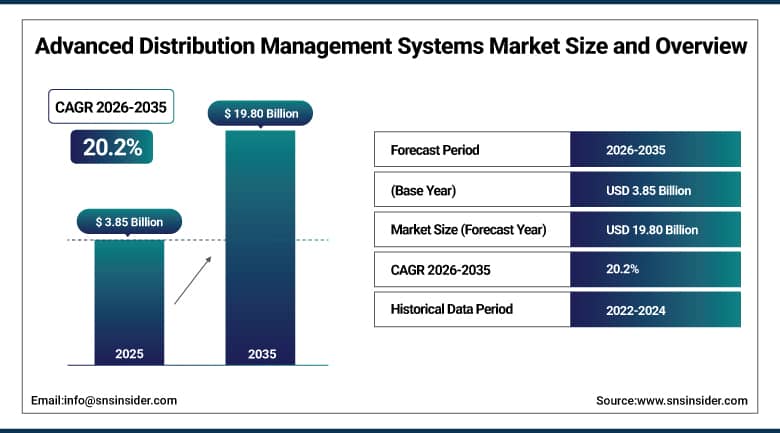
The Advanced Distribution Management System Market was valued at USD 3.85 Billion in 2025 and is projected to reach USD 19.80 Billion by 2035, registering a CAGR of 20.2% over 2026-2035.
The Advanced Distribution Management System Market embodies the technical foundation for the current digitalization of the grid, consolidating SCADA, OMS and DERs management into one control room solution, allowing utilities to observe and manage more complex two-way distribution networks. The market segments are driven by the growing smart grid investments of investor-owned and municipal utilities, increasing cloud-native and AI-enabled control system implementations, increased integration of distributed solar, storage and electric vehicle charging loads, and applications in fault detection, voltage/var optimization, and demand response.
In May 2026, Siemens implemented Gridscale X at Alliander, providing support for applications developed by the utility company and for artificial intelligence-driven grid planning.
To Get More Information On Advanced Distribution Management System Market - Request Free Sample Report
Advanced Distribution Management System Market Trends
-
Utilities are increasingly consolidating SCADA, OMS, and DERMS functions onto a single unified control-room platform.
-
Growing adoption of cloud-native ADMS architecture is lowering deployment cost and accelerating utility upgrade cycles.
-
Rising integration of generative AI is helping operators forecast outages and automate switching plans faster.
-
Expanding rooftop solar and EV charging load is pushing utilities toward real-time distributed energy resource visibility.
-
Increasing state-level grid resilience mandates continue directing regulated capital toward distribution automation upgrades.
U.S. Advanced Distribution Management System Market Size Outlook
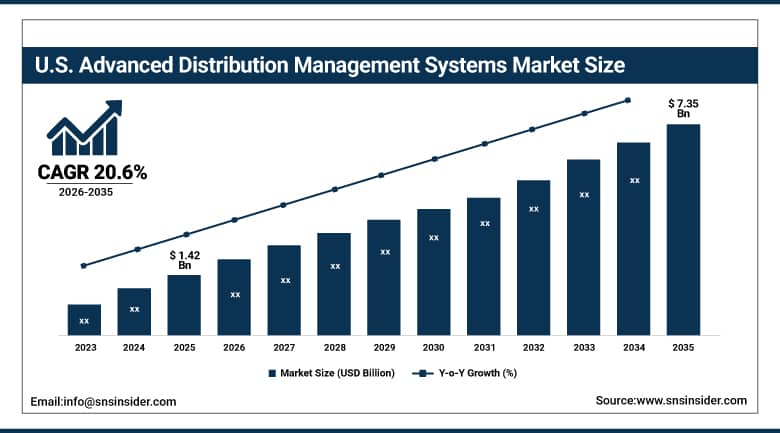
The U.S. Advanced Distribution Management System Market was valued at approximately USD 1.42 Billion in 2025 and is projected to reach approximately USD 7.35 Billion by 2035, registering a CAGR of approximately 20.6% from 2026 to 2035.
In the U.S. the demands is driven by public utility commissions of states requiring filing of grid modernization reports, high investments by investor-owned utilities in upgrading their existing SCADA control rooms, and increased demands of managing the bi-directional flow of electricity from distributed solar, energy storage, and electric vehicle charging sources. Adoption of unified ADMS systems by large investor-owned utilities and increased adoption by smaller municipal and cooperative utilities that are applying for federal grid resilience grants have strengthened its position as the largest addressable market for distribution management software.
In May 2026, Emerson Oncor chose AspenTech OSI ADMS for improving grid visibility, automation, and outage management on their electricity network in the USA. This implementation will aid the utility companies in increasing the efficiency of their operations due to growing demand for electricity and distributed energy sources.
Advanced Distribution Management System Market Segment Analysis
-
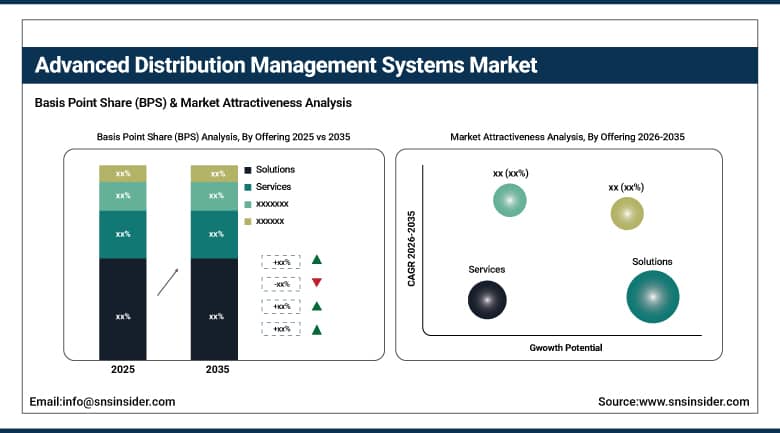
By Offering, Solutions segment dominated the Advanced Distribution Management System Market in 2025 with 63.09% share; Services segment is the fastest growing segment, registering a CAGR of 22.1% over 2026-2035.
-
By Deployment Mode, On-Premises segment dominated the market in 2025 with 57.11% share; Cloud-Based segment is the fastest growing segment, registering a CAGR of 21.8% over 2026-2035.
-
By Functionality, SCADA segment dominated the market in 2025 with 34.02% share; Distributed Energy Resource Management segment is the fastest growing segment, registering a CAGR of 22.5% over 2026-2035.
-
By Application, Fault Detection & Isolation segment dominated the market in 2025 with 31.61% share; Demand Response segment is the fastest growing segment, registering a CAGR of 22.3% over 2026-2035.
-
By End User, Investor-Owned Utilities segment dominated the market in 2025 with 61.01% share; Cooperative Utilities segment is the fastest growing segment, registering a CAGR of 21.6% over 2026-2035.
By Offering, Solutions Lead, While Services Grow Fastest
Solutions segment was leading the Advanced Distribution Management System Market during 2025 as the utilities preferred to license the key SCADA, OMS, and DERMS platforms from reputable companies like Schneider Electric and Oracle, followed by subsequent support services. The sheer magnitude of the cost of licensing software in comparison with support services kept the solution segment at the forefront during the base year.
Services segment is growing at the highest pace among the offerings segments, as utilities are increasingly becoming dependent upon systems integration providers for migrating their legacy SCADA systems, custom interfaces, and managed services for several years. Capgemini and Wipro have also diversified into utility ADMS integration solutions.
By Deployment Mode, On-Premises Dominates, Cloud-Based Emerges Fastest
On-Premises dominated the market in 2025 because of large investor-owned utilities’ preference for hosting control room infrastructure locally for SCADA operations due to their requirement for cyber-secure environment and data residency rules that slow down the adoption of cloud-based solutions.
The Cloud-Based deployment is expected to witness the highest growth rate driven by the adoption of cheaper subscription-based ADMS solutions by smaller municipalities and cooperatives. This category of solutions has seen expansions of its portfolio offered by both Survalent Technology and Open Systems International.
By Functionality, SCADA Leads, While DERMS Grows Fastest
SCADA was the biggest contributor when it came to functionality share in 2025 because SCADA has become the foundation of almost every utility control room and has also been used as a foundation through which other modules such as outage management and distributed energy resource management system are added later on.
Distributed energy resource management system functionality has grown the fastest as the volume of solar energy, behind-the-meter battery storage, and EV charging loads has increased so much that the existing SCADA alone systems do not have the capability to see or dispatch that load. Both GE Vernova and Siemens have enhanced their DERMS modules for utilities.
By Application, Fault Detection & Isolation Leads, While Demand Response Grows Fastest
Fault detection and isolation had the maximum percentage in the applications of the ADMS market, as utility companies have become focused on automating the fault location, isolation, and restoration process, which will directly help in reducing downtime and penalties. This is still the most widely recognized business case for the first investment in ADMS.
Demand response was identified as the area having the highest growth rate in the ADMS applications due to the increasing implementation of ADMS for the orchestration of real-time demand-side management using smart meter readings and other smart technologies. Demand-response orchestration has been added to Itron's and Landis+Gyr's ADMS products.
By End User, Investor-Owned Utilities Dominate, Cooperative Utilities Grow Fastest
Investor-Owned Utilities was the predominant end user category in 2025 because of their bigger capital expenditure budgets, exposure to regulatory modernization initiatives by states, and bigger distribution network infrastructure that needs central control. The larger IOUs in the U.S. and Europe were early adopters of ADMS platforms.
The Cooperative Utilities were the fastest growing end user category because of increased federal grants for grid resilience projects, which extended to smaller cooperative utilities that had not been eligible for capital expenditures for control room modernization before. Survalent Technology is among vendors that have developed ADMS solutions for cooperatives.
Regional Analysis:
|
Region |
Major Country |
Share within Region, 2025 (%) |
|---|---|---|
|
North America |
United States |
92.5% |
|
Europe |
Germany |
21.80% |
|
Asia Pacific |
China |
42.60% |
|
Middle East and Africa |
Saudi Arabia |
25.90% |
|
Latin America |
Brazil |
30.70% |
North America Advanced Distribution Management System Market Insights
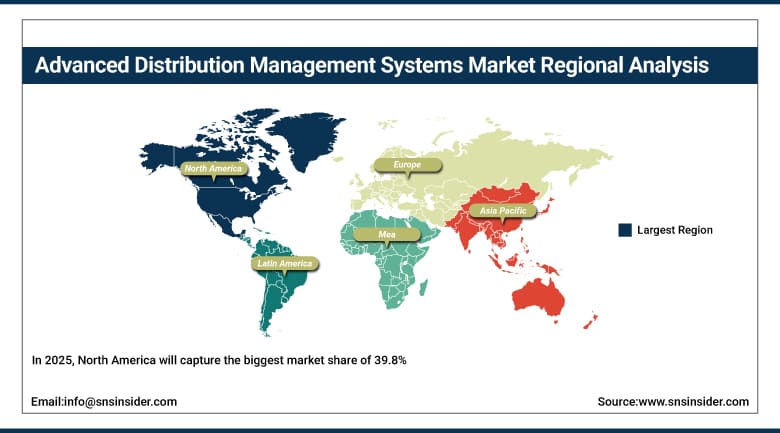
In 2025, North America will capture the biggest market share of 39.8% owing to the mandate by state public utility commission regarding the filing for grid modernization, continued federal grid resilience grants funding, and strong existing investor-owned utilities that operate with SCADA-only control rooms. Utility companies that initially used SCADA or OMS alone for their operations have now moved into multi-function ADMS systems. This makes North America the largest addressable market for distribution management systems and services.
The U.S. is the top country in the region due to its large number of investor-owned utilities, grid modernization filing at the state level, and active vendor players including Oracle and Schneider Electric. Canada was another small but growing market because of the provincial utilities that were enhancing the distribution automation system to accommodate more renewable energy and EV charging loads.
Get Customized Report as Per Your Business Requirement - Enquiry Now
Europe Advanced Distribution Management System Market Insights
The Advanced Distribution Management System Market was characterized by considerable Europe share in 2025, due to the region's aggressive renewable energy targets under the EU Green Deal and REPowerEU initiatives and also the incentives provided by the distribution system operators within the region for digitizing the aged low and medium voltage networks. The penetration of the rooftop solar and the increasing charging stations for electric vehicles have only added impetus to the demand for visibility of distributed energy resources in the distribution grid of the region.
Germany was the leading revenue generator for the Advanced Distribution Management System Market in Europe in terms of revenues, backed by its significant rooftop solar penetration rate and also its efforts to digitize the distribution network operation centers by the central government. Other regions that made significant contributions include the United Kingdom and the Nordic nations.
Asia Pacific Advanced Distribution Management System Market Insights
The Asia Pacific region is forecast to experience the highest growth rate of CAGR 23.0% in the ADMS market on account of rapid investments in grid modernization and distribution automation and smart grid projects backed by governments in China, Japan, and South Korea. Urban electrification and government renewable integration targets in the region ensure that the region outperformed all others in terms of market growth rates.
Among the regions, China is the top performing country on account of its huge investments in state-driven grid infrastructure and distribution automation. Japanese and Korean utilities have also made meaningful contributions towards the region’s performance with the help of projects carried out by Toshiba Corporation for control rooms and pilot projects carried out in Korean distribution utilities for DERMS.
Middle East & Africa and Latin America Advanced Distribution Management System Market Insights
Both the Middle East & Africa and Latin America regions demonstrated stable development of the Advanced Distribution Management System Market due to the rise in grid modernization programs, investments into distribution networks and cooperation between utilities in these regions and foreign ADMS suppliers. The necessity of obtaining validated visibility for control rooms appeared to be more realistic task for the utilities of these regions that traditionally used fragmented systems of monitoring.
Saudi Arabia is the biggest market in the Middle East & Africa region because of the grid modernization development program that is part of the Vision 2030 project and also because of the grid modernization at the Saudi Electricity Company. Brazil is the leading market of Latin America from the revenues' point of view.
Market Dynamics:
Growth Drivers: Grid Modernization Mandates and Rising Distributed Energy Resource Penetration
The market is driven by state and national grid modernization laws requiring utilities to submit digitalization roadmaps, increasing adoption of rooftop PV, behind-the-meter battery storage, and EV charging loads that can’t be visualized via traditional SCADA systems, as well as mounting regulatory requirements for reduced outage times and improved reliability. With the rise of utility electrification needs due to data centers and transport, ADMS as an integrated solution provides a faster way to gain visibility compared to separate solutions focused on specific tasks.
Moreover, strategic cooperation between utilities and systems integrators contributes to the adoption of the market, with more utilities committing to multi-year platform-based licensing and migration initiatives after successful piloting. Investment in cloud-native infrastructure, AI-based analysis capabilities, and DERMS modules made by venture and corporate companies drives further evolution of solutions offered by vendors, ensuring high growth rates of the market throughout the forecast period.
Restraints: High Legacy System Migration Cost and Utility Workforce Constraints
The fact that high costs and risks are involved in migrating from SCADA-based systems to ADMS systems is a real constraint to rapid expansion in the market because of the need for continuous operation of the power grid even during migration processes, which will involve running both systems simultaneously.
Another serious constraint is the decrease in the number of workers operating in utilities control rooms. This means that not enough operators will be there to handle the migration to new systems. There are several measures that could help bridge the skill gap; however, they will take some more time and money.
Opportunities: AI-Driven Grid Analytics and Expanding Cooperative Utility Grant Funding
Increasing investments into AI-based grid analytics represent a legitimate big opportunity, as vendors go past simple monitoring toward predictive analytics, which predict machine breakdowns, optimize switching schedules, and automate sequencing of power restoration. Vendors that gain an advantage in terms of forecasting accuracy and model robustness can grab a disproportional share of software business within the market maturing past basic SCADA-only solutions.
The other major opportunity relates to increased government and state grant funding aimed at the modernization of control rooms of smaller cooperatives and municipal utilities unable to afford their control room upgrades without external funding. Vendors capable of delivering appropriately sized and rapidly deployable ADMS solutions for small grids have an opportunity to earn revenues from a novel type of customers.
Recent Developments:
-
2026: Oracle Corporation launched enhanced generative AI outage-forecasting capabilities within its Oracle Utilities Network Management System, enabling utilities to simulate storm-response scenarios and automate crew dispatch planning ahead of severe weather events.
-
2026: Survalent Technology Corporation released its SurvalentONE DERMS module with expanded distributed solar and battery storage orchestration features, targeted at cooperative and municipal utilities managing rising behind-the-meter generation.
-
2026: GE Vernova expanded its Grid Software Solutions ADMS platform with new AI-based volt/VAR optimization tools, deployed across multiple U.S. investor-owned utility control rooms to reduce distribution line losses during peak load periods.
Advanced Distribution Management System Companies are:
-
ABB Ltd
-
Siemens AG
-
GE Vernova
-
Oracle Corporation
-
Capgemini SE
-
Open Systems International, Inc.
-
Itron, Inc.
-
Landis+Gyr Group AG
-
Honeywell International Inc.
-
Hitachi Energy Ltd
-
Emerson Electric Co.
-
Advanced Control Systems, Inc.
-
ETAP (Operation Technology, Inc.)
-
Trimble Inc.
-
Wipro Limited
-
Tata Consultancy Services Limited
-
Kalkitech (L&T Technology Services)
-
Toshiba Corporation
Advanced Distribution Management System Market Report Scope:
| Report Attributes | Details |
|---|---|
| Market Size in 2025 | USD 3.85 Billion |
| Market Size by 2035 | USD 19.80 Billion |
| CAGR | 20.2% from 2026 to 2035 |
| Base Year | 2025 |
| Forecast Period | 2026-2035 |
| Historical Data | 2022-2024 |
| Report Scope & Coverage | Market Size, Segments Analysis, Competitive Landscape, Regional Analysis, DROC & SWOT Analysis, Forecast Outlook |
| Key Segments |
• By Offering (Solutions, Services) • By Deployment Mode (On-Premises, Cloud-Based) • By Functionality (SCADA, Distributed Energy Resource Management, Outage Management System, Distribution Management System)
• By Application (Fault Detection & Isolation, Demand Response, Volt/VAR Optimization, Load Forecasting)
• By End User (Investor-Owned Utilities, Cooperative Utilities, Public/Municipal Utilities)
|
| Regional Analysis/Coverage | North America (US, Canada), Europe (Germany, UK, France, Italy, Spain, Russia, Poland, Rest of Europe), Asia Pacific (China, India, Japan, South Korea, Australia, ASEAN Countries, Rest of Asia Pacific), Middle East & Africa (UAE, Saudi Arabia, Qatar, South Africa, Rest of Middle East & Africa), Latin America (Brazil, Argentina, Mexico, Colombia, Rest of Latin America). |
| Company Profiles | Schneider Electric SE, ABB Ltd, Siemens AG, GE Vernova, Oracle Corporation, Capgemini SE, Survalent Technology Corporation, Open Systems International, Inc., Itron, Inc., Landis+Gyr Group AG, Honeywell, International Inc., Hitachi Energy Ltd, Emerson Electric Co., Advanced Control Systems, Inc., ETAP (Operation Technology, Inc.), Trimble Inc., Wipro Limited, Tata Consultancy Services Limited, Kalkitech (L&T Technology Services), Toshiba Corporation. |

Frequently Asked Questions
Key players include Schneider Electric SE, ABB Ltd, Siemens AG, GE Vernova, Oracle Corporation, and Capgemini SE, among others.
Key opportunities include rising grid modernization investments, increasing renewable energy integration, growing demand for real-time grid optimization, and expanding adoption of AI-enabled distribution management technologies.
The major growth factor is rising grid modernization mandates, expanding distributed solar, storage, and EV charging load, and growing utility demand for unified SCADA, outage management, and DERMS platforms.
The Solutions segment dominated the Advanced Distribution Management Systems Market by offering, representing the largest share of revenue in 2025.
North America dominated the Advanced Distribution Management Systems Market in 2025, holding an estimated 39.8% share of total global market revenue.
