
Tissue Processing Systems Market Report Scope and Overview:
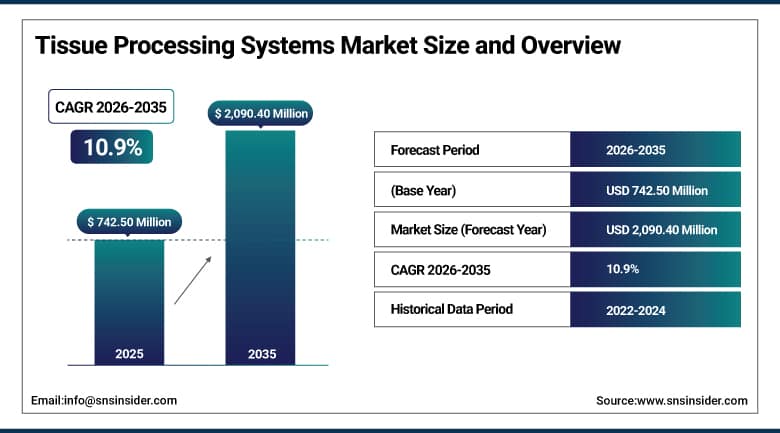
The Tissue Processing Systems Market was valued at USD 742.50 Million in 2025 and is projected to reach USD 2,090.40 Million by 2035, registering a CAGR of 10.9% from 2026 to 2035.
The Tissue Processing Systems Market is revolutionizing the field of histopathology and biomedical studies through automation of the process of fixing, dehydrating, clearing, and infiltrating biological tissue samples to prepare them for microscopic analysis. Drivers of the market include the increasing need for high-volume sample preparations, rising demand for oncology diagnoses, increased number of biopsies related to the prevalence of diseases, and increasing use of closed and vacuum-based tissue processing systems to reduce contact with xylene and formaldehyde by technicians. An increasing number of modular embedding systems, digital pathology solutions, and green reagents are observed in the Tissue Processing Systems Market, as laboratories focus on developing error-free tissue preparation processes that can support an increasing number of specimens without increasing laboratory workforce.
Thermo Fisher Scientific continued broadening its Excelsior AS reagent-cartridge portfolio throughout 2025, pairing closed-system consumables directly with its automated tissue processor line to cut manual reagent handling and improve turnaround consistency across high-volume histology laboratories in the United States and abroad.
To Get More Information On Tissue Processing Systems Market - Request Free Sample Report
Tissue Processing Systems Market Trends
-
Rising adoption of closed, vacuum-based tissue processors continues improving reagent safety and reducing technician exposure to xylene and formalin fumes.
-
Growing integration of tissue processing hardware with digital pathology and laboratory information systems continues streamlining end-to-end histology workflows.
-
Expanding use of eco-friendly, alcohol-based fixatives and isoparaffinic clearants continues reducing laboratory dependence on traditional toxic reagents.
-
Increasing deployment of compact benchtop tissue processors continues supporting decentralized histopathology testing across smaller diagnostic laboratories.
-
Rising investment in automation-driven throughput scaling continues helping laboratories manage growing biopsy volumes tied to expanding cancer screening programs.
U.S. Tissue Processing Systems Market Outlook
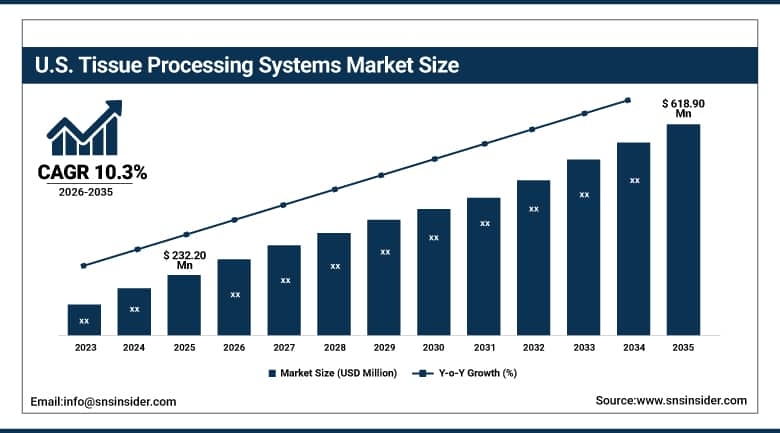
The U.S. Tissue Processing Systems Market was valued at approximately USD 232.20 Million in 2025 and is projected to reach approximately USD 618.90 Million by 2035, registering a CAGR of approximately 10.3% from 2026 to 2035.
Demand across the United States continued to be shaped by a dense concentration of leading histology equipment manufacturers, sustained hospital and reference-laboratory capital spending on automation, and steady growth in biopsy volumes tied to expanding cancer screening programs. Rising adoption of closed, vacuum-based tissue processors among large hospital networks and independent diagnostic laboratories continued reinforcing the country's position as both the largest and one of the most mature markets for tissue processing technology. Growing investment in digital pathology integration, laboratory information system connectivity, and eco-friendly reagent adoption added further layers of sustained domestic demand well beyond routine histopathology, extending into pharmaceutical quality control and academic biomedical research applications nationwide.
Sakura Finetek USA continued expanding deployment of its Tissue-Tek VIP 6 AI vacuum infiltration processor across major American hospital networks throughout 2025, targeting laboratories seeking faster turnaround times and tighter quality control across high-volume histopathology workflows.
Tissue Processing Systems Market Segment Analysis
-
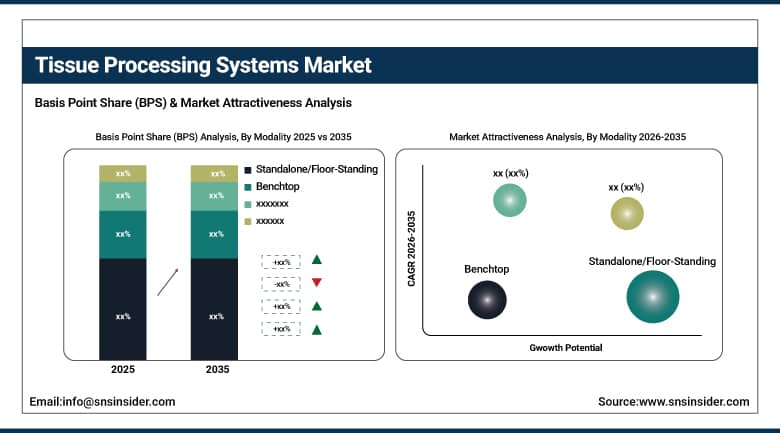
By Modality, Standalone/Floor-Standing segment dominated the market in 2025 with 53.80% share; Benchtop segment is the fastest growing segment, registering a CAGR of approximately 9.0%.
-
By Product Type, Automated Tissue Processors segment dominated the Tissue Processing Systems Market in 2025 with 54.20% share; Semi-Automated Tissue Processors segment is the fastest growing segment, registering a CAGR of approximately 9.23%.
-
By Technology, Vacuum/Retort Tissue Processors segment dominated the market in 2025 with 55.80% share; Microwave Tissue Processors segment is the fastest growing segment, registering a CAGR of approximately 8.87%.
-
By Application, Histopathology segment dominated the market in 2025 with 61.40% share; Cytopathology segment is the fastest growing segment, registering a CAGR of approximately 9.23%.
-
By End Use, Hospitals segment dominated the market in 2025 with 43.20% share; Diagnostic Laboratories segment is the fastest growing segment, registering a CAGR of approximately 8.67%.
By Modality, Standalone Systems Lead Adoption While Benchtop Processors Record the Fastest Growth
The Standalone/Floor Standing sub-segment led the Tissue Processing Systems market in 2025 due to their use by major hospitals and reference labs that need high throughput systems with an ability to process multiple cassettes in one cycle at night. floor-standing platforms generally comprise more advanced features such as increased capacity of reagents, safety systems, and number of cassettes, which make them preferable systems in central pathology laboratories with high volume samples per day. The existing business relationship between major histology equipment manufacturers and major hospitals has contributed to the dominance of standalone systems.
The Benchtop segment is the fastest growing in the Tissue Processing Systems Market as smaller diagnostic laboratories, satellite clinics, and research institutes increasingly favor compact instruments that fit constrained laboratory footprints without sacrificing processing consistency. Falling equipment costs and improving benchtop throughput capability continue narrowing the performance gap with larger floor-standing systems, making compact processors an increasingly practical option for decentralized and point-of-care histopathology testing across both established and emerging healthcare markets.
By Product Type, Automated Systems Lead the Market While Semi-Automated Processors Post the Fastest Growth
The Automated Tissue Processors market segment led the Tissue Processing Systems Market during 2025 as a result of demand for reliable, high-volume tissue processing by hospitals and reference laboratories, thus eliminating the possibility of error due to human intervention in fixation, dehydration, clearing, and infiltration processes. An increase in biopsies resulting from cancer screening initiatives has forced major diagnostic centers to adopt automated and closed processing systems that run unattended and require no exposure to chemicals during the night shift. Increasing compatibility between automated processing systems and laboratory information systems and bar coding of specimens is yet another factor supporting hospitals’ preferences for automated processing systems, especially in accredited pathology departments.
The Semi-Automated Tissue Processors segment is the fastest growing in the Tissue Processing Systems Market, driven by cost-sensitive diagnostic laboratories and mid-sized hospitals seeking a practical middle ground between manual flexibility and full automation expense. Smaller pathology departments and emerging-market laboratories increasingly favor semi-automated platforms that lower upfront capital requirements while still delivering programmable reagent cycles and improved consistency over purely manual processing. Rising laboratory establishment across Asia Pacific, Latin America, and the Middle East, where budget constraints often outweigh throughput requirements, continues expanding demand for semi-automated systems that balance affordability against meaningful gains in specimen preparation reliability and staff safety
By Technology, Vacuum and Retort Systems Dominate While Microwave Processing Emerges as the Fastest-Growing Technology
The Vacuum/Retort Tissue Processors segment dominated the Tissue Processing Systems Market because sealed retort chambers deliver superior reagent penetration, faster infiltration cycles, and substantially reduced fume exposure compared with open, gravity-fed alternatives. Widespread replacement of legacy open processors across accredited hospital and reference laboratories has reinforced vacuum-based technology as the established standard for routine histopathology. Continued regulatory emphasis on laboratory worker safety and reagent containment has further cemented vacuum and retort architecture as the preferred technology platform across large-volume diagnostic and academic medical center settings worldwide.
The Microwave Tissue Processors segment is the fastest growing in the Tissue Processing Systems Market owing to dramatically shorter processing cycles that compress fixation-to-embedding turnaround from hours to under an hour for time-sensitive specimens. Rapid intraoperative and urgent biopsy workflows increasingly rely on microwave-assisted processing to accelerate diagnostic reporting without compromising tissue morphology. Growing laboratory interest in reducing specimen backlog during periods of rising biopsy volume continues expanding adoption of microwave technology across both hospital and independent diagnostic laboratory settings globally.
By Application, Histopathology Dominates While Cytopathology Emerges as the Fastest-Growing Application
The Histopathology segment dominated the Tissue Processing Systems Market in 2025, reflecting the central role tissue processors play in preparing surgical and biopsy specimens for routine microscopic diagnosis across oncology, gastroenterology, dermatology, and general surgical pathology. Rising cancer incidence and expanding population-level screening programs have sustained elevated specimen volumes flowing through hospital and reference laboratory histopathology departments. Continued reliance on histological examination as the diagnostic gold standard across most solid-tumor and inflammatory disease workups has kept histopathology the dominant application driving tissue processor demand worldwide.
The Cytopathology segment is the fastest growing in the Tissue Processing Systems Market, supported by expanding cell-block preparation protocols that increasingly rely on tissue processing equipment to convert liquid-based cytology and fine-needle aspiration samples into paraffin-embedded blocks suitable for ancillary molecular and immunohistochemical testing. Growing use of cell-block techniques in lung, thyroid, and pleural fluid diagnostics continues expanding cytopathology laboratory demand for processors capable of handling smaller, more delicate specimen types alongside conventional surgical tissue.
By End Use, Hospitals Dominate the Market While Diagnostic Laboratories Post the Fastest Growth
The Hospitals segment dominated the Tissue Processing Systems Market in 2025 due to the concentration of in-house pathology departments handling high daily volumes of surgical, biopsy, and autopsy specimens across general medicine, oncology, and emergency care. Large hospital networks and academic medical centers continued investing in automated, high-capacity tissue processors to support accredited pathology services without relying on external reference laboratories. Sustained hospital capital spending on laboratory modernization and accreditation compliance has reinforced this segment's position as the largest end-use category for tissue processing equipment.
The Diagnostic Laboratories segment is the fastest growing in the Tissue Processing Systems Market as independent and reference laboratory networks continue expanding testing capacity to absorb rising outpatient biopsy referrals from smaller hospitals and clinics lacking in-house pathology infrastructure. Growing outsourcing of routine and specialized histopathology testing to centralized diagnostic laboratory chains, particularly across emerging markets, continues driving sustained investment in high-throughput tissue processing capacity outside the traditional hospital setting.
Regional Analysis
|
Region |
Major Country |
Share within Region, 2025 (%) |
|
North America |
United States |
82.30% |
|
Europe |
Germany |
23.50% |
|
Asia Pacific |
China |
29.60% |
|
Middle East and Africa |
UAE |
25.40% |
|
Latin America |
Brazil |
33.20% |
North America Tissue Processing Systems Market Insights
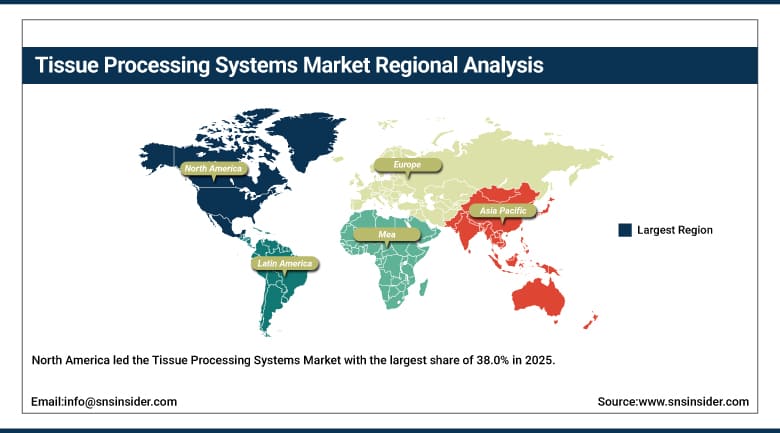
North America led the Tissue Processing Systems Market with the largest share of 38.0% in 2025. Deep concentration of leading histology equipment manufacturers, well-established hospital and reference laboratory infrastructure, and high per-capita diagnostic testing volumes across the region continued reinforcing this dominant regional position. Sustained capital investment in laboratory automation and accreditation compliance across major hospital networks further supported regional demand for advanced tissue processing equipment throughout the historical and current forecast period.
The United States accounted for roughly 82.30% of regional revenue, anchored by dense concentration of major histology equipment manufacturers, extensive hospital and reference laboratory networks, and sustained capital spending on pathology department modernization. Canada added further regional demand through steady public healthcare system investment in diagnostic laboratory automation, and that combined strength kept the continent the largest addressable market for tissue processing equipment vendors through the forecast period.
Get Customized Report as Per Your Business Requirement - Enquiry Now
Europe Tissue Processing Systems Market Insights
Europe held a meaningful share of global revenue, supported by well-established public healthcare systems, strong cancer screening infrastructure, and continued regulatory emphasis on laboratory worker safety that favors closed, vacuum-based processing technology. Government-funded pathology modernization programs across the region's major economies continued reinforcing demand for automated, compliance-ready tissue processing equipment across accredited hospital and reference laboratory networks.
Germany led demand at roughly 23.50% of European revenue, supported by its strong precision-instrument manufacturing base and centralized pathology service model. The United Kingdom and France contributed substantial additional demand through National Health Service and public hospital system investment in diagnostic modernization, and continued European emphasis on early cancer detection should keep regional demand for tissue processing technology climbing through the forecast period.
Asia Pacific Tissue Processing Systems Market Insights
Asia Pacific is advancing at the fastest pace among all regions tracked in this report, growing at a CAGR of 12.8% through 2035, driven by rapidly expanding hospital and diagnostic laboratory infrastructure, rising cancer incidence, and growing government investment in healthcare access across the region's largest economies. That combination of expanding laboratory capacity and genuine unmet diagnostic need across large, underserved populations kept the region's growth trajectory well ahead of every other region tracked in this report.
China led the pack at roughly 29.60% of regional revenue, supported by substantial government investment in hospital infrastructure and expanding domestic histology equipment manufacturing capability. Japan and India contributed meaningful additional demand, with India's rapidly expanding diagnostic laboratory network and Japan's advanced healthcare infrastructure both reinforcing the region's position as the fastest-growing market tracked in this report.
MEA and Latin America Tissue Processing Systems Market Insights
The Middle East and Africa and Latin America both showed steady growth, driven by expanding hospital infrastructure investment, growing government focus on cancer screening access, and rising demand for modern diagnostic laboratory capacity across both areas. As these markets continued building out modern healthcare infrastructure, automated tissue processing technology proved a genuinely efficient way to expand diagnostic capacity beyond historically constrained manual laboratory workflows.
The UAE led Middle East and Africa demand at roughly 25.40% of regional revenue, supported by the country's advanced private hospital infrastructure and substantial healthcare investment. Saudi Arabia contributed further demand through its own hospital modernization programs. In Latin America, Brazil accounted for roughly 33.20% of regional revenue, with growing public and private hospital laboratory investment continuing to anchor regional demand for tissue processing technology.
Market Dynamics
Growth Drivers: Rising Diagnostic Volumes and Laboratory Automation Demand
The industry is driven by rising global cancer incidence, expanding population-level screening programs, and growing laboratory investment in automated, high-throughput specimen preparation capable of handling increasing biopsy volumes without expanding technician headcount. As diagnostic testing volumes and specimen complexity continue rising across hospitals and reference laboratories, the need for consistent, error-resistant tissue preparation continues driving adoption of automated and semi-automated processing technologies over traditional manual workflows.
Growing regulatory emphasis on laboratory worker safety continues reinforcing this driver, as closed, vacuum-based processors reduce technician exposure to xylene, formaldehyde, and other hazardous histology reagents compared with open, manual alternatives. Rising integration of tissue processors with digital pathology and laboratory information systems continues improving specimen traceability and audit-trail documentation, and that combination of workflow consistency and regulatory compliance is exactly what keeps hospital and laboratory demand climbing at such a sustained, steady pace.
Restraints: High Capital Costs and Reagent Compliance Complexity
The substantial capital investment required for fully automated tissue processing systems continues posing a genuine restraint on faster market-wide expansion, particularly for smaller diagnostic laboratories and hospitals in cost-constrained healthcare systems without the capital budgets that large hospital networks and reference laboratory chains can commit. That cost profile has kept advanced automated processing concentrated among comparatively well-resourced institutions.
Reagent handling and disposal compliance complexity continues posing a further restraint, as hazardous chemical regulations governing xylene, formaldehyde, and other histology reagents vary meaningfully across jurisdictions and require ongoing laboratory investment in ventilation, containment, and disposal infrastructure. That regulatory burden keeps some smaller laboratory operators reliant on outsourced histopathology services rather than committing to in-house tissue processing capability.
Opportunities: Digital Pathology Integration and Emerging Market Laboratory Expansion
Deepening integration between tissue processing hardware and digital pathology platforms represents a genuinely significant opportunity, as laboratories increasingly seek end-to-end workflow connectivity linking specimen accessioning, processing, embedding, and digital slide scanning. Vendors positioned early in open-API connectivity and laboratory information system integration stand to capture meaningful share as hospital networks continue prioritizing interoperable, digitally connected pathology infrastructure over standalone instrument purchases.
Expansion of hospitals and laboratories in emerging markets also provides another major opportunity as there is ongoing demand created by government healthcare investment programs in APAC, Latin America, and MEA regions for cost-effective tissue processing solutions. Equipment manufacturers with reliable semi-automated and benchtop offerings provide good prospects in such markets as modern laboratories are being established in emerging healthcare environments where the starting base is relatively low.
Recent Developments:
-
2025: STEMCELL Technologies launched the STEMprep Tissue Dissociator System, an automated benchtop instrument designed to standardize and accelerate tissue dissociation workflows across research and translational laboratories.
-
2025: Singleron Biotechnologies introduced its PythoN i platform, engineered to support advanced tissue processing workflows spanning single-cell sequencing, molecular extraction, and precision oncology research applications.
-
2024: Leica Biosystems (Danaher Corporation) expanded its Peloris and ST Infinity processor lineup with open-API connectivity, enabling tighter integration with third-party digital pathology and laboratory information system platforms.
-
2024: Thermo Fisher Scientific broadened its Excelsior AS reagent-cartridge portfolio, pairing closed-system consumables directly with its automated tissue processor line to reduce manual reagent handling in high-volume histology laboratories.
Tissue Processing Systems Market key players are:
-
Thermo Fisher Scientific Inc.
-
Leica Biosystems (Danaher Corporation)
-
Sakura Finetek USA, Inc.
-
Epredia (PHC Holdings Corporation)
-
Milestone Medical S.r.l.
-
Medite Medical GmbH
-
SLEE Medical GmbH
-
Bio-Optica Milano S.p.A.
-
Histo-Line Laboratories S.r.l.
-
General Data Healthcare
-
Diapath S.p.A.
-
Avantik Biogroup, LLC
-
Amos Scientific Pty Ltd
-
JOKOH Co., Ltd.
-
boeco Germany GmbH
-
STEMCELL Technologies Inc.
-
Mopec Group
-
Bright Instruments Ltd.
-
Wuhan Junray Medical Science & Technology Co., Ltd.
-
Global Medical Instrumentation, Inc.
Tissue Processing Systems Market Report Scope:
| Report Attributes | Details |
|---|---|
| Market Size in 2025 | USD 742.50 Million |
| Market Size by 2035 | USD 2,090.40 Million |
| CAGR | CAGR of 10.09% From 2026 to 2035 |
| Base Year | 2025 |
| Forecast Period | 2026-2035 |
| Historical Data | 2022-2024 |
| Report Scope & Coverage | Market Size, Segments Analysis, Competitive Landscape, Regional Analysis, DROC & SWOT Analysis, Forecast Outlook |
| Key Segments | • By Product Type (Automated Tissue Processors, Semi-Automated Tissue Processors, Manual Tissue Processors) • By Technology (Vacuum/Retort Tissue Processors, Microwave Tissue Processors, Conventional Tissue Processors) • By Modality (Standalone/Floor-Standing, Benchtop) • By Application (Histopathology, Cytopathology, Hematopathology, Others) • By End Use (Hospitals, Diagnostic Laboratories, Research & Academic Institutes, Pharmaceutical & Biotechnology Companies, Others) |
| Regional Analysis/Coverage | North America (US, Canada), Europe (Germany, UK, France, Italy, Spain, Russia, Poland, Rest of Europe), Asia Pacific (China, India, Japan, South Korea, Australia, ASEAN Countries, Rest of Asia Pacific), Latin America (Brazil, Argentina, Mexico, Colombia, Rest of Latin America), Middle East & Africa (UAE, Saudi Arabia, Qatar, South Africa, Rest of Middle East & Africa). |
| Company Profiles | Thermo Fisher Scientific Inc., Leica Biosystems (Danaher Corporation), Sakura Finetek USA, Inc., Epredia (PHC Holdings Corporation), Milestone Medical S.r.l., Medite Medical GmbH, SLEE Medical GmbH, Bio-Optica Milano S.p.A., Histo-Line Laboratories S.r.l., General Data Healthcare, Diapath S.p.A., Avantik Biogroup, LLC, Amos Scientific Pty Ltd, JOKOH Co., Ltd., boeco Germany GmbH, STEMCELL Technologies Inc., Mopec Group, Bright Instruments Ltd., Wuhan Junray Medical Science & Technology Co., Ltd., Global Medical Instrumentation, Inc. |

Frequently Asked Questions
The key playesrs in the Tissue Processing Systems Market include Thermo Fisher Scientific Inc., Leica Biosystems (Danaher Corporation), Sakura Finetek USA, Inc., Epredia (PHC Holdings Corporation), and Milestone Medical S.r.l.,among others
Key opportunities include rising digital pathology adoption, laboratory automation, precision medicine, emerging-market healthcare expansion, and demand for high-throughput, connected tissue processing systems.
The major growth factor is rising diagnostic biopsy volumes, expanding cancer screening programs, and increasing laboratory investment in automated, high-throughput tissue preparation technology.
The Automated Tissue Processors segment dominated the Tissue Processing Systems Market by product type, representing the largest share of revenue in 2025.
North America dominated the Tissue Processing Systems Market in 2025, holding an estimated 38.0% share of total global market revenue.
