
Enterprise Search Market Report Scope & Overview:
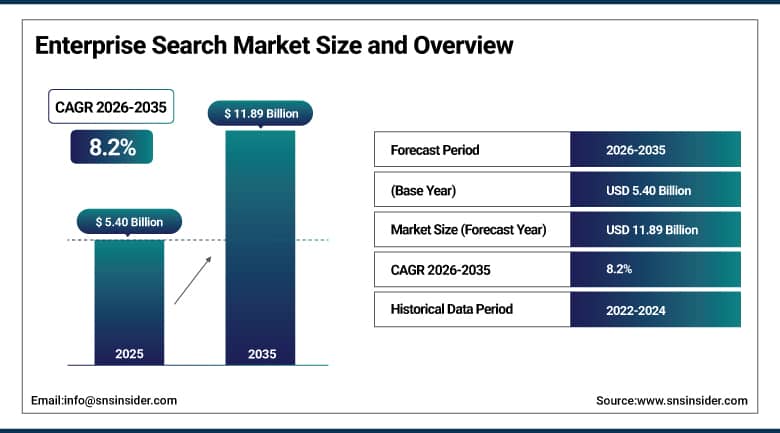
The Enterprise Search Market was valued at USD 5.40 Billion in 2025 and is expected to reach USD 11.89 Billion by 2035, growing at a CAGR of 8.2% from 2026 to 2035.
The global enterprise search market is experiencing accelerating growth driven by the exponential expansion of organisational data volumes, the increasing proportion of unstructured information across enterprise environments, and the transformative integration of artificial intelligence and natural language processing into search platform architectures. Enterprise search systems enable employees, customers, and partners to efficiently retrieve relevant information from across disparate data repositories including document management systems, email archives, collaboration platforms, databases, ERP systems, and cloud storage, replacing manual navigation of siloed information environments with unified intelligent retrieval. Organisations generate approximately 2.5 quintillion bytes of data daily, with an estimated 80% existing as unstructured content spanning documents, emails, audio recordings, and video assets that conventional database query architectures cannot index or retrieve.
In December 2023, Coveo Solutions Inc. was recognised as a Leader in The Forrester Wave: Cognitive Search Platforms, Q4 2023 report. This acknowledgement highlights Coveo’s strengths in automated relevancy tuning and robust analytics capabilities, reinforcing its competitive positioning in the enterprise search market as organisations progressively require search platforms capable of delivering personalised, AI-optimised search experiences across customer-facing and employee-facing information environments simultaneously.
Market Size and Forecast:
-
Market Size in 2026E: USD 5.84 Billion
-
Market Size by 2035: USD 11.89 Billion
-
CAGR: 8.2% from 2026 to 2035
-
Fastest Growing Region: Asia Pacific
-
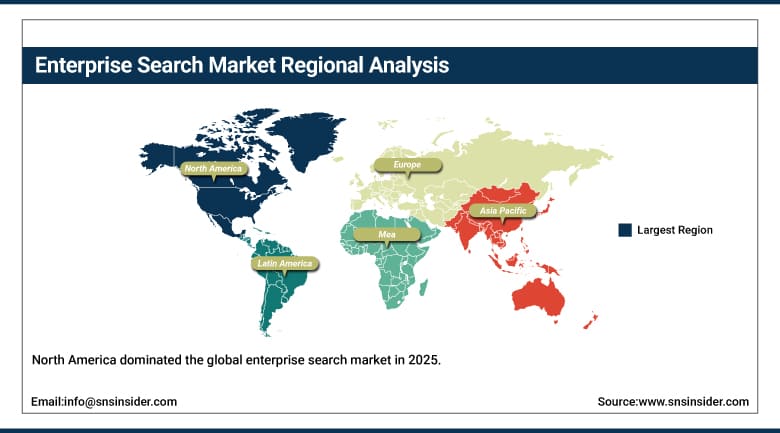
Largest Region: North America
To Get More Information On Enterprise Search Market - Request Free Sample Report
Enterprise Search Market Trends:
-
Retrieval-Augmented Generation (RAG) integration is transforming enterprise search by enabling AI systems to retrieve, synthesize, and generate contextual answers from organizational knowledge sources
-
Growing adoption of vector embeddings is enhancing semantic search capabilities, allowing users to discover relevant information based on meaning and context rather than exact keyword matches
-
Conversational and NLP-powered search interfaces are improving user experience by enabling employees to access information through natural language queries and AI-driven intent understanding
-
Federated search architectures are gaining traction by providing unified access to data across cloud applications, on-premises repositories, collaboration platforms, and enterprise systems without requiring data migration
-
AI-powered personalization is improving search relevance by dynamically ranking results based on user roles, behavior patterns, team context, and content engagement history
U.S. Enterprise Search Market Outlook:
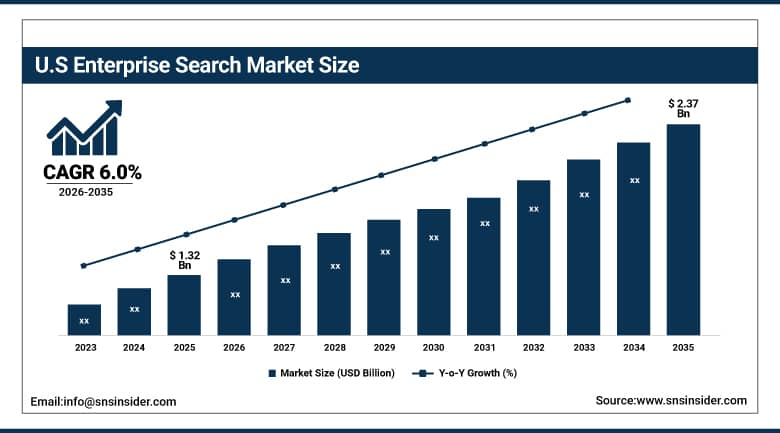
The U.S. Enterprise Search Market was valued at approximately USD 1.32 Billion in 2025 and is expected to reach approximately USD 2.37 Billion by 2035, growing at a CAGR of approximately 6.0%.
The U.S. is the most commercially significant enterprise search market within North America’s dominant regional position, supported by accelerating digital transformation, the proliferation of unstructured data across enterprise environments, and the increasing adoption of AI and machine learning to improve search efficiency. The U.S. enterprise software ecosystem’s early AI adoption, the venture capital investment environment that funded Glean’s USD 150 million Series F and AlphaSense’s USD 650 million funding round, and the extraordinary scale of unstructured data management challenges facing U.S. enterprise organisations collectively sustain the domestic market’s commercial leadership.
In 2024, Glean, a U.S. AI-powered work assistant platform, raised USD 260 million in a Series F funding round valuing the company at USD 4.6 billion, reflecting the extraordinary commercial momentum of AI-powered enterprise search as organisations invest in work search platforms capable of retrieving knowledge across all enterprise application repositories through a single natural language interface that replaces manual application-by-application information hunting.
Enterprise Search Market Segment Analysis:
-
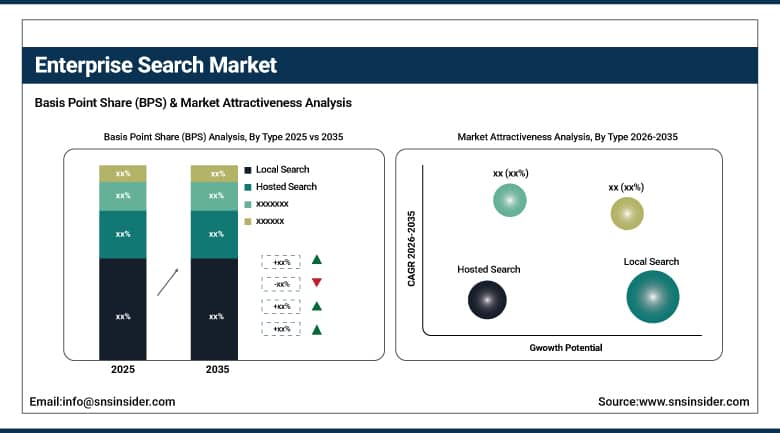
By Type, the Local Search segment dominated the Enterprise Search Market with approximately 49% share in 2025, while the Hosted Search segment is the fastest growing at a CAGR of approximately 9.36%.
-
By Enterprise Size, the Large Enterprises segment dominated the Enterprise Search Market with approximately 70% share in 2025, , while the Small Enterprises segment is the fastest growing.
-
By Vertical, the Healthcare segment dominated the Enterprise Search Market with approximately 20% share in 2025, while the Banking & Financial Services segment is the fastest growing.
By Type, local search dominates, hosted search grows fastest
Local search retained the dominant type position with approximately 49% of the enterprise search market in 2025. The segment’s commercial primacy reflects the performance advantage of directly indexed on-premise enterprise data repositories, whose query response latency, data sovereignty compliance, and integration with legacy enterprise application infrastructure create specification preference among large enterprises with established on-premise information management environments. Healthcare organisations whose patient data sovereignty requirements restrict cloud hosting, financial institutions whose regulatory compliance mandates on-premise data storage, and government entities whose national security classification requirements prohibit cloud exposure collectively sustain local search’s dominant market position. Elasticsearch’s on-premise deployment capability, Lucidworks Fusion’s on-premise enterprise search architecture, and legacy FAST Search installations collectively represent the most commercially established local search platform relationships.
Hosted search is the fastest growing type at approximately 9.36% CAGR because the migration of enterprise data to cloud platforms creates a natural specification alignment with cloud-hosted search infrastructure, the remote workforce’s requirement for location-independent information access creates cloud delivery preference over VPN-dependent on-premise alternatives, and the subscription economics of SaaS-hosted search eliminate capital expenditure barriers that moderate on-premise search infrastructure investment. Each enterprise that migrates its document management, collaboration, and CRM data to Microsoft 365, Google Workspace, or Salesforce creates procurement alignment with cloud-native search platforms that index across these cloud repositories without requiring on-premise indexing infrastructure. Microsoft Search’s native Microsoft 365 integration and Google Workspace’s cloud search capability demonstrate the commercial scale of cloud-hosted enterprise search adoption.
By Enterprise Size, large enterprises dominate, small enterprises grow fastest
Large enterprises retained the dominant size position with approximately 70% of the enterprise search market in 2025. Their commercial concentration reflects the proportional relationship between enterprise data volume, complexity, and the financial and productivity impact of information retrieval inefficiency. Each large enterprise whose knowledge workers collectively spend an estimated 1.8 hours daily searching for and gathering information across multiple application silos creates a productivity improvement opportunity that enterprise search ROI calculations can quantify in millions of dollars annually. The compliance and regulatory requirement dimension of large enterprise search adoption, where financial services firms require searchable audit trails, healthcare organisations require HIPAA-compliant patient record retrieval, and government entities require classified document access control, sustains premium search platform procurement that commodity alternatives cannot satisfy.
Small enterprises are the fastest growing segment because the declining cost of cloud-based enterprise search platforms, the availability of consumption-based pricing from USD 10 to USD 50 per user per month from platforms including Elastic Cloud, Algolia, and Microsoft Search, and the growing recognition that information retrieval inefficiency affects small business productivity as significantly as large enterprise are collectively creating first-time enterprise search adoption among organisations that previously managed information retrieval through folder navigation and email search. Each small business whose growth creates information volume exceeding manual retrieval management capacity creates an enterprise search adoption decision whose commercial motivation compounds with small business digital tool adoption trends.
By Vertical, healthcare dominates, banking & financial services grows fastest
Healthcare retained the dominant vertical position with approximately 20% of the enterprise search market in 2025. The commercial primacy of healthcare enterprise search reflects the direct connection between rapid information retrieval and clinical outcome quality in patient care environments where clinicians require instant access to patient history, diagnostic imaging reports, laboratory results, medication records, and evidence-based treatment protocols across multiple electronic health record systems and clinical decision support databases. Each hospital system whose clinical staff searches across Epic, Cerner, and departmental documentation systems for complete patient information creates enterprise search procurement whose clinical urgency creates non-negotiable performance requirements and budget priority. The regulatory compliance dimension of healthcare search, including HIPAA-compliant access logging, role-based access control for sensitive patient information, and audit trail maintenance for quality assurance programmes, sustains premium platform specification.
Banking and financial services is the fastest growing vertical because the regulatory compliance requirement to retrieve and analyse massive financial datasets for transaction monitoring, suspicious activity reporting, risk exposure assessment, and customer service personalisation creates structured and growing enterprise search investment. Each financial institution whose compliance team must retrieve relevant transaction records, correspondence, and policy documentation in response to regulatory examination requests creates search platform procurement whose regulatory necessity creates non-discretionary investment motivation. The BFSI sector’s progressive adoption of AI-powered search for customer-facing financial planning assistant applications and advisor knowledge retrieval creates additional commercial demand beyond compliance-driven internal search investment.
Regional Analysis:
|
Region |
Major Country |
Share within Region, 2025 (%) |
|---|---|---|
|
North America |
United States |
87.4% |
|
Europe |
Germany |
22.3% |
|
Asia Pacific |
China |
44.8% |
|
Middle East & Africa |
UAE |
31.2% |
|
Latin America |
Brazil |
44.2% |
North America Enterprise Search Market Insights
North America dominated the global enterprise search market in 2025, supported by advanced digital infrastructure, early AI adoption, a strong venture capital investment pipeline in AI-powered search startups, and the commercial presence of Microsoft, Google, Elastic, Lucidworks, and Coveo whose combined platform revenues define the global enterprise search commercial benchmark. The United States accounts for approximately 87.4% of North American revenues through its extraordinary enterprise software investment scale and the density of large enterprise headquarters creating premium search platform procurement.
Canada contributes approximately 12.6% of North American revenues through its financial services sector’s compliance-driven search investment, the healthcare system’s patient record retrieval requirement, and the technology industry’s knowledge management platform adoption. Coveo Solutions’ Canadian headquarters in Quebec City sustains domestic AI-powered enterprise search platform development.
Get Customized Report as Per Your Business Requirement - Enquiry Now
Europe Enterprise Search Market Insights
Europe is a technically sophisticated enterprise search market where GDPR’s data discovery and retrieval compliance requirements create structured procurement motivation, and the strong manufacturing, financial services, and pharmaceutical industries create diverse enterprise search applications. Germany accounts for approximately 22.3% of European revenues through its manufacturing sector’s technical documentation search investment, the financial services industry’s compliance information retrieval requirement, and the pharmaceutical sector’s clinical research data management investment.
The United Kingdom, France, and the Netherlands are significant secondary markets where the financial services sector’s London concentration, LVMH and Airbus’ knowledge management investment, and the advanced enterprise software adoption culture create consistent demand. Dassault Systèmes’ 3DEXPERIENCE platform’s enterprise search integration demonstrates the French software sector’s contribution to European market supply.
Asia Pacific Enterprise Search Market Insights
Asia Pacific is the fastest growing regional enterprise search market, driven by China’s digital economy scale, India’s IT services sector’s knowledge management investment, Japan’s manufacturing sector’s technical documentation retrieval requirement, South Korea’s advanced technology enterprise adoption, and the extraordinary pace of digital transformation investment across the region. China accounts for approximately 44.8% of Asia Pacific revenues through its large enterprise digital transformation investment, the government’s data management regulatory framework, and the technology sector’s above-average search platform adoption.
India represents the most commercially dynamic emerging market within Asia Pacific where the IT and business process outsourcing sector’s knowledge management investment, the growing enterprise software adoption among Indian corporations, and the financial services sector’s compliance information retrieval requirement create above-average enterprise search market growth.
MEA & Latin America Enterprise Search Market Insights
The UAE leads MEA revenues at approximately 31.2% through its smart government digital transformation investment, the financial services sector’s compliance information management, and the technology hub ecosystem’s enterprise software adoption. Saudi Arabia’s Vision 2030 enterprise digitalisation investment adds complementary Gulf demand. Brazil leads Latin American revenues at approximately 44.2% through its financial services sector’s compliance search investment, the IT services industry’s knowledge management platform adoption, and the growing enterprise software market. Mexico’s manufacturing sector and Colombia’s financial services growth collectively sustain regional market development through 2035.
Market Dynamics:
Growth Drivers: Unstructured enterprise data explosion requiring intelligent retrieval and AI-powered search capability transformation
The exponential growth of unstructured enterprise data is the enterprise search market’s most commercially certain structural growth driver. Organisations generate data volumes that double approximately every two years, with the vast majority existing as unstructured documents, emails, presentations, and multimedia content that relational database architectures cannot query. Each enterprise whose knowledge worker productivity is impaired by the estimated 1.8 hours daily spent searching for information across siloed applications creates a quantifiable ROI case for enterprise search investment. IDC estimates that information worker time spent searching for and not finding information costs Fortune 500 companies approximately USD 31 billion annually, creating procurement motivation that scales proportionally with enterprise size and data volume.
AI-powered search capability transformation, where generative AI and retrieval-augmented generation convert enterprise search from a document retrieval tool into an intelligent knowledge assistant, is simultaneously expanding the addressable value proposition of enterprise search investment beyond productivity improvement into revenue generation and customer experience enhancement. Each customer-facing search deployment that converts search interactions into product discovery, sales assistance, or service resolution creates commercial value that sustains premium platform pricing above internal-only knowledge management alternatives.
Restraints: Data privacy and security concerns and legacy system integration complexity
Data privacy and security concerns create procurement barriers for organisations whose sensitive enterprise information includes personally identifiable data, financial records, proprietary intellectual property, and confidential communications that enterprise search indexing aggregates into a unified accessible repository. Each organisation whose enterprise search deployment creates a comprehensive searchable knowledge base from previously siloed sensitive information creates a data governance challenge whose access control, audit trail, and breach exposure management requirements add implementation complexity and cost.
Legacy system integration complexity creates implementation barriers for organisations whose enterprise information spans decades of accumulated data in proprietary format legacy applications, custom database systems, and file server archives whose indexing requires custom integration development beyond standard enterprise search connector libraries. Each legacy application whose proprietary data format requires bespoke integration engineering creates implementation cost and timeline exposure that moderates enterprise search deployment pace.
Opportunities: Generative AI and RAG integration and vertical-specific search platform development
Generative AI and retrieval-augmented generation integration represents the most commercially transformative enterprise search market opportunity whose transformation of search from document retrieval into answer generation creates a new value proposition that justifies substantially higher platform investment. Each enterprise AI assistant deployment that grounds generative responses in enterprise knowledge through RAG architecture creates enterprise search procurement that is motivated by AI investment rather than conventional search efficiency arguments, creating a new buyer motivation that sustains above-historical-growth investment rates.
Vertical-specific search platform development represents the most commercially premium differentiation opportunity for enterprise search vendors whose domain-specific ontologies, regulatory compliance architectures, and integration with vertical-specific applications create switching cost advantages beyond commodity horizontal search platforms. Each healthcare organisation that adopts a clinical search platform, each law firm that deploys a legal discovery search system, and each financial institution that implements a compliance search solution creates a vertical-specialist commercial relationship that commodity horizontal search alternatives struggle to displace.
Recent Developments:
-
2024: Glean raised USD 260 million in a Series F funding round in 2024, valuing the AI-powered enterprise work search platform at USD 4.6 billion, reflecting extraordinary investor confidence in AI-driven enterprise search as a foundational enterprise productivity infrastructure category.
-
2024: Microsoft integrated Copilot enterprise search capabilities across Microsoft 365 in 2024, enabling natural language retrieval from Teams conversations, SharePoint documents, Outlook emails, and OneDrive files through a unified AI-powered search interface embedded across Microsoft productivity applications.
-
2024: Elastic released Elasticsearch 8.13 in 2024 with enhanced semantic search capabilities and native retrieval-augmented generation support, enabling enterprises to build AI-powered search applications that combine vector semantic search with traditional keyword relevance ranking for hybrid retrieval performance.
-
2023: Coveo Solutions Inc. was recognised as a Leader in The Forrester Wave: Cognitive Search Platforms, Q4 2023 report, highlighting strengths in automated relevancy tuning and robust analytics that reinforce Coveo’s position in the AI-powered enterprise search market.
-
2023: In February 2023, Google launched Vertex AI Search for Enterprise in general availability, providing a fully managed enterprise search service combining Google’s search quality, natural language understanding, and AI-powered ranking with enterprise data connector integration for Google Workspace, Salesforce, and custom data sources.
Enterprise Search Market Key Players:
-
Microsoft Corporation
-
Google LLC (Alphabet Inc.)
-
Elastic N.V.
-
IBM Corporation
-
Coveo Solutions Inc.
-
Lucidworks Inc.
-
Glean Technologies Inc.
-
Sinequa SAS
-
Attivio Inc.
-
Alfresco Software Inc.
-
Fabasoft AG
-
Dassault Systèmes SE
-
OpenText Corporation
-
SAP SE
-
Salesforce Inc.
-
Amazon Web Services Inc. (Kendra)
-
Algolia Inc.
-
AlphaSense Inc.
-
Mindbreeze GmbH
-
Yext Inc.
Enterprise Search Market Report Scope:
| Report Attributes | Details |
|---|---|
| Market Size in 2025 | USD 5.40 Billion |
| Market Size by 2035 | USD 11.89 Billion |
| CAGR | CAGR of 8.2% From 2026 to 2035 |
| Base Year | 2025 |
| Forecast Period | 2026-2035 |
| Historical Data | 2022-2024 |
| Report Scope & Coverage | Market Size, Segments Analysis, Competitive Landscape, Regional Analysis, DROC & SWOT Analysis, Forecast Outlook |
| Key Segments | • by Type (Local Search, Hosted Search) • by Enterprise Size (Large Enterprises, Small and Medium Enterprises) • Vertical (Healthcare, Banking & Financial Services, IT & Telecom, Retail & E-Commerce, Government & Public Sector, Manufacturing, Others) |
| Regional Analysis/Coverage | North America (US, Canada, Mexico), Europe (Eastern Europe [Poland, Romania, Hungary, Turkey, Rest of Eastern Europe] Western Europe] Germany, France, UK, Italy, Spain, Netherlands, Switzerland, Austria, Rest of Western Europe]), Asia Pacific (China, India, Japan, South Korea, Vietnam, Singapore, Australia, Rest of Asia Pacific), Middle East & Africa (Middle East [UAE, Egypt, Saudi Arabia, Qatar, Rest of Middle East], Africa [Nigeria, South Africa, Rest of Africa], Latin America (Brazil, Argentina, Colombia, Rest of Latin America) |
| Company Profiles | Microsoft Corporation, Google LLC (Alphabet Inc.), Elastic N.V., IBM Corporation, Coveo Solutions Inc., Lucidworks Inc., Glean Technologies Inc., Sinequa SAS, Attivio Inc., Alfresco Software Inc., Fabasoft AG, Dassault Systèmes SE, OpenText Corporation, SAP SE, Salesforce Inc., Amazon Web Services Inc. (Kendra), Algolia Inc., AlphaSense Inc., Mindbreeze GmbH, Yext Inc. |
Frequently Asked Questions
The Enterprise Search Market is expected to grow at a CAGR of 8.2% from 2026 to 2035.
The Enterprise Search Market was valued at USD 5.40 Billion in 2025.
The exponential growth of unstructured enterprise data creating retrieval efficiency requirements that conventional manual navigation cannot meet, and the AI-powered search and retrieval-augmented generation capability transformation that converts enterprise search from document retrieval into intelligent knowledge assistance creating above-historical-growth investment motivation.
Local Search dominated the Enterprise Search Market with approximately 49% share in 2025, while Hosted Search is the fastest growing segment at approximately 9.36% CAGR.
North America dominated the Enterprise Search Market in 2025, while Asia Pacific is the fastest growing region driven by China's digital economy scale and India’s IT services sector knowledge management investment.
