
Financial Risk Management Software Market Report Scope & Overview:
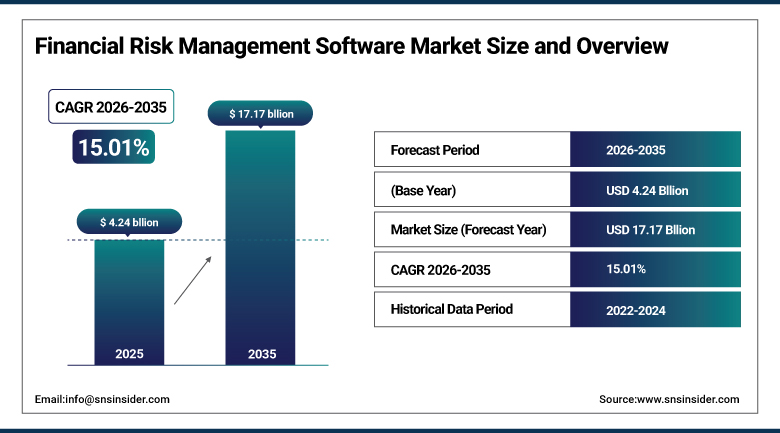
The Financial Risk Management Software Market was valued at USD 4.24 Billion in 2025 and is expected to reach USD 17.17 Billion by 2035, growing at a CAGR of 15.01% from 2026–2035.
The Financial Risk Management Software Market is growing as the growing need for regulatory compliance, financial uncertainties, and advanced risk assessment tools. Businesses are increasingly implementing AI, machine learning, and predictive analytics in order to ensure efficient risk identification, prevention of fraud, and decision-making. Expansion of cloud-based risk management platforms, digitization of banking, and cyber security threats are driving the adoption of the solution even further. Financial institutions are increasingly opting for integrated risk management solutions in order to strengthen their operations and manage various risks effectively.
82% of financial firms have already deployed AI-powered risk management software, using it to sharpen real-time visibility, meet tightening regulatory demands, and get ahead of credit, operational, and cyber risk during periods of market volatility. That's a genuinely high adoption number for a technology that was still considered experimental in this space just a few years back.
Market Size and Forecast:
-
Market Size in 2026E: USD 4.88 Billion
-
Market Size by 2035: USD 17.17 Billion
-
CAGR: 15.01% from 2026 to 2035
-
Fastest Growing Region: Asia Pacific
-
Largest Region: North America
To Get more information Financial Risk Management Software Market - Request Free Sample Report
Financial Risk Management Software Market Trends:
-
Rising complexity of financial risks and market volatility driving demand for advanced financial risk management software across organizations
-
Growing adoption of AI, machine learning, and predictive analytics to enhance risk assessment, fraud detection, and decision-making capabilities
-
Increasing regulatory compliance requirements encouraging financial institutions to implement automated risk monitoring and reporting solutions
-
Expanding use of cloud-based risk management platforms enabling scalable, real-time risk analysis and improved operational efficiency
-
Continuous integration of data analytics, automation, and scenario modeling tools improving financial forecasting, stress testing, and risk mitigation strategies
U.S. Financial Risk Management Software Market Outlook:
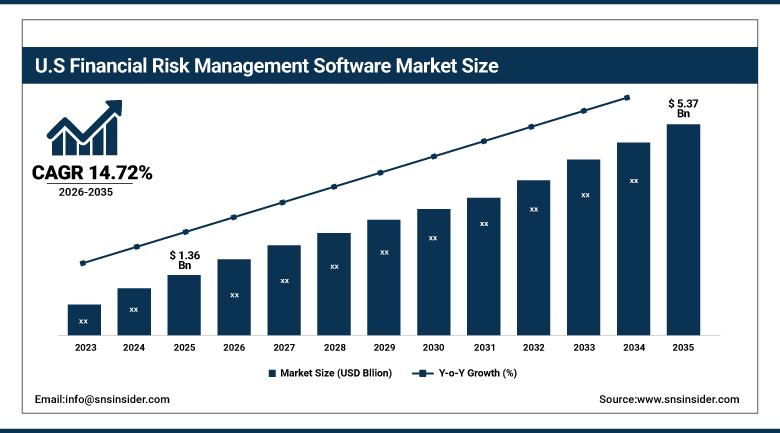
The U.S. Financial Risk Management Software Market was valued at approximately USD 1.36 Billion in 2025 and is expected to reach approximately USD 5.37 Billion by 2035, growing at a CAGR of approximately 14.72%.
Growth in the U.S. market continues to be driven by strict regulatory compliance mandates, rising cybersecurity and fraud exposure, and market volatility that keeps risk teams on their toes. Banks and enterprises across the country are investing in AI-driven, real-time risk analytics specifically to strengthen governance, sharpen forecasting accuracy, and support broader digital transformation efforts across their financial operations.
Financial Risk Management Software Market Segment Analysis:
-
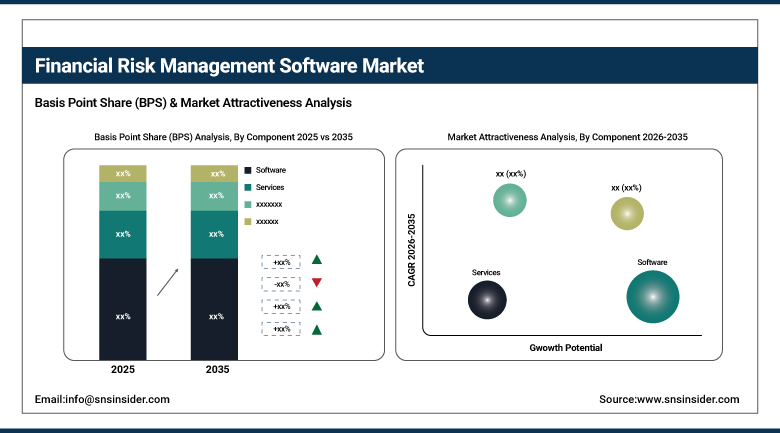
By Component, Software segment dominated the Financial Risk Management Software Market in 2025 with 64% share; Services segment is the fastest growing segment.
-
By Deployment Mode, Cloud-Based segment dominated the market in 2025 with 58% share; Hybrid segment is the fastest growing segment.
-
By Risk Type, Credit Risk Management segment dominated the market in 2025 with 32% share; Enterprise Risk Management segment is the fastest growing segment.
-
By End User, Banks & Financial Institutions segment dominated the market in 2025 with 46% share; Corporate Enterprises segment is the fastest growing segment.
By Component, Software segment dominates the Financial Risk Management Software Market, Services segment expected to grow fastest
The Software segment dominated the Financial Risk Management Software Market in 2025 owing to an increased requirement for automated risk assessment, real-time monitoring, compliance, and advanced analytics features. Financial companies and firms are using software to effectively manage their risks including credit, market, operational, and liquidity risks. The application of artificial intelligence, machine learning, and predictive analytics has made software solutions essential for effective risk assessment and decision-making.
The Services segment is the fastest growing because of the increasing requirement for implementation services, consultancy, integration, training, and maintenance. Companies are looking for experts who can help them design risk management software that can meet their needs and comply with regulations. The complexity in financial risks along with the changing compliance regulations and optimized deployment of software is expected to drive the growth of the services segment.
By Deployment Mode, Cloud-Based segment dominates the Financial Risk Management Software Market, Hybrid segment expected to grow fastest
The Cloud-Based segment dominated the Financial Risk Management Software Market in 2025 due to the rising preference towards scalable, economical and flexible risk management software. Cloud-based software helps in achieving better risk analysis in real time, making data available easily and reducing the cost of infrastructure. Cloud-based solutions are preferred by financial organizations and enterprises to boost efficiency, allow remote access and improve compliance process. The rising trend of digitalization and developments in the area of cloud security will continue to drive the adoption of cloud-based risk management software.
The Hybrid segment is the fastest growing due to increasing preference towards flexible deployment models which can benefit from scalability of cloud along with security and control offered by on-premise systems. Complex regulatory environment is driving financial organizations to opt for hybrid deployment model so that they can keep their sensitive data secure while still making use of cloud analytics and automation features. Increasing concerns about data privacy, cybersecurity and compliance issues are making it more popular.
By Risk Type, Credit Risk Management segment dominates the Financial Risk Management Software Market, Enterprise Risk Management segment expected to grow fastest
The Credit Risk Management segment dominated the Financial Risk Management Software Market in 2025 because of the increasing significance of analyzing borrower creditworthiness, handling loans, and minimizing financial risks. The banking and finance companies depend highly on the credit risk software to analyze their lending risks, monitor customer behaviors, and meet regulations. Increasing digital lending, rising volumes of loans, and usage of sophisticated analysis tools in assessing the creditworthiness of borrowers are boosting the demand for the credit risk management software.
The Enterprise Risk Management segment is the fastest growing because of increasing awareness amongst companies of the need to manage various types of interconnected financial, operational, strategic, and compliance risks. Companies are opting for the risk management software solutions to enhance visibility of their operations across various departments as well as making better decisions. Increasing regulation, cybersecurity risks, market volatility, and complicated business environment are pushing companies towards enterprise risk management software solutions.
By End User, Banks & Financial Institutions segment dominates the Financial Risk Management Software Market, Corporate Enterprises segment expected to grow fastest
The Banks & Financial Institutions segment dominated the Financial Risk Management Software Market in 2025 because of their vulnerability to risks in finance, legal requirements, and complexities of transactions. There is a requirement for sophisticated risk management solutions for the evaluation of credit, protection from fraud, compliance management, and management of capital in banks. Increased regulation, growth of digital banking services, and increased number of transactions are expected to drive the use of financial risk management software in the banking industry.
The Corporate Enterprises segment is the fastest growing owing to the growing awareness regarding the need for financial risk management software to manage financial uncertainty and risks. Industries are increasingly embracing risk management systems to assist in their financial planning, governance, and decision-making processes. Growing cybersecurity threats, market volatility, and business expansion are some of the major factors that are pushing companies to adopt risk management software.
Regional Analysis:
|
Region |
Major Country |
Share within Region, 2025 (%) |
|---|---|---|
|
North America |
United States |
78.0% |
|
Europe |
Germany |
25.0% |
|
Asia Pacific |
China |
36.0% |
|
Latin America |
Brazil |
35.0% |
|
Middle East & Africa |
UAE |
26.0% |
North America Financial Risk Management Software Market Insights
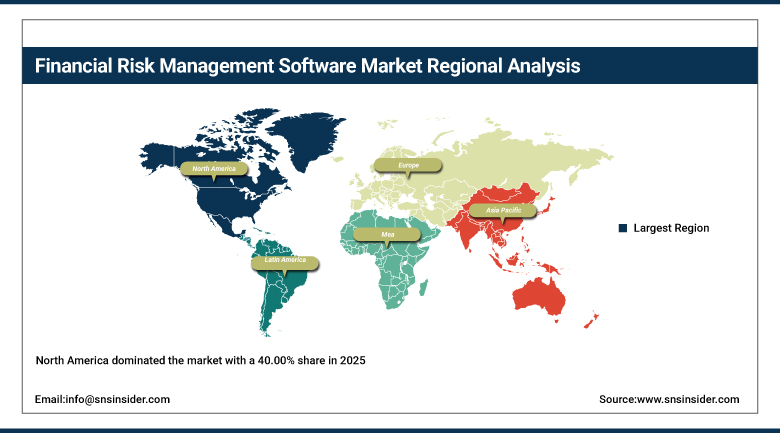
North America dominated the market with a 40.00% share in 2025, owing to the presence of leading financial institutions, advanced IT infrastructure, and strong adoption of sophisticated risk management tools across the region. Stringent regulatory frameworks and high demand for real-time risk analytics continue reinforcing this leadership position.
Continuous technological innovation across the region's financial sector keeps pushing FRM software adoption further, with U.S. institutions in particular setting the pace for AI-driven risk analytics that other markets often follow. Canada contributes a smaller but consistent share of regional demand, aided by its own well-regulated financial sector.
Get Customized Report as per Your Business Requirement - Enquiry Now
Europe Financial Risk Management Software Market Insights
Europe held a significant share of the market in 2025, supported by mature financial markets, strong regulatory compliance requirements, and widespread adoption of advanced risk analytics tools. The presence of major banks and financial institutions across the region continues to strengthen Europe's market position.
Increasing demand for integrated, AI-driven software solutions keeps building on top of that established financial infrastructure, positioning Europe as a technically sophisticated, if more measured, growth market relative to Asia Pacific and North America.
Asia Pacific Financial Risk Management Software Market Insights
Asia Pacific is expected to grow at the fastest CAGR, at about 21.06% from 2026 to 2035, driven by rapid digital transformation in banking and financial services, growing adoption of cloud-based risk solutions, and rising awareness of regulatory compliance requirements. Expanding financial markets and growing fintech adoption continue to accelerate the region's demand for advanced risk management software.
Investment in AI and analytics technology keeps climbing across the region's largest financial hubs, and that combination of digital transformation and fintech growth positions Asia Pacific to keep outpacing every other region in growth rate through the forecast period.
MEA & Latin America Financial Risk Management Software Market Insights
The Middle East and Africa and Latin America together showed moderate growth in the market in 2025, driven by increasing financial sector modernization, rising adoption of digital risk management platforms, and growing awareness of regulatory compliance requirements across the region. Expanding banking infrastructure and fintech investment continue supporting gradual market development.
Demand for real-time analytics is climbing steadily across both regions as financial institutions modernize their operations, and that combination of infrastructure investment and growing fintech presence continues to reinforce both regions' emerging presence in the global market.
Market Dynamics:
Growth Drivers: Tightening regulatory compliance requirements accelerate FRM software adoption
Stringent compliance requirements have been set forth by governments and regulatory bodies globally, such as the Basel III, IFRS 9, and Dodd-Frank regulations, to lower financial risks. Companies are under increasing scrutiny to be able to keep track of their compliance, monitor risk levels, and report any risks, which is something FRM software helps companies achieve through automated compliance reporting, tracking of real-time risk levels, and transparency with regulators.
Financial regulations becoming more complex have definitely made many organizations adopt FRM software to ensure they are not facing increased regulatory fines. Almost 81% of financial institutions have started using FRM software to comply with ever-increasing regulatory requirements and strengthen their risk management processes.
Restraints: High implementation costs limit adoption among smaller organizations
The implementation of FRM software is expensive and involves heavy technological investments which smaller and medium sized enterprises do not have the money or IT resources for. The incorporation of FRM software into already existing legacy systems poses a technical challenge to the company and can lead to problems arising when it comes to transferring data into the new system and making it compatible with the older one.
70% of SMEs have decided against using financial risk management software because of high costs involved in its implementation and compatibility issues with legacy systems. The lack of trained risk analysts and IT professionals is another reason that has hindered companies from implementing FRM software, since 65% of financial institutions claim to have delayed the process because of unqualified staff.
Opportunities: AI, machine learning, and cloud integration open substantial new growth avenues
The development of technologies such as AI, machine learning, and cloud computing has become a genuine revolution in financial risk management since algorithms based on artificial intelligence can identify anomalies, make predictions concerning credit defaults, optimize risks in portfolios, whereas cloud technologies enable organizations to access risk information instantly without investing in their maintenance.
By 2025, 76% of FRM platforms utilized AI, ML, and cloud technologies, allowing for real-time monitoring and predictions and 40% faster risk response. The increasing demand for enterprise risk management solutions in developing countries becomes yet another area of growth since banks, investment companies, and corporations in these countries strive for an effective risk management framework.
Recent Developments:
-
2023: In October 2023, Oracle enhanced its Financial Services Risk Management Cloud, offering a unified platform for credit, market, liquidity, and operational risk fully integrated with Oracle Fusion Cloud ERP and Banking.
-
2024: In March 2024, IBM launched IBM Risk Analytics for Finance, a cloud-native suite powered by watsonx.ai and watsonx.data, designed for real-time financial risk modeling and scenario analysis.
-
2025: In January 2025, SAP launched SAP Risk Management for Financial Services, a SaaS solution on SAP Business Technology Platform, enabling banks and insurers to manage financial and compliance risk in real time.
Financial Risk Management Software Market Key Players:
-
IBM
-
Oracle
-
SAP
-
SAS Institute
-
FIS Global
-
Moody’s Analytics
-
Murex
-
IHS Markit
-
RiskMetrics Group
-
Thomson Reuters
-
S&P Global
-
Misys
-
Kyriba
-
Active Risk
-
Pegasystems
-
Resolver
-
MetricStream
-
LogicManager
Financial Risk Management Software Market Report Scope:
| Report Attributes | Details |
|---|---|
| Market Size in 2025 | USD 4.24 Billion |
| Market Size by 2035 | USD 17.17 Billion |
| CAGR | CAGR of 15.01% From 2026 to 2035 |
| Base Year | 2025 |
| Forecast Period | 2026-2035 |
| Historical Data | 2022-2024 |
| Report Scope & Coverage | Market Size, Segments Analysis, Competitive Landscape, Regional Analysis, DROC & SWOT Analysis, Forecast Outlook |
| Key Segments | • By Component (Software, Services, Support & Maintenance) • By Deployment Mode (On-Premises, Cloud-Based, Hybrid) • By Risk Type (Credit Risk Management, Market Risk Management, Operational Risk Management, Liquidity Risk Management, Enterprise Risk Management) • By End-User (Banks & Financial Institutions, Insurance Companies, Hedge Funds & Asset Management Firms, Corporate Enterprises, Government & Regulatory Authorities) |
| Regional Analysis/Coverage | North America (US, Canada), Europe (Germany, UK, France, Italy, Spain, Russia, Poland, Rest of Europe), Asia Pacific (China, India, Japan, South Korea, Australia, ASEAN Countries, Rest of Asia Pacific), Middle East & Africa (UAE, Saudi Arabia, Qatar, South Africa, Rest of Middle East & Africa), Latin America (Brazil, Argentina, Mexico, Colombia, Rest of Latin America). |
| Company Profiles | IBM, Oracle, SAP, SAS Institute, Experian, FIS Global, Moody’s Analytics, Murex, IHS Markit, RiskMetrics Group, Thomson Reuters, S&P Global, Wolters Kluwer, Misys, Kyriba, Active Risk, Pegasystems, Resolver, MetricStream, LogicManager. |
Frequently Asked Questions
The Financial Risk Management Software Market is expected to grow at a CAGR of 15.01% from 2026 to 2035, driven by regulatory pressure and market volatility.
The Financial Risk Management Software Market was valued at USD 4.24 Billion in 2025, supported by rising adoption of AI-driven risk analytics and compliance tools.
Increasing regulatory compliance requirements, rising credit and operational risks, and adoption of AI-powered real-time risk analytics are the primary growth drivers.
Software segment dominated the Financial Risk Management Software Market.
North America dominated the market in 2025 with a 40.00% share, driven by advanced financial infrastructure, strict regulations, and high technology adoption.
