
Fuel Station Market Report Scope & Overview:
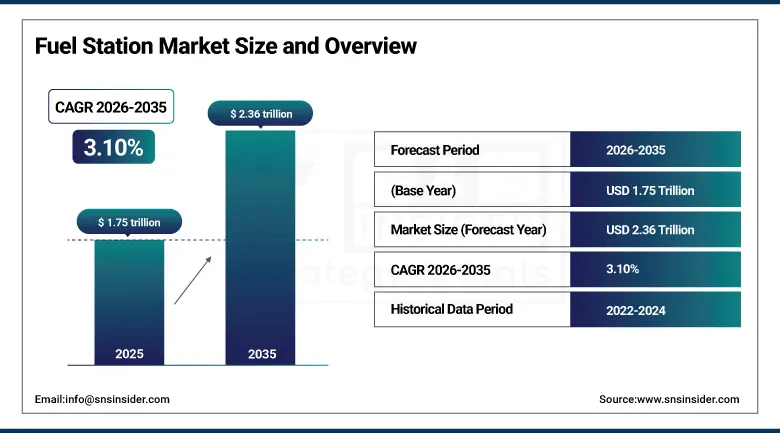
The Fuel Station Market was valued at USD 1.75 Trillion in 2025 and is expected to reach USD 2.36 Trillion by 2035, growing at a CAGR of 3.10% from 2026 to 2035.
The Fuel Station Market enjoys a growing demand fueled by the increased need for alternative fuel stations such as petrol, diesel, CNG, LPG, EV charging stations, and hydrogen stations. Innovations in multi-fuel stations, EV charging hubs, hydrogen stations, and digital payment networks continue to enhance operational capacities in both urban and highway stations. With the ever-growing responsibility to support energy transition policies, urbanization, and sustainability through mobility fuels, the Fuel Station Market shows high growth potential in delivering updated facilities.
In support of this market trend, the U.S. Energy Information Administration (EIA) estimates that the consumption of gasoline and diesel will remain strong until 2025 while EV charging will grow rapidly as federal mandates encourage EVs. Additionally, Canada's Natural Resources Agency predicts steady growth in CNG and hydrogen stations, signaling a move towards diversified energy supply in North America.
Furthermore, regulatory bodies in the United States have been working on creating new opportunities for the adoption of alternative fuels. For example, in 2024, the Department of Energy announced new programs to develop hydrogen refueling corridors and EV charging hubs.
To Get more information on Fuel Station Market - Request Free Sample Report
Key Market Trends
-
EV charging integration is accelerating as fuel stations increasingly add fast-charging hubs to meet rising electric vehicle demand.
-
Hydrogen refueling corridors are expanding, with governments and energy companies investing in infrastructure for long-haul and commercial fleets.
-
Biofuel adoption is growing, particularly in Latin America where ethanol and biodiesel are being integrated into fueling networks.
-
Natural gas fueling stations for CNG and LNG are expanding, especially in MEA, driven by cost efficiency and emission reduction goals.
-
Digital transformation is reshaping operations through AI, IoT, and mobile apps that enable smart fueling, predictive maintenance, and seamless digital payments.
-
Hybrid fuel stations combining traditional fuels with EV, hydrogen, and biofuel options are becoming more common to serve diverse consumer needs.
-
Government sustainability policies are driving investments in clean energy infrastructure and setting stricter emission standards.
-
Urbanization and mobility demand are fueling growth in MEA and Latin America, with rising vehicle ownership and modernization of fueling networks.
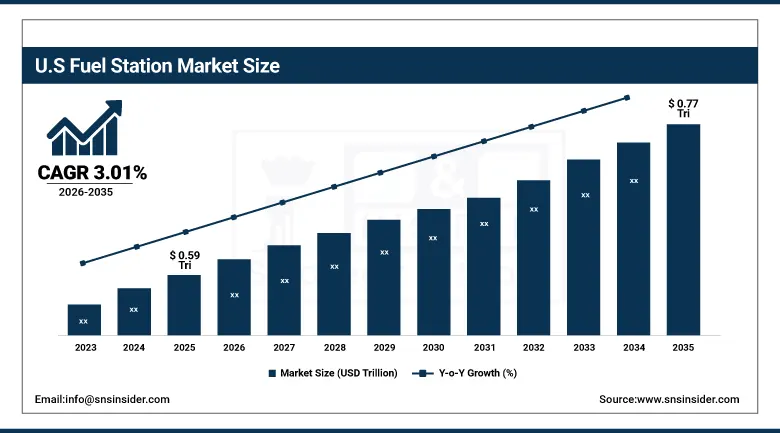
U.S. Fuel Station Market was valued at USD 0.59 Trillion in 2025 and is expected to reach USD 0.77 Trillion by 2035, growing at a CAGR of 3.01% from 2026-2035.
The U.S. Fuel Station Market has the position of the biggest market globally, due to an advanced energy infrastructure system, favorable investment environment, as well as a presence of some leading fuel and energy companies such as ExxonMobil, Chevron, Shell, and BP. Government regulation favoring the increase in the number of EVs charging stations, hydrogen refueling corridors, and use of clean fuels contributes to the modernization of the company-owned, dealer-owned, and highway fuel stations.
Furthermore, according to the data provided by the U.S. Energy Information Administration, gasoline and diesel are dominating fuels, however, the need for electricity for charging electric vehicles grows fast. Moreover, the infrastructure for hydrogen and CNG fuels is developing, thus allowing a variety of options for passenger car and fleet vehicle fueling. The federal and state-level authorities work hard on increasing the use of alternative energy sources.
According to the 2024 report of the Department of Energy, new investments have been made for hydrogen refueling corridors and EV charging networks. These facts speak about the increasing tendency towards promoting innovations related to next-generation fuel stations.
Fuel Station Market Segment Analysis
-
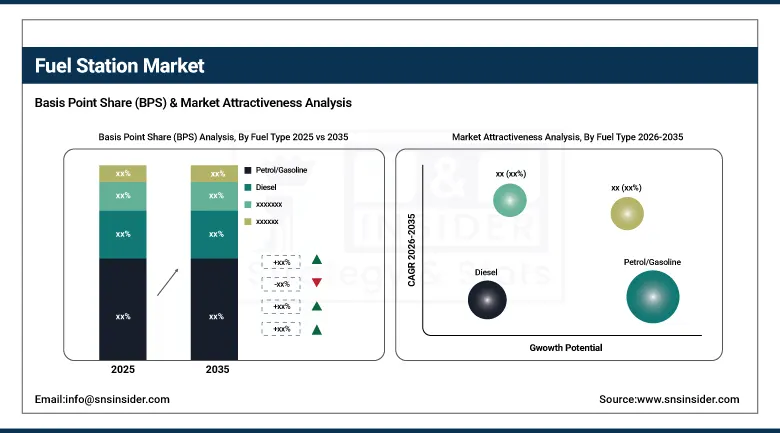
By Fuel Type, Petrol/Gasoline dominated the Fuel Station Market with 44.74% share in 2025; Compressed Natural Gas (CNG) fastest growing (CAGR).
-
By Station Type, Company-Owned & Company-Operated (COCO) dominated the Fuel Station Market with 34.75% share in 2025; Urban Fuel Stations fastest growing (CAGR).
-
By Service Type, Fuel Filling Services dominated the Fuel Station Market with 54.71% share in 2025; EV Charging Services fastest growing (CAGR).
-
By End User, Passenger Vehicles dominated the Fuel Station Market with 50.39% share in 2025; Public Transportation fastest growing (CAGR).
By Fuel Type, Petrol/Gasoline Dominated the Fuel Station Market, Compressed Natural Gas (CNG) Expected to Grow Fastest
For the year 2025, Petrol/Gasoline held the dominant market share, constituting around 44.74% of the total revenue. The key factors driving the prominence of this segment include the enormous number of gasoline-powered passenger cars in the world and the continued use of internal combustion engine-based transportation worldwide. Petrol refueling stations are among the most widely available fueling stations around the globe due to their matured supply chain, large transaction volumes per day, and extensive urban-highway network.
For the period between 2026 and 2035, the segment that would witness the highest CAGR is Compressed Natural Gas (CNG). The growing concerns about environmental degradation, increased vehicular emissions regulations, and escalating cost pressure of transportation fuels are forcing a shift towards cleaner and affordable energy resources. Multiple governments around the globe have been supporting the use of CNG fuel as a viable alternative source of transportation energy.
By Station Type, Company-Owned & Company-Operated (COCO) Dominated the Fuel Station Market, Urban Fuel Stations Expected to Grow Fastest
The Company-Owned and Company-Operated (COCO) segment led the Fuel Station Market in 2025, contributing about 34.75% to the total market revenue. This segment remained in the lead because of the advantages of operational control, consistency of service provision, centralization of fuel prices, and retailing skills of leading energy corporations. With large-scale investment abilities, the stations in the COCO segment could adopt advanced fuel dispensing technology, modernized payment systems, convenience stores, and EV chargers.
During the forecast period from 2026 to 2035, the fastest compound annual growth rate (CAGR) will be observed in the Urban Fuel Stations segment. Growth drivers include the process of urbanization, population density, and the growing demand for easy-to-access mobility-related services. Urban stations have increasingly become more of multi-functionality centers that provide services such as fuel dispensation, electric vehicle chargers, food retail shops, payment facilities, and convenience shops.
By Service Type, Fuel Filling Services Dominated the Fuel Station Market, EV Charging Services Expected to Grow Fastest
The Fuel Filling Services category held the largest share of approximately 54.71% of the overall Fuel Station Market in 2025. The traditional fuel filling services have remained the primary source of income for the players operating in the fuel stations sector, owing to the constant requirement for petrol and diesel by various types of transport, including passengers and logistics.
The EV Charging Services category will likely register the highest CAGR between 2026 and 2035. With the growing transition towards electric vehicles in the world, the need for fuel stations to offer more services than conventional ones has become imminent. Governments around the world are setting up stringent policies to ensure that their countries decarbonize and encourage EV usage through incentives.
By End User, Passenger Vehicles Dominated the Fuel Station Market, Public Transportation Expected to Grow Fastest
The Passenger Vehicles segment accounted for around 50.39% of the total revenue share in 2025 in the Fuel Station Market. Factors such as the large passenger car fleet and an increase in personal mobility needs in metropolitan and suburban areas have led to the dominance of the segment. The need for daily commuting, higher automobile penetration, and convenient access to fuel stations have contributed positively towards fuel demand from passenger vehicles.
Between 2026 and 2035, the Public Transportation segment is anticipated to report the highest CAGR. Increasing funding for sustainable transport infrastructure development, growth in the number of public buses, and high adoption of fuel-efficient and electric buses have been driving the demand for fueling and charging facilities for the public transportation system.
Regional Analysis
|
Region |
Major Country |
Share within Region (%) |
|---|---|---|
|
North America |
United States |
26.57% |
|
Europe |
Germany |
21.23% |
|
Asia Pacific |
China |
38.41% |
|
Middle East & Africa |
UAE |
6.78% |
|
Latin America |
Brazil |
7.01% |
Asia Pacific Fuel Station Market Insights
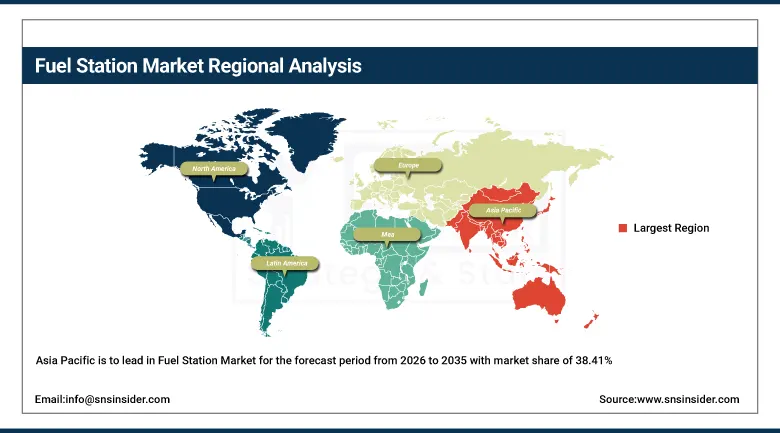
The Asia Pacific is to lead in Fuel Station Market for the forecast period from 2026 to 2035 with market share of 38.41%. This would be due to rapid energy infrastructure development, soaring demand for diverse energy sources, high vehicle presence, and significant investments from the government to develop technologies for clean energy and EV charging infrastructure. Key countries that would be leading include China, Japan, India, South Korea, and Australia, where China accounts for the majority of growth in the region. The key driving factor behind the massive growth seen in the region would be the rapid growth of middle classes with higher incomes, increased awareness regarding sustainable travel, and robust governmental policies to promote the use of alternative fuels such as CNG, LPG, EV charging, and hydrogen.
This would be supported by initiatives such as the inclusion of clean energy infrastructure like EV charging, hydrogen refueling, and CNG/LPG infrastructure under the nation's emerging industrial strategy framework, allocating significant funding from the government for fuel station renovations. Another major player that would be driving EV charging technology adoption through supportive policies and subsidies would be Japan, specifically through the Ministry of Economy, Trade, and Industry (METI).
Get Customized Report as per Your Business Requirement - Enquiry Now
North America Fuel Station Market Insights
North America has emerged as the fastest-growing market in the Global Fuel Station Market on account with 3.93% CAGR due to its robust energy infrastructure, high concentration of international fuel and energy enterprises, and supportive government policies favoring the adoption of clean fuels. The continuous expansion of EV charging stations, hydrogen refueling routes, and the upgradation of conventional fuel stations in cities and highways further contribute to North America's position as the world's leader in developing fuel stations of the future.
To consolidate their dominance, governments in North America have increasingly invested in initiatives aimed at promoting the adoption of clean fuel, such as EV charging stations, hydrogen refueling corridors, and CNG/LPG fuel stations. As per the U.S. Department of Energy, there are more than a hundred thousand EV charging stations across the country. The massive adoption of alternate fuel technology across North America exemplifies the continent's dominance in upgrading its fuel stations and implementing next-generation energy solutions.
Europe Fuel Station Market Insights
The European market serves as an indispensable segment for the global Fuel Station Market due to its developed energy infrastructure, government investments in clean fuel innovations, and regulatory environment that favors alternative energies. Several key countries like Germany, the UK, France, and the Netherlands boast well-developed energy fueling systems that include high integration rates of EV charging, hydrogen fuel stations, and CNG/LPG stations.
In support of the above statement, Horizon Europe project by the European Commission has earmarked significant funding for sustainable mobility, EV charging, and hydrogen energy technology initiatives in line with EU’s energy policy goals. Moreover, the implementation of renewable energy directive and the Green Deal has increased quality standards of sustainable fuels in Europe through certification processes, thereby solidifying the adoption curve.
Middle East & Africa and Latin America Fuel Station Market Insights
The Middle East & Africa and Latin America have emerged as growth frontier areas in the Fuel Station Market, owing to rapid urbanization, increasing number of vehicles, and efforts by governments towards diversifying sources of energy. While in MEA, countries such as Saudi Arabia, UAE, and Qatar are making substantial investments in hydrogen technology and EV charging stations as part of their plans for sustainable development in the long term, countries in Latin America such as Brazil, Mexico, and Chile are working towards increasing production and usage of biofuels along with renewable energies as sources for fuel.
Regulatory agencies and energy organizations in Brazil are driving initiatives to enhance the efficiency of fuel distribution systems while encouraging adoption of alternative fuels such as ethanol, biodiesel, and natural gas-based transportation fuels. The presence of an efficient biofuel network along with increased investments in urban and commercial transport sectors has helped in implementing advanced fuel stations.
Market Growth Drivers: Rising global vehicle ownership, expanding transportation activity, and increasing demand for convenient mobility infrastructure driving growth of the Fuel Station Market
One of the most compelling structural factors driving the growth of the Fuel Station Market is the changing trends in global mobility towards more intensive use of vehicles, growth in logistics operations, and increased urban transport demand. The consumers as well as fleet users are seeking more rapid and convenient fueling systems and technologies that provide uninterrupted mobility, long-range travel needs, and enhanced freight movements. Fuel stations have responded to such demands by increasing their network coverage, offering more convenience store offerings, utilizing advanced digital payment solutions, and installing more facilities for alternative fuels.
According to the International Energy Agency (IEA), the growth in energy needs in terms of transportation will continue on account of increasing number of vehicles, increased freight transport activities, and increased urbanization, especially in the developing countries. In addition, fuel retail infrastructure is being supported by the government around the world to modernize their systems by incorporating alternative fuels, electric vehicle charging facilities, etc.
Market Restraints: High infrastructure development and operational costs associated with modern fuel station networks creating expansion barriers, particularly in rural regions and emerging economies
The huge amount of capital needed for the construction, development, and maintenance of advanced fuel station infrastructure can be considered as one of the main limitations of Fuel Station Market development, especially when considering independent players and smaller fuel sellers. The construction of fuel stations necessitates a large number of investments in the purchase of land, storage infrastructure underground, fuel dispensers, compliance systems for safety and environment, as well as digital payments technology. Furthermore, all these expenses have been further escalated due to environmental regulations and emission restrictions in many countries.
Market Opportunities: Accelerating transformation of traditional fuel stations into multi-energy mobility hubs creating new growth pathways for integrated fueling, charging, and digital retail ecosystems
The opportunities for the next wave of growth in the Fuel Station Market are focused on the development of traditional fueling retail facilities into multi-purpose mobility centers driven by innovative technologies. Fuel retailers are progressively adopting comprehensive energy systems that incorporate electric vehicle (EV) fast charging capabilities, compressed natural gas (CNG) fueling, hydrogen refueling stations, battery swap facilities, and energy management systems to cater to the shifting dynamics of the transport industry.
Recent Developments:
• 2026: Shell plc hastened the growth of its global multi-energy fuel station network through the installation of ultra-fast EV chargers in Europe, North America, and the Asia-Pacific regions. Shell increased investments in digital mobility services, loyalty programs, and convenient retail stores in its fuel retail system, thus reinforcing its focus on low carbon mobility and future roadside energy stations.
• 2025: BP plc boosted its EV charging and alternative fuels retailing strategy through further investment in high-speed charging corridors and urban charging hubs through its bp pulse brand. BP noted increasing consumer uptake of integrated mobility services in several international locations alongside continued upgrades of its fuel stations through modern payment systems and renewable energy sources.
• 2026: The Exxon Mobil Corporation improved its fuel-retailing and mobility capabilities through investments in technologically superior fuel stations with digital fueling equipment, automated payments, and improved fleet fueling capabilities. The corporation also made significant investments in fuels that have fewer emissions in their distribution process and in mobility infrastructure for meeting future energy demands of the transportation sector.
• 2025: The Chevron Corporation further improved its retail fuel strategy by extending EV charging facilities, renewable fuels, and convenient retail services using technology at all its fueling stations worldwide. The corporation formed more strategic alliances in areas related to sustainability and intelligent mobility, while improving its customers' experiences through mobile payment solutions and loyalty programs.
Key Market Players
-
Shell plc
-
BP plc
-
Chevron Corporation
-
TotalEnergies SE
-
Saudi Aramco
-
PetroChina Company Limited
-
Indian Oil Corporation
-
China Petroleum & Chemical Corporation (Sinopec)
-
Phillips 66
-
Valero Energy Corporation
-
ENEOS Holdings Inc.
-
Petronas
-
PTT Public Company Limited
-
Repsol S.A.
-
OMV Aktiengesellschaft
-
Couche-Tard Inc.
-
Gazprom Neft
-
Rosneft
Fuel Station Market Report Scope:
| Report Attributes | Details |
|---|---|
| Market Size in 2025 | USD 1.75 Trillion |
| Market Size by 2035 | USD 2.36 Trillion |
| CAGR | CAGR of 3.10% From 2026 to 2035 |
| Base Year | 2025 |
| Forecast Period | 2026-2035 |
| Historical Data | 2022-2024 |
| Report Scope & Coverage | Market Size, Segments Analysis, Competitive Landscape, Regional Analysis, DROC & SWOT Analysis, Forecast Outlook |
| Key Segments | • By Process Type (Wet-Mix Sprayed Concrete, Dry-Mix Sprayed Concrete, Robotic Spraying Systems, Manual Spraying Systems, Others), • By System Type (Open System, Closed System, Dense Flow System, Dilute Flow System, Others), • By Application (Underground Construction (Tunnels & Mining), Repair & Rehabilitation, Water Retaining Structures, Protective Coatings & Linings, Others), • By End-Use Industry (Construction & Infrastructure, Mining, Oil & Gas, Water & Wastewater Management, Others), • By Material Type (Fiber-Reinforced Sprayed Concrete, Polymer-Modified Sprayed Concrete, Silica Fume-Based Sprayed Concrete, Standard Cement-Based Sprayed Concrete, Others) |
| Regional Analysis/Coverage | North America (US, Canada), Europe (Germany, UK, France, Italy, Spain, Russia, Poland, Rest of Europe), Asia Pacific (China, India, Japan, South Korea, Australia, ASEAN Countries, Rest of Asia Pacific), Middle East & Africa (UAE, Saudi Arabia, Qatar, South Africa, Rest of Middle East & Africa), Latin America (Brazil, Argentina, Mexico, Colombia, Rest of Latin America). |
| Company Profiles | Shell plc, BP plc, Exxon Mobil Corporation, Chevron Corporation, TotalEnergies SE, Saudi Aramco, PetroChina Company Limited, Indian Oil Corporation, China Petroleum & Chemical Corporation (Sinopec), Marathon Petroleum Corporation, Phillips 66, Valero Energy Corporation, ENEOS Holdings Inc., Petronas, PTT Public Company Limited, Repsol S.A., OMV Aktiengesellschaft, Couche-Tard Inc., Gazprom Neft, Rosneft. |

Frequently Asked Questions
The Company-Owned & Company-Operated (COCO) segment dominated the Fuel Station Market in 2025.
Asia Pacific dominated the Fuel Station Market in 2025.
The major growth factor is rising demand for diversified fuel options, including EV charging and hydrogen, Convenience retail and integrated services, Regulatory push for clean energy and urbanization further accelerate market expansion.
The Fuel Station Market was valued at USD 1.75 Trillion in 2025.
The Fuel Station Market is expected to grow at a CAGR of 3.10% from 2026 to 2035.
