
Advanced Biofuels Market Report Scope & Overview:
The Advanced Biofuels Market size was valued at USD 17.82 Billion in 2025 and is projected to reach USD 42.27 Billion by 2035, growing at a CAGR of 9.06% during 2026-2035.
The Advanced Biofuels Market is growing due to increasing global demand for sustainable and low-carbon energy alternatives. Government policies and mandates promoting renewable fuels, rising fuel prices, and stricter environmental regulations are driving adoption. Technological advancements in feedstock conversion, such as lignocellulosic biomass, algae, and waste oils, are enhancing production efficiency. Growing investments in biojet fuel, renewable diesel, and biobutanol, along with the push for decarbonization in transportation and aviation, are further accelerating market growth worldwide.

To Get more information On Advanced Biofuels Market - Request Free Sample Report
Advanced Biofuels Market Trends
-
Rising adoption of advanced biofuels driven by environmental concerns and global greenhouse gas reduction goals.
-
Increased government support through stringent regulations, renewable fuel mandates, and incentives for sustainable fuel production.
-
Technological advancements in feedstock conversion, including lignocellulosic biomass, algae, and waste oils, improving efficiency and scalability.
-
Rapid growth potential in emerging markets like Asia Pacific and Latin America due to energy demand, urbanization, and policy support.
-
Expansion of sustainable aviation fuels and circular economy practices, supported by industry collaborations and investment in next-generation biofuels.
U.S. Advanced Biofuels Market Size Outlook:
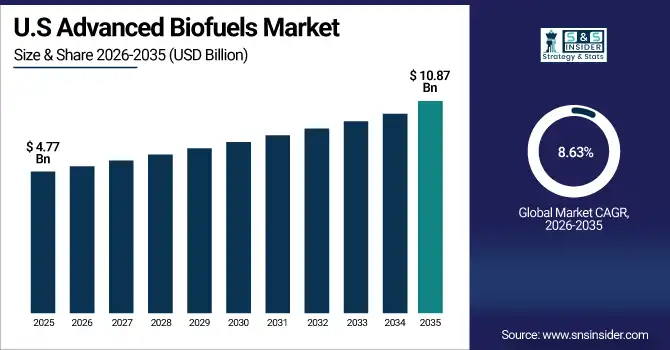
The U.S. Advanced Biofuels Market was valued at USD 4.77 Billion in 2025 and is projected to reach USD 10.87 Billion by 2035, growing at a CAGR of 8.63% during 2026-2035. The U.S. Advanced Biofuels Market is growing due to supportive government policies, renewable fuel mandates, rising demand for low-carbon transportation fuels, technological advancements in biofuel production, and increasing adoption of bioethanol, biodiesel, and renewable aviation fuels.
Market Growth Drivers: Environmental Concerns and Technological Advances Drive Global Advanced Biofuels Market Expansion Across Transportation and Industry Sectors
The growth of the global advanced biofuels market is primarily driven by increasing environmental concerns and the urgent need to reduce greenhouse gas emissions. Governments worldwide are implementing stringent regulations and renewable fuel mandates to curb carbon emissions from transportation and industrial sectors. Rising fuel prices and the volatility of fossil fuel markets are further motivating industries and consumers to adopt sustainable alternatives. Technological advancements in feedstock conversion, including lignocellulosic biomass, algae, and waste oils, have enhanced production efficiency and scalability, making advanced biofuels more cost-competitive. Additionally, the growing demand for bioethanol, biodiesel, biobutanol, and sustainable aviation fuels is propelling market expansion, particularly in regions like North America and Europe, where supportive policies and infrastructure facilitate widespread adoption.
Under the U.S. Renewable Fuel Standard (RFS), the EPA set advanced biofuel blending requirements to increase from ~5.94 billion gallons in 2023 to ~6.54 billion gallons in 2024 and ~7.33 billion gallons in 2025, highlighting regulatory support for higher advanced biofuel use in transportation fuels
Market Restraints: Advanced Biofuels Market Growth Constrained by Feedstock Limits Conversion Complexity and Regulatory Challenges Globally
The global advanced biofuels market faces restraints due to feedstock availability and seasonal variability, which can limit consistent production. Complex and time-consuming conversion technologies, along with limited large-scale infrastructure for distribution and blending, hinder rapid adoption. Regulatory differences across countries and uncertainties in policy implementation can slow market growth. Additionally, competition from conventional fossil fuels and first-generation biofuels, as well as technical challenges in scaling next-generation fuels like algae-based biofuels and biojet, pose operational and logistical challenges for producers globally.
Market Opportunities: Emerging Markets Drive Advanced Biofuels Growth Unlocking High Potential Through Algae Biojet Fuel Innovation and Aviation Decarbonization Initiatives
Significant opportunities exist globally in emerging markets such as Asia Pacific and Latin America, where increasing energy demand, urbanization, and government incentives are accelerating the adoption of renewable fuels. Investment in research and development for next-generation biofuels, such as algae-based fuels and biojet fuel, presents high-growth potential. The aviation sector’s decarbonization initiatives and the push for circular economy practices, including the use of agricultural residues and waste oils, also offer substantial prospects for market players. Collaboration between technology providers, energy majors, and governments is expected to further expand production capacity and drive long-term growth in the global advanced biofuels market.
Australia announced a A$1.1 billion (≈ US$735 million) cleaner fuels programme to support low‑carbon liquid fuels including SAF and renewable diesel, with projects expected by 2029
Advanced Biofuels Market Segment Analysis
-
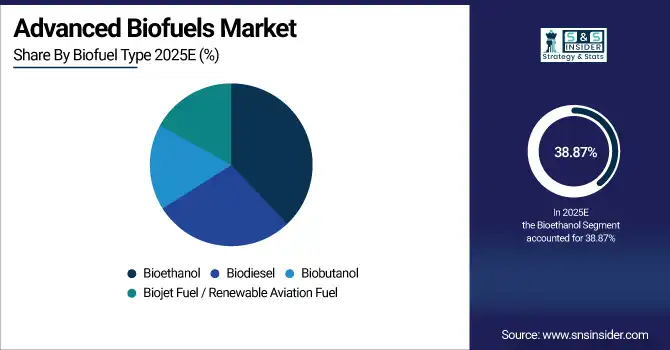
By Biofuel Type, Bioethanol dominated with 38.87% in 2025, and Biojet Fuel / Renewable Aviation Fuel is expected to grow at the fastest CAGR of 9.78% from 2026 to 2035.
-
By Feedstock, Lignocellulosic Biomass (e.g., agricultural residues, wood chips) dominated with 34.76% in 2025, and Algae is expected to grow at the fastest CAGR of 10.22% from 2026 to 2035.
-
By Application, Transportation (Road, Aviation, Marine) dominated with 53.12% in 2025, and it is expected to grow at the fastest CAGR of 9.39% from 2026 to 2035.
-
By End-User, Automotive Manufacturers & Fleet Operators dominated with 41.55% in 2025, Airlines & Aviation Companies is expected to grow at the fastest CAGR of 9.54% from 2026 to 2035.
By Biofuel Type, Bioethanol Dominates Advanced Biofuels While Biojet Fuel Soars Driving Aviation Decarbonization and Sustainable Travel Growth
In 2025, bioethanol remained the most widely used advanced biofuel due to its compatibility with existing vehicles and fuel infrastructure. The period from 2026 to 2035 is expected to see significant growth in biojet fuel and renewable aviation fuels, driven by global aviation decarbonization initiatives, airline commitments to sustainable fuels, and increased government support for cleaner air travel.
By Feedstock, Lignocellulosic Biomass Leads Feedstock Use While Algae-Based Biofuels Gain Momentum Driving Future Growth
Lignocellulosic biomass was the leading feedstock in 2025, sourced from agricultural residues and wood. From 2026 to 2035, algae-based feedstocks are expected to gain momentum due to their high yield potential, non-competition with food crops, and suitability for next-generation biofuels.
By Application, Transportation Sector Drives Advanced Biofuels Market Growth Boosting Emission Reduction and Sustainable Mobility Globally
Transportation, including road, aviation, and marine, dominated the market in 2025 as advanced biofuels were primarily used to reduce emissions in mobility sectors. Between 2026 and 2035, demand in these segments is projected to grow strongly, fueled by global decarbonization goals and regulatory mandates.
By End-User Industry, Airlines and Automotive Industries Lead Global Shift Toward Advanced Biofuels Driving Sustainable Transportation Growth
Automotive manufacturers and fleet operators were the primary consumers of advanced biofuels in 2025, driven by the push for greener fleets. From 2026 to 2035, airlines and aviation companies are expected to increasingly adopt sustainable fuels to meet environmental targets and reduce carbon footprints.
Advanced Biofuels Market Report Analysis
North America Advanced Biofuels Market Insights
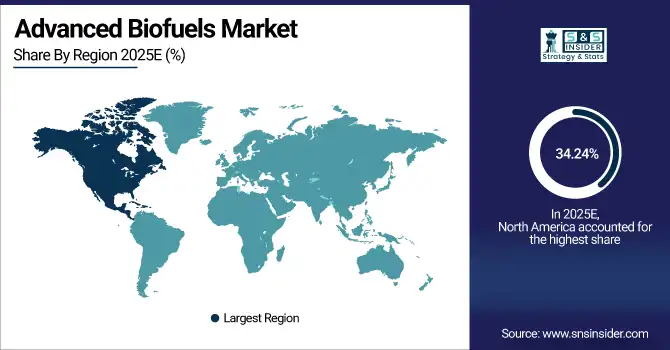
In 2025, North America dominated the global advanced biofuels market with a 34.24% share, driven by supportive government policies, renewable fuel mandates, and well-established biofuel infrastructure. The region’s strong adoption of bioethanol, biodiesel, and renewable aviation fuels, particularly in the United States, has fueled market leadership. From 2026 onwards, continued investment in next-generation biofuels, sustainable aviation fuel production, and technological advancements in feedstock conversion are expected to further strengthen North America’s position as a key global market for advanced biofuels.
Get Customized Report as per Your Business Requirement - Enquiry Now
U.S. Advanced Biofuels Market Insights
In North America, the United States dominated the advanced biofuels market in 2025, driven by the Renewable Fuel Standard, extensive bioethanol and biodiesel production, government incentives, and well-established infrastructure supporting both transportation fuels and emerging sustainable aviation fuels.
Europe Advanced Biofuels Market Insights
In 2025, Europe accounted for 29.76% of the global advanced biofuels market, led by strong regulatory support, such as the EU Renewable Energy Directive, and increasing investments in sustainable fuels. Advanced biofuels like biodiesel, bioethanol, and biojet fuel are widely adopted to reduce carbon emissions in transportation and industrial sectors. From 2026 onwards, growing demand for cleaner fuels, expansion of bio-refineries, and government incentives are expected to drive continued growth across European countries.
Germany Advanced Biofuels Market Insights
In Europe, Germany dominated the advanced biofuels market in 2025, supported by strong government policies, extensive biodiesel and bioethanol production, advanced bio-refinery infrastructure, and initiatives promoting sustainable aviation fuels to reduce greenhouse gas emissions across the transportation and industrial sectors.
Asia Pacific Advanced Biofuels Market Insights
The Asia Pacific advanced biofuels market is expected to grow at the fastest CAGR of 9.94% from 2026 to 2035, driven by rising energy demand, rapid urbanization, and increasing focus on sustainable transportation. Countries like China, India, Japan, and Australia are investing heavily in bio-refineries, algae-based fuels, and renewable aviation fuels. Government incentives, supportive policies, and the need to reduce carbon emissions in transportation and industrial sectors are fueling market expansion, making Asia Pacific a high-growth region for advanced biofuels during this period.
China Advanced Biofuels Market Insights
In the Asia Pacific region, China dominated the advanced biofuels market, driven by strong government policies, large-scale bio-refinery projects, investments in algae-based fuels and sustainable aviation fuels, and initiatives to reduce carbon emissions in transportation and industrial sectors.
Latin America (LATAM) and Middle East & Africa (MEA) Advanced Biofuels Market Insights
In 2025, Latin America and the Middle East & Africa (MEA) are emerging markets for advanced biofuels, driven by increasing energy demand and government initiatives promoting renewable fuels. Brazil and Argentina lead LATAM with strong bioethanol, biodiesel, and renewable aviation fuel production, supported by abundant feedstocks. In MEA, early-stage adoption of biofuels is growing due to investments in renewable diesel and SAF projects. From 2026 to 2035, continued policy support, infrastructure development, and technological advancements are expected to accelerate market growth in both regions.
Competitive Landscape for Advanced Biofuels Market:
Neste Corporation is a global leader in renewable and sustainable fuels, specializing in advanced biofuels such as renewable diesel and sustainable aviation fuel (SAF). The company focuses on converting waste, residues, and innovative feedstocks into low-carbon fuels, supporting decarbonization across transportation, aviation, and industrial sectors worldwide.
-
In May 2025, Neste began supplying sustainable aviation fuel to FedEx at Los Angeles International Airport, marking FedEx’s first major U.S. SAF deployment.
Chevron Corporation is a major U.S. energy company expanding into advanced biofuels through strategic acquisitions and renewable fuel production. It owns and operates multiple biorefineries via Chevron Renewable Energy Group, is developing renewable diesel and sustainable aviation fuel technologies, and partners with feedstock and catalyst developers to produce lower‑carbon fuels. Chevron’s efforts support broader decarbonization goals by integrating biofuel production into its global fuel distribution and refining network while reducing lifecycle emissions.
-
In November 2024, Chevron inaugurated the Ames Technology Center in Iowa to boost R&D in lower‑carbon fuels including biodiesel, renewable diesel, sustainable aviation fuel (SAF), and renewable natural gas.
Advanced Biofuels Companies are:
-
Chevron Corporation
-
BP plc
-
TotalEnergies SE
-
Royal Dutch Shell plc
-
POET LLC
-
Gevo, Inc.
-
Verbio AG
-
Raízen S.A.
-
UPM‑Kymmene Corporation
-
Eni S.p.A.
-
Abengoa Bioenergy
-
Clariant AG
-
LanzaTech
-
LanzaJet Inc.
-
Aemetis, Inc.
-
Enerkem Inc.
-
Algenol Biotech
-
GranBio
| Report Attributes | Details |
|---|---|
| Market Size in 2025 | USD 17.82 Billion |
| Market Size by 2035 | USD 42.27 Billion |
| CAGR | CAGR of 9.06% From 2026 to 2035 |
| Base Year | 2025 |
| Forecast Period | 2026-2035 |
| Historical Data | 2022-2024 |
| Report Scope & Coverage | Market Size, Segments Analysis, Competitive Landscape, Regional Analysis, DROC & SWOT Analysis, Forecast Outlook |
| Key Segments | • By Biofuel Type (Bioethanol, Biodiesel, Biobutanol, and Biojet Fuel / Renewable Aviation Fuel) • By Feedstock (Lignocellulosic Biomass (e.g., agricultural residues, wood chips), Algae, Waste Oils & Fats, and Energy Crops (e.g., switchgrass, sugarcane)) • By Application (Transportation (Road, Aviation, Marine), Power Generation, Industrial & Chemical Applications, and Residential / Heating) • By End-User (Automotive Manufacturers & Fleet Operators, Airlines & Aviation Companies, Industrial Energy Users, and Government & Defense Agencies) |
| Regional Analysis/Coverage | North America (US, Canada), Europe (Germany, UK, France, Italy, Spain, Russia, Poland, Rest of Europe), Asia Pacific (China, India, Japan, South Korea, Australia, ASEAN Countries, Rest of Asia Pacific), Middle East & Africa (UAE, Saudi Arabia, Qatar, South Africa, Rest of Middle East & Africa), Latin America (Brazil, Argentina, Mexico, Colombia, Rest of Latin America). |
| Company Profiles | Neste Corporation, Chevron Corporation, BP plc, TotalEnergies SE, Royal Dutch Shell plc, POET LLC, Renewable Energy Group (REG), Gevo, Inc., Verbio AG, Raízen S.A., UPM‑Kymmene Corporation, Eni S.p.A., Abengoa Bioenergy, Clariant AG, LanzaTech, LanzaJet Inc., Aemetis, Inc., Enerkem Inc., Algenol Biotech, GranBio. |
Frequently Asked Questions
North America dominated the Advanced Biofuels Market in 2025.
Bioethanol dominated the Advanced Biofuels Market.
Rising environmental concerns, government mandates, renewable fuel adoption, and technological advancements drive advanced biofuels growth.
The Advanced Biofuels Market size was USD 17.82 Billion in 2025 and is expected to reach USD 42.27 Billion by 2035.
The Advanced Biofuels Market is expected to grow at a CAGR of 9.06% from 2026-2035.
