
Healthcare IT Consulting Market Report Scope & Overview:
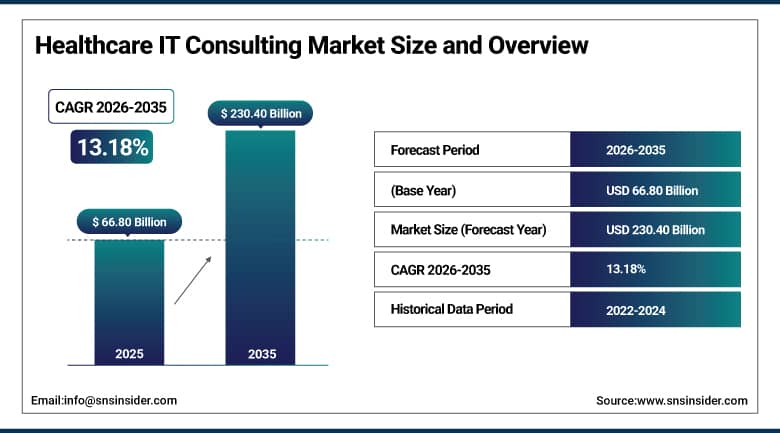
The Healthcare IT Consulting Market was valued at USD 66.80 Billion in 2025 and is projected to reach USD 75.60 Billion in 2026 and USD 230.40 Billion by 2035, registering a CAGR of 13.18% over the forecast period. Growth is anchored in the complexity of electronic health record programs, the shift of clinical and financial systems to the cloud, and the need to apply artificial intelligence safely inside regulated care settings. Hospitals, payers, and life sciences companies lack the specialist staff for these projects, so they rely on outside advisors for strategy, implementation, optimization, and managed support.
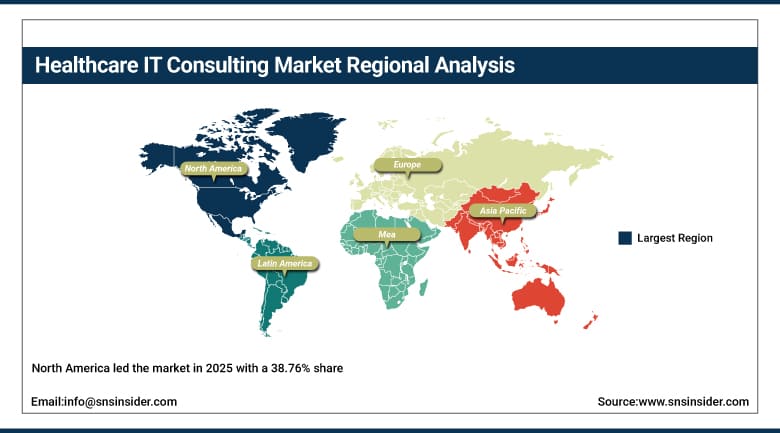
North America accounted for the largest share of the market at 38.76% in 2025, supported by large health systems, a mature electronic record base, and heavy spending on revenue cycle and interoperability programs. The United States leads regional demand because provider consolidation, payment reform, and federal data exchange rules create continuous project work. Asia Pacific is the fastest growing region, helped by national digital health programs, expanding private hospital networks, and rising adoption of cloud platforms across India, China, Japan, Australia, and Southeast Asia. Regulatory deadlines and talent shortages make outside expertise a practical necessity for most organizations.
To Get More Information On Healthcare IT Consulting Market - Request Free Sample Report
Key Report Takeaways
-
By consulting type, healthcare business process management held a 27.14% share in 2025, while data analytics and AI advisory is the fastest growing.
-
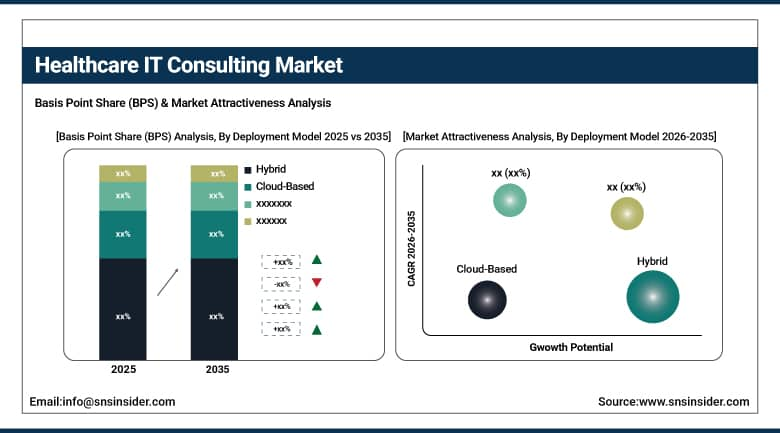
By deployment model, hybrid deployments accounted for 44.62% of the market in 2025, while cloud-based deployments are the fastest growing.
-
By organization size, large enterprises led with a 63.48% share in 2025, while small and medium-sized enterprises are the fastest growing.
-
By end user, healthcare providers represented 68.21% of the market in 2025, while healthcare payers are the fastest growing.
-
By region, North America led with a 38.76% share in 2025, while Asia Pacific is expected to expand fastest at a CAGR of 14.46%.
Market Trends and Insights
Artificial intelligence advisory is becoming a standalone practice. Consultants now help clients select use cases, set governance rules, validate models, and train clinicians, so AI work is moving from pilots into funded enterprise programs.
Epic specialist firms are being absorbed by larger groups. Private equity-backed platforms and global integrators continue to buy electronic record advisory firms, which gives buyers broader services but concentrates scarce implementation talent.
Revenue cycle and technology consulting are converging. Providers want one partner to redesign billing workflows, automate coding and claims tasks, and manage the underlying systems after go-live.
Managed services are replacing project-only engagements. Hospitals increasingly sign multi-year application support and optimization contracts so that consultants stay responsible for system performance after implementation.
Drivers Impact Analysis
|
Driver |
(~) Percentage Point Impact on Market CAGR |
Geographic Relevance |
Impact Timeline |
|---|---|---|---|
|
Complexity of electronic health record and cloud migration programs |
+3.12% |
North America, Europe |
Short term (2 years or less) |
|
Adoption of artificial intelligence and advanced analytics in care and operations |
+2.86% |
Global |
Medium term (2 to 4 years) |
|
Interoperability, data exchange, and regulatory compliance requirements |
+2.34% |
North America, Europe |
Medium term (2 to 4 years) |
|
Margin pressure and the need for revenue cycle automation |
+1.78% |
North America, Asia Pacific |
Short term (2 years or less) |
|
Shortage of in-house health IT and cybersecurity talent |
+1.42% |
Global |
Long term (4 years or more) |
Complexity of Electronic Health Record and Cloud Migration Programs
Electronic health record installations, upgrades, and conversions are among the largest technology projects a hospital undertakes, and they involve clinical design, data migration, training, and revenue cycle alignment. Health systems that merge or acquire facilities must also consolidate several record systems into one. Internal teams rarely have the capacity for such work alongside daily operations, so organizations hire specialists to plan, build, test, and support go-live. As more facilities move applications and data to the cloud, demand for migration advice and managed support continues to rise.
Adoption of Artificial Intelligence and Advanced Analytics in Care and Operations
Health systems are testing ambient documentation, predictive models, and automated administrative tools, yet few have the expertise to evaluate vendors, manage data quality, or monitor model performance. Consultants fill this gap by running readiness assessments, designing governance committees, and integrating tools into clinical workflows. Boards want measurable returns before approving broad deployment, which creates work in business case development and benefit tracking. As regulators and accreditation bodies pay closer attention to algorithm safety, hospitals look for advisors who can document controls and support audits.
Interoperability, Data Exchange, and Regulatory Compliance Requirements
Rules on information sharing, patient access, and prior authorization require health systems and payers to rebuild data flows and application interfaces. Compliance deadlines are fixed, and penalties for missing them can affect payment. Consultants help organizations map data, design application programming interfaces, and test exchange with partners. Cross-border projects in Europe and Asia Pacific add further work, as national health data frameworks and privacy laws differ. The steady arrival of new mandates creates a recurring pipeline of advisory and implementation engagements for providers and payers.
Margin Pressure and the Need for Revenue Cycle Automation
Hospital margins remain thin because of labor costs, denials, and payment delays, which pushes leaders to modernize billing, coding, and patient access processes. Technology consulting is closely tied to these efforts, since automation requires redesigned workflows, system configuration, and data cleanup. For instance, in May 2026, Carlyle combined two revenue cycle management businesses into an artificial intelligence native platform, showing investor appetite for automation services. Providers prefer partners who can deliver savings quickly and stay engaged to maintain performance after launch.
Shortage of In-House Health IT and Cybersecurity Talent
Hospitals compete with technology companies for analysts, architects, and security specialists, and many cannot match private sector pay. Skilled electronic record analysts are especially scarce, and turnover leaves projects exposed. Consulting firms provide flexible capacity, certified staff, and proven methods that organizations can use for defined periods. Managed services contracts also allow smaller hospitals to obtain round-the-clock support without building large teams. This talent gap makes outsourcing a structural feature of health IT delivery, and it supports demand through economic cycles.
Restraints Impact Analysis
|
Restraint |
(~) Percentage Point Impact on Market CAGR |
Geographic Relevance |
Impact Timeline |
|---|---|---|---|
|
Budget pressure and slower discretionary technology spending at providers |
-2.04% |
North America, Europe |
Short term (2 years or less) |
|
Data privacy, security, and compliance liability concerns |
-1.36% |
Global |
Medium term (2 to 4 years) |
|
Consultant talent shortages and rising delivery costs |
-1.12% |
North America, Asia Pacific |
Medium term (2 to 4 years) |
|
Vendor lock-in and in-sourcing of advisory work |
-0.78% |
North America, Europe |
Long term (4 years or more) |
Budget Pressure and Slower Discretionary Technology Spending at Providers
Many hospitals face wage inflation, payer pressure, and uncertain public funding, so leadership teams delay projects that are not essential for compliance or safety. Consulting spending is often discretionary, and it is among the first lines reduced when margins decline. Smaller and rural hospitals in particular postpone optimization and analytics work. Even when projects proceed, buyers push for fixed fees, outcome-based pricing, and shorter engagements, which reduces revenue per project and increases the pressure on firms to demonstrate measurable value.
Data Privacy, Security, and Compliance Liability Concerns
Consultants deal with sensitive information and access to systems, and hence healthcare organizations carry out stringent security assessments prior to choosing partners. Security breaches at vendors may result in regulatory penalties and reputational risks to hospitals, making legal departments careful about such issues. There are stringent clauses on indemnification and auditing in contracts, and there are additional restrictions on international transfer of data. Such conditions result in extended sales cycle and increased compliance costs for organizations, as well as reduce their ability to offer offshore solutions.
Consultant Talent Shortages and Rising Delivery Costs
The same shortages that push hospitals to outsource also affect consulting firms, which compete for certified record analysts and data specialists. Rising salaries and retention bonuses reduce margins, and projects can be delayed when qualified staff are unavailable. Firms invest in training and offshore capacity, yet quality issues can arise when experienced leaders are stretched across too many engagements. Clients sometimes respond by shifting work between suppliers, which adds transition cost and slows the pace of large transformation programs overall.
Vendor Lock-in and In-Sourcing of Advisory Work
Large electronic record vendors offer their own implementation and optimization services, and health systems that standardize on a single platform may rely on those services rather than independent advisors. Some large systems have also built internal consulting teams to retain knowledge and control costs. When organizations move from project work to steady operations, they may reduce external support. This shift limits growth for independent firms and encourages them to specialize in niche areas or to join larger platforms over time.
Healthcare IT Consulting Market Segment Analysis
By Deployment Model, Hybrid Dominates Healthcare IT Consulting Market; Cloud-Based to Register Fastest Growth.
Hybrid deployments comprised 44.62% of the market in 2025 due to the nature of the clinical systems and the cloud-based solutions used by many health systems. The older imaging, laboratory, and departmental systems are unable to move fast enough, whereas the newer analytics, scheduling, and engagement solutions are cloud-hosted. Consulting expertise is required to help with designing the integration layer, handling the data flows, and maintaining the security across both environments, resulting in hybrid architectures being the dominant sources of advisory fees, especially for big hospital networks with legacy applications.
The cloud-based deployments will experience a CAGR of 15.37% from 2026 to 2035 due to hospitals moving their record hosting, data warehousing, and revenue cycle management solutions to public and private cloud infrastructures. Cloud deals involve cost management, security management, and operation models which internal teams are not good at. Consultants help with creating the migration plan, vendor selection, and managed cloud operations. Better certifications for healthcare loads have made it easier to counter the previous concerns.
By Consulting Type, Healthcare Business Process Management Dominates Healthcare IT Consulting Market; Data Analytics and AI Advisory to Register Fastest Growth.
Healthcare business process management held a 27.14% share in 2025 because providers and payers invest heavily in redesigning revenue cycle, patient access, supply chain, and claims workflows alongside technology changes. These engagements are large, recurring, and tied to measurable financial outcomes such as reduced denials and lower days in accounts receivable. Established consultancies bundle process redesign with system implementation and managed operations, which allows them to hold long contracts and expand scope across departments, facilities, and care settings.
Data analytics and AI advisory is expected to expand at a CAGR of 16.84% from 2026 to 2035, as clients seek help choosing use cases, preparing data, and governing models. Demand covers population health analytics, clinical decision support, ambient documentation, and operational forecasting. Hospitals want independent advice on vendor claims and evidence of safety, while payers use advisors to apply analytics to utilization and fraud detection. Rapid product change keeps this practice growing faster than traditional implementation work.
By Organization Size, Large Enterprises Dominate Healthcare IT Consulting Market; Small and Medium-Sized Enterprises to Register Fastest Growth.
Large organizations had an estimated 63.48% market share in 2025 due to the large number of programs being conducted at various locations by integrated delivery networks, national payers, and global life science companies. The budgets of such organizations can cover multiyear transformation roadmaps, program management offices, and managed services. They also have maximum regulatory exposure and system landscapes. Outsourcing becomes a necessity in such situations and global consultancies target such organizations as their first preference. Framework agreements ensure that these organizations get continuous work from preferred vendors for a period of several years.
The small and medium organizations are expected to grow at a compound annual growth rate of 15.12% from 2026 to 2035 owing to the fact that independent hospitals, physicians' practices, and regional payers would be adopting the cloud applications along with becoming compliant with new regulations. These organizations do not have architects inside them. Hence, they purchase packaged assessments, subscriptions to advice, and fixed fee implementations. Firms offering consultancy services are developing standardized offerings for the segment while private equity-backed platforms acquire regional players.
By End User, Healthcare Providers Dominate Healthcare IT Consulting Market; Healthcare Payers to Register Fastest Growth.
Healthcare providers represented 68.21% of the market in 2025 because hospitals and health systems operate the most complex clinical and financial systems and carry the largest implementation burden. Electronic record programs, revenue cycle redesign, cybersecurity, and clinician workflow optimization all generate sustained consulting demand. Provider consolidation adds integration work, and quality and payment reforms require new data capabilities. Providers also depend on advisors for staffing support during go-live events and for ongoing application management after new systems go live.
Healthcare payers are expected to record a CAGR of 14.92% from 2026 to 2035 as insurers modernize claims platforms, adopt cloud core systems, and comply with interoperability and prior authorization rules. Payers also invest in analytics for risk adjustment, fraud detection, and member engagement, and they need partners that can connect with provider systems. Mergers among insurers and the growth of government-sponsored plans create further integration work, which supports the rapid growth of this segment through the forecast period.
Geography Analysis
|
Region |
Major Country |
Share within Region, 2025 (%) |
|---|---|---|
|
North America |
United States |
89.37% |
|
Europe |
United Kingdom |
26.84% |
|
Asia Pacific |
India |
27.65% |
|
Middle East & Africa |
Saudi Arabia |
32.18% |
|
Latin America |
Brazil |
45.92% |
North America Healthcare IT Consulting Market
North America led the market in 2025 with a 38.76% share, supported by large integrated health systems, a mature electronic record base, and strong spending on revenue cycle and interoperability programs. The United States contributes most of the regional demand, with its 2025 value estimated at USD 23.14 Billion and a projected CAGR of 13.52% through 2035. Provider consolidation, payment reform, and federal data exchange rules create a continuous flow of implementation, optimization, and managed service work for consultancies. Hospital margins are shaping every buying decision.
Deal activity shows the strength of the region. For example, in September 2026, Kyndryl completed its acquisition of Healthcare IT Leaders, a U.S. enterprise IT services provider for hospitals and health systems, for up to USD 350.00 million including an earnout. Smaller specialist firms continue to be bought by private equity-backed platforms, and Canada adds demand through provincial digital health programs and investment in shared clinical information systems. Large health systems are consolidating suppliers and prefer partners that provide strategy, build, and support under one contract.
Get Customized Report as Per Your Business Requirement - Enquiry Now
Europe Healthcare IT Consulting Market
Europe was the second largest market share holder due to the leading country demand from the UK through its national health service digital programs and its advanced advisory industry. Germany, France, and the Nordic countries are also large spenders due to hospital digitization funds, patient electronic record deployments, and health data interoperability across borders. Consultants that know how to deal with the national procurement regulations, are multilingual, and have very strict data protection are valued more and thus create a strong position for regional companies alongside global system integrators. Hospital upgrades are funded publicly.
Regulations present barriers but also opportunities. The European Health Data Space framework forces members of the union to develop interoperable IT infrastructure, and the artificial intelligence regulation puts certain obligations to high-risk clinical software. Hospitals need help to comply with requirements, data governance and hosting securely, and public tenders prefer suppliers with local references. The fragmented national infrastructure prolongs project cycles, but at the same time, maintains various engagement opportunities for specialists among consultants in the region. Cross-border projects become more popular since national platforms are integrated with pan-European services.
Asia Pacific Healthcare IT Consulting Market
The Asia Pacific region is the fastest-growing region with a predicted compound annual growth rate of 14.46% between 2026 and 2035. The biggest national share is held by India due to its huge technology services industry, its digital health mission and increasing numbers of private hospital chains. China, Japan, Australia, and countries of Southeast Asia increase their needs due to hospital information system upgrades and cloud migration. Increasing investments into health care and rising middle class are making more players capable of purchasing consultation.
A lot of hospitals in the region are installing their record systems for the very first time; therefore, there is a demand in design, training, and change management services. Foreign companies open delivery centers, while local consultancies collaborate with foreign vendors and cover provincial hospitals. Government programs related to digital identity and health data exchanges provide additional public sector consulting jobs. However, language and regulation differences, along with price sensitiveness, remain a problem, so companies modify their service offering depending on the specific country's conditions.
Latin America Healthcare IT Consulting Market
Latin America constituted 5.76% of the market in 2025, of which Brazil represented the largest national market. Private hospital networks and health insurers in Brazil and Mexico are embracing cloud computing and upgrading their revenue cycle management processes. Public health facilities move at a slower pace due to budgetary issues; however, national digital transformation initiatives provide stable projects. Foreign consultancies work through regional offices, while regional consultancies win contracts based on language skills, regulatory expertise, and lower pricing. The competition is becoming tough.
Fluctuations in currency rates make it difficult to execute large projects and thus prompt consultants to provide phased projects and local currency pricing. Regulations on data protection in Brazil, Mexico, and Argentina raise the obligation of hospitals regarding patients' data, and that fosters demand for security and governance consulting services. Increased telemedicine adoption and collaboration of insurers with healthcare providers present new chances for consultancies. The market development is highest for cloud computing migration, interoperability, and analytics because of the shortage of skilled professionals in Latin American countries.
Middle East & Africa Healthcare IT Consulting Market
Middle East and Africa constituted the smallest percentage of 5.33% in 2025. The leading country in this region is Saudi Arabia due to its programs on health transformation of the country, hospital constructions and investments in health IT software by the government. The next countries in the region with a high demand for health information exchange programs and systems are the UAE and Qatar due to their development of integrated electronic records and health information exchange. The regional governments prefer large programs that are provided by recognized global consultancy companies, hence creating an opportunity for consulting firms providing such services as program management, training and managed services.
In Africa, the major part of the demand comes from South Africa, where private hospital organizations and insurance companies are willing to provide modern health IT software. However, other African countries will rely on donor financing, public private partnerships and mobile technologies in their projects. The lack of local health IT experts increases the need for international expert teams, though the governments are willing to create training programs in this field.
Competitive Landscape
The Healthcare IT Consulting Market shows a fragmented structure. Global professional services groups, technology services companies, specialist health advisory firms, and electronic record vendors all compete for provider, payer, and life sciences budgets. Large firms hold advantages in scale, global delivery, and cross-industry experience, while specialists win work through deep platform certifications and clinical knowledge. Buyers increasingly seek partners who can combine advisory, implementation, and managed services under one contract with shared accountability for outcomes.
Vendors follow four main strategic lines. Acquisitions bring specialist advisory firms and certified talent into larger platforms, partnerships connect consultancies with electronic record, cloud, and artificial intelligence vendors, service launches package advisory methods into repeatable offerings, and managed services extend relationships beyond go-live. Firms also invest in training programs and offshore delivery to relieve talent shortages, and several are building proprietary artificial intelligence tools that speed up documentation, testing, and support work.
Healthcare IT Consulting Market Industry Leaders
1. Accenture plc: Global professional services company with large healthcare strategy, technology implementation, and managed services practices.
2. Deloitte Touche Tohmatsu Limited: Advisory and consulting network serving providers, payers, and life sciences companies in digital transformation.
3. Cognizant Technology Solutions Corporation: Technology services provider with deep healthcare platforms for payers and providers.
4. Infosys Limited: Digital services and consulting company offering healthcare modernization, cloud, and analytics programs.
5. IBM Corporation: Technology and consulting group offering hybrid cloud, data, and artificial intelligence services for healthcare clients.
Companies Covered in this Report
-
Accenture plc
-
Deloitte Touche Tohmatsu Limited
-
Cognizant Technology Solutions Corporation
-
Infosys Limited
-
IBM Corporation
-
Genpact Limited
-
HCL Technologies Limited
-
Oracle Corporation
-
Kyndryl Holdings, Inc.
-
Chartis Group, LLC
-
Huron Consulting Group Inc.
-
Impact Advisors, LLC
-
VMG Health, LLC
-
Med Tech Solutions
Recent Industry Developments
-
October 2025: Chartis agreed to acquire Healthlink Advisors, a Florida firm of more than 60 professionals, to expand its digital and technology services.
-
May 2026: Med Tech Solutions, backed by Silversmith Capital Partners, acquired Avarion, a healthcare IT advisory firm focused on electronic record strategy, revenue cycle, and analytics.
-
May 2026: Impact Advisors acquired Canopii Collaborative, a specialist in Epic payer implementations and application managed services.
-
May 2026: VMG Health acquired Community Link Consulting, which serves community health centers with revenue cycle, cost reporting, and compliance services.
-
May 2026: Carlyle acquired majority stakes in Knack RCM and EqualizeRCM and merged them into an AI-native healthcare revenue cycle management platform.
-
September 2026: Kyndryl completed its acquisition of Healthcare IT Leaders for up to USD 350.00 million including a performance-based earnout.
Scope and Research Methodology
This study defines the Healthcare IT Consulting Market as the advisory, implementation, integration, optimization, and managed support services purchased by healthcare providers, payers, and pharmaceutical and life sciences companies to plan, deploy, secure, and operate information technology systems. The base year is 2025, the forecast period runs from 2026 to 2035, and all values are expressed in USD. The market is segmented by consulting type, deployment model, organization size, end user, and region, and each segment is reported with its 2025 share and its forecast growth rate. Regional coverage spans North America, Europe, Asia Pacific, Latin America, and the Middle East and Africa, with country-level detail for the leading national markets in each region.
The research program combines secondary and primary work. Secondary research draws on company annual reports, investor presentations, regulatory filings, public procurement records, government health statistics, trade association data, service documentation, and peer-reviewed and industry publications. Primary research consists of structured interviews and surveys with executives, practice heads, partners, chief information officers, procurement managers, and clinical informatics leaders across the value chain. These conversations validate assumptions on engagement pricing, utilization, delivery models, and contract length. Interview findings are compared across respondent groups so that vendor views are tested against buyer experience, and conflicting answers are resolved through follow-up discussions before they are accepted.
Market engineering follows a bottom-up build from service provider revenue, engagement counts, and adoption data, which is then cross-checked top-down against health system technology spending, payer administrative budgets, and sector indicators. Triangulation across these routes narrows differences before figures are finalized. Forecasts take into account regulation, technology adoption, labor costs, deal activity, and macroeconomic factors in each region. Every estimate passes a structured analyst quality review for consistency across segments and regions before it is released in the report. Estimates are refreshed as new regulatory decisions, company disclosures, and procurement data become available during the research cycle.
Healthcare IT Consulting Market Report Scope:
| Report Attributes | Details |
|---|---|
| Market Size in 2025 | USD 66.80 Billion |
| Market Size by 2035 | USD 230.40 Billion |
| CAGR | CAGR of 13.18% From 2026 to 2035 |
| Base Year | 2025 |
| Forecast Period | 2026-2035 |
| Historical Data | 2022-2024 |
| Report Scope & Coverage | Market Size, Segments Analysis, Competitive Landscape, Regional Analysis, DROC & SWOT Analysis, Forecast Outlook |
| Key Segments | • By Consulting Type (Healthcare Business Process Management, Implementation and Integration, Cybersecurity and Compliance Consulting, Data Analytics and AI Advisory, and Other Consulting Types) • By Deployment Model (On-Premises, Cloud-Based, and Hybrid) • By Organization Size (Large Enterprises and Small and Medium-Sized Enterprises) • By End User (Healthcare Providers, Healthcare Payers, and Pharmaceutical and Life Sciences Companies) |
| Regional Analysis/Coverage | North America (US, Canada), Europe (Germany, UK, France, Italy, Spain, Russia, Poland, Rest of Europe), Asia Pacific (China, India, Japan, South Korea, Australia, ASEAN Countries, Rest of Asia Pacific), Middle East & Africa (UAE, Saudi Arabia, Qatar, South Africa, Rest of Middle East & Africa), Latin America (Brazil, Argentina, Mexico, Colombia, Rest of Latin America). |
| Company Profiles | Accenture plc, Deloitte Touche Tohmatsu Limited, Cognizant Technology Solutions Corporation, Infosys Limited, IBM Corporation, Genpact Limited, HCL Technologies Limited, Oracle Corporation, Kyndryl Holdings, Inc., Chartis Group, LLC, Huron Consulting Group Inc., Impact Advisors, LLC, VMG Health, LLC, Med Tech Solutions |

Frequently Asked Questions
The market was valued at USD 66.80 Billion in 2025 and is expected to reach USD 75.60 Billion in 2026 and USD 230.40 Billion by 2035.
The market is projected to grow at a CAGR of 13.18% from 2026 to 2035.
North America leads with a 38.76% share in 2025, supported by large health systems and mature electronic record adoption.
Asia Pacific is expected to grow fastest, at a CAGR of 14.46% from 2026 to 2035.
Healthcare business process management, hybrid deployments, large enterprises, and healthcare providers lead their respective segments. Data analytics and AI advisory, cloud-based deployments, small and medium-sized enterprises, and healthcare payers are the fastest growing.
