
Healthcare Predictive Analytics Market Report Scope & Overview:
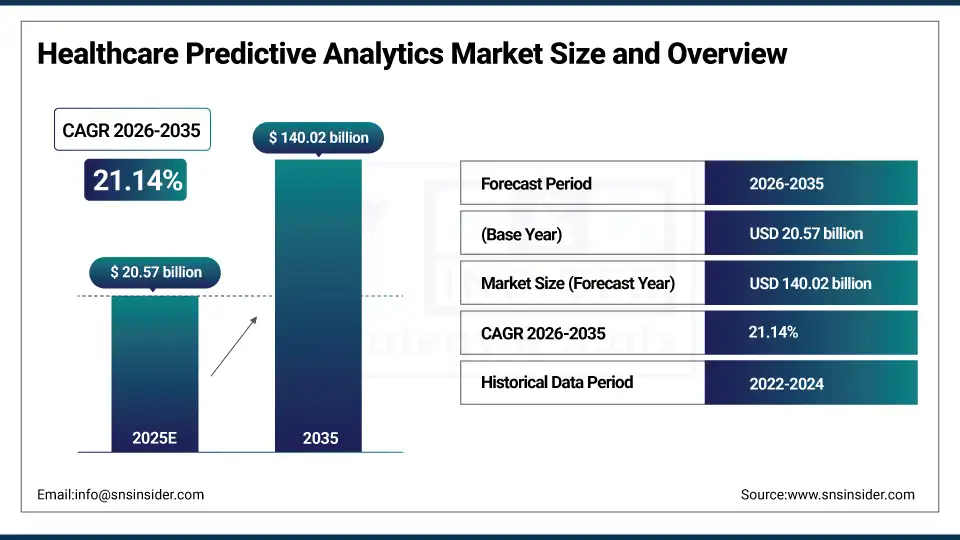
The Healthcare Predictive Analytics Market size was valued at USD 20.57 billion in 2025 and is expected to reach USD 140.02 billion by 2035, growing at a CAGR of 21.14% over the forecast period of 2026-2035.
The global healthcare predictive analytics market trend is a growing demand for AI and machine learning-powered solutions such as clinical decision support systems, population health management platforms, and revenue cycle analytics. The growth of the market is driven by increasing volumes of electronic health records (EHR), government mandates for healthcare digitization, and rising expectations for early disease detection and value-based care delivery. This trend is also driven by a growing adoption of real-time patient monitoring technologies and the growing focus on operational efficiency in healthcare as providers and payers become more focused on reducing preventable hospital readmissions and are more willing to invest in data analytics infrastructure, resulting in growth in the domestic and international market for cloud-based and on-premises predictive analytics platforms and services.
For instance, in February 2024, growing awareness and improved health IT infrastructure drove a 17% increase in predictive analytics platform deployments across hospital networks in North America, boosting early patient risk identification and remote care management adoption.
Healthcare Predictive Analytics Market Size and Forecast:
-
Market Size in 2025E: USD 20.57 billion
-
Market Size by 2035: USD 140.02 billion
-
CAGR: 21.14% from 2026 to 2035
-
Base Year: 2025
-
Forecast Period: 2026–2035
-
Historical Data: 2022–2024
To Get more information On Healthcare Predictive Analytics Market - Request Free Sample Report
Healthcare Predictive Analytics Market Trends
-
Predictive analytics solutions are being adopted as healthcare providers demand faster identification of high-risk patients, accurate demand forecasting, and real-time clinical outcome monitoring.
-
Customized population health management tools based on patient risk scores, treatment history, and demographic factors to improve care outcomes and reduce preventable hospital admissions.
-
The development of AI-driven clinical decision support tools, mobile health applications, and natural language processing platforms to improve communication between patients and providers and reduce administrative burden.
-
Fraud detection systems, revenue cycle management analytics, and remote patient monitoring integration are all available to ensure continuous financial integrity and treatment adherence across payer and provider networks.
-
Increased demand for cloud-based analytics platforms, mobile-responsive dashboards, and self-service reporting tools to improve accessibility of health data insights and data security compliance.
-
Collaboration between healthcare providers, health IT companies, and EHR vendors to develop integrated predictive analytics ecosystems and improve standards of data interoperability and cross-system exchange.
-
ONC, CMS, and FDA promoting standards for algorithmic transparency, HIPAA compliance, meaningful use requirements, and responsible AI deployment in clinical decision-making environments.
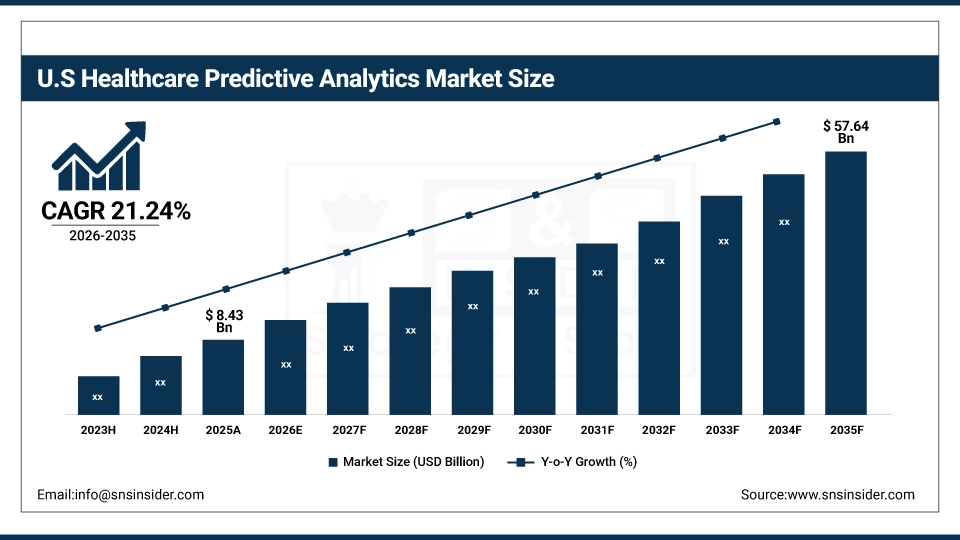
The U.S. Healthcare Predictive Analytics Market was valued at USD 8.43 billion in 2025 and is expected to reach USD 57.64 billion by 2035, growing at a CAGR of 21.24% from 2026-2035. The United States represents the largest market for healthcare predictive analytics, primarily driven by the widespread EHR adoption, federal laws facilitating interoperable access to patient data, and well-developed healthcare IT infrastructure. Government incentives, high levels of health insurance penetration, and increased provider and payer spending on value-based care technology help to drive growth in the market. Also, the U.S. is the largest regional market in the world, due to the regulatory support and swift adoption of cloud-based and AI-integrated healthcare predictive analytics solutions.
Healthcare Predictive Analytics Market Growth Drivers:
-
Government Mandates and Value-Based Care Adoption is Driving the Healthcare Predictive Analytics Market Growth
Government mandates and value-based care adoption take the center stage as a growth driver for the healthcare predictive analytics market share, and are driven by the implementation of CMS quality reporting requirements, 21st Century Cures Act interoperability provisions, and HIPAA regulations for broader patient data access and healthcare transparency. These policies for healthcare digitization and clinical efficiency are expanding the base of the market, the penetration of cloud-based and AI-integrated analytics platforms, and adding to the overall market share globally.
For instance, in June 2024, AI-integrated and cloud-based predictive analytics solutions accounted for ~71% of the total U.S. healthcare provider technology investments, reflecting growing institutional preference and expanding market share.
Healthcare Predictive Analytics Market Restraints:
-
Data Privacy Concerns and Integration Complexity are Hampering the Healthcare Predictive Analytics Market Growth
Data privacy concerns and integration complexity of healthcare predictive analytics platforms also restrict the healthcare predictive analytics market growth, as a large number of healthcare organizations that have access to analytics tools remain underutilizers or face difficulties integrating predictive models with legacy EHR and claims systems. This might lead to underperformance, limited clinical adoption, and reduced return on investment for hospitals and health plans. As a result, patient outcomes suffer and market growth is stunted in regions where health IT maturity is limited and skilled data science talent is in short supply.
Healthcare Predictive Analytics Market Opportunities:
-
AI Integration in Life Sciences and Genomics Analytics Drive Future Growth Opportunities for the Healthcare Predictive Analytics Market
The opportunity in AI integration and life sciences analytics in the healthcare predictive analytics market is in the form of real-world evidence generation, drug discovery acceleration, and clinical trial optimization. These solutions provide for early identification of patient cohorts, individualized therapy predictions, and real-time adverse event monitoring. Through enhanced clinical research efficiency, pharmacovigilance support, and population therapy management capabilities, particularly in areas with high chronic disease burden and active pharmaceutical R&D investment, these technologies may improve trial outcomes, reduce time-to-market, and expand the market.
For instance, in April 2024, the ONC reported that 73% of U.S. healthcare providers had deployed or were actively piloting predictive analytics platforms within their clinical workflows, highlighting rising platform availability and increasing demand for AI-driven health decision tools.
Healthcare Predictive Analytics Market Segment Analysis
-
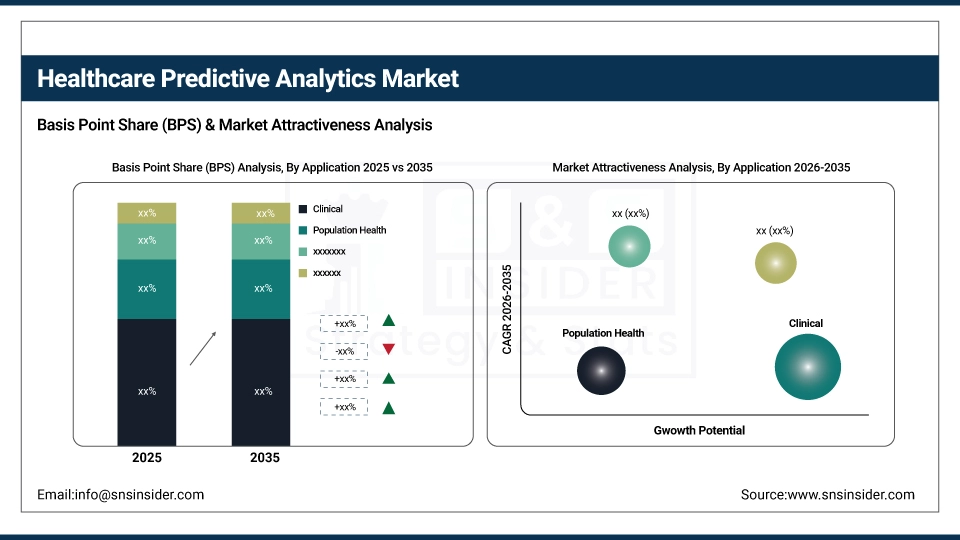
By application, clinical held the largest share of around 35.62% in 2025E, and the population health segment is expected to register the highest growth with a CAGR of 22.38%.
-
By end-use, providers accounted for the leading share of nearly 52.14% in 2025E, and the life science industry segment is expected to register the highest growth with a CAGR of 22.76%.
By Application, Clinical Leads the Market, While Population Health Registers Fastest Growth
The clinical segment accounted for the highest revenue share of approximately 35.62% in 2025, owing to strong healthcare provider reliance on quality benchmarking tools, patient care enhancement platforms, and clinical outcome analysis systems that integrate directly into existing EHR and care coordination workflows. Emerging trends, including increasing regulatory requirements for clinical performance reporting and the growing focus on reducing avoidable adverse events and readmissions. In comparison, the population health segment is anticipated to achieve the highest CAGR of nearly 22.38% during the 2026–2035 period, driven by the increasing demand for population risk management and patient engagement analytics as health systems transition toward value-based and accountable care models. Drivers include rising adoption among payer-provider partnerships, the preference for proactive chronic disease management features, and growing investment in population therapy management tools. Within operations management, demand forecasting, workforce planning and scheduling, and inpatient and outpatient scheduling analytics are gaining traction as hospitals seek to reduce operational inefficiencies and improve resource utilization. The financial segment, covering revenue cycle management and fraud detection, is growing steadily as payers and providers face intensifying pressure to protect margins and ensure claims accuracy.
By End-Use, Providers Lead, and Life Science Industry Registers Fastest Growth
The providers accounted for the largest share of the healthcare predictive analytics market with about 52.14%, owing to their direct patient care responsibilities, regulatory compliance requirements for quality reporting, and significant investment capacity in digital health and analytics infrastructure. Reasons driving the provider segment include increasing patient volume management demands, growing pressure to demonstrate outcome-based performance metrics, and rapid deployment of AI-powered clinical decision support tools across hospital networks and physician groups. In addition, the life science industry segment is slated to grow at the fastest rate with a CAGR of around 22.76% throughout the forecast period of 2026–2035, as pharmaceutical companies, biotech firms, and contract research organizations seek advanced analytics platforms for drug discovery, clinical trial design optimization, and real-world evidence generation. Increased focus on precision medicine and personalized therapy development contribute to their adoption, while improved regulatory submission timelines and reduced trial failure rates drive continued investment in predictive modeling tools.
Healthcare Predictive Analytics Market Regional Highlights:
North America Healthcare Predictive Analytics Market Insights:
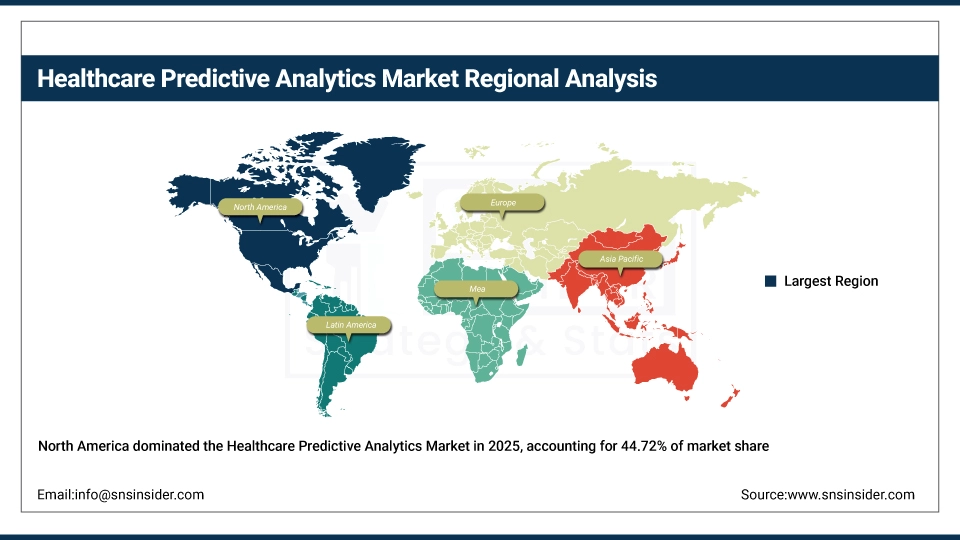
North America held the largest revenue share of over 44.72% in 2025 of the healthcare predictive analytics market due to an established health IT environment, stringent requirements for clinical data access and interoperability, and increased provider awareness regarding the advantages of AI-powered analytics in care delivery and financial management. Drivers include ubiquitous use of EHRs, an improved broadband network, growing smartphone penetration, and greater acceptance of telehealth and remote patient monitoring services stemming from lessons learned during the COVID-19 pandemic. At the same time, various government incentives, CMS meaningful use requirements, and enormous investments in healthcare technology from providers and payers are anchoring predictive analytics software and services in the market, and ensuring multibillion dollar revenues across the region.
Get Customized Report as per Your Business Requirement - Enquiry Now
Asia Pacific Healthcare Predictive Analytics Market Insights:
Asia Pacific is the fastest-growing segment in the healthcare predictive analytics market with a CAGR of 23.15%, as the awareness about AI-driven healthcare solutions, government health IT modernization initiatives, and digital health infrastructure development in countries such as China, India, Japan, and South Korea is growing. Factors including rapid urbanization, rising middle-class population with expanding health insurance coverage, and growing uptake of smartphone-based health applications are stimulating the market growth. National eHealth programs and telemedicine expansion have been instrumental in improving access to data-driven care, especially in rural and semi-urban settings. Public-private partnerships and regional government programs also help in advancing digital health transformation and healthcare analytics adoption. Increase in demand in the Asia Pacific region owing to rising healthcare expenditure against historical spending levels and growing affordability and accessibility of cloud-based predictive analytics platforms.
Europe Healthcare Predictive Analytics Market Insights:
The healthcare predictive analytics market in Europe is the second-dominating region after North America on account of an increase in the adoption of electronic health records, robust data protection regulations including GDPR, and increasing patient empowerment and digital health initiatives across national healthcare systems. Rising implementation of the European Health Data Space (EHDS) framework, advanced national AI strategies, favorable government funding for health IT projects, and cross-border healthcare data exchange directives are also contributing to the sustained growth of the market in leading European countries.
Latin America (LATAM) and Middle East & Africa (MEA) Healthcare Predictive Analytics Market Insights:
In Latin America, and Middle East & Africa, the growing healthcare digitization efforts and increase in internet connectivity with mobile device penetration support the healthcare predictive analytics market growth. The rising popularity of affordable cloud-based analytics solutions and multilingual platform capabilities, along with public awareness campaigns around preventive care, will aid healthcare accessibility and data-driven patient engagement. The increasing urban population and improving healthcare infrastructure in these regions are continuing to encourage market growth.
Healthcare Predictive Analytics Market Competitive Landscape:
IBM Corporation (est. 1911) is a global technology and AI solutions leader that focuses on enterprise-grade data analytics and cloud computing for the healthcare sector. It uses its Watson AI ecosystem and extensive clinical data partnerships to deliver advanced predictive analytics tools for population health, fraud detection, and revenue cycle management.
-
In January 2025, IBM Corporation it expanded its healthcare AI portfolio with enhanced predictive analytics modules for population risk management and payer fraud detection, targeting large integrated delivery networks and health plan organizations across North America and Europe.
Cerner Corporation (Oracle Health) (est. 1979) is a well-known global health information technology company focused on EHR-integrated analytics, population health management, and revenue cycle solutions. It invests in interoperable predictive analytics platforms and AI-powered clinical decision support tools with the hopes of revolutionizing care delivery with accessible, secure, and real-time health data insights.
-
In June 2024, launched an enhanced cloud-based predictive analytics suite featuring real-time inpatient demand forecasting and clinical outcome benchmarking capabilities across North American health systems, enhancing patient care and operational planning efficiency.
Optum, Inc. (UnitedHealth Group) (est. 1992) is a leading health services and analytics company in the fields of population health management, pharmacy care, and payer analytics solutions. The company's predictive analytics product portfolio focuses on risk stratification, care management, and fraud detection, and features a strong commitment to value-based care outcomes and continuous innovation to complement a strong market presence across both payer and provider settings.
-
In September 2024, introduced advanced predictive analytics and personalized care gap identification features for its OptumIQ platform, strengthening population health management capabilities and expanding adoption among regional health plans and accountable care organizations.
Healthcare Predictive Analytics Market Key Players:
-
IBM Corporation
-
Oracle Health
-
Optum, Inc.
-
Epic Systems Corporation
-
SAS Institute Inc.
-
Microsoft Corporation
-
Google LLC
-
Amazon Web Services, Inc.
-
Allscripts Healthcare Solutions
-
Philips Healthcare
-
GE HealthCare Technologies Inc.
-
Siemens Healthineers
-
McKesson Corporation
-
Inovalon Holdings, Inc.
-
Health Catalyst, Inc.
-
Cotiviti, Inc.
-
Apixio Inc.
-
Arcadia.io
-
Ayasdi AI LLC
-
Zynx Health
| Report Attributes | Details |
|---|---|
| Market Size in 2025 | USD 20.57 billion |
| Market Size by 2035 | USD 140.02 billion |
| CAGR | CAGR of 21.14% From 2026 to 2035 |
| Base Year | 2025 |
| Forecast Period | 2026-2035 |
| Historical Data | 2022-2024 |
| Report Scope & Coverage | Market Size, Segments Analysis, Competitive Landscape, Regional Analysis, DROC & SWOT Analysis, Forecast Outlook |
| Key Segments | • By Application (Operations Management, Financial, Population Health, Clinical) • By End-Use (Payers, providers, Life Science Industry) |
| Regional Analysis/Coverage | North America (US, Canada, Mexico), Europe (Eastern Europe [Poland, Romania, Hungary, Turkey, Rest of Eastern Europe] Western Europe] Germany, France, UK, Italy, Spain, Netherlands, Switzerland, Austria, Rest of Western Europe]), Asia Pacific (China, India, Japan, South Korea, Vietnam, Singapore, Australia, Rest of Asia Pacific), Middle East & Africa (Middle East [UAE, Egypt, Saudi Arabia, Qatar, Rest of Middle East], Africa [Nigeria, South Africa, Rest of Africa], Latin America (Brazil, Argentina, Colombia, Rest of Latin America) |
| Company Profiles | IBM Corporation, Oracle Health, Optum Inc., Epic Systems Corporation, SAS Institute Inc., Microsoft Corporation, Google LLC, Amazon Web Services Inc., Allscripts Healthcare Solutions, Philips Healthcare, GE HealthCare Technologies Inc., Siemens Healthineers, McKesson Corporation, Inovalon Holdings, Inc., Health Catalyst Inc., Cotiviti Inc., Apixio Inc., Arcadia.io, Ayasdi AI LLC, Zynx Health |

Frequently Asked Questions
The market was valued at USD 20.57 billion in 2025 and is expected to reach USD 140.02 billion by 2035, growing at a CAGR of 21.14% (2026–2035).
Key drivers include increasing EHR adoption, government digitization mandates, value-based care models, AI-powered clinical decision support systems, and demand for early disease detection.
North America holds the largest market share (over 44% in 2025), while Asia Pacific is the fastest-growing region with a CAGR of 23.15%.
The clinical application segment leads with around 35.62% market share in 2025, while population health management is projected to grow the fastest.
Major challenges include data privacy concerns, integration complexity with legacy systems, limited skilled professionals, and regulatory compliance requirements.
