
Hyaluronic Acid Market Report Scope & Overview:
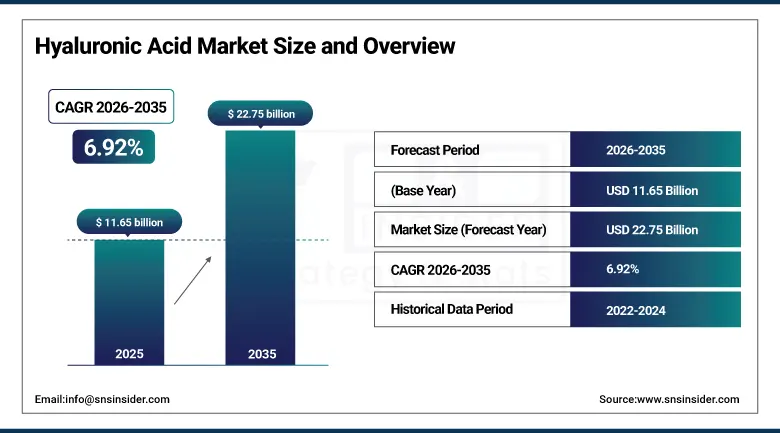
The Hyaluronic Acid Market was valued at USD 11.65 billion in 2025 and is expected to reach USD 22.75 billion by 2035, growing at a CAGR of 6.92% from 2026–2035.
The market for hyaluronic acid (HA) is experiencing continuous growth and is expanding consistently. The increase is attributed to the increasing usage of hyaluronic acid in various sectors, including cosmetics and healthcare. Hyaluronic acid occurs naturally in the human body in areas such as skin, connective tissues, and eyes. Its moisturizing properties, along with its joint lubrication capabilities and capacity for tissue regeneration, make it an extremely useful compound. Consumer demand for nonsurgical cosmetic procedures and treatments for age-related issues keeps increasing around the world, resulting in a high requirement for hyaluronic acid in procedures such as dermal fillers, orthopedic injections, eye surgery, and drug delivery systems.
Regulatory support for HA-based products remains broadly positive across major markets. The FDA and equivalent agencies in Europe and Asia have approved a growing number of HA-based formulations for both medical and cosmetic applications, providing a stable regulatory foundation for continued market expansion.
To Get more information on Hyaluronic Acid Market - Request Free Sample Report
Hyaluronic Acid Market Trends
-
Rising global demand for minimally invasive aesthetic procedures including dermal fillers, lip augmentation, and facial volumization using HA-based injectables.
-
Growing aging population across North America, Europe, and Asia Pacific driving increased clinical use of HA for osteoarthritis management and joint pain relief.
-
Expanding use of pharmaceutical-grade hyaluronic acid in ophthalmic surgery, including cataract extraction, corneal transplantation, and dry eye treatment.
-
Increasing consumer interest in anti-aging skincare driving strong demand for HA-infused topical creams, serums, and moisturizers across mass and premium segments.
-
Technological advancements in HA cross-linking and formulation enabling longer-lasting dermal fillers with improved safety profiles and more natural aesthetic outcomes.
-
Growing adoption of single-injection HA formulations in orthopedics for early-stage osteoarthritis, improving patient compliance and reducing clinic visit burdens.
-
Expanding research into HA-based drug delivery systems and tissue engineering applications creating new revenue streams beyond established aesthetic and orthopedic categories.
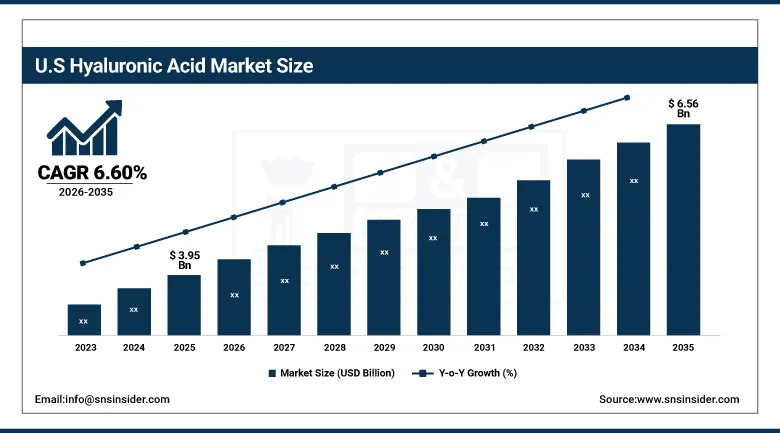
U.S. Hyaluronic Acid Market was valued at USD 3.95 billion in 2025 and is expected to reach USD 6.56 billion by 2035, registering a CAGR of 6.60% during 2026–2035.
United States of America takes the lead among individual countries with regard to the market share of HA due to the presence of an extremely advanced cosmetic industry, strong health care infrastructure, and high purchasing power. The industry providing aesthetic procedures in the United States is highly developed, boasting numerous clinics specializing in dermatology, plastic surgeries, and other branches of medicine with the provision of HA treatment options for a wide array of consumers. HA dermal fillers and HA pharmaceuticals are well-recognized by the Food & Drug Administration (FDA) of the United States.
The high prevalence of osteoarthritis in the U.S., where a significant proportion of the adult population is affected by this condition, continues to support steady demand for HA intraarticular injections as both a first-line and adjunct therapy. Increasing utilization of HA in ophthalmic procedures, particularly cataract surgery which is one of the most commonly performed surgical procedures in the country, provides an additional and reliable demand driver for pharmaceutical-grade HA products throughout the forecast period.
Hyaluronic Acid Market Segment Insights
-
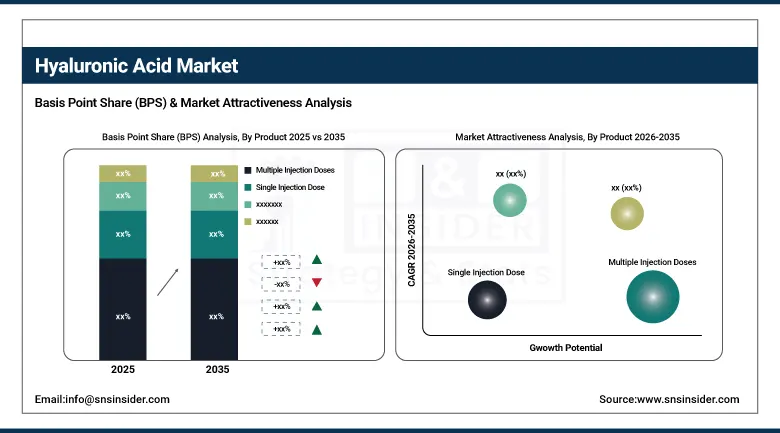
Based on Product, Multiple Injection Doses accounted for the largest market share (~78.54%) in 2025; Single Injection Dose expected to be the fastest-growing segment (CAGR).
-
Based on Application, Dermal Fillers accounted for the largest market share (~42.36%) in 2025; Ophthalmic segment expected to be the fastest-growing segment (CAGR).
-
Based on Grade, Pharmaceutical Grade accounted for the largest market share (~71.25%) in 2025; Cosmetic Grade expected to record a strong CAGR driven by topical skincare growth.
-
Based on End-Use, Hospitals accounted for the largest market share in 2025; Dermatology Clinics expected to be the fastest-growing segment (CAGR).
Hyaluronic Acid Market Segment Analysis
By Product, Multiple Injection Doses dominate the Hyaluronic Acid Market, Single Injection Dose expected to grow fastest
Injections of more than one dose captured the largest market share, capturing about 78.54% of the entire revenue share in 2025. The large market share of injections in more than one dose is attributed to the broad application of HA multi-dose injection techniques in the treatment of various chronic disorders such as osteoarthritis. Patients with osteoarthritis receive multiple injections within a specified time duration that ensures patients get prolonged relief from pain and improve their mobility. In addition, dermatologists employ multi-dose technique to treat patients seeking aesthetic benefits. Multi-dose treatment techniques offer predictability hence making this product a preferred choice by clinicians.
The single injection dose segment is expected to register the fastest growth rate throughout the forecast period of 2026 to 2035. Single-injection HA formulations appeal to both patients and clinicians because they simplify treatment protocols, reduce the number of clinic visits required, and improve overall patient compliance. In orthopedics, once-weekly single-dose formulations for early-stage osteoarthritis are gaining acceptance among patients who prefer a less intensive treatment schedule. In aesthetics, single-session injectable treatments are attracting new patients who may be hesitant about multi-visit commitments but are open to a single convenient procedure with immediate visible results.
By Application, Dermal Fillers dominate the Hyaluronic Acid Market, Ophthalmic segment expected to grow fastest
In 2025, the segment of dermal fillers’ application will have the maximum market share in the HA industry, accounting for around 42.36% of the global revenue. Demand for these fillers has witnessed significant growth during the past decade owing to increased awareness about minimally invasive cosmetic procedures amongst all the demographics and regions. These fillers have diverse uses including filling in facial contours, treating wrinkles, lips enlargement, and addressing sunken eyes. The biocompatibility of these fillers along with their reversible nature by hyaluronidase and proven safety profile makes them more desirable than any other filler material.
The ophthalmic segment is expected to register the fastest growth rate over the forecast period. Hyaluronic acid is a critical component in ophthalmic surgery, where it serves as a viscoelastic surgical aid during procedures such as cataract extraction and corneal transplantation. Its lubricating and tissue-protecting properties prevent damage to delicate intraocular structures during surgery and support post-operative healing. The increasing global prevalence of age-related cataracts and the rising volume of ophthalmic surgeries performed worldwide, driven by aging populations and improving access to eye care in emerging markets, are creating a growing and durable demand base for ophthalmic-grade HA throughout the forecast period.
By Grade, Pharmaceutical Grade dominates the Hyaluronic Acid Market, Cosmetic Grade recording strong CAGR
In the year 2025, the pharmaceutical-grade hyaluronic acid would dominate the market with its market share amounting to roughly 71.25% in total market revenue. The reason why only pharmaceutical grade HA is used in medical applications, such as intra-articular injections, eye surgery, and in the formulation of drugs is because of the extremely high purity and quality requirements of pharmaceutical-grade HA. These requirements result in significant barriers to entry and thus give a competitive advantage to existing manufacturers with long-term experience producing high-quality HA products.
Cosmetic-grade hyaluronic acid is recording a strong and consistent growth rate, driven by the rapid expansion of the global anti-aging skincare market. Topical HA products including serums, moisturizers, eye creams, and sheet masks have become mainstream skincare staples across multiple price segments globally. Growing consumer education about HA's moisture-binding and skin-plumping properties, combined with the proliferation of HA-containing products across both prestige and mass-market skincare brands, is driving volume growth in the cosmetic-grade segment at a pace that rivals therapeutic applications.
By End-Use, Hospitals dominate the Hyaluronic Acid Market, Dermatology Clinics expected to grow fastest
The hospitals have dominated the market for hyaluronic acid by forming the highest-end use market share of 2025. Hospitals act as the leading location for the treatment of highly complicated applications of HA, such as ophthalmic surgery, joint injection for osteoarthritis, and delivery of medication to treat diseases. The large number and economic significance of HA-based treatments performed in hospitals, together with the demand by surgical teams for thoroughly tested pharmaceutical-grade HA, have led to the dominance of the end-use category.
Dermatology clinics are expected to grow at the fastest CAGR throughout the forecast period. The rapid expansion of aesthetic medicine as a specialty, combined with growing consumer demand for non-surgical cosmetic treatments performed in outpatient settings, is driving significant growth in the number and revenue of dermatology and medical aesthetics clinics worldwide. These clinics serve as the primary delivery channel for HA dermal fillers, anti-aging injectables, and skin booster treatments, and their growing reach, particularly in Asia Pacific and Latin America where aesthetic clinic networks are expanding rapidly, makes them the fastest-growing end-use segment for HA products.
Hyaluronic Acid Market Regional Analysis
|
Region |
Major Country |
Share within Region (%) |
|---|---|---|
|
North America |
United States |
80% |
|
Europe |
Germany |
29% |
|
Asia Pacific |
China |
38% |
|
Middle East & Africa |
UAE |
34% |
|
Latin America |
Brazil |
50% |
North America Hyaluronic Acid Market Insights
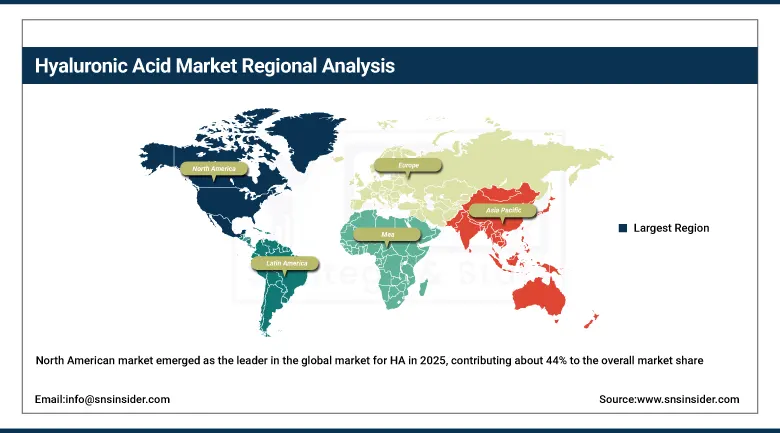
The North American market emerged as the leader in the global market for HA in 2025, contributing about 44% to the overall market share. The US plays a critical role in sustaining the dominance of the market, being one of the leading countries in terms of developed and active medical aesthetics market. Consumer knowledge and willingness to adopt HA treatments, presence of numerous dermatology and aesthetic centers, and financial capabilities lead to a high demand for HA for cosmetic and therapeutic purposes. Osteoarthritis and high number of ophthalmological surgeries carried out each year drive up the demand for pharmaceutical HA. The Canadian market is also among important factors contributing to the revenues of the North American market due to a well-developed healthcare and aesthetics sectors.
Get Customized Report as per Your Business Requirement - Enquiry Now
Asia Pacific Hyaluronic Acid Market Insights
The Asia Pacific region is estimated to be the fastest-growing CAGR holder in the global hyaluronic acid industry between 2026 to 2035. This growth can be attributed to various factors such as rapid aging population, higher disposable income, increasing awareness about aesthetics among young customers, and increased focus on developing infrastructure in medical tourism. Japan, South Korea, and China form the leading and well-established markets in the region, where there is significant demand for hyaluronic acid for dermatological fillers as well as orthopedic purposes. South Korea is emerging as one of the leading destinations when it comes to cosmetic surgeries, and trends adopted in South Korea influence the consumers' decisions in the rest of the region. Governments in Southeast Asia and India are also investing in improving their healthcare infrastructure, thus enabling greater accessibility of treatment with HA.
Europe Hyaluronic Acid Market Insights
Europe serves as an established and rapidly expanding hyaluronic acid market, characterized by a highly regulated health care system, a robust aesthetic medicine tradition, and high consumer awareness about the advantages of HA. Among the leading national markets in Europe are Germany, France, the UK, and Italy, all of which have developed systems of aesthetic clinics and a high level of consumer involvement in minimally invasive cosmetic procedures. Regulations regarding HA-based dermal fillers and medical devices in the European Union offer a precise approval process and high-quality standards for products, thus increasing consumer trust. Aging demographics in Europe continue to drive demand for cosmetic and therapeutic anti-aging HA products.
Middle East & Africa and Latin America Hyaluronic Acid Market Insights
In terms of the interest in aesthetic medicine and HA treatments in the MEA region, there has been an increase, especially among the Gulf Cooperation Council nations, where consumer purchasing power and their fascination with wellness and beauty are leading factors in driving market growth. The United Arab Emirates stands out in the region as it boasts a highly developed private healthcare and aesthetics industry that serves not only local but also international medical tourists. In Latin America, too, the trend is similar, with Brazil being the leader in terms of generating revenue from HA treatment, due to the extremely active population of the country in terms of its desire to look good and stay young.
Hyaluronic Acid Market Growth Drivers:
-
Rising consumer demand for minimally invasive aesthetic procedures and anti-aging treatments
Growth in the global hyaluronic acid market will be driven by the ever-growing and expanding consumer preference towards less invasive forms of cosmetic procedures that provide them with an improved appearance with minimal downtime. With hyaluronic acid dermal fillers becoming one of the most sought-after forms of aesthetics treatment worldwide owing to their instant effects, ability to be reversed, and high safety, HA fillers are attracting more clients of different ages and demographics who prefer to opt for nonsurgical options as opposed to going under the knife. Moreover, the growing role of social media and evolving beauty standards, as well as the rising acceptance of aesthetic treatment among younger generations, represent a key trend that will help maintain steady market development during the forecast period.
Industry data and clinical surveys consistently confirm that patient satisfaction with HA-based aesthetic treatments is high, driving strong repeat procedure rates and positive word-of-mouth that continues to bring new patients into the aesthetic medicine ecosystem. The combination of new patient acquisition and high retention among existing patients is creating compounding volume growth in the HA dermal filler segment that is expected to remain a core driver of overall market expansion through 2035.
Hyaluronic Acid Market Restraints
-
High manufacturing costs and stringent regulatory requirements limiting market accessibility for smaller producers
A significant restraint on the hyaluronic acid market is the combination of high production costs and demanding regulatory requirements associated with pharmaceutical-grade HA manufacturing. Producing hyaluronic acid at the purity and quality standards required for medical applications requires specialized fermentation or extraction processes, sophisticated purification technology, and rigorous quality control systems. The capital investment required to build and maintain compliant manufacturing facilities creates meaningful barriers to entry that limit competition and can constrain supply responsiveness to demand increases. For cosmetic-grade HA products, while regulatory requirements are less stringent, the need for investment in formulation technology and brand-building remains a challenge for newer or smaller market entrants seeking to compete with established brands.
Hyaluronic Acid Market Opportunities
-
Expanding applications in regenerative medicine, drug delivery, and tissue engineering
The major areas of growth expected to drive the market for hyaluronic acid during the forecast period will include the increasing utilization of HA as a platform biomaterial for regenerative medicine, targeted drug delivery, and tissue engineering. HA’s characteristics of biocompatibility, biodegradability, and modification potential offer an ideal platform for developing HA delivery systems for carrying therapeutic molecules into diseased tissues. The use of HA delivery systems is proving valuable in a wide variety of therapeutic fields, including oncology, wound care, and inflammatory disease treatment, among others. With these applications progressing from preclinical studies through clinical testing and into commercial deployment, substantial additional sales should be generated for the global HA industry.
Recent Developments:
2025 (March): Allergan Aesthetics, an AbbVie company, showcased 29 research abstracts at the American Academy of Dermatology Annual Meeting in San Diego, demonstrating ongoing commitment to innovation in medical dermatology and aesthetic applications and highlighting new clinical data supporting the safety and performance of its HA-based filler portfolio.
2024 (January): Galderma received regulatory approval for Restylane SHAYPE, a next-generation hyaluronic acid injectable specifically formulated for chin augmentation, expanding the clinical indications for HA-based dermal fillers into facial structural enhancement beyond traditional wrinkle and volume applications.
Hyaluronic Acid Market Key Players
Some of the Hyaluronic Acid Market Companies
-
Allergan (AbbVie)
-
Galderma Laboratories L.P.
-
Zimmer Biomet
-
Smith & Nephew Plc
-
Sanofi
-
F. Hoffmann-La Roche AG
-
Bloomage Biotechnology Corporation Limited
-
Shiseido Company, Limited
-
HTL Biotechnology
-
Genzyme Corporation (Sanofi)
-
Ferring B.V.
-
LG Life Sciences Ltd. (LG Chem.)
-
Lifecore Biomedical, LLC
-
Maruha Nichiro, Inc.
-
Salix Pharmaceuticals
-
Anika Therapeutics, Inc.
-
Seikagaku Corporation
-
Contipro a.s.
-
Kewpie Corporation
-
Bioiberica S.A.U.
| Report Attributes | Details |
|---|---|
| Market Size in 2025 | USD 11.65 Billion |
| Market Size by 2035 | USD 22.75 Billion |
| CAGR | CAGR of 6.92% From 2026 to 2035 |
| Base Year | 2025 |
| Forecast Period | 2026-2035 |
| Historical Data | 2022-2024 |
| Report Scope & Coverage | Market Size, Segments Analysis, Competitive Landscape, Regional Analysis, DROC & SWOT Analysis, Forecast Outlook |
| Key Segments | • By Product (Single Injection Dose, Multiple Injection Doses) • By Application (Dermal Fillers, Osteoarthritis, Ophthalmic, Vesicoureteral Reflux, Other Applications) • By Grade (Pharmaceutical Grade, Cosmetic Grade) • By End-Use (Hospitals, Dermatology Clinics, Ambulatory Surgical Centers, Other End-Users) |
| Regional Analysis/Coverage | North America (US, Canada), Europe (Germany, UK, France, Italy, Spain, Russia, Poland, Rest of Europe), Asia Pacific (China, India, Japan, South Korea, Australia, ASEAN Countries, Rest of Asia Pacific), Middle East & Africa (UAE, Saudi Arabia, Qatar, South Africa, Rest of Middle East & Africa), Latin America (Brazil, Argentina, Mexico, Colombia, Rest of Latin America). |
| Company Profiles | Allergan (AbbVie), Galderma Laboratories L.P., Zimmer Biomet, Smith & Nephew Plc, Sanofi, F. Hoffmann-La Roche AG, Bloomage Biotechnology Corporation Limited, Shiseido Company, Limited, HTL Biotechnology, Genzyme Corporation (Sanofi), Ferring B.V., LG Life Sciences Ltd. (LG Chem.), Lifecore Biomedical, LLC, Maruha Nichiro, Inc., Salix Pharmaceuticals, Anika Therapeutics, Inc., Seikagaku Corporation, Contipro a.s., Kewpie Corporation, Bioiberica S.A.U. |
Frequently Asked Questions
North America dominated the Hyaluronic Acid Market in 2024.
The “Multiple injection doses” segment dominated the Hyaluronic Acid Market.
An increase in Osteoarthritis and Joint Disorders is driving the global hyaluronic Acid market growth.
The Hyaluronic Acid Market was USD 3.95 billion in 2024 and is expected to reach USD 6.56 billion by 2032.
The Hyaluronic Acid Market is expected to grow at a CAGR of 6.60% from 2025-2032.
