
Industrial Embedded System Market Report Scope & Overview:
The Industrial Embedded System Market size was valued at USD 61.94 Billion in 2025E and is projected to reach USD 92.63 Billion by 2033, growing at a CAGR of 5.16% during 2026–2033.
The Industrial Embedded System market is experiencing steady growth driven by rising demand for high-performance, energy-efficient computing platforms capable of handling complex industrial and IoT workloads. Advances in microcontroller architectures, including dual-core designs, enable improved processing, real-time control, and graphics performance within compact embedded systems. Integration of advanced memory technologies, deterministic networking, and strong security features supports reliable operation in automation, smart manufacturing, and industrial control environments. Increasing adoption of connected devices, human–machine interfaces, and real-time data processing further accelerates market expansion, as industries seek scalable, secure, and efficient embedded solutions to support digital transformation and Industry 4.0 initiatives.
October 24, 2025: New dual-core microcontrollers are launched for high-performance industrial and IoT embedded systems, combining Cortex-M85 and Cortex-M33 cores.They feature MRAM, Gigabit Ethernet with TSN, strong security, and graphics support for advanced embedded and HMI applications.
Industrial Embedded System Market Size and Forecast:
-
Market Size in 2025E: USD 61.94 Billion
-
Market Size by 2033: USD 92.63 Billion
-
CAGR: 5.16% from 2026 to 2033
-
Base Year: 2025E
-
Forecast Period: 2026–2033
-
Historical Data: 2022–2024

To Get more information on Industrial Embedded System Market - Request Free Sample Report
Industrial Embedded System Market Highlights:
-
Rising demand for advanced communication interfaces is driving adoption of embedded systems that support high-speed data exchange, dual-protocol connectivity, and reliable diagnostics in industrial and automotive environments.
-
Growth in industrial automation, smart manufacturing, and Industrial IoT is increasing the need for compact, standardized, and energy-efficient embedded platforms that simplify integration and reduce development time.
-
High development costs, complex integration with legacy systems, and stringent regulatory requirements remain key challenges limiting large-scale adoption, particularly for small and mid-sized enterprises.
-
Security and data privacy concerns in connected and networked embedded systems continue to influence design complexity and deployment decisions.
-
Increasing demand for high-performance, scalable, and energy-efficient embedded solutions is creating opportunities across industrial automation, robotics, medical devices, automotive electronics, and IoT applications.
-
Compatibility with existing hardware and modular designs enables faster upgrades, lower costs, and accelerated time-to-market, supporting broader adoption of advanced industrial embedded technologies.
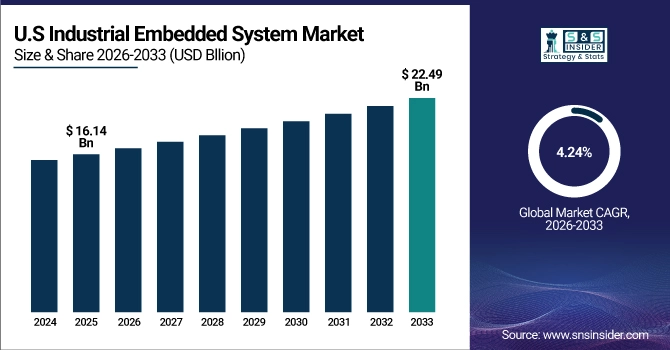
The U.S. Industrial Embedded System Market size was valued at USD 16.14 Billion in 2025E and is projected to reach USD 22.49 Billion by 2033, growing at a CAGR of 4.24% during 2026–2033, driven by rising adoption of industrial automation, Industry 4.0 initiatives, and IoT-enabled systems across manufacturing and infrastructure sectors. Increasing demand for real-time data processing, secure embedded platforms, and advanced human–machine interfaces further supports market expansion, alongside strong investments in smart factories, robotics, and digital transformation across U.S. industries.
Industrial Embedded System Market Drivers:
-
Growing Demand for Advanced Communication Interfaces in Industrial Embedded Systems
The Industrial Embedded System market is being driven by increasing demand for reliable, high-speed communication interfaces that support seamless data exchange across industrial and automotive environments. Embedded solutions enabling dual-protocol connectivity, low-power operation, and robust diagnostics are becoming essential for automation, smart manufacturing, and industrial IoT applications. Compact and standardized hardware platforms help reduce development time, improve system reliability, and simplify integration with existing networks. As industries adopt connected and intelligent systems, the need for flexible, scalable, and energy-efficient embedded communication solutions continues to accelerate, supporting broader deployment of advanced industrial control, monitoring, and automation technologies.
In Dec 2025, MIKROE launches CAN-LIN SBC Click, a compact board enabling high-speed CAN and LIN communication for automotive and industrial systems, supporting low-power operation, diagnostics, and rapid prototyping.
Industrial Embedded System Market Restraints:
-
High Costs, Complex Integration, and Regulatory Challenges Restricting Industrial Embedded System Market Growth
The Industrial Embedded System market faces several restraints that could hinder growth. High development and deployment costs for advanced hardware and software solutions pose a significant barrier, especially for small and medium-sized enterprises. Integration complexity across legacy systems and diverse industrial applications increases implementation time and operational challenges. Security and data privacy concerns in connected and IoT-enabled systems further restrict adoption. Additionally, limited skilled workforce, supply chain disruptions for specialized components, and stringent regulatory compliance in various regions can delay deployments, impacting market expansion despite growing demand for automation, smart manufacturing, and industrial digitalization.
Industrial Embedded System Market Opportunities:
-
Market Potential in Energy-Efficient and Versatile Embedded Systems Across Key Industries
The Industrial Embedded System market presents significant opportunities driven by the increasing demand for high-performance, energy-efficient, and scalable computing solutions. Enhanced modules with advanced processing, graphics, and memory capabilities enable diverse applications across industrial automation, medical devices, automotive electronics, robotics, and IoT systems. Compatibility with existing hardware allows seamless upgrades, reducing development time and costs. Growing adoption of connected devices, smart factories, and automated industrial processes fuels the need for versatile embedded systems. Companies that offer flexible, reliable, and high-performance solutions can capitalize on the expanding market, meeting the rising requirements for compact, efficient, and future-ready embedded technologies globally.
In Dec 2025, Tria Technologies launches advanced Qseven modules for embedded systems, offering enhanced processing, graphics, and memory with full compatibility with existing carrier boards.These modules target industrial automation, medical devices, automotive, robotics, and IoT applications, delivering high performance, energy efficiency, and scalability.
Industrial Embedded System Market Segment Analysis:
-
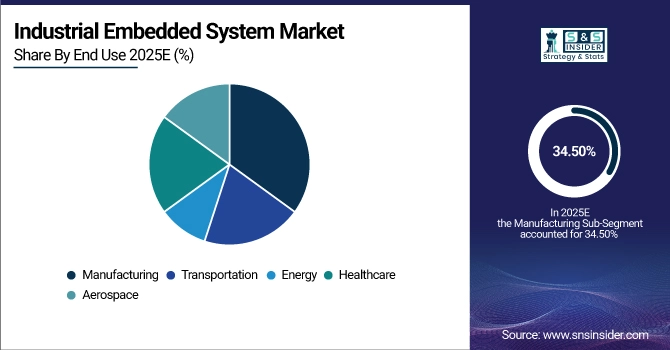
By End Use: Dominant – Manufacturing (34.50% in 2025 → 31.50% in 2033); Fastest-Growing – Transportation (CAGR 7.49%)
-
By Component: Dominant – Microcontrollers (39.75% in 2025 → 38.25% in 2033); Fastest-Growing – Field-Programmable Gate Arrays (CAGR 6.40%)
-
By Application: Dominant – Industrial Automation (27.75% in 2025 → 26.25% in 2033); Fastest-Growing – Telecommunications (CAGR 6.68%)
-
By Architecture: Dominant – Embedded Hardware (37.50% in 2025 → 34.50% in 2033); Fastest-Growing – Embedded Software (CAGR 6.28%)
By End Use, Manufacturing Dominating and Transportation Fastest-Growing
Manufacturing remains the dominant end-use segment from 2025 to 2033, supported by consistent demand across industrial, electronics, and production sectors. Its critical role in large-scale production and established infrastructure ensures sustained market presence. In contrast, Transportation represents the fastest-growing segment, driven by rising adoption of advanced electronics, automation, and smart mobility solutions, reflecting a shift toward mobility-focused applications and innovation in the transportation ecosystem.
By Component, Microcontrollers Dominating and Field-Programmable Gate Arrays Fastest-Growing
Microcontrollers remain the dominant component segment from 2025 to 2033, driven by their extensive use in consumer electronics, automotive, industrial, and IoT applications, supported by mature manufacturing and integration ecosystems. In contrast, Field-Programmable Gate Arrays (FPGAs) represent the fastest-growing segment, fueled by increasing demand for customizable, high-performance, and flexible processing solutions across communications, AI, and advanced computing applications.
By Application, Industrial Automation Dominating and Telecommunications Fastest-Growing
Industrial Automation remains the dominant application segment from 2025 to 2033, driven by steady adoption in manufacturing, robotics, and production systems. Its critical role in optimizing efficiency, reliability, and process automation ensures sustained market share. In contrast, Telecommunications is the fastest-growing application segment, supported by rising deployment of 5G, IoT networks, and connected devices across both consumer and enterprise environments.
By Architecture, Embedded Hardware Dominating and Embedded Software Fastest-Growing
Embedded Hardware remains the dominant architecture segment from 2025 to 2033, owing to its foundational role in computing devices, industrial machines, and consumer electronics. Its established ecosystem and widespread deployment secure long-term market presence. In contrast, Embedded Software represents the fastest-growing segment, driven by increasing complexity of applications, IoT integration, and the need for intelligent, flexible, and secure software solutions across diverse end-use sectors.
Industrial Embedded System Market Regional Analysis:
-
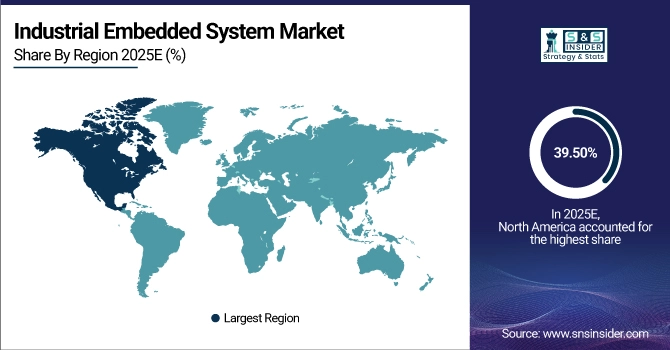
North America: In 2025 39.50% → 37.33% in 2033, Dominant Region, Maintaining Leadership through Mature Industrial Base, Advanced Electronics, and Enterprise Infrastructure (CAGR 4.42%).
-
Asia Pacific: In 2025 30.63% → 34.25% in 2033, Fastest-Growing Region, Driven by Expanding Electronics Manufacturing, Mobile Device Adoption, and IoT Connectivity (CAGR 6.63%).
-
Europe: In 2025 19.75% → 18.15% in 2033, Mature Market, Gradual Share Decline amid Slower Industrial Expansion but Strengthening Automotive & Telecom Electronics (CAGR 4.05%).
-
Latin America: In 2025 5.22% → 5.26% in 2033, Emerging Market, Moderate Growth led by Telecom Expansion & Mobile Connectivity Investments (CAGR 5.27%).
-
Middle East & Africa: In 2025 4.91% → 5.01% in 2033, Small Developing Market, Gradual Expansion supported by Smart City Projects & IoT Adoption (CAGR 5.44%).
North America Industrial Embedded System Market Insights:
North America dominates the Industrial Embedded System market, driven by a mature industrial base, advanced electronics infrastructure, and widespread adoption of automation and IoT technologies. The region’s strong presence of semiconductor manufacturers, enterprise electronics solutions, and supportive regulatory environment ensures sustained market leadership, while continuous innovation in smart manufacturing and connected devices reinforces its competitive advantage over other regions.
Get Customized Report as per Your Business Requirement - Enquiry Now
U.S. States Industrial Embedded System Market Insights:
The U.S. leads the Industrial Embedded System market, driven by advanced electronics infrastructure, strong semiconductor presence, and widespread adoption of automation, IoT, and smart manufacturing solutions across industries.
Asia-Pacific Industrial Embedded System Market Insights:
Asia-Pacific is the fastest-growing region in the Industrial Embedded System market, fueled by rapid industrialization, expanding electronics manufacturing, and increasing adoption of IoT and smart automation technologies. Strong demand for connected devices, mobile solutions, and industrial digitalization across countries like China, India, and Japan drives robust market growth throughout the forecast period.
China Industrial Embedded System Market Insights:
China dominates the Industrial Embedded System market, driven by rapid industrialization, extensive electronics manufacturing, and strong adoption of IoT, automation, and smart manufacturing technologies across multiple industrial and commercial sectors.
Europe Industrial Embedded System Market Insights:
The Europe Industrial Embedded System market is witnessing emerging trends driven by increasing adoption of Industry 4.0 technologies, automation, and smart manufacturing solutions. Growing investments in connected devices, energy-efficient systems, and advanced industrial electronics are shaping the market, while regulatory support and innovation in automotive, aerospace, and telecom sectors further fuel growth.
Germany Industrial Embedded System Market Insights:
Germany dominates the Industrial Embedded System market, supported by its advanced manufacturing infrastructure, strong industrial automation ecosystem, and widespread adoption of IoT and smart factory technologies, reinforcing its leadership in Europe and driving innovation across multiple industrial sectors.
Latin America Industrial Embedded System Market Insights:
The Latin America Industrial Embedded System market is steadily expanding, driven by growing investments in industrial automation, smart manufacturing, and IoT-enabled solutions. Increasing adoption of connected devices, telecom infrastructure development, and supportive government initiatives across countries like Brazil and Mexico are contributing to consistent market growth throughout the forecast period.
Brazil Industrial Embedded System Market Insights:
Brazil is the dominant country in the Latin America Industrial Embedded System market, driven by expanding industrial automation, growing adoption of IoT solutions, and investments in smart manufacturing and connected device technologies.
Middle East & Africa Industrial Embedded System Market Insights:
The Middle East and Africa Industrial Embedded System market is witnessing moderate growth, supported by increasing adoption of smart manufacturing, industrial automation, and IoT technologies. Investments in smart city projects, energy-efficient solutions, and connected industrial infrastructure across countries like UAE, Saudi Arabia, and South Africa are driving steady market expansion.
United Arab Emirates (UAE) Industrial Embedded System Market Insights:
The United Arab Emirates (UAE) is generally considered the dominant country, driven by advanced industrial infrastructure, strong investments in smart city and automation projects, and early adoption of IoT and connected industrial solutions across sectors.
Industrial Embedded System Market Competitive Landscape:
Texas Instruments, established in 1930, is a global semiconductor leader specializing in analog and embedded processing technologies. The company designs and manufactures chips for automotive, industrial, consumer electronics, and communications applications, driving innovation across devices, data centers, and smart systems worldwide.
-
In June 2025, Texas Instruments to invest USD 60B in seven U.S. semiconductor fabs, creating 60,000+ jobs and supporting innovation from vehicles to data centers.Partnerships with Apple, Ford, Medtronic, NVIDIA, and SpaceX strengthen U.S. semiconductor leadership.
STMicroelectronics, established in 1987, is a global semiconductor leader providing microcontrollers, MEMS sensors, power and analog devices. The company serves automotive, industrial, and consumer markets, delivering innovative solutions for smart devices, automotive safety, energy management, and connected systems, driving advanced electronics across a broad range of applications worldwide.
-
In July 2025, STMicroelectronics to acquire NXP’s MEMS sensor business for up to USD 950M, strengthening automotive and industrial sensor portfolio. The acquisition, generating USD 300M revenue in 2024, is expected to be accretive to ST’s earnings and expands MEMS capabilities across safety, industrial, and consumer applications.
Industrial Embedded System Market Key Players:
-
Advantech Co., Ltd.
-
Intel Corporation
-
WinSystems Inc.
-
Toradex Systems (India) Pvt. Ltd.
-
Infineon Technologies AG
-
Beckhoff Automation GmbH & Co. KG
-
Atmel Corporation
-
Texas Instruments
-
VIA Technologies Inc.
-
Foundries.io
-
AVIN System
-
Lynx Software Technologies
-
Leopard Imaging Inc.
-
Dedicated Computing
-
NXP Semiconductors
-
STMicroelectronics
-
Renesas Electronics Corporation
-
Siemens AG
| Report Attributes | Details |
|---|---|
| Market Size in 2025E | USD 61.94 Billion |
| Market Size by 2033 | USD 92.63 Billion |
| CAGR | CAGR of 5.16% From 2026 to 2033 |
| Base Year | 2025E |
| Forecast Period | 2026-2033 |
| Historical Data | 2022-2024 |
| Report Scope & Coverage | Market Size, Segments Analysis, Competitive Landscape, Regional Analysis, DROC & SWOT Analysis, Forecast Outlook |
| Key Segments | • By End Use(Manufacturing, Transportation, Energy, Healthcare and Aerospace) • By Component(Microcontrollers, Microprocessors, Field-Programmable Gate Arrays, Digital Signal Processors and Application-Specific Integrated Circuits) • By Application(Telecommunications, Automotive, Consumer Electronics, Industrial Automation and Healthcare) • By Architecture (Embedded Hardware, Embedded Software, Real-Time Systems, Single-Board Computers and System-on-Chip) |
| Regional Analysis/Coverage | North America (US, Canada), Europe (Germany, UK, France, Italy, Spain, Russia, Poland, Rest of Europe), Asia Pacific (China, India, Japan, South Korea, Australia, ASEAN Countries, Rest of Asia Pacific), Middle East & Africa (UAE, Saudi Arabia, Qatar, South Africa, Rest of Middle East & Africa), Latin America (Brazil, Argentina, Mexico, Colombia, Rest of Latin America). |
| Company Profiles | Key players in the Industrial Embedded System market include Advantech Co., Ltd., Intel Corporation, WinSystems Inc., National Instruments, Toradex Systems (India) Pvt. Ltd., Infineon Technologies AG, Beckhoff Automation GmbH & Co. KG, Atmel Corporation, Texas Instruments, VIA Technologies Inc., Foundries.io, Black Sesame Technologies, AVIN System, Lynx Software Technologies, Leopard Imaging Inc., Dedicated Computing, NXP Semiconductors, STMicroelectronics, Renesas Electronics Corporation, and Siemens AG. |
Frequently Asked Questions
The Industrial Embedded System Market is expected to grow at a CAGR of 5.16 % during 2026–2033.
The Market was valued at USD 61.94 Billion in 2025E and is projected to reach 92.63 USD Billion by 2033.
Rising demand for automation, IoT integration, smart manufacturing, and connected industrial solutions.
The “Microcontrollers” segment dominated during the projected period.
North America dominated the Industrial Embedded System Market in 2025.
