
Instant Coffee Market Report Scope & Overview:
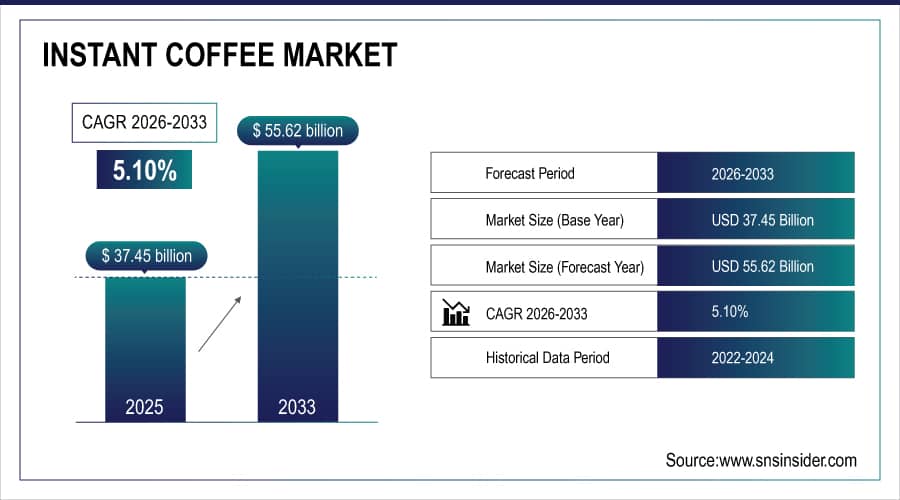
The Instant Coffee Market Size is valued at USD 37.45 Billion in 2025E and is projected to reach USD 55.62 Billion by 2033, growing at a CAGR of 5.10% during the forecast period 2026–2033.
The Instant Coffee Market analysis report provides an in-depth assessment of market performance, emphasizing product innovations, premiumization trends and evolving consumer preferences. Increasing preference for on-the-go beverages, widening retail presence and influx in food service consumption will drive instant coffee sales across the region over the forecast period.
Instant coffee consumption reached 1.12 million metric tons in 2025, driven by growing demand for convenient and affordable coffee options.
To Get More Information On Instant Coffee Market - Request Free Sample Report
Market Size and Forecast:
-
Market Size in 2025: USD 37.45 Billion
-
Market Size by 2033: USD 55.62 Billion
-
CAGR: 5.10% from 2026 to 2033
-
Base Year: 2025
-
Forecast Period: 2026–2033
-
Historical Data: 2022–2024
Instant Coffee Market Trends:
-
Changing consumer lifestyle and inclination toward convenient & on-the-go drinks are driving instant coffee innovations and product launches.
-
Also, increased demand for premium, flavored and specialty blends of coffee are fuelling product differentiation and brand competition.
-
Accelerating demand is also being created by expanding distribution through e-commerce and online grocery channels.
-
Functional and fortified instant coffees, with added protein, vitamins or adaptogens, are being driven by health-conscious trends.
-
Rising demand for coffee in offices, food service and institutions is driving steady market growth.
-
Sustainability projects and green packaging play a role in driving product development, and consumer demand as one that is eco-conscious.
U.S. Instant Coffee Market Insights:
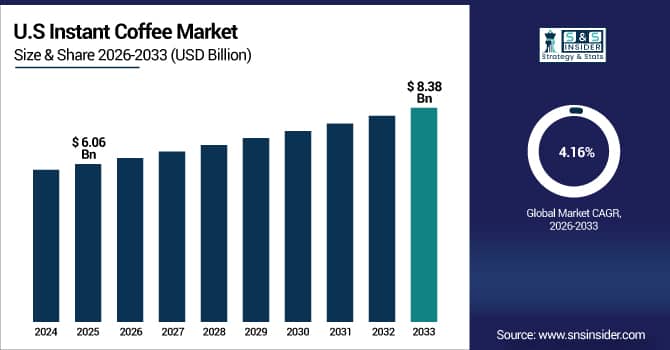
The U.S. Instant Coffee Market is projected to grow from USD 6.06 Billion in 2025E to USD 8.38 Billion by 2033, at a CAGR of 4.16%. Growth is led by increase in demand for ready-to-make, premium and flavored coffee products, growing e-commerce business and rising penetration at the household level and food service sector.
Instant Coffee Market Growth Drivers:
-
Rising demand for convenient, premium and ready-to-drink coffee products boosting instant coffee consumption.
Rising demand for convenient, premium, and ready-to-drink coffee products is a key driver of Instant Coffee Market growth. As the consumer drive toward ‘fast, convenient and delicious’ coffee continues to grow for use at home, in the office or while on-the-go, there is a market opportunity for new and innovative instant coffee solutions. This convenience, preference and premiumization in consumption habit is redefining coffee tastes/options & giving rise to product innovation that will drive penetration in households, foodservice & retail channels.
Instant coffee sales grew 5.8% in 2025, fueled by rising demand for convenient, premium, and ready-to-drink coffee products across households and foodservice channels.
Instant Coffee Market Restraints:
-
Volatile coffee bean prices, supply chain disruptions and high production costs are limiting instant coffee market expansion.
Volatile coffee bean prices, supply chain disruptions, and high production costs are major restraints for the Instant Coffee Market. Unpredictable prices and shortages of raw materials inflate the cost to produce a product, while disruptions in supply chains delay the product availability and raise distribution costs. Frasso feels that the quality and pricing cannot be maintained by small to medium size producers, stymieing market growth. All these factors piling up are restraining returns and access, especially for recent introductions and high-level product segments.
Instant Coffee Market Opportunities:
-
Rising demand for premium, functional and flavored instant coffees present opportunities for product innovation and differentiation.
Rising demand for premium, functional, and flavored instant coffees presents a significant opportunity for the Instant Coffee Market. Manufacturers are also pushing the envelope in this space with specialty blends, added nutrients, adaptogens and novel flavors to meet consumer's evolving tastes. The quality, taste and health-based product differentiation enhances the acceptation and loyaltiness of the brand. This innovation and customization underpin market growth via all three channels household, foodservice and emerging retail.
Premium and functional instant coffees accounted for 22% of new launches in 2025, driven by rising consumer demand.
Instant Coffee Market Segmentation Analysis:
-
By Product Type, Freeze-Dried held the largest market share of 32.45% in 2025, while Ready-to-Drink is expected to grow at the fastest CAGR of 7.12% during 2026–2033.
-
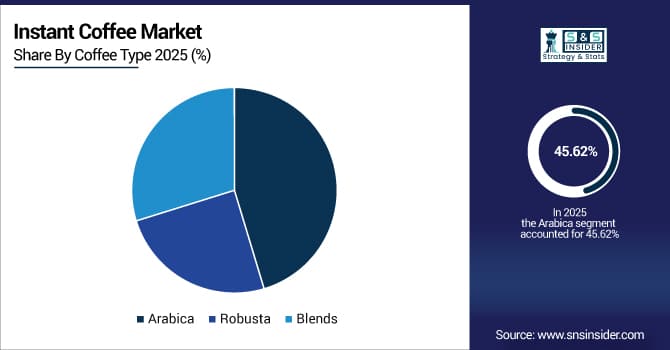
By Coffee Type, Arabica dominated with a 45.62% share in 2025, while Blends are projected to record the fastest CAGR of 6.25% through 2026–2033.
-
By Packaging Type, Jars accounted for the highest market share of 38.27% in 2025, while Sachets are anticipated to grow at the fastest CAGR of 6.40% during the forecast period.
-
By Distribution Channel, Supermarkets & Hypermarkets held the largest share of 42.15% in 2025, while Online Retail is expected to expand at the fastest CAGR of 7.05% during 2026–2033.
-
By End User, Households dominated with a 55.32% share in 2025, while Foodservice is forecasted to register the fastest CAGR of 6.98% through 2026–2033.
By Product Type, Freeze-Dried Dominates While Ready-to-Drink Expands Rapidly:
Freeze-Dried segment dominated the market on account of its uniform taste, longer shelf life and wider penetration among household and retail store. Traditional coffee aficionados found it to be the convenient and versatile option of choice. In 2025, Freeze-Dried instant coffee consumption reached 384,500 metric tons.
Ready-to-Drink is the fastest growing segment, driven by satisfying consumers’ demand for premium coffee experiences on-the-go and continued innovation within flavor. In 2025, Ready-to-Drink sales reached 123,400 metric tons, reflecting rising adoption among young and urban consumers.
By Coffee Type, Arabica Dominates While Blends Expand Rapidly:
Arabica segment dominated the market on account of its smooth taste, superior quality perception and popularity among coffee lovers. Light roasts of instant coffee from Arabica are popular in the cafes and homes. In 2025, Arabica consumption reached 512,300 metric tons.
Blends are the fastest growing segment, where new blends of Arabica and Robusta offer distinctive tastes while also offering cost advantages. In 2025, Blends consumption reached 228,100 metric tons, as consumers increasingly explore diverse taste experiences.
By Packaging Type, Jars Dominate While Sachets Expand Rapidly:
Jars segment dominated the market and are resealable, sturdy and convenient for owning at homes and had been as one of the most other packaging format. In 2025, jar-packaged instant coffee sales reached 421,700 metric tons.
Sachets are the fastest growing segment, attributed to their convenience for single serve, on-the-go use and rising in-office and travel usage. In 2025, sachet sales reached 170,300 metric tons, reflecting the trend for on-the-go consumption and sample-size trials.
By Distribution Channel, Supermarkets & Hypermarkets Dominate While Online Retail Expands Rapidly:
Supermarkets & Hypermarkets segment dominated the market with huge range of product availability, competitive pricing and aggressive promotion analogy. In 2025, sales through these channels reached 475,200 metric tons.
Online Retail is the fastest growing segment, driven by increasing e-commerce penetration, digital advertising and subscription-based delivery models. In 2025, online sales reached 211,800 metric tons, reflecting increasing consumer preference for convenient, doorstep coffee shopping and seamless purchasing experiences.
By End User, Households Dominate While Foodservice Expands Rapidly:
Households segment dominated the market due to the fact that instant coffee is considered as household consumption product which offers ease of access, low-cost and wide option. In 2025, household consumption reached 602,400 metric tons.
Foodservice is the fastest growing segment, powered by rising acceptance of premium and flavored soluble coffee products at cafés, restaurants and offices. In 2025, foodservice demand reached 155,700 metric tons, reflecting rapid growth in commercial coffee experiences and consumer willingness to pay for quality.
Instant Coffee Market Regional Analysis:
Europe Instant Coffee Market Insights:
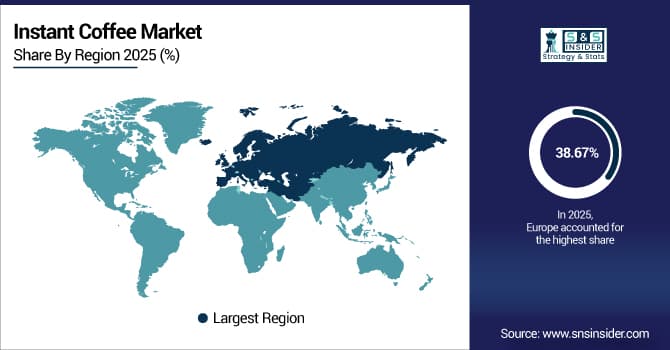
The Europe Instant Coffee Market is dominated with a 38.67% share due to high per capita coffee consumption and a mature coffee culture. High penetration of premium and specialty coffee brands, well-developed retail networks, and increased demand for the on-the-go drinks spur market growth. Germany is emerging as a major contributor and will be the new hotspots of growth in Europe led by robust distribution channels, introduction of innovative new products, growing consumer acceptance for flavored and functional instant coffee varieties.
Get Customized Report as Per Your Business Requirement - Enquiry Now
Germany Instant Coffee Market Insights:
Germany is a key Instant Coffee market as it has a tea-centric culture with high per-capita consumption and has developed retail market. The increasing demand and attractive marketing along with the introduction of innovative products having wide availability in super markets, e-commerce and others have strengthened Germany dominating power over European instant coffee market.
Asia-Pacific Instant Coffee Market Insights:
The Asia-Pacific Instant Coffee Market is the fastest-growing region, projected to expand at a CAGR of 6.63% during 2026–2033. Growth is being fuelled by increasing consumption of coffee, urbanization and the demand for on-the-go and premium drinks in China, India, Japan and South Korea. Rising e-commerce penetration, new product offerings in flavored and ready-to-drink segments, and the rise of café culture continue to make Asia-Pacific the most vibrant market in instant coffee.
China Instant Coffee Market Insights:
China’s Instant Coffee Market is driven by rising urbanization, increased demand for on-the-go and convenient beverages and popularity of premium flavored coffee products are the three significant push factors driving the market. E-commerce boom, café culture growing trends and inspiration from domestic instant coffee Manufacturers make China one of the key growth drivers in APAC Instant Coffee market.
North America Instant Coffee Market Insights:
North America holds a significant position in the Instant Coffee Market due to prevalent coffee culture, per capita consumption in addition to well-established retail and café networks. Increasing demand for flavoured, convenient and premium coffee products, rise in e-commerce penetration and ongoing successful innovations of new coffee developments fuel the market growth. Growing demand for RTD beverages, and functional coffee products will also serve to highlight North America’s status as an important region for instant coffee innovation and commercialization.
U.S. Instant Coffee Market Insights:
The U.S. Instant Coffee Market is primarily driven by high consumption of coffee, increasing inclination toward convenient and premium beverages and expanding café culture. Developments in flavored, functional and ready to drink products, significant R&D and marketing investment will all help cement the country’s position as one of the major players in the North American instant coffee market.
Latin America Instant Coffee Market Insights:
The Latin America Instant Coffee Market is growing due to increased coffee consumption, urbanization and demand for on-the-go beverages in Brazil, Mexico and Argentina support market growth. Increasing retail and e-commerce channels widening in distribution, coupled with increasing preference for premium, RTD soluble coffee products is anticipated to push the growth of the region.
Middle East and Africa Instant Coffee Market Insights:
The Middle East & Africa Instant Coffee Market is growing with the factors such as increasing urbanization, inclination toward café culture and rapid demand for convenient coffee and premium quality products. The investments toward modern retail, e-commerce channels and flavored or ready to drinks product offerings in the countries such as Saudi Arabia, UAE and South Africa are pushing the regional market.
Instant Coffee Market Competitive Landscape:
Nestlé S.A., headquartered in Switzerland, is a leader in the instant coffee market, primarily through its iconic Nescafé and Nespresso brands. The company leads on strength of product range, with flavoured and functional coffee holding potential to lead it again by value through the forecast, due to quality focus and premium positioning. Solid distribution, massive marketing and consumer loyalty programs support that reach. Its commitment to R&D, sustainability and its brand portfolio includes leadership in home-brewing, foodservice and corporate solutions continues to drive category growth.
-
In March 2025, Nestlé S.A. launched “Nescafé Espresso Concentrate,” a new instant coffee product enabling café-style cold and iced coffee at home. It blends premium Arabica beans and rich aroma to enhance convenience and flavor, reinforcing Nestlé’s leadership in instant coffee innovation.
JDE Peet’s N.V., based in the Netherlands, is a key player in the instant coffee market, managing brands such as Jacobs, Douwe Egberts, and Moccona. The wide product range has an advantage for company as availability of quality of coffee and distribution channel keeps the company ahead in the competition. Through its innovation, sustainability sourcing and consumer focus marketing it only ups the appeal of the brand. JDE Peet’s leveraged market penetration through retail, e-commerce and foodservice to maintain a leadership position and growth engine in both developed and emerging coffee markets.
-
In July 2025, JDE Peet’s N.V. introduced a refreshed brand-led instant coffee portfolio, including enhanced offerings under Peet’s and L’OR. The launch emphasizes innovation, sustainable sourcing, and premium flavor experiences, strengthening JDE Peet’s market presence and consumer appeal.
The Kraft Heinz Company, headquartered in the U.S., is a major instant coffee manufacturer known for Maxwell House and other recognized brands. It rules the market with an assorted lower priced input portfolio, standardized quality and bulk production. Strong marketing programs, supermarket distribution and foodservice partnerships drive its penetration. With its commitment to flavor, quality and convenience, The ICEE Company has obtained a proven Direct Store Delivery (DSD) model for success and a coveted place in the demanding consumer beverages market.
-
In January 2025, The Kraft Heinz Company launched a new Maxwell House instant coffee line, featuring convenient, café-style beverage formats for at-home consumption. The product reinforces Maxwell House’s instant coffee portfolio and strengthens Kraft Heinz’s position in North American markets.
Instant Coffee Market Key Players:
Some of the Instant Coffee Market Companies are:
-
Nestlé S.A.
-
JDE Peet’s N.V. (Jacobs Douwe Egberts)
-
The Kraft Heinz Company
-
Starbucks Corporation
-
Tata Consumer Products Limited
-
Unilever PLC
-
Tchibo GmbH
-
Strauss Group Ltd.
-
The J.M. Smucker Company
-
Luigi Lavazza S.p.A.
-
UCC Ueshima Coffee Co., Ltd.
-
Ajinomoto Co., Inc.
-
Massimo Zanetti Beverage Group
-
Moccona (JDE Peet’s)
-
Mount Hagen (Wertform GmbH)
-
Vinacafe (Vietnam National Coffee Corporation)
-
G7 (Trung Nguyen Group)
-
Café Bustelo
-
Folgers Coffee
-
Kenco Coffee
| Report Attributes | Details |
|---|---|
| Market Size in 2025E | USD 37.45 Billion |
| Market Size by 2033 | USD 55.62 Billion |
| CAGR | CAGR of 5.10% From 2026 to 2033 |
| Base Year | 2025E |
| Forecast Period | 2026-2033 |
| Historical Data | 2022-2024 |
| Report Scope & Coverage | Market Size, Segments Analysis, Competitive Landscape, Regional Analysis, DROC & SWOT Analysis, Forecast Outlook |
| Key Segments | • By Product Type (Spray-Dried, Freeze-Dried, Liquid Concentrates, Ready-to-Drink, Coffee Mixes/3-in-1, Others) • By Coffee Type (Arabica, Robusta, Blends) • By Packaging Type (Jars, Sachets, Pouches, Bottles, Cans, Others) • By Distribution Channel (Supermarkets & Hypermarkets, Convenience Stores, Online Retail, Specialty Stores, Foodservice Channels, Others) • By End User (Households, Commercial, Foodservice, Institutional, Others) |
| Regional Analysis/Coverage | North America (US, Canada), Europe (Germany, UK, France, Italy, Spain, Russia, Poland, Rest of Europe), Asia Pacific (China, India, Japan, South Korea, Australia, ASEAN Countries, Rest of Asia Pacific), Middle East & Africa (UAE, Saudi Arabia, Qatar, South Africa, Rest of Middle East & Africa), Latin America (Brazil, Argentina, Mexico, Colombia, Rest of Latin America). |
| Company Profiles | Nestlé S.A., JDE Peet’s N.V. (Jacobs Douwe Egberts), The Kraft Heinz Company, Starbucks Corporation, Tata Consumer Products Limited, Unilever PLC, Tchibo GmbH, Strauss Group Ltd., The J.M. Smucker Company, Luigi Lavazza S.p.A., UCC Ueshima Coffee Co., Ltd., Ajinomoto Co., Inc., Massimo Zanetti Beverage Group, Moccona (JDE Peet’s), Mount Hagen (Wertform GmbH), Vinacafe (Vietnam National Coffee Corporation), G7 (Trung Nguyen Group), Café Bustelo, Folgers Coffee, Kenco Coffee |

Frequently Asked Questions
Europe dominated the market with a 38.67% share in 2025, while Asia-Pacific is the fastest-growing region with a CAGR of 6.63% during 2026–2033.
Freeze-Dried dominated with a 32.45% share in 2025, while Ready-to-Drink is projected to grow at the fastest CAGR of 7.12% during 2026–2033.
Growth is driven by rising demand for convenient, premium, and ready-to-drink coffee, along with expanding e-commerce and foodservice consumption.
The market is valued at USD 37.45 Billion in 2025E and is projected to reach USD 55.62 Billion by 2033.
The Instant Coffee Market is expected to grow at a CAGR of 5.10% during the forecast period 2026–2033.
