
Linear Alkyl Benzene Market Report Scope & Overview:
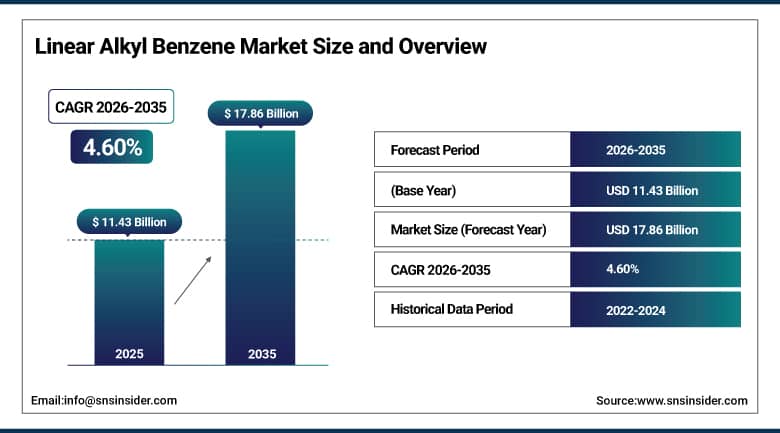
The Linear Alkyl Benzene Market was valued at USD 11.43 Billion in 2025 and is expected to reach USD 17.86 Billion by 2035, growing at a CAGR of 4.60% from 2026 to 2035.
Linear alkyl benzene (LAB) is an organic compound synthesized by the reaction of benzene with linear alpha-olefins or linear paraffins. LAB is the principal raw material for the preparation of linear alkyl benzene sulfonate (LAS), the most extensively employed biodegradable anionic surfactant globally. LAB is appreciated because of its specific chemical composition and reliable reactivity characteristics. This guarantees uniformity in its performance during the process of surfactant production. Linear alkyl benzene can be obtained by two commercial methods: the HF catalysis method and the solid-acid Detal process. The latter involves the use of zeolite or metal oxide catalysts and excludes the risks associated with the handling of liquid acids characteristic of the former method.
Farabi Petrochemicals Company commenced operations at its fourth integrated LAB plant in Yanbu Industrial City, Saudi Arabia, in September 2025. The plant represents a USD 950 million investment. It adds 120,000 metric tons per year of LAB capacity. The facility sources kerosene and benzene feedstocks from adjacent Saudi Aramco refineries. Simultaneously, Farabi signed a new memorandum of understanding with Unilever to expand their two-decade global LAB supply partnership. ExxonMobil launched a new high-purity LAB product for premium detergent formulations in Q3 2024. The product targeted manufacturers seeking enhanced performance and sustainability credentials. Honeywell announced a GBP 1.8 billion acquisition of Johnson Matthey's Catalyst Technologies business in May 2025. The move strengthened Honeywell's UOP division in petrochemical catalysts, including those used in LAB production.
Market Size and Forecast:
-
Market Size in 2026E: USD 11.96 Billion
-
Market Size by 2035: USD 17.86 Billion
-
CAGR: 4.60% from 2026 to 2035
-
Fastest Growing Region: Asia Pacific
-
Largest Region: Asia Pacific
To Get More Information On Linear Alkyl Benzene Market - Request Free Sample Report
Linear Alkyl Benzene Market Trends:
-
Rising liquid detergent consumption is driving global demand for linear alkyl benzene (LAB).
-
Adoption of Detal solid-acid catalysis is improving production efficiency and process safety.
-
Growing demand for heavy LAB grades is expanding industrial and specialty chemical applications.
-
LAB is finding niche opportunities in scientific research as a solvent for liquid scintillator detectors.
-
Expanding home care and personal care applications are broadening LAB demand beyond laundry detergents.
-
Rural detergent penetration in emerging markets is creating sustained growth opportunities for LAB producers.
-
Development of bio-based LAB is supporting the industry's transition toward low-carbon surfactant feedstocks.
U.S. Linear Alkyl Benzene Market Outlook:
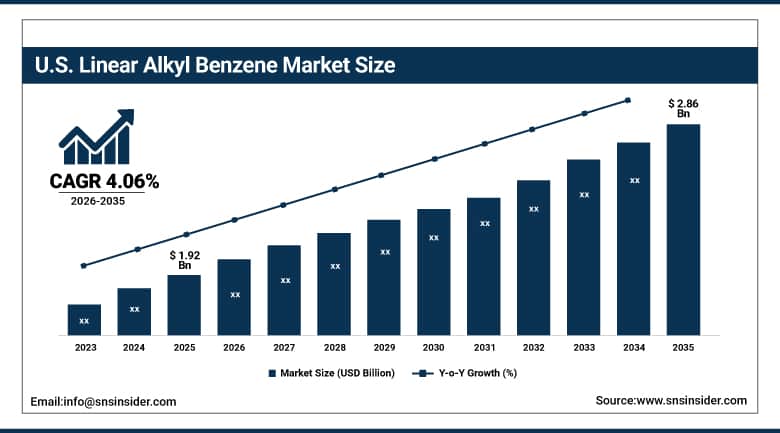
The U.S. Linear Alkyl Benzene Market was valued at approximately USD 1.92 Billion in 2025. It is expected to reach approximately USD 2.86 Billion by 2035, growing at a CAGR of approximately 4.06%.
The United States stands as one of the major LAB consumption markets in North America. The demand for LAB is influenced by the household and industrial cleaning agents industry. American consumers continue to have high per capita use of detergents. The adoption of the liquid concentrated form of detergents has resulted in high demand for LABSA. Two firms that produce LAB domestically in the U.S are Chevron Phillips Chemical Company and Huntsman Corporation. The U.S is also an importer of LAB from the Middle East countries. This is attributed to the disruption of supply chains due to the outbreak of the COVID-19 pandemic. American oilfield chemicals industry uses LAB based sulfonates for enhanced oil recovery purposes.
CEPSA Química launched its NextLab portfolio in 2025, offering low-carbon LAB certified under ISCC PLUS mass balance standards. The product targets European and North American brand owners seeking verifiable sustainability credentials for their surfactant supply chains. The certification allows brands to allocate renewable feedstock content to their LAB-derived LABSA through mass balance accounting. This enables green product claims without requiring a fully bio-based production pathway. Deten Química in Brazil expanded its LAB refining capacity in 2024 to serve growing South American demand. The expansion reflected the region's steady consumer goods sector growth and rising detergent penetration in lower-income urban households.
Linear Alkyl Benzene Market Segment Analysis:
-
By Grade, the standard LAB segment dominated the linear alkyl benzene market in 2025. The heavy LAB segment is the fastest growing grade, driven by industrial cleaner and lubricant additive applications.
-
By Application, the surfactants/LAS segment dominated the linear alkyl benzene market in 2025. Other applications including solvents and lubricant additives are growing steadily during 2026 to 2035.
-
By Distribution Channel, the direct sales segment dominated the linear alkyl benzene market with 63.00% share in 2025. Distributors serve smaller buyers and regional markets where direct supply is not economic.
-
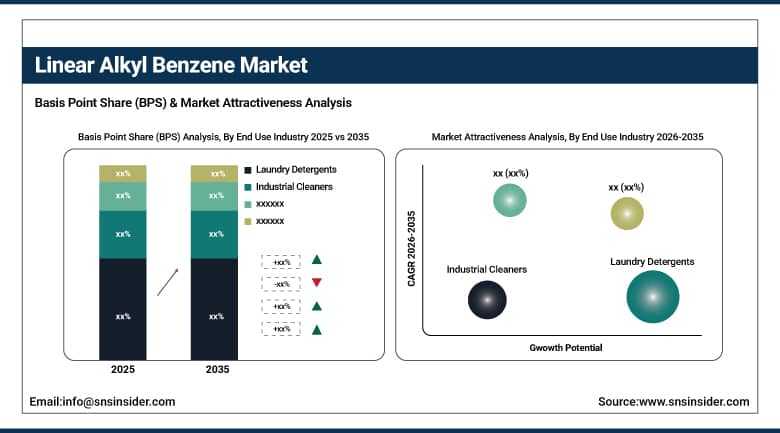
By End Use Industry, the laundry detergents segment dominated the linear alkyl benzene market in 2025. The industrial cleaners segment is among the fastest growing end uses during 2026 to 2035.
By End Use, laundry detergents dominate, industrial cleaners grow
Laundry detergents continued to hold their position as the largest end use in 2025. According to the OECD, about 55-60 percent of total consumption of LAS is represented by laundry detergents globally. Structural demand growth is being fueled by the increasing trend towards machine wash usage in India, Southeast Asia, and Africa. An increase in the washing machine penetration by one percent in the market means demand growth for LAB. Light-duty dishwashing liquids form the second biggest end use. Urbanization and reduced sizes of households make people eat out more frequently.
Industrial cleaners are the fastest growing end use. Demand for heavy duty degreasers based on LABSA grows due to increased manufacturing facility capacity in the Asia Pacific region. Environmental regulations compel companies to replace phosphorus-containing industrial cleaners with more environmentally friendly LAS-based products. Personal care products (shampoos, body washes, and hand soaps) form another end use which is gaining popularity. These products contain LABSA in lower concentrations than laundry detergents. Nevertheless, this end use features a very high purchase frequency rate.
By Application, LAS dominates overwhelmingly
Surfactants and LAS production retained major share of LAB demand in 2025. This dominance reflects LAB's structural role as the sole commercial precursor to linear alkylbenzene sulfonate. The OECD evaluated that LAS production consumes more than 98% of all LAB produced globally. LAS is the backbone of household laundry detergents, dishwashing liquids, and institutional cleaners. Its biodegradability under both aerobic and anaerobic conditions makes it the regulatory-compliant choice across all major markets.
Higher-grade LAS with above 96% active content is gaining share in premium detergent formulations. This drives demand for higher-purity LAB feedstocks. Industrial cleaner applications using LAS-based formulations are growing as manufacturing facility expansion in Asia Pacific requires effective degreasing solutions.
Regional Analysis:
|
Region |
Major Country |
Share within Region, 2025 (%) |
|---|---|---|
|
North America |
United States |
84.73% |
|
Europe |
Germany |
27.84% |
|
Asia Pacific |
China |
42.84% |
|
Middle East & Africa |
Saudi Arabia |
27.84% |
|
Latin America |
Brazil |
43.84% |
Asia Pacific Linear Alkyl Benzene Market Insights
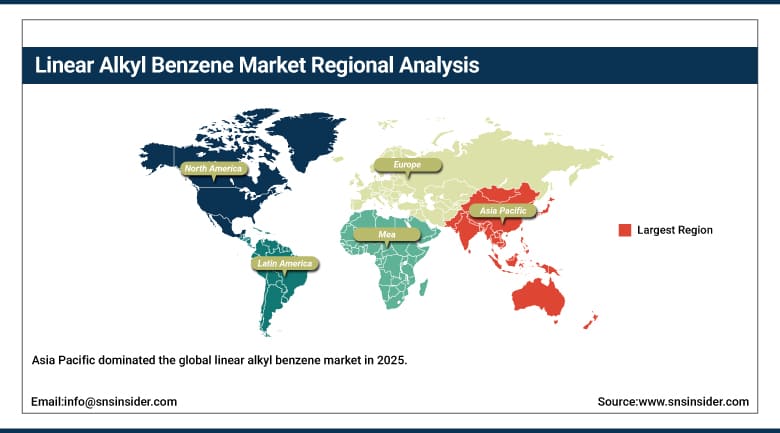
Asia Pacific dominated the global linear alkyl benzene market in 2025. The region held approximately 47.80% of global market share. China accounts for approximately 42.84% of Asia Pacific revenues. China operates the world's largest domestic LAB production capacity serving its massive detergent manufacturing base. India is the second largest regional market. Rapid urbanization, rising hygiene awareness, and government cleanliness campaigns are driving strong LAB demand growth in India. South Korea contributes through ISU Chemical's LAB production. Southeast Asian economies are growing LAB consumers as consumer goods penetration increases.
Get Customized Report as Per Your Business Requirement - Enquiry Now
North America Linear Alkyl Benzene Market Insights
North America held approximately 20.00% of global linear alkyl benzene revenues in 2025. The United States accounts for approximately 84.73% of regional revenue. Domestic production from Chevron Phillips and Huntsman serves the large household cleaning products sector. High per-capita detergent consumption sustains steady LAB procurement. Canada contributes supplementary demand through its household and institutional cleaning products manufacturing. Mexico's growing consumer goods industry creates additional regional demand. The North American market is also characterised by strong demand for premium and concentrated liquid detergent formulations. These products require higher LABSA loading per unit volume than powder detergents. This sustains above-average LAB value growth relative to volume growth in the region.
Europe Linear Alkyl Benzene Market Insights
Europe held major share of global linear alkyl benzene revenues in 2025. Germany accounts for approximately 27.84% of European revenues. CEPSA Química's Spanish LAB operations serve European household and industrial cleaning manufacturers. The EU's strict biodegradability regulations sustain demand for LAS over alternative surfactants. The United Kingdom, France, Italy, and the Netherlands each contribute meaningful European demand through their consumer goods manufacturing sectors. European brand owner sustainability commitments are driving uptake of low-carbon certified LAB grades.
MEA & Latin America Linear Alkyl Benzene Market Insights
The Middle East is emerging as the fastest-growing LAB production hub. Farabi Petrochemicals' September 2025 fourth plant in Yanbu positions Saudi Arabia as a major global LAB exporter. Low-cost kerosene and benzene feedstocks from adjacent refineries provide structural cost competitiveness. Logistical proximity to both European and Asian end markets further strengthens this position. Brazil leads Latin American revenues of the regional total. Deten Química serves the domestic and regional household cleaning markets. Brazil's large and growing consumer goods sector creates steady LAB demand growth.
Market Dynamics:
Growth Drivers: Rising global detergent demand driven by urbanization in emerging economies and regulatory preference for biodegradable LAS surfactants are the primary market demand drivers.
The global demand for cleaning products used in households and institutions is rising faster than the rate of population growth. People are getting more concentrated in urban settings where packaged cleaning products have become the norm. Rising incomes in emerging nations increase the number of families buying manufactured detergents as opposed to locally made products. Biodegradable surfactants are required in regulatory regimes in the EU, USA, and increasingly in Asia. LAB-based LAS always satisfies all these needs. LAB-based LAS is highly effective in soft and hard water, thus it becomes the obvious option in regions with varying water quality. Organized retail is becoming more widespread in emerging countries making these products more available.
Restraints: Dependence on crude oil feedstocks creates production cost volatility, while competition from bio-based and oleochemical surfactants is gradually emerging.
Economics of LAB production are related to the price of benzene and kerosene. Both substances are derivatives of crude oil. Prolonged instability of crude oil prices leads to margin pressure on the side of the producers of LAB, which sell their products according to the fixed-price supply agreement. It poses the problem of supply on the part of detergent makers. Increasing competition comes from surfactants made from oleochemicals, which are by-products of palm and coconut oil. Such alternatives are preferred by consumers who demand natural formulae. Moreover, they are price competitive in countries that have an industry of oleochemicals. However, they cannot compete with LAB-produced LAS industrially yet.
Opportunities: Bio-based LAB development for sustainable surfactant supply chains and heavy LAB grade expansion into industrial lubricant and heat transfer fluid applications represent commercial growth opportunities.
Certification systems such as ISCC PLUS provide the ability for mass-balanced bio-attributed LAB to claim their renewable content. Thus, it is possible for owners of detergent brands to meet sustainability claims without going through a complete route for bio-based production. Programs such as NextLab by CEPSA and others are shaping up this market. Price premiums for certified LABs help to ensure healthy margins in the production of LAB compared to commodity LAB. Industrial heavy LAB grades for use in heat transfer fluids, metal working fluids and rubber compounding are increasing in the industrial sector. Such applications cut down on the competition that exists in the household detergents feedstock market.
There is also an expansion of the pharmaceutical and food processing sectors which makes use of sulfonates made from LABs for sanitation. These have pharmaceutical grade impurity profiles and cost premiums.
Recent Developments:
-
2025: Farabi Petrochemicals commissioned its fourth integrated LAB plant in Yanbu, Saudi Arabia, adding 120,000 metric tons per year of capacity. Farabi simultaneously expanded its Unilever global supply partnership. The facility sources feedstocks directly from adjacent Saudi Aramco refineries.
-
2025: CEPSA Química launched the NextLab portfolio of low-carbon ISCC PLUS mass-balance certified LAB grades. The product targets European and North American brand owners seeking verifiable sustainability credentials for their surfactant supply chains.
-
2025: Honeywell announced a GBP 1.8 billion acquisition of Johnson Matthey's Catalyst Technologies business. This strengthens Honeywell UOP's position in LAB production catalysts. ExxonMobil launched a high-purity LAB product for premium sustainable detergent formulations.
Linear Alkyl Benzene Market Key Players are:
-
CEPSA Química SA
-
Sasol Limited
-
Farabi Petrochemicals Company
-
Tamil Nadu Petroproducts Limited
-
Huntsman Corporation
-
Chevron Phillips Chemical Company LLC
-
ISU Chemical Co. Ltd.
-
Reliance Industries Limited
-
Indian Oil Corporation Limited (IOCL)
-
Deten Química SA
-
SABIC (Saudi Basic Industries)
-
Arabian Petrochemical Company (Petrokemya)
-
Fushun Petrochemical Company
-
Honeywell International Inc. (UOP)
-
Gulf Farabi Petrochemicals Co. Ltd.
-
Formosan Union Chemical Corporation
-
Ho Tung Chemical Corp.
-
Deepak Fertilisers and Petrochemicals Corp.
-
Repsol SA
-
BASF SE
Linear Alkyl Benzene Market Report Scope:
| Report Attributes | Details |
|---|---|
| Market Size in 2025 | USD 11.43 Billion |
| Market Size by 2035 | USD 17.86 Billion |
| CAGR | CAGR of 4.60% From 2026 to 2035 |
| Base Year | 2025 |
| Forecast Period | 2026-2035 |
| Historical Data | 2022-2024 |
| Report Scope & Coverage | Market Size, Segments Analysis, Competitive Landscape, Regional Analysis, DROC & SWOT Analysis, Forecast Outlook |
| Key Segments | • By Grade (Standard LAB (C10–C13 Chain Length), Heavy LAB (C14–C17 Chain Length)) • By Application (Surfactants/Linear Alkylbenzene Sulfonates (LAS), Solvents, Lubricant Additives, Others) • By Distribution Channel (Direct Sales, Distributors) • By End Use Industry (Laundry Detergents, Light-Duty Dishwashing Liquids, Industrial Cleaners, Household Cleaners, Personal Care, Oil & Gas, Others) |
| Regional Analysis/Coverage | North America (US, Canada), Europe (Germany, UK, France, Italy, Spain, Russia, Poland, Rest of Europe), Asia Pacific (China, India, Japan, South Korea, Australia, ASEAN Countries, Rest of Asia Pacific), Middle East & Africa (UAE, Saudi Arabia, Qatar, South Africa, Rest of Middle East & Africa), Latin America (Brazil, Argentina, Mexico, Colombia, Rest of Latin America). |
| Company Profiles | CEPSA Química SA, Sasol Limited, Farabi Petrochemicals Company, Tamil Nadu Petroproducts Limited, Huntsman Corporation, Chevron Phillips Chemical Company LLC, ISU Chemical Co. Ltd., Reliance Industries Limited, Indian Oil Corporation Limited (IOCL), Deten Química SA, SABIC (Saudi Basic Industries), Arabian Petrochemical Company (Petrokemya), Fushun Petrochemical Company, Honeywell International Inc. (UOP), Gulf Farabi Petrochemicals Co. Ltd., Formosan Union Chemical Corporation, Ho Tung Chemical Corp., Deepak Fertilisers and Petrochemicals Corp., Repsol SA, and BASF SE |
Frequently Asked Questions
The Linear Alkyl Benzene Market is expected to grow at a CAGR of 4.60% from 2026 to 2035.
The Linear Alkyl Benzene Market was valued at USD 11.43 Billion in 2025.
The primary growth factors are rising global detergent demand driven by urbanization and income growth in emerging economies, regulatory preference for biodegradable LAS surfactants over branched alternatives.
The surfactants/LAS segment dominated the Linear Alkyl Benzene Market share in 2025.
Asia Pacific dominated the Linear Alkyl Benzene Market in 2025, holding approximately 47.80% of global market share.
