
Lipid Market Report Scope & Overview:
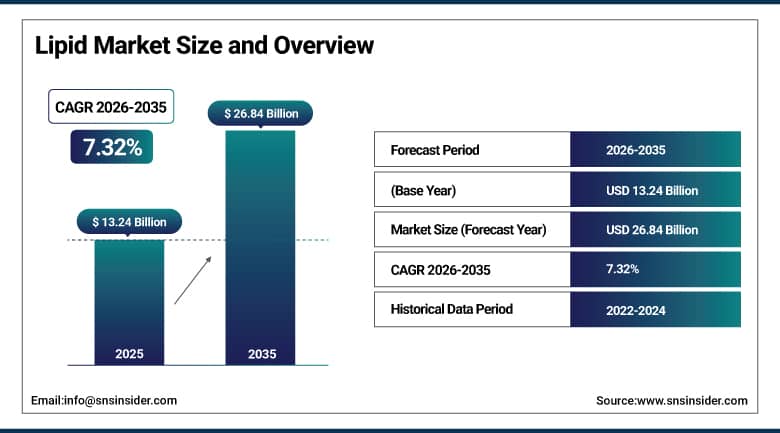
The Lipid Market was valued at USD 13.24 Billion in 2025 and is expected to reach USD 26.84 Billion by 2035, growing at a CAGR of 7.32% from 2026 to 2035.
Lipid market is witnessing strong growth due to increasing necessity of supplementing adequate nutrition to daily diet along with increased demand for healthy food and functional food supplements. Increased focus on personalized medicine is increasing the demand for drug delivery systems based on lipids, especially liposomes used in mRNA vaccines and RNA-based therapeutics. Increasing awareness about functional ingredients is driving the adoption of lipids in cosmetic and personal care products, while omega-3 fatty acids and medium chain triglycerides are gaining popularity due to their health benefits related to cardiac, brain and metabolic functions. Along with all this, technological advancements in the process of extraction and purification, use of oils derived from plants and focus on heart-healthy and sustainable products is driving this trend.
Evonik invested over USD 100 million for setting up of a new GMP manufacturing facility in Vancouver, Canada in August 2026 for increasing the production of lipids for use in drug delivery applications by its pharmaceutical and biotech clients for vaccines and RNA-based therapeutics.
To Get More Information On Lipid Market - Request Free Sample Report
Lipid Market Trends
- Growing demand for lipid nanoparticles in mRNA vaccine and RNA-based therapeutic delivery is driving sustained capital investment in pharmaceutical-grade lipid manufacturing.
- Rising consumer interest in specialty lipid supplements, including omega-3 polyunsaturated fatty acids and MCTs, is expanding at double-digit annual rates as consumers embrace their cardiovascular and cognitive health benefits.
- Expanding use of phospholipids in liposomes, cosmetics, and cognitive health formulations is broadening the ingredient’s application versatility beyond traditional food use.
- Increasing government support for domestic lipid manufacturing capacity is accelerating capital investment among leading pharmaceutical lipid producers.
- Growing consumer preference for plant-derived and sustainably sourced lipids is shaping premium positioning strategies among manufacturers across food and personal care categories.
U.S. Lipid Market Outlook
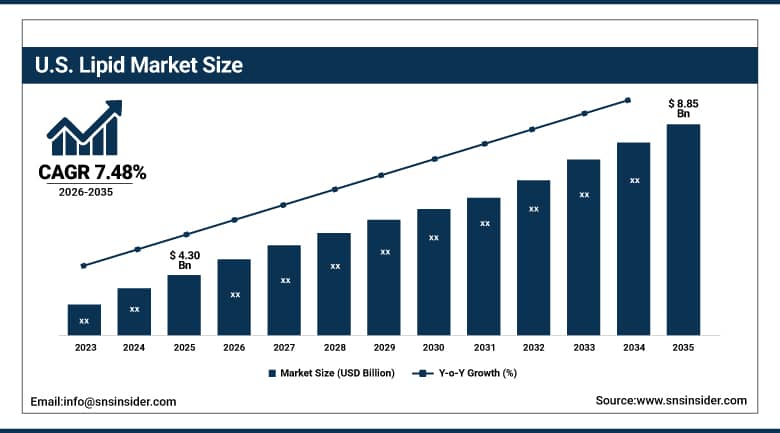
The U.S. Lipid Market was valued at USD 4.30 Billion in 2025 and is projected to reach USD 8.85 Billion by 2035, growing at a CAGR of 7.48% during 2026-2035.
The U.S. Lipid Market is growing steadily, due to strong demand from both the pharmaceutical sector, where lipid nanoparticles are central to RNA-based drug delivery, and the food and nutraceutical sectors, where consumer demand for functional fats and omega-3 supplementation continues rising. The increased federal government support for domestic pharmaceutical-grade lipid manufacturing capacity, including cooperative funding agreements with leading producers, is contributing to the growth of production infrastructure. Food and beverage manufacturers are expanding lipid-based ingredient use across cooking oils, functional foods, and fortified products. Innovations such as high-purity synthetic lipids and advanced extraction technologies are driving customer choice options. Robust distribution networks through direct industrial supply agreements and specialty ingredient distributors are increasing product availability.
In 2025, Croda International received a cooperative agreement of up to USD 75 Million from the U.S. government, combined with Croda’s own investment of up to USD 58 Million, for a total project investment of up to USD 133 Million, to expand its lipid systems manufacturing capacity at a new site in Lamar, Pennsylvania.
Lipid Market Segment Analysis
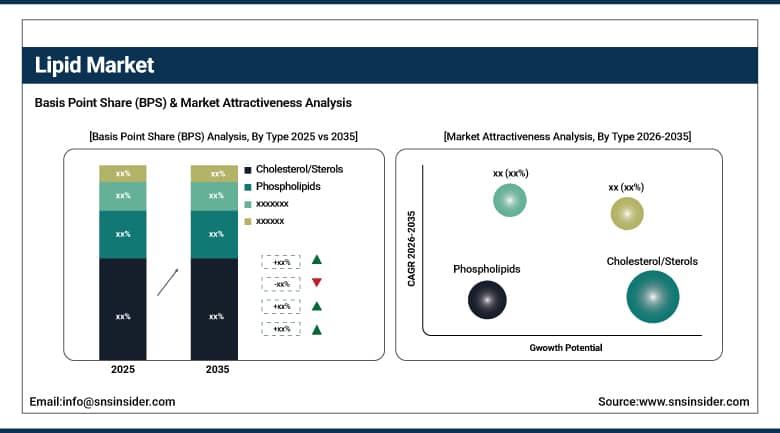
- By Type, cholesterol/sterols segment dominated the lipid market in 2025 with around 28.60% share; phospholipids segment is the fastest-growing segment.
- By Source, plant-based segment dominated the market in 2025 with around 61% share; marine-based segment is the fastest-growing segment.
- By Application, food & beverages segment dominated the market in 2025 with around 47% share; pharmaceuticals segment is the fastest-growing segment.
- By Function, emulsifiers & stabilizers segment dominated the market in 2025; drug delivery & encapsulation agents segment is the fastest-growing segment.
By Type, Cholesterol/Sterols Dominates the Lipid Market While Phospholipids Register the Fastest Growth
Cholesterol/Sterols dominates the Lipid Market, accounting for 28.60% of revenue in 2025, owing to its widespread use as a foundational raw material in pharmaceutical formulations, cosmetics, and lipid nanoparticle production. Plant-derived cholesterol analogues, such as phytosterols, have become increasingly important in vaccine and RNA-therapeutic lipid systems, supporting sustained demand from pharmaceutical manufacturers. The broad applicability of cholesterol and sterol derivatives across food fortification, pharmaceutical excipients, and personal care formulations is reinforcing the segment’s continued market leadership.
Phospholipids is experiencing the fastest growth, projected to expand at an 8.1% CAGR through the forecast period, driven by its amphiphilic properties that underpin applications in liposomes, lipid nanoparticles, and emulsions. Pharmaceutical demand for phospholipids surged during recent years and continues to accelerate in oncology and gene therapy pipelines, while nutraceutical use of phosphatidylcholine and phosphatidylserine for cognitive and liver health is expanding rapidly across North America and Europe. Growing cosmetics industry adoption for skin hydration and barrier repair is further supporting this segment’s above-average growth trajectory.
By Source, Plant-Based Dominates the Lipid Market While Marine-Based Emerges as the Fastest-Growing Source
Plant-Based dominates the Lipid Market as vegetable oils and plant-derived lipids benefit from established global agricultural supply chains, cost efficiency, and broad regulatory acceptance across food, pharmaceutical, and cosmetic applications. Rising global per-capita vegetable oil consumption, driven by growing middle-class incomes and fortification of staple foods, continues supporting this segment’s volume leadership. The wide availability, scalable sourcing, and long-standing manufacturing infrastructure for plant-based lipids are reinforcing this segment’s continued market leadership.
Marine-Based is experiencing rapid growth as consumer demand for omega-3 fatty acids derived from fish oil and algae continues to outpace supply, with global omega-3 supplement sales exceeding USD 3.5 Billion in 2024 alone. Rising awareness of the cardiovascular and cognitive benefits associated with marine-derived polyunsaturated fatty acids, combined with a persistent gap between recommended dietary intake and actual consumption, is compelling supplement and functional food manufacturers to expand marine lipid sourcing. Advances in algae-based omega-3 production are opening up several opportunities for sustainable marine lipid supply.
By Application, Food & Beverages Dominates the Lipid Market While Pharmaceuticals Experiences the Fastest Growth
Food & Beverages accounts for the largest share of the Lipid Market because of the significance of lipids in cooking, frying, baking and transportation of fat-soluble vitamins in all food processing activities worldwide. Lipids are a source of flavor, texture, and nutritional content in a wide array of packaged and ready-made food products and hence have consistent demand from food producers worldwide. The extensive applicability of lipids in virtually every type of food and beverages preparation is fueling the consumption in this market.
Pharmaceuticals is the fastest growing due to an increasing demand for lipid nanoparticles as delivery mechanisms for mRNA vaccines and gene therapies including RNA medicines for cancer, heart conditions and autoimmune diseases. Increased occurrence of chronic diseases and hence the need for biological drugs is pushing pharmaceutical companies to invest significantly in lipid-based drug delivery systems. Innovations in lipid nanoparticle development and increased support by governments to manufacture them domestically have created plenty of business prospects for this segment.
By Function, Emulsifiers & Stabilizers Dominates the Lipid Market While Drug Delivery & Encapsulation Agents Register the Fastest Growth
Emulsifiers & Stabilizers dominates the Lipid Market due to the widespread use of lipid-derived compounds to control texture, consistency, and shelf stability across food, beverage, and cosmetic formulations. Such functional applications give manufacturers reliable, cost-effective tools for achieving desired product characteristics across a broad range of processed goods. Existing manufacturing infrastructure and established formulation expertise contribute to sales in this segment, ensuring its continued dominance in the market.
Drug Delivery & Encapsulation Agents is growing rapidly because of rising demand for lipid nanoparticles and liposomal delivery systems used to protect and transport nucleic acid-based therapeutics to their intended site of action within the body. Growing pharmaceutical industry investment in RNA-based vaccine and therapeutic pipelines, following the widespread adoption of lipid nanoparticle technology during recent years, continues to accelerate demand. The increased government funding support for lipid-based drug delivery manufacturing capacity is facilitating the growth of this segment.
Regional Analysis
|
Region |
Country |
Share (2025) |
|
North America |
United States |
84.75% |
|
Asia Pacific |
China |
36.20% |
|
Europe |
Germany |
23.40% |
|
Middle East & Africa |
UAE |
18.10% |
|
Latin America |
Brazil |
24.70% |
North America Lipid Market Insights
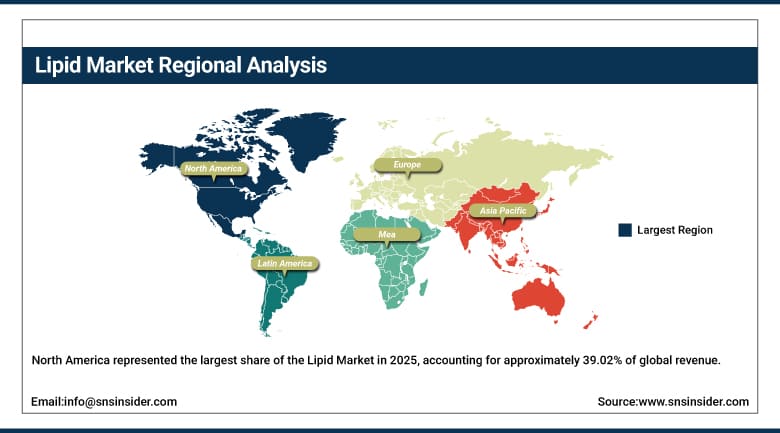
North America represented the largest share of the global Lipid Market in 2025, accounting for approximately 39.02% of global revenue, supported by robust pharmaceutical lipid demand tied to RNA-based drug delivery and a well-established food and nutraceutical manufacturing base. Increasing federal government investment in domestic pharmaceutical-grade lipid manufacturing capacity, including cooperative agreements with leading producers, is reinforcing the region’s production infrastructure. Growing consumer interest in functional foods and omega-3 supplementation is encouraging manufacturers to expand specialty lipid product lines. Well-established distribution networks across the United States and Canada are also improving product accessibility and sustaining regional market development.
The United States accounted for approximately 84.75% of the North American market in 2025, reflecting its position as the global center for pharmaceutical lipid nanoparticle development and its large food and nutraceutical manufacturing base. Canada is contributing to regional growth through expanding pharmaceutical lipid manufacturing investment, including new GMP facility development supported by federal strategic response funding.
Get Customized Report as Per Your Business Requirement - Enquiry Now
Europe Lipid Market Insights
The Lipid Market had a considerable portion of the market in Europe in 2025, owing to stringent regulatory policies for health claim functional ingredients and established pharmaceuticals and cosmetic manufacturing facilities. Increasing demand for phospholipid-based cosmetic products and functional food products in countries such as Germany, France, and the United Kingdom will help drive innovation in the industry. Increased investments by leading manufacturers of lipid nanoparticles in the pharmaceutical ingredients industry will bolster the market in Europe.
Germany dominated the European market in 2025 with a regional market share of 23.40%, due to its robust pharmaceutical and specialty chemicals manufacturing capabilities. France and the United Kingdom have also been significantly contributing to the regional market, due to leading lipid ingredient companies located across the region.
Asia Pacific Lipid Market Insights
Asia Pacific is expected to register the fastest CAGR in the Lipid Market during 2026–2035, growing at approximately 9.40%, driven by expanding food processing capacity, rising healthcare expenditure, and growing pharmaceutical manufacturing investment across the region’s large population base. China and India are witnessing particularly strong growth as expanding middle-class populations increase demand for functional foods, dietary supplements, and advanced pharmaceutical therapies. Rising product innovation and growing consumer awareness regarding omega-3 and specialty lipid health benefits are further supporting market expansion. Rising demand for plant-based and marine-derived lipids is also reinforcing Asia Pacific’s above-average growth trajectory compared with more mature markets.
China accounted for approximately 36.20% of the Asia Pacific market in 2025, supported by its large-scale food processing base and expanding pharmaceutical manufacturing sector. Japan, India, and South Korea are also contributing meaningfully to regional growth, with Japan benefiting from strong consumer demand for omega-3 and functional lipid products among its aging population.
Middle East & Africa and Latin America Lipid Market Insights
The Middle East & Africa region is exhibiting steady growth as food processing and pharmaceutical manufacturing infrastructure expands across the Gulf states, supported by growing modern retail and healthcare investment. Latin America is similarly benefiting from expanding food processing capacity and growing consumer interest in functional nutrition and omega-3 supplementation across major regional markets.
The UAE led the Middle East & Africa market with an 18.10% regional share in 2025, supported by growing healthcare and food processing infrastructure investment. Brazil represented 24.70% of the Latin American market in 2025, driven by expanding food processing and functional nutrition demand, with Mexico also contributing to regional growth through rising interest in pharmaceutical and cosmetic lipid applications.
Market Dynamics
Growth Drivers: Personalized Medicine and Functional Nutrition Demand Driving Market Growth
The major drivers of growth for the Lipid Market are growing interest in personalized medicine, which boosts the demand for drug delivery systems using lipids, in addition to growing demand for healthy food and functional products. Since the utilization of lipid nanoparticles is vital in the development of RNA vaccines and therapeutics, more and more pharmaceuticals are investing in facilities for manufacturing of lipids, thus driving the global Lipid market.
Growing awareness among consumers of functional ingredients drives the development of lipids as ingredients in cosmetics and personal care products, while omega-3 fatty acids and medium chain triglycerides are gaining popularity for their cardiovascular, cognitive and metabolic effects. Innovation in technologies of extraction and purification of lipids affects trends in production efficiency in the global Lipid market.
Restraints: Raw Material Price Volatility and Production Complexity Limiting Market Expansion
In addition to the positive demand conditions, there are certain restraints related to fluctuations in the cost of raw materials due to agricultural commodities and marine resources. There are only a few companies that possess the required knowledge and finances necessary for the manufacture of pharmaceutical grade lipids with high purity. Variations in regulations of food ingredients, pharmaceutical excipients, and lipid nanoparticles in different areas affect the market entry of companies in the category.
High costs of the extraction and purification process, as well as certification, result in higher production expenses, which makes it impossible for smaller manufacturers to compete in terms of pricing. In addition, the growing competition between existing companies and new producers from other regions adds to the pressure on pricing. As the category develops, manufacturers have to consider their costs, purity levels, and compliance with the regulations in order to keep customers' trust and grow further.
Opportunities: RNA Therapeutics Expansion and Specialty Lipid Innovation Creating New Growth Avenues
Significant opportunities exist through expanding RNA-based therapeutic applications, specialty lipid supplement innovation, and growing cosmetics industry adoption. Developing higher-purity synthetic and plant-derived lipids can address growing pharmaceutical demand for consistent, scalable lipid nanoparticle production. Manufacturers can capitalize on growing consumer interest in omega-3, MCT, and phospholipid supplements that address cardiovascular, cognitive, and metabolic health needs. Expanding lipid nanoparticle applications beyond vaccines into gene therapy and oncology treatment provides another avenue for sustained pharmaceutical demand growth.
Innovation around sustainable and traceable sourcing from plant, marine, and microbial feedstocks can create differentiated applications and attract sustainability-minded manufacturers and consumers. Government funding support for domestic lipid manufacturing capacity also offers producers an opportunity to expand production infrastructure with reduced capital risk. Additionally, advances in algae-based omega-3 production and microbial fermentation technology can strengthen supply chain resilience. These developments can help companies capture emerging demand, broaden application occasions, and support premiumization across multiple end-use segments and distribution channels.
Recent Developments:
- 2026: Evonik continued expanding its lipid production infrastructure following its earlier triple-digit million-dollar joint investment with the U.S. government to build a new lipid production facility in Tippecanoe, Indiana.
- 2026: Lipid-based drug delivery continued to gain momentum as LNPs expanded beyond vaccines into gene therapies, nucleic-acid therapeutics, and precision medicines, increasing demand for specialized pharmaceutical-grade lipids and scalable manufacturing technologies.
Lipid Market key players are:
- NOF Corporation
- Stepan Company
- Archer Daniels Midland Company
- Cargill, Incorporated
- Kerry Group plc
- BASF SE
- Merck KGaA
- Koninklijke DSM N.V. (dsm-firmenich)
- Croda International Plc
- Lipoid GmbH
- Avanti Polar Lipids, Inc.
- Evonik Industries AG
- Corbion N.V.
- Lonza Group Ltd.
- Wacker Chemie AG
- Bunge Limited
- Wilmar International Limited
- IOI Corporation Berhad
- CordenPharma International
- Musim Mas Group
Lipid Market Report Scope:
| Report Attributes | Details |
|---|---|
| Market Size in 2025 | USD 13.24 Billion |
| Market Size by 2035 | USD 26.84 Billion |
| CAGR | CAGR of 7.32% From 2026 to 2035 |
| Base Year | 2025 |
| Forecast Period | 2026-2035 |
| Historical Data | 2022-2024 |
| Report Scope & Coverage | Market Size, Segments Analysis, Competitive Landscape, Regional Analysis, DROC & SWOT Analysis, Forecast Outlook |
| Key Segments | • By Type (Cholesterol/Sterols, Phospholipids, Triglycerides, Fatty Acids, and Waxes) • By Source (Plant-Based, Animal-Based, Marine-Based, and Synthetic/Microbial) • By Application (Food & Beverages, Pharmaceuticals, Cosmetics & Personal Care, and Nutraceuticals) • By Function (Emulsifiers & Stabilizers, and Drug Delivery & Encapsulation Agents |
| Regional Analysis/Coverage | North America (US, Canada), Europe (Germany, UK, France, Italy, Spain, Russia, Poland, Rest of Europe), Asia Pacific (China, India, Japan, South Korea, Australia, ASEAN Countries, Rest of Asia Pacific), Middle East & Africa (UAE, Saudi Arabia, Qatar, South Africa, Rest of Middle East & Africa), Latin America (Brazil, Argentina, Mexico, Colombia, Rest of Latin America). |
| Company Profiles | NOF Corporation; Stepan Company; Archer Daniels Midland Company; Cargill, Incorporated; Kerry Group plc; BASF SE; Merck KGaA; Koninklijke DSM N.V. (dsm-firmenich); Croda International Plc; Lipoid GmbH; Avanti Polar Lipids, Inc.; Evonik Industries AG; Corbion N.V.; Lonza Group Ltd.; Wacker Chemie AG; Bunge Limited; Wilmar International Limited; IOI Corporation Berhad; CordenPharma International; Musim Mas Group. |
Frequently Asked Questions
Key players include Cargill, Incorporated, Croda International Plc, Evonik Industries AG, BASF SE, and Koninklijke DSM N.V. (dsm-firmenich), among others.
The Cholesterol/Sterols segment dominated the Lipid Market in 2025, accounting for 28.60% of revenue share.
The North America region dominated the Lipid Market in 2025, accounting for approximately 39.00% of global market share, driven by robust pharmaceutical lipid demand and government-supported domestic manufacturing investment.
