
Ethernet Controller Market Report Scope & Overview:
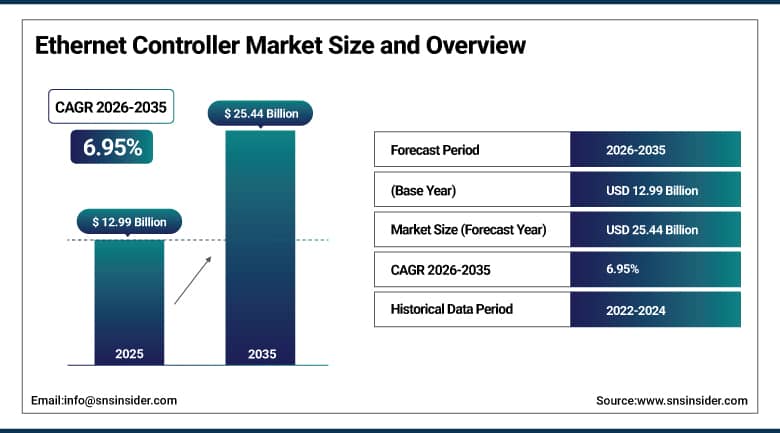
The Ethernet Controller Market size was valued at USD 12.99 Billion in 2025 and is expected to reach USD 25.44 Billion by 2035, growing at a CAGR of 6.95% from 2026 to 2035.
The ethernet controller market is growing due to the increasing requirement for fast and low latency networking hardware due to the development of hyper-scale data centers, cloud computing architectures, and AI applications which need more advanced networking hardware than previous models of controllers can provide. The increase in the usage of Internet of Things devices, the deployment of 5G technology, and the move towards smart or vehicle-grade Ethernet devices increases the addressable market beyond enterprise IT to include industrial automation, automobiles, and consumer products. The emphasis by manufacturers on efficient controller hardware that can handle time-sensitive networks and increased bandwidth levels means this market will continue to grow.
Infineon Technologies agreed in 2025 to acquire Marvell Technology's automotive Ethernet business for USD 2.5 billion, strengthening its portfolio for software-defined vehicle networking and automotive semiconductor solutions. Separately, Texas Instruments introduced its DP83TG720S-Q1 physical layer transceiver, delivering 1 gigabit transmission over a single twisted-pair cable while meeting ISO 26262 ASIL B safety requirements for automotive applications.
To Get More Information On Ethernet Controller Market - Request Free Sample Report
Ethernet Controller Market Trends
-
Rising deployment of 10GbE, 25GbE, and higher-bandwidth Ethernet solutions is accelerating across hyperscale data centers.
-
Growing adoption of automotive Ethernet is supporting zonal electrical architectures and centralized vehicle computing platforms.
-
Integration of time-sensitive networking capability is becoming a standard requirement for industrial and automotive controllers.
-
Vendors are prioritizing power-efficient chipset designs to meet sustainability and thermal management requirements.
-
Convergence of Ethernet controllers with edge computing and AI workloads is pushing demand for smarter, more adaptive designs.
United States Ethernet Controller Market Size Outlook
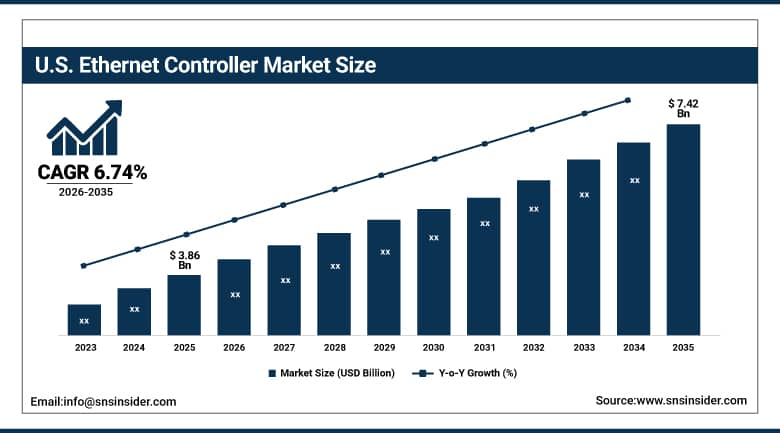
The United States Ethernet Controller Market was valued at USD 3.86 Billion in 2025 and is expected to reach USD 7.42 Billion by 2035, growing at a CAGR of 6.74% from 2026 to 2035.
The United States maintained the largest single national market for Ethernet controllers, supported by high demand from AI-based data centers, cloud computing platforms, and enterprise networks requiring feature-rich, high-bandwidth solutions. Continued expansion of 5G infrastructure, rising IoT device deployment, and sustained enterprise investment in advanced networking technology all continued to reinforce the country's leadership position, with domestic chip designers driving much of the innovation behind next-generation Ethernet controller architecture.
Intel added application-device queues and precision time protocol timestamping to its E810 controller family, a feature set designed to optimize distributed training synchronization for large-scale AI computing clusters operating across United States data centers.
Ethernet Controller Market Segment Analysis
-
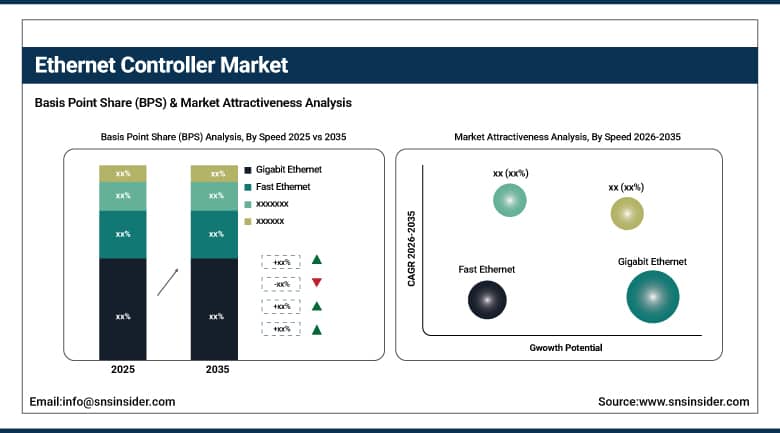
By Speed, the Gigabit Ethernet segment held approximately 30% share in 2025, while the Multi-Gigabit/High-Speed Ethernet segment is the fastest growing.
-
By Application, the Servers segment held approximately 34% share in 2025, while the Embedded Systems segment is the fastest growing.
-
By End-Use, the IT & Telecommunications segment held approximately 33% share in 2025, while the Automotive segment is the fastest growing.
By Speed, Gigabit Ethernet led the market, Multi-Gigabit/High-Speed Ethernet grew fastest
The Gigabit Ethernet Segment led in terms of the fastest speed category share in 2025, representing about 30% of the market. Its versatility across current enterprise and consumer networking infrastructure was a key factor that kept it the go-to option for routers, switches, and general computing devices which do not need extremely high speeds.
The Multi-Gigabit/High-Speed Ethernet Segment will experience the highest CAGR during the forecast period. The growing investment in hyperscale data centers equipped with 100 gigabit, 400 gigabit, and even faster Ethernet speeds remains the driving force behind this trend due to an increased demand from AI training clusters and cloud services for hardware that could transfer much larger amounts of data per second compared to classic Gigabit Ethernet technology.
By Application, Servers led the market, Embedded Systems grew fastest
The Servers segment held the largest application share in 2025, at approximately 34%. Continued expansion of enterprise data centers and hyperscale cloud infrastructure continued to reinforce this leadership position, as every additional server rack deployed requires Ethernet controllers capable of handling growing east-west and north-south data traffic within modern computing facilities.
The Embedded Systems segment is projected to grow at the fastest CAGR during the forecast period. Rising integration of Ethernet connectivity into industrial equipment, smart city infrastructure, and connected devices continues to drive this growth, as Industry 4.0 initiatives and IoT deployment push networking capability into an increasingly wide range of embedded and edge computing applications.
By End-Use, IT & Telecommunications led the market, Automotive grew fastest
The IT & Telecommunications segment held the largest end-use share in 2025, at approximately 33%. Sustained investment in cloud infrastructure, enterprise networking, and telecom backbone equipment continued to reinforce this leadership position, keeping this end-use category firmly at the center of overall Ethernet controller demand.
The Automotive segment is projected to grow at the fastest CAGR during the forecast period. Accelerating adoption of zonal electrical and electronic architectures, connected vehicle platforms, and advanced driver assistance systems continues to drive this growth, as automakers replace legacy CAN and LIN bus networks with multi-gigabit automotive Ethernet backbones capable of aggregating radar, lidar, and camera data streams.
Regional Insights
|
Region |
Major Country |
Share within Region, 2025 (%) |
|---|---|---|
|
North America |
United States |
76.0% |
|
Europe |
Germany |
28.0% |
|
Asia Pacific |
China |
38.0% |
|
Middle East & Africa |
UAE |
27.0% |
|
Latin America |
Brazil |
40.0% |
North America Ethernet Controller Market Insights
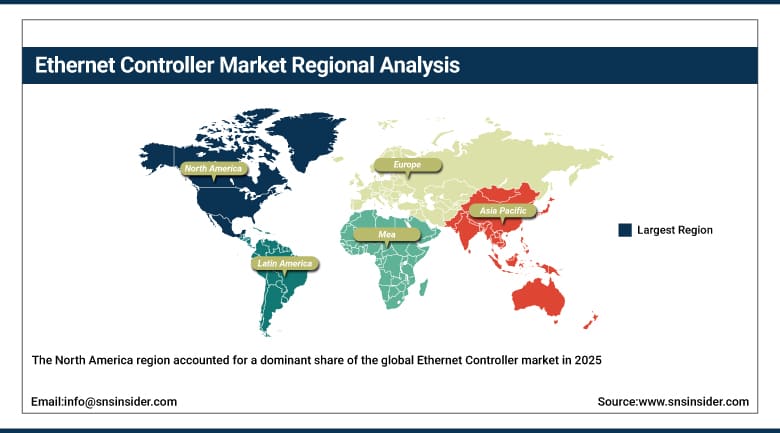
The North America region accounted for a dominant share of the global Ethernet Controller market in 2025, due to an early inclination towards the development and implementation of next-generation networks in the region, and investments made in data centers. The USA accounted for around 76% of the total regional revenue, owing to the abundance of chip manufacturers, hyperscale cloud providers, and enterprise network end-users.
The Canadian region accounted for a relatively lower but continuously increasing share of total revenue generated from the region. This ensured that North America was one of the commercially important regional markets for Ethernet controllers during the year.
Get Customized Report as Per Your Business Requirement - Enquiry Now
Europe Ethernet Controller Market Insights
Europe followed closely behind North America in 2025, driven by industrial automation initiatives and automotive Ethernet adoption across the continent's manufacturing and vehicle electronics sectors. Germany accounted for roughly 28% of regional revenue, supported by its concentration of automotive manufacturers and industrial automation companies integrating Ethernet controllers into next-generation vehicle and factory systems.
France, the United Kingdom, and Italy followed a broadly similar trajectory, as European Union level digital infrastructure investment continued extending advanced networking capability across the continent's largest national markets. Continued automotive electrification and zonal architecture adoption are expected to keep reinforcing European demand through the remainder of the forecast period.
Asia Pacific Ethernet Controller Market Insights
Asia Pacific was the fastest-growing region in the Ethernet Controller Market, driven by rapid industrialization, expanding consumer electronics manufacturing, and rising data center investment across the region. China accounted for roughly 38% of regional revenue, supported by its large-scale electronics manufacturing base and growing domestic semiconductor design capability.
Japan, South Korea, and India contributed significant additional regional demand through their own advanced electronics and automotive industries. That combination of manufacturing scale and rising domestic design sophistication continued to reinforce Asia Pacific's position as the clear growth leader in Ethernet controller adoption through the forecast period.
MEA & Latin America Ethernet Controller Market Insights
The Middle East and Africa region recorded steady growth in Ethernet controller adoption in 2025, driven by expanding data center investment and growing telecommunications infrastructure development across the Gulf states in particular. The UAE accounted for roughly 27% of regional revenue, supported by national digitization strategies and rising enterprise demand for advanced networking hardware.
Latin America expanded at a comparable pace, led by Brazil at roughly 40% of regional revenue, where growing data center and telecommunications infrastructure investment continued to support category growth. Mexico and Argentina followed a similar trajectory as regional digital infrastructure investment expanded further through the remainder of the forecast period.
Market Dynamics
Growth Drivers: Rising demand for high-speed networking across cloud and AI infrastructure
The primary driving factors for the growth of the Ethernet controller market are rising demand for improved network technology. As a result of business expansion and growth in data centers, there is an increase in the data transfer rate. There is increasing demand for increased bandwidth owing to the amount of data being transferred on a day-to-day basis by organizations. These developments have been driven by the rise in cloud computing, IoT, and digitalization of various industries.
Continued investment in hyperscale data centers for advanced Ethernet technology along with the move towards zonal electrical and electronic architecture for automotive is continuing to drive high demand visibility in spite of occasional semiconductor component shortages. The differentiating features include power-efficient design, MAC-PHY architecture, and smart offloading capabilities in network interface cards.
Restraints: Compatibility challenges and legacy infrastructure constraints
The ever-changing Ethernet controller industry is faced with problems concerning compatibility and scalability to cope with today’s networks. In the face of the increasing data flow and changing network speed, the need for Ethernet controllers that are scalable and efficient becomes an ongoing driving factor. Nonetheless, technological progress and the problem of compatibility may affect the motivation to innovate and upgrade old equipment, hampering the adoption of new technology Ethernet.
Ensuring the reliability and scalability of Ethernet controllers for data centers and other industrial use cases becomes quite challenging because they have to be compatible with other systems already installed in enterprise and industrial networks. Another challenge associated with cybersecurity issues and encryption needs arises from this problem.
Opportunities: Expanding embedded systems and automotive Ethernet applications
The Ethernet controller market has substantial opportunity owing to rapid advancements in embedded systems and automotive applications. With the emergence of smart cities, IoT, connected devices, and Industry 4.0 initiatives, there is a growing need for Ethernet solutions in embedded systems, which continues to drive innovation across the broader controller ecosystem.
The increasing need for high-performance computing and networking in data centers and enterprise networks creates further growth opportunities for manufacturers to launch next-generation Ethernet controllers. The growth of 5G networks, combined with an increasing number of AI and machine learning applications, opens up even greater opportunities to develop solutions for these sophisticated networking requirements, supporting continued expansion across the broader market.
Recent Developments:
-
2025: NXP Semiconductors integrated time-sensitive networking capability directly into its automotive Ethernet controllers, aiming to guarantee microsecond-level determinism for drive-by-wire and fail-operational steering system applications.
-
2025: Spirent Communications expanded its Automotive Ethernet test portfolio with high-speed validation platforms supporting 400G, 800G, and 1.6T Ethernet, alongside improved Base T1 conformance testing capability for OEM verification programs.
-
2024: Marvell Technology advanced development of its custom silicon Ethernet switch and controller portfolio for hyperscale data center customers, targeting next-generation AI cluster networking requirements ahead of IEEE 802.3df standardization.
Ethernet Controller Companies are:
-
Intel Corporation
-
Broadcom Inc.
-
Realtek Semiconductor Corp.
-
Texas Instruments Incorporated
-
NXP Semiconductors N.V.
-
Cisco Systems, Inc
-
Qualcomm Technologies, Inc.
-
Renesas Electronics Corporation
-
STMicroelectronics N.V.
-
Analog Devices, Inc.
-
ON Semiconductor Corporation
-
Infineon Technologies AG
-
MediaTek Incorporated
-
Nordic Semiconductor ASA
-
Silicon Labs Inc.
-
Lantiq (MaxLinear)
-
Vitesse Semiconductor Corporation
-
Spirent Communications plc
Ethernet Controller Market Report Scope:
| Report Attributes | Details |
|---|---|
| Market Size in 2025 | USD 12.99 Billion |
| Market Size by 2035 | USD 25.44 Billion |
| CAGR | CAGR of 6.95% From 2026 to 2035 |
| Base Year | 2025 |
| Forecast Period | 2026-2035 |
| Historical Data | 2022-2024 |
| Report Scope & Coverage | Market Size, Segments Analysis, Competitive Landscape, Regional Analysis, DROC & SWOT Analysis, Forecast Outlook |
| Key Segments | • by Speed (Fast Ethernet, Gigabit Ethernet, and Multi-Gigabit/High-Speed Ethernet) • by Application (Servers, PCs, Embedded Systems, and Industrial Equipment) • by End-Use (IT & Telecommunications, Automotive, Industrial Automation, and Consumer Electronics) |
| Regional Analysis/Coverage | North America (US, Canada, Mexico), Europe (Eastern Europe [Poland, Romania, Hungary, Turkey, Rest of Eastern Europe] Western Europe] Germany, France, UK, Italy, Spain, Netherlands, Switzerland, Austria, Rest of Western Europe]), Asia Pacific (China, India, Japan, South Korea, Vietnam, Singapore, Australia, Rest of Asia Pacific), Middle East & Africa (Middle East [UAE, Egypt, Saudi Arabia, Qatar, Rest of Middle East], Africa [Nigeria, South Africa, Rest of Africa], Latin America (Brazil, Argentina, Colombia, Rest of Latin America) |
| Company Profiles | Intel Corporation, Marvell Technology, Inc., Broadcom Inc., Realtek Semiconductor Corp., Texas Instruments Incorporated, NXP Semiconductors N.V., Microchip Technology Incorporated, Cisco Systems, Inc., Qualcomm Technologies, Inc., Renesas Electronics Corporation, STMicroelectronics N.V., Analog Devices, Inc., ON Semiconductor Corporation, Infineon Technologies AG, MediaTek Incorporated, Nordic Semiconductor ASA, Silicon Labs Inc., Lantiq (MaxLinear), Vitesse Semiconductor Corporation, Spirent Communications plc. |
Frequently Asked Questions
The Ethernet Controller Market is expected to grow at a CAGR of 6.95% from 2026 to 2035.
The Ethernet Controller Market was valued at USD 12.99 Billion in 2025.
Rising demand for high-speed networking across cloud computing, AI-driven data centers, and automotive Ethernet applications is the major growth factor.
The Gigabit Ethernet segment held approximately 30% share in 2025.
North America held a prominent share of the Ethernet Controller Market in 2025, while Asia Pacific was the fastest-growing region.
