
Medicated Feed Additives Market Report Scope & Overview:
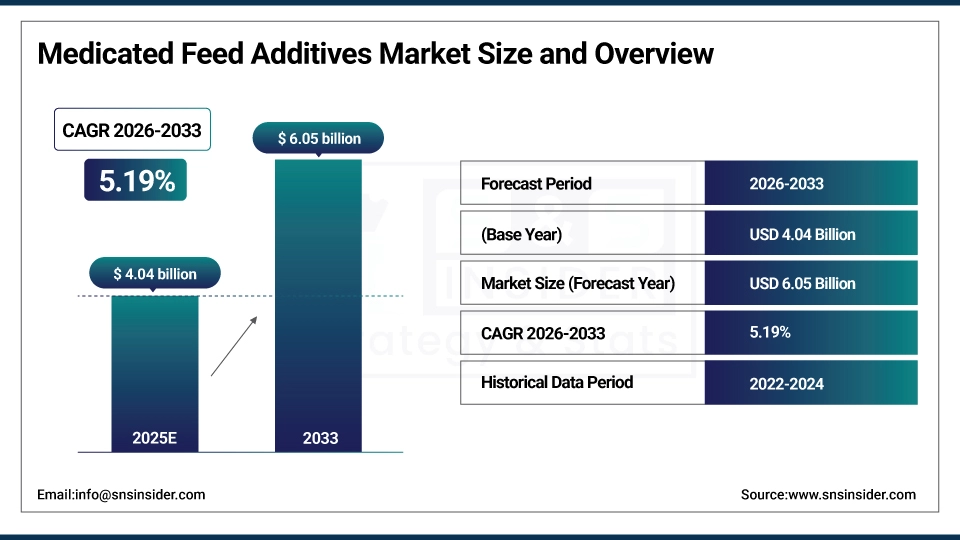
The Medicated Feed Additives Market size was valued at USD 4.04 billion in 2025E and is expected to reach USD 6.05 billion by 2033, growing at a CAGR of 5.19% over the forecast period of 2026-2033.
The medicated feed additives market is mainly driven by the increasing occurrence of animal diseases. These diseases in pigs are endangering animal health and threatening food safety, compelling farmers to add medicated feed to their diets for disease prevention and treatment. Additives, including antibiotics, probiotics, and vitamins help in mitigating pathogen risks and effects on mortality and production loss, in particular in intensive production systems. You also have tighter animal welfare and food safety regulations driving demand for safer, more effective formulations.
Medicated Feed Additives Market Size and Forecast:
-
Market Size in 2025E: USD 4.04 Billion
-
Market Size by 2033: USD 6.05 Billion
-
CAGR: 5.19% from 2026 to 2033
-
Base Year: 2025
-
Forecast Period: 2026–2033
-
Historical Data: 2022–2024
To Get more information on Medicated Feed Additives Market - Request Free Sample Report
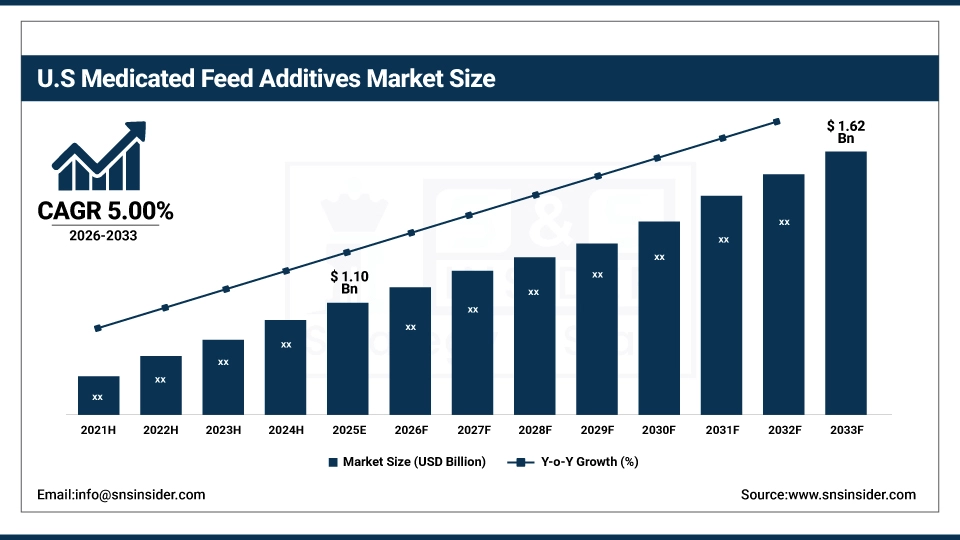
The U.S. Medicated Feed Additives Market was valued at USD 1.10 billion in 2025E and is expected to reach USD 1.62 billion by 2033, growing at a CAGR of 5.00% from 2026-2033.
The U.S leads in the medicated feed additives market thanks to high biotechnological investment that stimulates the innovation of possible advanced and sustainable animal health solutions. With more than USD 96 billion invested in research and development and supportive regulatory conditions, the U.S. supports the fast-paced creation of enzyme-driven, probiotic, and genetically edited enhancers. Federal programs, including BioMADE and precision nutrition technologies, also elevate domestic output.
Medicated Feed Additives Market Drivers:
-
Increasing Health Concerns, Driving the Medicated Feed Additives Market Growth
Increasing health concerns in animal husbandry are among the prominent factors fuelling the medicated feed additives industry, with product development being progressively oriented towards the development of safer, multipurpose, and environment-friendly products. Producers are turning to alternatives as the use of antibiotics becomes increasingly restricted, including probiotics, phytogenic, and immune modulators. Innovative delivery systems and precision feeding optimize efficiency and animal robustness. These advancements are contributing to the global medicated feed additives market share.
For instance, in April 2025, EFSA reported an 18% reduction in antibiotic use in EU livestock, leading to a 13.5% rise in natural medicated feed additives sales.
Medicated Feed Additives Market Restraints:
-
Industry Consolidation is Restraining the Medicated Feed Additives Market
Consolidation is also a major suppressant to the medicated feed additives industry since it has centralised market forces into the hands of bigger companies, leaving behind small-scale producers. These smaller ones encounter obstacles, including a lack of access to financing and difficulty competing. Without getting lost in the trees, innovation is also stifled due to a lack of access to the market. Accordingly, it is difficult for small companies wishing to enter the medicated feed additives market, and as the result in a variety and competition rate in the market share.
For instance, in October 2024, Large feed manufacturers in Brazil and Argentina expanded by 15.5%, causing an 8.3% market share loss for small medicated feed additive producers.
Medicated Feed Additives Market Segmentation Analysis:
By Type, Anticoccidials Lead the Market and Remain the Fastest-Growing Segment
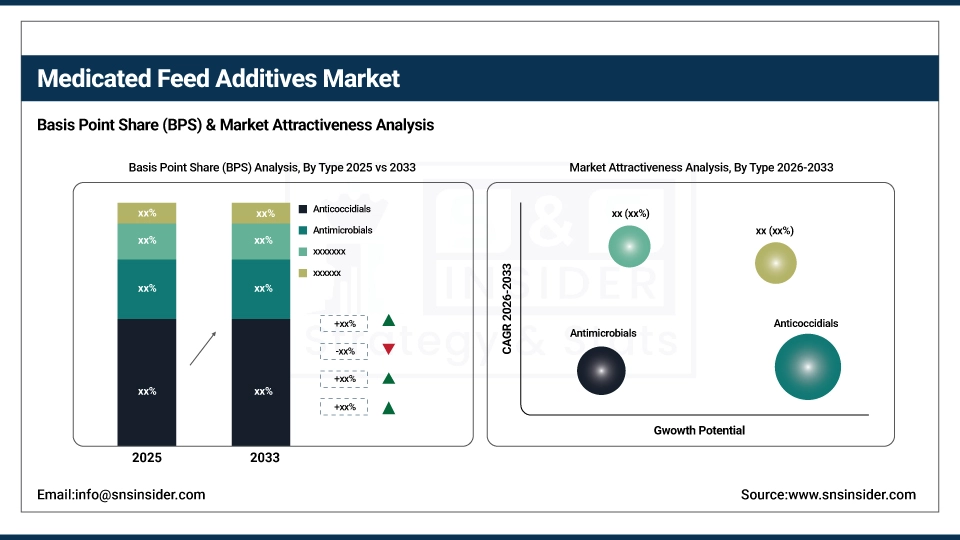
Anticoccidials were the dominant and fastest-growing segment in the Medicated Feed Additives Market analysis, with a 35.13% market share and a CAGR of 5.47% in 2025, owing to the great incidence of coccidiosis, particularly in aviculture. Intensive breeding produces animals that are more susceptible to parasitic infections, hence the widespread practice of adding anticoccidials to feed as a prophylactic measure to prevent disease outbreaks, minimize mortality, and increase productivity. They are proven and widely used, which has led to a large proportion of the medicated feed additives market share, especially in Asia-Pacific and North America, which have large poultry industries.
By Animal Type, Livestock Dominates the Market, While Companion Animals Drive Fastest Growth
In 2025, the Livestock, controlled Medicated Feed Additives Market had with 92.64% market share, the vast global appetite for meat, dairy, and other livestock-based products Not surprisingly, there are meat eaters everywhere. Increasing incidence of diseases in poultry, swine, and cattle, along with the growing need for enhanced feed efficiency and better growth performance and health of the animals, are the key factors that are responsible for the significant utilization of medicated feed additives. This continuous requirement from commercial farming tends to increase the medicated feed additives market share of the livestock segment.
The Companion is the fastest-growing segment in the global Medicated Feed Additives Market trend in the forecasted period 2026-2033, the increasing pet preferences, surge in pet wellness expenditure, and expanding demand for premium, functional pet food. Pet owners who are mindful about pet health are looking for more protection for their pets' immune and digestive system health, and overall wellness. This trend, most notably in the urban regions of North America and Europe, is propelling the consumption of medicated feed additives market growth in the pet care sector.
By Distribution Channel, Veterinary Hospitals Hold the Largest Share as Alternative Channels Rapidly Expand
In 2025, the Veterinary Hospitals controls the global Medicated Feed Additives industry with a significant market share of 35.80%. owing to their sophisticated diagnostics, veterinary expertise, and authority to prescribe and administer specialised treatments. These veterinary hospitals are frequently the initial site of disease in companion animals and livestock and are responsible for the regulated use of medicated additives. They possess strong clinical credentials spreading across both developed and developing nations, which has a strong impact on their high medicated feed additives market share.
In the Medicated Feed Additives industry, the other segment, which includes online platforms, feed mills, and cooperatives, is driven by the rising prevalence of e-commerce, direct-to-farm delivery models, and collaboration between feed mills and livestock producers when it comes to bulk purchasing. Meanwhile, these distribution channels expand their presence, and provide more cost-effective, more readily available and customized products, enlarging the medicated feed additives market growth, particularly in the Asia-Pacific, Latin American zones.
Medicated Feed Additives Market Regional Analysis:
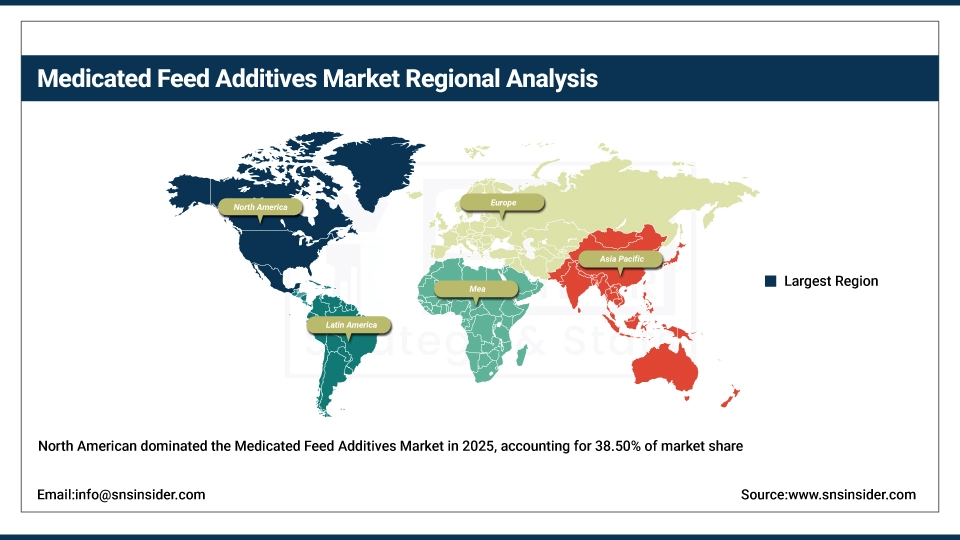
North America Leads the Global Market With 38.50% Revenue Share
In 2025, the North American region dominated the Medicated Feed Additives industry and accounted for 38.50% of the overall revenue share. owing to its well-established livestock industry, modern infrastructure for veterinary care, and major manufacturers including Zoetis, Elanco, and Phibro. The area presents a growing market for meat and dairy production, which encourages the use of medicated supplements to improve animal health, performance, and disease control. Favorable government regulations, steady investment in biotechnology, and precision nutrition technologies also contribute to innovation and product acceptance. Moreover, the region’s emphasis on food safety, antibiotic stewardship, and sustainable production has led it to have a significant for medicated feed additives market share and maintain its global position.
Get Customized Report as per Your Business Requirement - Enquiry Now
Europe Secures Second Position Driven by Strict Regulations and Sustainable Feed Solutions
The second position is held by Europe in the medicated feed additives market, with an established livestock industry and stringent regulation, with increasing meat without antibiotics. This scenario has driven the shift toward alternative additives, including probiotics, enzymes, and phytogenics, as a result of more stringent EU regulations. Moreover, rising consumer consciousness towards food safety and animal well-being further propels the market. Key industry participants and research institutes in Europe are involved in the development and commercialization of sustainable feed solutions, thus maintaining the European medicated feed additives market share globally.
Asia-Pacific Expected to Record the Fastest Growth With a 5.70% CAGR
The Asia Pacific region is projected to grow with the fastest CAGR of 5.70% over the forecast period in 2026-2033, owing to its burgeoning livestock population, rising meat consumption, and increasing incidence of animal diseases. Increasing commercialization of poultry, swine, and cattle in countries including China, India, and Vietnam generates a market for disease prevention and performance improvement in feed in these countries. Increasing governmental programs for animal health and for food security, coupled with the increase in investments in veterinary infrastructure, have further propelled the market for animal health in the region. Furthermore, greater awareness of feed quality, more extensive guidelines on the use of antibiotics, and the rising use of alternatives in the form of probiotics and phytogenics all support movement towards fortified feed. All these factors cumulatively contribute to the medicated feed additives market share in the region.
Middle East & Africa Witness Steady Growth Backed by Rising Livestock Production
The Medication in feed additives market in the Middle East & Africa is also anticipated to grow at a significant rate, due to increasing livestock production for meat consumption and increasing awareness regarding animal health. Increasing adoption of medicated feed due to the efforts of governments to improve food security and reduce livestock mortality is another factor that drives the market. It has low market penetration as compared to other regions, but the increased commercial farming and growing awareness among the people are driving the medicated feed additives market growth in the region.
Latin America Shows Moderate Growth Supported by Expanding Poultry and Livestock Sectors
The Latin American medicated feed additives market is growing slowly, owing to the growth in livestock and poultry production in Brazil and Argentina, which has kept the market ticking here too. Steadily growing meat exports, escalating demand for animal health products, and commercial farming practices are contributing to the growth of the region. Growth is further spurred by government backing for animal disease control and spreading feed mill networks. These are the factors that are driving Latin America to consolidate its medicated feed additives market share across the globe.
Medicated Feed Additives Market Key Players:
-
Cargill, Inc.
-
Archer Daniels Midland Company (ADM)
-
Phibro Animal Health Corporation
-
Elanco Animal Health Incorporated
-
Zoetis Inc.
-
BASF SE
-
Evonik Industries AG
-
Nutreco N.V.
-
Novozymes A/S
-
Alltech, Inc.
-
Kemin Industries, Inc.
-
Adisseo France SAS
-
Chr. Hansen Holding A/S
-
Novus International, Inc.
-
Biomin Holding GmbH
-
CHS Inc.
-
Purina Animal Nutrition (Land O' Lakes, Inc.)
-
De Heus Animal Nutrition B.V.
-
Boehringer Ingelheim Animal Health
-
Virbac S.A.
Competitive Landscape of the Medicated Feed Additives Market:
Cargill, Inc.
Cargill, Inc. is a U.S.-based global leader in agriculture, animal nutrition, and feed solutions, offering a wide range of medicated feed additives for livestock and companion animals. The company specializes in delivering high-quality, safe, and performance-enhancing feed products, including antibiotics, anticoccidials, enzymes, and probiotics, aimed at improving animal health, growth, and productivity. Cargill’s role in the medicated feed additives market is significant, providing innovative nutrition solutions, technical support, and scalable supply chain services to commercial farms and veterinary clients worldwide.
-
In 2025, Cargill launched an expanded line of medicated feed additives with enhanced gut-health formulations and disease-prevention solutions for poultry, swine, and cattle.
Archer Daniels Midland Company (ADM)
Archer Daniels Midland Company (ADM) is a U.S.-based multinational specializing in agricultural processing and animal nutrition products, including medicated feed additives. The company focuses on providing additives that enhance livestock performance, improve feed efficiency, and prevent common animal diseases. ADM’s role in the medicated feed additives market is critical, supporting global animal agriculture with customized solutions, research-backed formulations, and technical advisory services that optimize health and productivity.
-
In 2025, ADM introduced a new probiotic and enzyme blend for livestock feed, targeting improved digestion, immune support, and sustainable production outcomes.
Phibro Animal Health Corporation
Phibro Animal Health Corporation is a U.S.-based animal health company that develops and markets medicated feed additives, vaccines, and nutritional supplements for livestock and poultry. The company specializes in anticoccidials, antibiotics, and specialty feed ingredients that enhance disease control, growth performance, and overall animal well-being. Phibro’s role in the medicated feed additives market is vital, offering innovative solutions, research-driven formulations, and extensive technical support to commercial farms globally.
-
In 2025, Phibro expanded its anticoccidial portfolio with next-generation formulations aimed at improving efficacy and minimizing resistance in poultry production.
Elanco Animal Health Incorporated
Elanco Animal Health Incorporated is a U.S.-based global leader in animal health and nutrition, offering medicated feed additives, vaccines, and therapeutic solutions for livestock and companion animals. The company focuses on disease prevention, growth optimization, and sustainable feed practices through a comprehensive portfolio of antibiotics, anticoccidials, and feed supplements. Elanco’s role in the medicated feed additives market is central, providing research-driven products, expert advisory services, and scalable solutions that enhance productivity and animal welfare.
-
In 2025, Elanco introduced a new line of multifunctional feed additives combining probiotics and anticoccidials for poultry, supporting gut health and improved feed efficiency.
| Report Attributes | Details |
|---|---|
| Market Size in 2025E | USD 4.04 billion |
| Market Size by 2033 | USD 6.05 billion |
| CAGR | CAGR of 5.19% From 2026 to 2033 |
| Base Year | 2025 |
| Forecast Period | 2026-2033 |
| Historical Data | 2022-2024 |
| Report Scope & Coverage | Market Size, Segments Analysis, Competitive Landscape, Regional Analysis, DROC & SWOT Analysis, Forecast Outlook |
| Key Segments | • By Type (Antimicrobials, Anticoccidials, Antiparasitics, Others) • By Animal Type (Companion, Livestock) • By Distribution Channel (Veterinary Hospitals, Veterinary Clinics, Pharmacies & Drug Stores, Others) |
| Regional Analysis/Coverage | North America (US, Canada, Mexico), Europe (Germany, France, UK, Italy, Spain, Poland, Turkey, Rest of Europe), Asia Pacific (China, India, Japan, South Korea, Singapore, Australia, Rest of Asia Pacific), Middle East & Africa (UAE, Saudi Arabia, Qatar, South Africa, Rest of Middle East & Africa), Latin America (Brazil, Argentina, Rest of Latin America) |
| Company Profiles | Key players in the Medicated Feed Additives Market include Cargill, Inc., Archer Daniels Midland Company (ADM), Phibro Animal Health Corporation, Elanco Animal Health Incorporated, Zoetis Inc., BASF SE, Evonik Industries AG, Nutreco N.V., Novozymes A/S, Alltech, Inc., Kemin Industries, Inc., Adisseo France SAS, Chr. Hansen Holding A/S, Novus International, Inc., Biomin Holding GmbH, CHS Inc., Purina Animal Nutrition (Land O' Lakes, Inc.), De Heus Animal Nutrition B.V., Boehringer Ingelheim Animal Health, and Virbac S.A. |

Frequently Asked Questions
Zoetis Inc., Elanco Animal Health Incorporated, Phibro Animal Health Coporation, and Merck Animal Health are the key players in the Medicated Feed Additives Market.
Major trends impacting the medicated feed additives market include rising livestock disease outbreaks, growing demand for antibiotic alternatives, regulatory shifts, and precision nutrition.
The CAGR of the Medicated Feed Additives Market is 9.76% during the forecast period of 2026-2033.
The North American region dominated the Medicated Feed Additives Market in 2025.
The current size of the medicated feed additives market is at USD 4.24 billion.
