
Microgrid as a Service (MaaS) Market Report Scope & Overview:
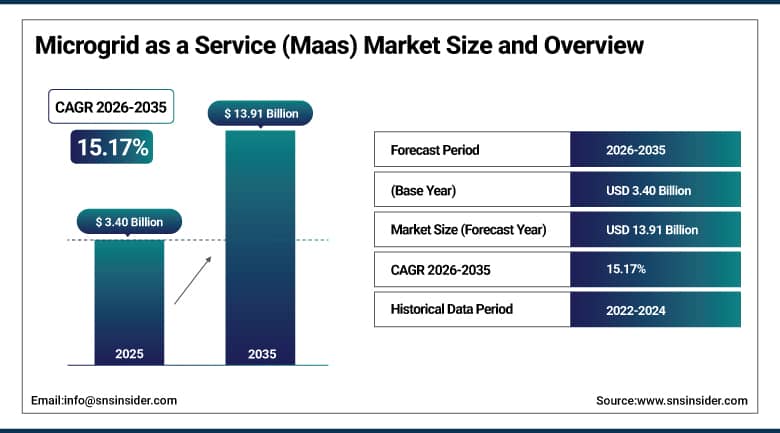
The Microgrid as a Service (MaaS) Market size was valued at USD 3.40 billion in 2025 and is expected to reach USD 13.91 billion by 2035, growing at a CAGR of 15.17% from 2026–2035.
The global Microgrid as a Service (MaaS) Market is witnessing strong growth in the global market owing to increasing demand for resilient, decentralized energy infrastructure. Rising deployment of renewable energy systems, battery storage, grid-connected microgrids, and remote energy solutions is accelerating market expansion. Utilities and service providers are focusing on AI-enabled energy management, predictive maintenance, demand response optimization, and digital microgrid control platforms. Growing investments in distributed energy resources, energy-as-a-service business models, and subscription-based financing are supporting technology advancement. Increasing demand for energy resilience, peak load management, rural electrification, and decarbonization initiatives is further driving market adoption.
According to the International Energy Agency Global Energy Review, structural changes in decentralized energy networks were observed due to the rise in electricity demand in the world by 3% in 2025. The measures taken indicated that the fastest growing area of technology was battery storage, adding about 110 gigawatts of additional capacity worldwide. Intergovernmental bodies helped implement the measures, indicating that through competitive bidding, 60% of the gross addition in distributed capacity could be achieved.
To Get More Information On Microgrid as a Service (MaaS) Market - Request Free Sample Report
Microgrid as a Service (MaaS) Market Trends:
-
Increasing adoption of AI-powered energy management platforms for intelligent microgrid optimization and predictive operational performance.
-
Rising deployment of subscription-based Microgrid as a Service (MaaS) business models across commercial and industrial sectors.
-
Growing integration of renewable energy resources with battery storage for resilient decentralized energy infrastructure development.
-
Expanding use of digital twins and cloud-based monitoring for real-time microgrid performance optimization and maintenance.
-
Increasing investments in grid modernization initiatives supporting distributed energy resources and advanced microgrid controller deployment.
-
Rising emphasis on energy resilience, carbon reduction, and operational continuity driving global Microgrid as a Service adoption.
U.S. Microgrid as a Service Market Size Outlook:
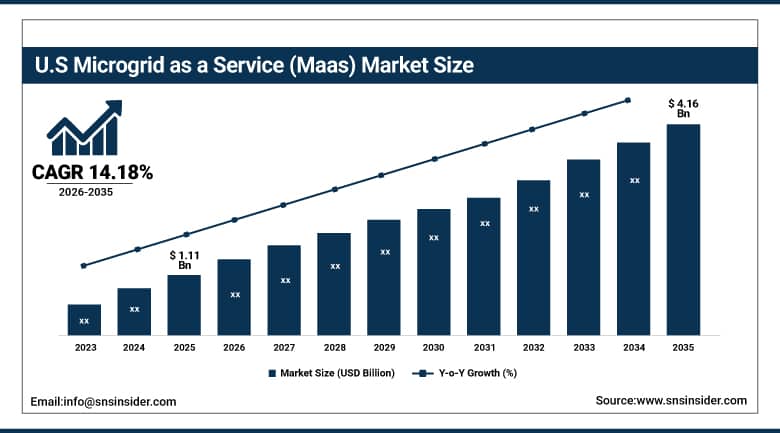
The U.S. Microgrid as a Service Market was valued at USD 1.11 billion in 2025 and is expected to reach around USD 4.16 billion by 2035, growing at a CAGR of 14.18% from 2026–2035.
The U.S. Microgrid as a Service (MaaS) Market is expanding rapidly owing to rising deployment of resilient distributed energy infrastructure across critical facilities. Increasing adoption by commercial enterprises, utilities, government agencies, and industrial facilities is supporting market growth nationwide. Rising investments in renewable energy integration, battery energy storage, advanced microgrid controllers, and digital energy management platforms are driving operational efficiency and energy resilience. Growth in grid modernization and energy decentralization initiatives is further accelerating microgrid deployments across industries. Service providers are focusing on predictive maintenance, AI-enabled energy optimization, and subscription-based energy service models across diverse customer segments. Increasing demand for backup power, peak demand reduction, and sustainable energy management is strengthening long-term market penetration.
As the U.S. Energy Information Administration points out, distributed generation capacity reached its peak in 2025 with the installation of solar power and battery storage occupying 81% of all new generation capacity additions to domestic energy grids. In accordance with the U.S. Department of Energy Microgrid Program Strategy, such modular microgrids have successfully scaled from megawatts to gigawatts to guarantee the resiliency of infrastructure, data centers, and rural areas.
Microgrid as a Service (MaaS) Market Segment Analysis:
-
By Microgrid Type, grid-connected microgrids dominated the market with 69.79% share in 2025; while remote/off-grid microgrids are the fastest growing segment with CAGR of 17.80% during 2026 to 2035.
-
By Service Type, engineering, procurement & construction (EPC) dominated the market with 31.77% share in 2025; while software & energy management services are the fastest growing segment with CAGR of 19.26% during 2026 to 2035.
-
By Power Source Mix, hybrid microgrids dominated the market with 49.59% share in 2025; while renewable-based microgrids are the fastest growing segment with CAGR of 17.80% during 2026 to 2035.
-
By Application, backup power & energy resilience dominated the market with 37.39% share in 2025; while renewable energy integration & decarbonization are the fastest growing segment with CAGR of 18.89% during 2026 to 2035.
-
By End-User, commercial dominated the market with 29.75% share in 2025; while utilities & energy providers are the fastest growing segment with CAGR of 19.66% during 2026 to 2035.
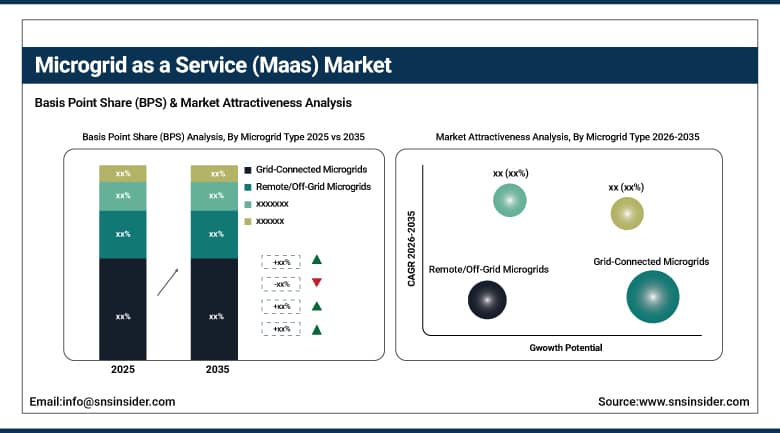
By Microgrid Type, grid-connected microgrids dominated the Microgrid as a Service (MaaS) Market, while remote/off-grid microgrids are the fastest growing segment.
The grid-connected microgrids segment led the Maas market, contributing the dominated share of revenue in 2025. The dominance was attributed to the presence of microgrids throughout commercial campuses, industrial premises, health care facilities, and utility infrastructures that require steady power supply. Good compatibility with the power grids, low risks associated with their use, conducive policy environment, and increased investments in energy security and renewables further fueled the adoption in developed economies.
The remote/off-grid microgrids segment is anticipated to register the fastest CAGR during 2026-2035. The growth is attributable to increased electrification projects in remote areas, mining sites, islands, and military bases that lack access to dependable grid connections. Increased investments in renewables, battery storage, government rural development initiatives, and economical energy security solutions have helped accelerate their adoption.
By Service Type, engineering, procurement & construction (EPC) dominated the Microgrid as a Service (MaaS) Market, while software & energy management services are the fastest growing segment.
The engineering, procurement & construction (EPC) segment was dominating the Microgrid as a Service (MaaS) Market with the highest market revenue share in 2025, owing to increasing investments in full-scale microgrid projects, engineering capabilities, and end-to-end project delivery. More commercial, industrial, utility, and governmental clients are choosing EPC segments to decrease the complexity of implementation. The increasing need for efficient and resilient energy infrastructure, renewable generation capacity, and fast deployment drives the segment into its leading position within the market.
The software & energy management services segment will have the fastest CAGR between 2026 and 2035. Increasing use of energy management software, which utilizes artificial intelligence for optimizing energy consumption and cloud-based management of energy infrastructure, leads to increased market demand. The expansion of distributed energy sources and battery storage is expected to drive fast growth of the segment during the forecast period.
By Power Source Mix, hybrid microgrids dominated the Microgrid as a Service (MaaS) Market, while renewable-based microgrids are the fastest growing segment.
The hybrid microgrids segment accounted for the dominated revenue share in 2025 as they offered capabilities to integrate renewable power generation, battery storage, and traditional back-up within a single system. Such types of microgrids generate power supply when there is a loss of power in the main grid. They offer reliable power in addition to efficient operations and low-cost energy. Extensive installations of hybrid microgrids in commercial, industrial, utility, and institutional establishments have been another reason that has led to market dominance.
Renewable-based microgrids segment is anticipated to register a faster growth rate between 2026-2035 due to the growing investment in renewable energy infrastructure and decarbonization policies adopted globally. The growing adoption of technologies such as solar power, wind power, and battery storage is likely to drive the installation of renewable microgrids across different end-user verticals. Incentives provided by governments, falling costs of renewable technologies, and the growing need for sustainable energy sources are driving the rapid growth of the segment.
By Application, backup power & energy resilience dominated the Microgrid as a Service (MaaS) Market, while renewable energy integration & decarbonization is the fastest growing segment.
The backup power and energy resilience Microgrid as a Service (MaaS) Market segment was the dominant one in terms of revenue share in 2025. The dominance was due to the high demand for consistent supply of electricity in commercial premises, hospitals, industries, and infrastructures. Grid outages, natural disasters, and constant power demands pushed companies to opt for resilient microgrids. In addition, service providers offered the flexibility of dependable backup power generation in a subscription-based model without incurring large costs of capital.
Renewable energy integration and decarbonization will have the fastest CAGR between 2026-2035. Issues such as increased company commitments to sustainability, government incentives in favor of renewable energy, and increased renewable energy capacity globally were contributing to this growth. Companies are increasingly adopting MaaS solutions for integration of solar, wind energy, energy storage systems, and energy management systems. The growing concern about reduction in CO2 emissions and grid modernization is boosting the investments in renewables microgrids.
By End-User, commercial dominated the Microgrid as a Service (MaaS) Market, while utilities & energy providers are the fastest growing segment.
The commercial segment led the Microgrid as a Service (MaaS) Market in terms of the dominated market share in 2025. The popularity of the product in office complexes, retail centers, data centers, education campuses, and hotels boosted the market dominance. Companies started spending more money on the infrastructure development that ensures stable supply of power in order to save from outages, increase energy efficiency and maintain business continuity. Moreover, more integration of renewable energy sources, energy storage and intelligent energy management systems increased the demand for the solution from the segment.
Utilities & energy providers segment is predicted to grow with the fastest CAGR from 2026-2035. Investments in grid modernization, distributed energy resources and renewable energy will drive the growth of large-scale microgrids installations. More and more utilities start using Maas solutions to make their grids more flexible and resilient, as well as ensure decentralized generation of electricity. Expansion of electrification programs, grid automation solutions and favorable government policies will boost the growth of the market even more.
Regional Insights:
|
Region |
Major Country |
Share within Region, 2025(%) |
|---|---|---|
|
North America |
United States |
81.97% |
|
Europe |
Germany |
24.80% |
|
Asia Pacific |
China |
38.60% |
|
Middle East & Africa |
UAE |
17.20% |
|
Latin America |
Brazil |
43.10% |
North America Microgrid as a Service (MaaS) Market Insights.
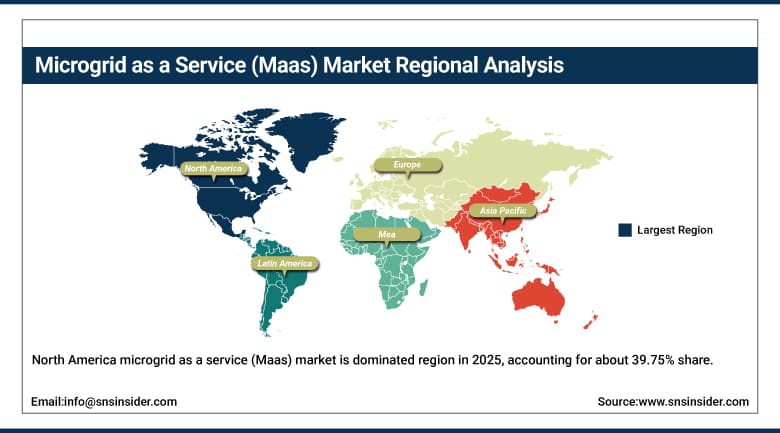
North America Microgrid as a Service (MaaS) Market is dominated region in 2025, accounting for about 39.75% share, driven by increasing deployment of resilient distributed energy systems across commercial, industrial, and institutional facilities. The region benefits from advanced grid infrastructure, strong renewable energy investments, and established energy technology companies. Increasing adoption of battery energy storage, digital energy management platforms, and grid modernization initiatives is strengthening market growth. Expansion of decentralized energy systems further reinforces the region’s dominant position in the market.
According to the U.S. Department of Energy, there has been tremendous growth in microgrid application for improving the resilience of the electricity distribution system in case of any possible disruption. It is anticipated that by 2025, the use of distributed storage using clean technologies will increase significantly to 18.9 gigawatts, which would help in increasing the resilience of the grid to meet the demands of commercial and institutional buildings. In this context, it indicates that these smart automatic systems operate as building blocks of the decentralized energy system.
Get Customized Report as Per Your Business Requirement - Enquiry Now
Europe Microgrid as a Service (MaaS) Market Insights.
Europe Microgrid as a Service (MaaS) Market is characterized by stable growth in 2025 owing to increasing investments in decentralized renewable energy infrastructure and intelligent energy management technologies. Key countries include Germany, France, United Kingdom, Italy, and Spain. Rising deployment of battery energy storage, solar-powered microgrids, and advanced digital control platforms is supporting market expansion. Increasing adoption of energy-as-a-service business models is strengthening long-term industry development. Technological advancements continue encouraging efficient energy optimization and resilient power management across the region.
As per the Renewable Capacity Highlights report published by the International Renewable Energy Agency, the capacity of renewable energy for Europe has increased by 76.8 gigawatts in the year 2025. It is an increase of 9.0% every year. The use of renewables in the region is very much dependent upon the distributed resources in the area as the global off-grid capacity has increased by 1.7 gigawatts to reach 17.8 gigawatts. Furthermore, the total solar photovoltaic capacity of Europe reached 405 gigawatts in 2025.
Asia Pacific Microgrid as a Service (MaaS) Market Insights.
Asia Pacific is the fastest growing region in the Microgrid as a Service (MaaS) Market, registering a CAGR of about 16.32% during 2026–2035. Rapid industrialization and increasing renewable energy adoption are driving strong market demand across China, Japan, India, South Korea, and Southeast Asia. Rising investments in distributed energy resources, battery storage systems, and intelligent energy management platforms are accelerating regional market growth. Growing rural electrification and grid modernization initiatives continue supporting widespread Microgrid as a Service (Maas) deployment across energy infrastructure.
The APAEC model indicates that there has been a set target of a 32% reduction in energy intensity for the region by the year 2025. According to the model of the World Bank and ESMAP, it is indicated that there have been more than 16,000 decentralized microgrids in South and Southeast Asia as an attempt to assist in the process of rural electrification. These decentralized grids are designed with the help of clean integration technologies in order to meet the region’s target of 23% renewable energy mix.
Middle East & Africa and Latin America Microgrid as a Service (MaaS) Market Insights.
The Middle East & Africa along with Latin America regions are witnessing steady growth due to expanding renewable energy capacity and increasing investments in resilient distributed energy infrastructure. Key contributing countries include Saudi Arabia, UAE, South Africa, Brazil, Mexico, and Argentina. Growing adoption of battery energy storage, hybrid microgrids, and digital energy management platforms is supporting market expansion. Continued investments in decentralized energy infrastructure are strengthening long-term regional opportunities.
According to the International Renewable Energy Agency, the total number of population using off-grid renewable energy systems was increased from 86.0 million persons around the world where Africa accounted for 76.7% of the population, which implies that 66.0 million persons were benefiting from the off-grid energy system. Moreover, as per the World Bank, the Mission 300 project had enabled 50 million people to get the benefit of modular energy systems in 40 countries.
Market Dynamics:
Growth Drivers: Rising Demand for Resilient Energy Infrastructure Drives Global Maas Market Growth
There are rising concerns related to power outages, climate-related catastrophes, and the aging of the electrical power infrastructure. Organizations need an energy source that is reliable to support their operations. Firms, industrial units, healthcare centers, and governmental institutions require constant supplies of power to operate their operations. Through its new models of services, Maas is able to cut down huge initial investments. The use of renewable energy, battery energy storage, and control systems improves efficiency and performance.
According to World Bank Energy Sector Management Assistance Program in 2025, the requirement of over 217,000 mini grids will be needed for providing energy to five hundred million people by 2030, which will solve the problem of energy deficit in the world. In addition, the use of solar hybrid microgrid technology in its third generation uses the remote monitoring platform technology in order to minimize operations and maintenance metrics by 15%.
Restraints:Regulatory Uncertainty and Standardization Challenges Restrict Global Maas Market Expansion
Regulations in energy sector vary widely from one nation to another, thus raising uncertainties for Maas firms and investors in terms of how they operate. Variations in policies surrounding distributed energy sources, pricing of energy, connection to grid, and involvement of utility companies make the implementation of Maas project difficult. Lack of standardization in communication protocols and energy management systems also raises issues in terms of interfacing different technology vendors. Regular changes in regulations raise financial risks, thereby discouraging investments in decentralized energy systems.
Opportunities: AI-Based Energy Management and Digital Platforms Expand Global Maas Service Opportunities
Technology is advancing quickly and bringing about a change in Microgrid as a service through intelligent automation, predictive analysis, and real-time energy optimization. There are advancements in the use of artificial intelligence, digital twins, cloud-based monitoring, and microgrid controllers that lead to better efficiency and performance of assets. The service providers are coming up with unique energy management services under subscription-based models. There is an increase in carbon reductions, predictive maintenance, and intelligent distributed energy management that drive innovation.
As per the report from the International Energy Agency concerning the impact of energy and artificial intelligence in the year 2025, the application of automation technologies through digitization reduces the cost by 3%-10% of the energy costs incurred in the industrial process. However, the installation of decentralized energy systems that consist of microgrid and battery storage system onsite has been improved because of the 3% increase in electricity demand in 2025.
Recent Developments:
-
2026: ABB scheduled its Q3 2026 results release for October 20, following its ongoing commitment to leaner, cleaner industry technology solutions.
-
2025: Siemens focused on accelerating digital and sustainability transformations, empowering customers through its extensive portfolio of industrial hardware and software solutions.
-
2025: Eaton pivoted its microgrid strategy toward AI optimization through a cornerstone software partnership and investment with Xendee.
-
2024: Schneider Electric partnered with NTT DATA to integrate edge computing, private 5G, and IoT solutions for industrial AI adoption.
Microgrid as a Service (MaaS) Companies are:
-
Schneider Electric
-
ABB
-
Eaton
-
GE Vernova
-
Honeywell
-
Caterpillar
-
ENGIE
-
Enchanted Rock
-
Aggreko
-
Scale Microgrids
-
Bloom Energy
-
Duke Energy
-
NextEra Energy
-
Itron
-
Spirae
-
Power Analytics Corporation
-
Canopy Power
-
S&C Electric Company
Microgrid as a Service (MaaS) Market Report Scope:
| Report Attributes | Details |
|---|---|
| Market Size in 2025 | USD 3.40 Billion |
| Market Size by 2035 | USD 13.91 Billion |
| CAGR | CAGR of 15.17% From 2026 to 2035 |
| Base Year | 2025 |
| Forecast Period | 2026-2035 |
| Historical Data | 2022-2024 |
| Report Scope & Coverage | Market Size, Segments Analysis, Competitive Landscape, Regional Analysis, DROC & SWOT Analysis, Forecast Outlook |
| Key Segments | • By Service Type (Engineering, Procurement & Construction (EPC), Software & Energy Management Services, Monitoring and Control Services, Operation & Maintenance (O&M) Services, Consulting & Feasibility Assessment Services, Financing, Leasing & Subscription-Based Services) • By Microgrid Type (Grid-Connected Microgrids, Remote/Off-Grid Microgrids) • By Power Source Mix (Hybrid Microgrids, Renewable-Based Microgrids, Conventional-Based Microgrids) • By Application (Backup Power & Energy Resilience, Peak Shaving & Demand Charge Management, Renewable Energy Integration & Decarbonization, Rural Electrification & Remote Energy Access) • By End-User (Commercial, Industrial, Utilities & Energy Providers, Government & Defense, Healthcare & Institutional Facilities, Residential) |
| Regional Analysis/Coverage | North America (US, Canada), Europe (Germany, UK, France, Italy, Spain, Russia, Poland, Rest of Europe), Asia Pacific (China, India, Japan, South Korea, Australia, ASEAN Countries, Rest of Asia Pacific), Middle East & Africa (UAE, Saudi Arabia, Qatar, South Africa, Rest of Middle East & Africa), Latin America (Brazil, Argentina, Mexico, Colombia, Rest of Latin America). |
| Company Profiles | Schneider Electric, Siemens, ABB, Eaton, GE Vernova, Honeywell, Caterpillar, Ameresco, ENGIE, Enchanted Rock, Aggreko, Scale Microgrids, Bloom Energy, Duke Energy, NextEra Energy, Itron, Spirae, Power Analytics Corporation, Canopy Power, S&C Electric Company |

Frequently Asked Questions
The major growth factors include rising demand for resilient energy infrastructure, renewable integration, battery storage, grid modernization, AI-enabled energy management, decarbonization, and distributed energy resources.
The engineering, procurement & construction (EPC) dominated in 2025 due to rising investments in integrated microgrid projects, resilient energy infrastructure, and comprehensive end-to-end project execution services.
The microgrid as a service (Maas) market was valued at USD 3.40 billion in 2025.
The microgrid as a service (Maas) market is expected to grow at a CAGR of 15.17% from 2026 to 2035.
North America dominated the microgrid as a service (Maas) market in 2025.
