
Electrolyzer as a Service Market Report Scope & Overview:
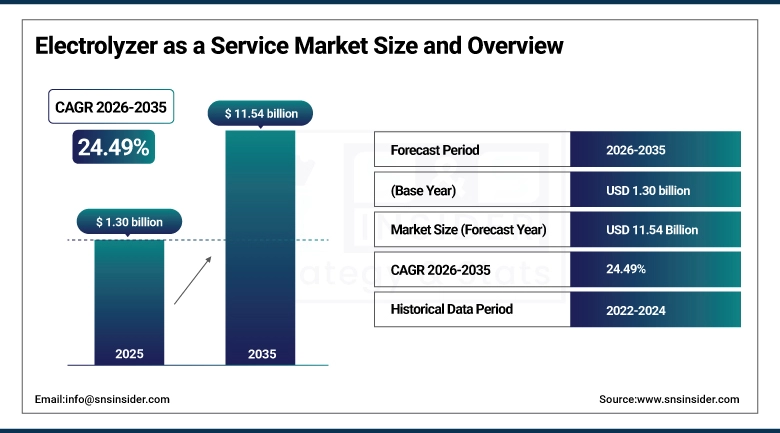
The Electrolyzer as a Service Market was valued at USD 1.30 billion in 2025 and is expected to reach USD 11.54 billion by 2035, growing at a CAGR of 24.49% from 2026-2035.
Electrolyzer as a Service Market growth will be driven by the rising demand for hydrogen fuel, favorable policies by the government, and increased use in various industries, including mobility, utilities, and industry. Increased cost-effectiveness, flexible business model, and higher efficiency from integration with renewable energy sources are other key factors propelling market growth. Advanced technologies, investment in hydrogen fuel infrastructure, and global efforts towards decarbonization are adding impetus to market growth.
This trend is further supported by the International Energy Agency, which reports that global electrolyzer capacity reached approximately 1.4 GW in 2023, nearly doubling from the previous year, while manufacturing capacity expanded to around 25 GW annually, reflecting the rapid scaling of hydrogen infrastructure worldwide.
Electrolyzer as a Service Market Size and Forecast
-
Market Size in 2025: USD 1.30 Billion
-
Market Size by 2035: USD 11.54 Billion
-
CAGR: 24.49% from 2026 to 2035
-
Base Year: 2025
-
Forecast Period: 2026–2035
-
Historical Data: 2022–2024
To Get more information on Electrolyzer as a Service Market - Request Free Sample Report
Electrolyzer as a Service Market Trends
-
Rising demand for green hydrogen production is driving the electrolyzer as a service (EaaS) market.
-
Growing adoption of hydrogen for industrial, power, and transportation applications is boosting market growth.
-
Expansion of renewable energy–integrated electrolyzer projects is fueling service-based deployment models.
-
Increasing focus on reducing upfront capital expenditure and operational complexity is shaping adoption trends.
-
Advancements in PEM, alkaline, and solid oxide electrolyzer technologies are enhancing efficiency and scalability.
-
Rising government incentives, decarbonization initiatives, and corporate net-zero commitments are supporting market expansion.
-
Collaborations between energy companies, technology providers, and service operators are accelerating innovation and global adoption.
U.S. Electrolyzer as a Service Market Size Outlook:
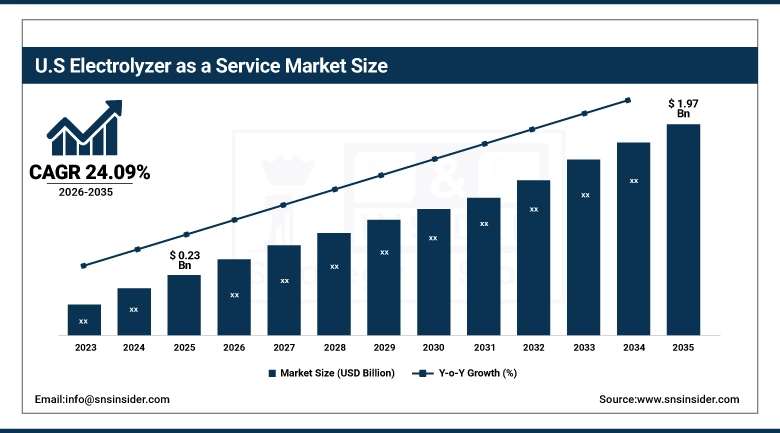
U.S. Electrolyzer as a Service Market was valued at USD 0.23 billion in 2025 and is expected to reach USD 1.97 billion by 2035, growing at a CAGR of 24.09% from 2026-2035. The United States Electrolyzer as a Service Market is expanding owing to high adoption rates of renewable energy, government initiatives, increased demand for hydrogen fuel from industry and transportation sectors, and the development of green hydrogen production facilities.
This growth is further reinforced by the U.S. Energy Information Administration, which reports that planned U.S. projects alone could increase electrolyzer capacity from approximately 116 MW to over 4,500 MW, supporting a significant shift toward green hydrogen production across industrial and mobility sectors.
Electrolyzer as a Service Market Growth Drivers:
-
Rising demand for green hydrogen adoption across industries and mobility sectors to reduce carbon footprint and comply with environmental regulations
The increasing trend towards decarbonization and green energy adoption around the world is pushing businesses to incorporate green hydrogen technology. The Electrolyzer as a Service (EaaS) solution allows the production of hydrogen using this technology without much initial investment on capital equipment. The industrial and mobility segments as well as utility businesses are increasingly turning towards this service-based approach for obtaining pure hydrogen for their operations and fuelling stations. Flexibility through this system means that the capacity can be scaled up or down as per the requirement, minimizing operational risk. Incentives from the government towards green hydrogen also push its adoption.
Electrolyzer as a Service Market Restraints:
-
Dependence on reliable renewable electricity supply for cost-effective hydrogen production affecting market growth in certain regions
Electrolysis technology depends heavily on reliable electricity, especially renewable energy, for the production of green hydrogen. The production rate becomes inefficient if there are irregularities in electricity supplies or a lack of renewable energy facilities in the area. The grid dependence and irregularity in the supply of renewable energy pose difficulties in maintaining constant production levels. Energy storage also makes the process difficult and expensive. As such, the technology cannot be utilized in places that lack reliable renewable energy sources or government support. As a result, Electrolyzer as a Service cannot grow in regions where energy facilities are lacking.
Electrolyzer as a Service Market Opportunities:
-
Integration of electrolyzers with renewable energy projects to produce cost-efficient green hydrogen for industrial and mobility sectors
There is a huge potential for Electrolyzers as a Service in the growing trend towards renewable energy worldwide. The combination of electrolysis technology with renewable energy such as solar, wind, or hydro power offers an affordable way to generate green hydrogen, thereby minimizing reliance on fossil fuels. Both industrial, transportation, and utilities may access hydrogen on demand without investing in their own plant. This provides opportunities for collaborations between renewable energy developers and Electrolyzers as a Service companies. Furthermore, there is increasing international interest in zero emissions goals.
Integration of Electrolyzers with Renewable Energy Projects: Key Global Case Studies
|
Project Name |
Details |
|
NEOM Green Hydrogen Company |
One of the largest green hydrogen projects powered by 4 GW solar and wind energy, producing ~600 tons/day of hydrogen (converted to ammonia). Backed by Air Products and ACWA Power, demonstrating utility-scale renewable-electrolyzer integration. |
|
H2Future Project |
Developed by Siemens Energy and Voestalpine, using hydropower to run a 6 MW electrolyzer for green hydrogen production in steelmaking, supporting industrial decarbonization. |
|
Western Green Energy Hub |
Large-scale project integrating wind and solar (>50 GW planned) with electrolyzers to produce hydrogen and ammonia for export, highlighting renewable-driven hydrogen ecosystems. |
|
HyDeal España |
Combines solar power with electrolyzers to deliver low-cost green hydrogen (<€1.5/kg), involving multiple industrial and energy partners to improve cost efficiency. |
|
Shell Holland Hydrogen I |
Developed by Shell plc, featuring a 200 MW electrolyzer powered by offshore wind, supplying hydrogen to refining and industrial sectors. |
|
Asian Renewable Energy Hub |
Integrates large-scale wind and solar energy with hydrogen production infrastructure, targeting export of green hydrogen and ammonia to Asian markets. |
|
NTPC Green Hydrogen Project |
Led by NTPC Limited, using solar energy for hydrogen production to support mobility (hydrogen buses) and industrial applications. |
Electrolyzer as a Service Market Segment Highlights
-
By Deployment, Onsite dominated the Electrolyzer as a Service Market with ~55% share in 2025; Offsite fastest growing (CAGR).
-
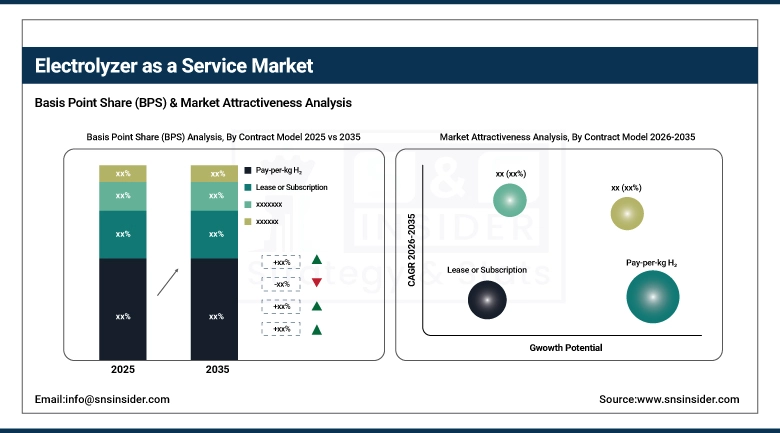
By Contract Model, Pay-per-kg H₂ dominated the Electrolyzer as a Service Market with ~42% share in 2025; Lease or Subscription fastest growing (CAGR).
-
By System Size, 5 to 20 MW dominated the Electrolyzer as a Service Market with ~41% share in 2025; Greater than 20 MW fastest growing (CAGR).
-
By Customer Type, Industrial dominated the Electrolyzer as a Service Market with ~38% share in 2025; Mobility H₂ Stations fastest growing (CAGR).
-
By Electrolyzer Technology, Alkaline dominated the Electrolyzer as a Service Market with ~41% share in 2025; PEM fastest growing (CAGR).
By Contract Model, Pay-per-kg H₂ segment dominates the Electrolyzer as a Service Market, Lease or Subscription segment expected to grow fastest
The Pay per Kg H₂ segment is the dominant segment in Electrolyzers-as-a-Service Market in terms of market revenue due to negligible upfront cost and consistent operating costs. The industries and mobility service providers prefer this segment because it relates the cost of usage to the quantity of hydrogen produced and minimizes risk. It also ensures that there are no ownership obligations and that the volume of hydrogen can be scaled up or down depending on the needs of the customer.
Lease or Subscription segment is estimated to register the highest CAGR during the period 2026-2035 owing to rising preference among organizations to opt for flexibility along with the reduction in the amount of capital expenditure involved. It provides customers with maintenance, performance optimization, and monitoring services on a subscription basis.
By Deployment, Onsite segment dominates the Electrolyzer as a Service Market, Offsite segment expected to grow fastest
The Onsite Segment held the largest market share in terms of Electrolyzer as a Service in 2025 owing to its installation on-site at the facility, which reduces hydrogen transportation cost and helps in utilizing it immediately. Onsite Segment is preferred by consumers as it ensures efficiency and reliability and avoids logistical problems related to transporting the product.
The OffSite segment is projected to expand at the fastest CAGR between 2026 and 2035 because hydrogen production in one facility and distribution to several locations ensures cost savings in terms of scale, ease of maintenance, and adaptability. Off-Site deployment will allow for efficient utilization of renewable energy and large infrastructure, hence driving investments in regional hydrogen centers and expansion into new regions.
By System Size, 5 to 20 MW segment dominates the Electrolyzer as a Service Market, Greater than 20 MW segment expected to grow fastest
5 to 20 MW segment held the largest revenue share in the Electrolyzer as a Service market in 2025 as they are ideal for mid-sized industrial and regional projects. They can balance out capacity and efficiency, providing an affordable capital cost, limited scalability, and efficient integration with renewable energy sources. This makes them ideal systems for meeting current industrial demands for hydrogen.
Greater than 20 MW segment is anticipated to register the highest CAGR during the forecast period of 2026 to 2035 due to the potential to generate large quantities of hydrogen in massive power plants that can be used by industry centers, for exports, and utilities. This category attracts investments due to scale efficiencies, improved efficiencies, and ability to harness renewable energy sources.
By Customer Type, Industrial segment dominates the Electrolyzer as a Service Market, Mobility H₂ Stations segment expected to grow fastest
Industrial segment led the Electrolyzer as a Service Market in terms of revenue share in 2025 due to the need for constant supply of hydrogen in heavy industries for purposes such as steelmaking, chemicals, and refining. This will help in cutting down on capital expenditure and ensure constant hydrogen production. This ensures continued revenue and adoption of Electrolyzer as a Service.
Mobility H₂ Stations segment is forecasted to record the highest CAGR over the projected period from 2026 to 2035 due to the increasing number of hydrogen stations as electric vehicles gain popularity. The development of fast-reaction PEM technology and service-oriented business models facilitate the provision of hydrogen in a scalable manner.
By Electrolyzer Technology, Alkaline segment dominates the Electrolyzer as a Service Market, PEM segment expected to grow fastest
The Alkaline segment accounted for the maximum share of revenue in the Electrolyzer as a Service Market in 2025 due to well-established technology, lower costs, and applicability in large-scale hydrogen generation by the industries. This segment is the optimal option because of its higher efficiency, long life span, and high throughput capacity.
The PEM segment is forecasted to have the highest CAGR during the forecast period due to its efficiency, portability, and flexibility in operation even with the fluctuating input of renewable energy sources. The high rate of adoption in mobility and small-scale industries along with the rising need for pure hydrogen contributes to the growth of this segment.
Electrolyzer as a Service Market Regional Analysis
Europe Electrolyzer as a Service Market Insights
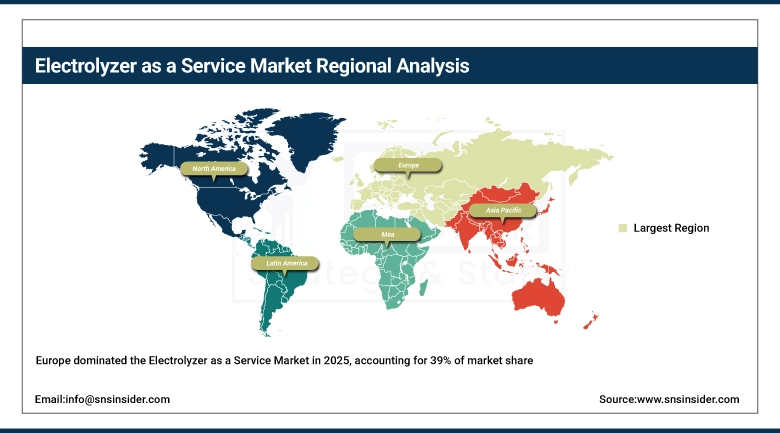
The European region held the largest revenue share in the Electrolyzer as a Service Market, accounting for approximately 39% in 2025. Well-developed hydrogen infrastructure, supportive policies by the government, and substantial investment in green hydrogen projects have allowed the European region to dominate the market in terms of revenue share. The presence of key market players, supportive regulatory environment, and incentives for decarbonization have contributed to the dominance of the European region.
Get Customized Report as per Your Business Requirement - Enquiry Now
Asia Pacific Electrolyzer as a Service Market Insights
The Asia Pacific segment is anticipated to exhibit the highest CAGR of approximately 26.08%, over 2026-2035, owing to high industrial development, growing energy consumption, and increasing attention towards hydrogen as a fuel alternative. Growing investment in renewable sources of energy, favorable government policies, and increased usage in mobility and industries propel Electrolyzer-as-a-Service adoption. Developing nations are focusing on setting up green hydrogen facilities, while the availability of new market players fuels growth in the region.
North America Electrolyzer as a Service Market Insights
The North American Electrolyzer as a Service Market is expected to make a prominent contribution to the total value as a result of its sophisticated industrial base, adoption of renewable energy, and favorable government support mechanisms. The region can take advantage of a high level of demand for mobility, power-to-X, and industrial applications, as well as the presence of electrolyzer service providers. Green hydrogen projects, innovations, and the pursuit of decarbonization contribute to market growth.
Middle East & Africa and Latin America Electrolyzer as a Service Market Insights
Middle East & Africa and Latin America are emerging regions for the Electrolyzer as a Service Market due to increased investments in renewable energy, industrial growth, and the development of hydrogen infrastructure. The presence of favorable government policies, decarbonization strategies, and rising demand for green hydrogen for mobility and industrial applications provide opportunities for growth. With limited existing infrastructure that is developing at a fast pace, global service providers are flocking into the regions to ensure they can make a significant contribution to the growth of the global market.
Electrolyzer as a Service Market Competitive Landscape:
Waaree Energies
Founded in 1989, Waaree Energies is a reputable renewable energy solutions provider based out of India. The firm has been active in providing solar panels, EPC solutions, and even green energy projects. Waaree Energies has been focused on deploying sustainable energy solutions and implementing innovative technologies for the benefit of the country’s energy transition efforts. Waaree Energies is now looking towards the implementation of green hydrogen and HaaS solutions for its clients.
2026
-
Waaree Clean Energy Solutions signed a 2.5 MW Electrolyzer‑as‑a‑Service agreement with Zero Footprint Industries to design, install, own, operate, and supply green hydrogen in Uttar Pradesh under a 15‑year contract.
ITM Power
ITM Power, incorporated in 2001 and headquartered in the United Kingdom, is a world leader in developing and producing PEM electrolyzers for the production of green hydrogen. The firm concentrates on providing support for the transition from conventional fuels by enabling environmentally friendly hydrogen production for various industries, businesses, and transport sectors. ITM Power also highlights a service approach for long-term solutions that eliminate the issue of high capital costs.
2025
-
ITM Power launched Hydropulse GmbH, a wholly-owned subsidiary focused on building, owning, and operating decentralised green hydrogen plants under long-term hydrogen‑as‑a‑service contracts to serve industrial customers across Europe.
-
Hydropulse GmbH (subsidiary of ITM Power) entered a strategic partnership with Eternal Power GmbH to drive industrial hydrogen projects using a hydrogen‑as‑a‑service model, reducing industry capex barriers.
Electrolyzer as a Service Companies are:
-
ITM Power (Hydropulse)
-
Linde
-
Air Liquide
-
Air Products
-
Electric Hydrogen
-
Siemens AG
-
Cummins Inc.
-
Nel Hydrogen (Nel ASA)
-
Plug Power Inc.
-
McPhy Energy
-
Green Hydrogen Systems
-
Thyssenkrupp nucera
-
John Cockerill
-
Giner Inc.
-
Ohmium International
-
Sunfire GmbH
-
Hysata
-
Asahi Kasei
| Report Attributes | Details |
|---|---|
| Market Size in 2025 | USD 1.30 Billion |
| Market Size by 2035 | USD 11.54 Billion |
| CAGR | CAGR of 24.49% From 2026 to 2035 |
| Base Year | 2025 |
| Forecast Period | 2026-2035 |
| Historical Data | 2022-2024 |
| Report Scope & Coverage | Market Size, Segments Analysis, Competitive Landscape, Regional Analysis, DROC & SWOT Analysis, Forecast Outlook |
| Key Segments | • By Electrolyzer Technology (PEM, Alkaline, SOEC, AEM, Other) • By Contract Model (Pay-per-kg H₂, Lease or Subscription, Build-Own-Operate-Transfer (BOOT), Other) • By Customer Type (Industrial, Mobility H₂ Stations, Power-to-X, Utilities, Storage) • By System Size (Less than 5 MW, 5 to 20 MW, Greater than 20 MW) • By Deployment (Onsite, Offsite) |
| Regional Analysis/Coverage | North America (US, Canada), Europe (Germany, UK, France, Italy, Spain, Russia, Poland, Rest of Europe), Asia Pacific (China, India, Japan, South Korea, Australia, ASEAN Countries, Rest of Asia Pacific), Middle East & Africa (UAE, Saudi Arabia, Qatar, South Africa, Rest of Middle East & Africa), Latin America (Brazil, Argentina, Mexico, Colombia, Rest of Latin America). |
| Company Profiles | Waaree Energies, ITM Power (Hydropulse), Linde, Air Liquide, Air Products, RCT Hydrogen, Electric Hydrogen, Siemens AG, Cummins Inc., Nel Hydrogen (Nel ASA), Plug Power Inc., McPhy Energy, Green Hydrogen Systems, Thyssenkrupp nucera, John Cockerill, Giner Inc., Ohmium International, Sunfire GmbH, Hysata, Asahi Kasei. |
Frequently Asked Questions
Europe dominated the Electrolyzer as a Service Market in 2025.
The Pay-per-kg H₂ segment dominated the Electrolyzer as a Service Market in 2025.
Rising demand for green hydrogen adoption across industries and mobility sectors to reduce carbon footprint and comply with environmental regulations.
The Electrolyzer as a Service Market was valued at USD 1.30 billion in 2025.
The Electrolyzer as a Service Market is expected to grow at a CAGR of 24.49% from 2026 to 2035.
Get in Touch
