
Minimalist Packaging Market Report Scope & Overview:
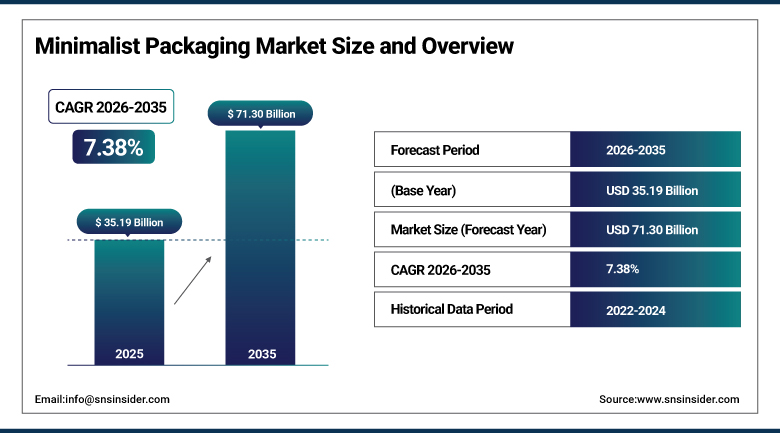
The Minimalist Packaging Market was valued at USD 35.19 Billion in 2025 and is expected to reach USD 71.30 Billion by 2035, growing at a CAGR of 7.38% from 2026 to 2035.
The minimalist packaging market exists because brands increasingly discovered that less packaging often sells better than more, a compressed powder tablet that eliminates an outer shipping carton, a skincare box stripped down to a single recyclable sleeve, a shipping mailer sized to the product rather than padded with excess void-fill. That stripped-down approach delivers real, measurable savings across material cost, shipping weight, and warehouse space, savings that compound significantly at the scale major consumer goods companies operate. What is changing the category now is how central e-commerce has become to its growth story, since online retail rewards lighter, more compact packaging in ways traditional shelf retail never did, and stringent environmental regulations targeting packaging waste are pushing brands toward genuinely simplified designs rather than cosmetic sustainability claims.
In January 2025, Sonoco Products Company launched its first Global Capability Centre, the Sonoco Performance Hub, in Hyderabad, India, representing a USD 10 million initial-phase investment.
To Get more information Minimalist Packaging Market - Request Free Sample Report
Minimalist Packaging Market Trends
- Boxes and cartons continue leading packaging type adoption for their structural efficiency and alignment with simplified design principles.
- Plastics are gaining share fastest among materials as lighter, mono-material formats replace multilayer structures.
- E-commerce brands are driving demand for right-sized packaging that eliminates excess void-fill and outer shipping cartons.
- Personal care and cosmetics brands are adopting minimalist design to signal premium positioning and sustainability credentials simultaneously.
- Compressed and concentrated product formats are reducing overall packaging volume across household and personal care categories.
The U.S. Minimalist Packaging Market Outlook
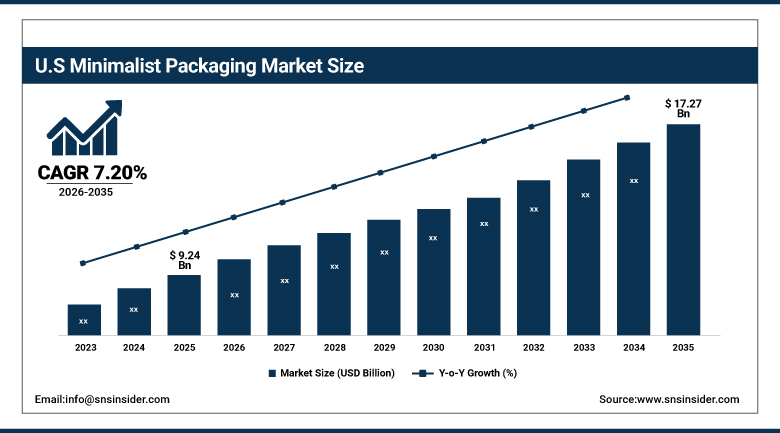
The U.S. Minimalist Packaging Market was valued at USD 9.24 Billion in 2025 and is projected to reach USD 17.27 Billion by 2035, growing at a CAGR of 7.20% during 2026-2035.
The United States Minimalist Packaging Market is being driven by sustainability laws, requirements from retailers, and the rise in consumer preference for minimalist packaging. In states like California, Colorado, Maine, and Oregon, the implementation of extended producer responsibility programs is putting more pressure on companies to minimize waste and promote recycling in the packaging process. Mono-material flexible packaging is being used by many American companies since the lightweight structure of packaging helps in reducing material usage and also meets the recyclability requirement. Paper packaging is one of the most common types of packaging used owing to the availability of recycling systems for it. E-commerce is motivating U.S. businesses to adopt the right-sized and recyclable packing.
In 2025, Ranpak Holdings Corp. continued expanding adoption of its paper-based void-fill and protective packaging systems, designed to reduce material use and plastic dependency for e-commerce shippers.
Minimalist Packaging Market Segment Analysis
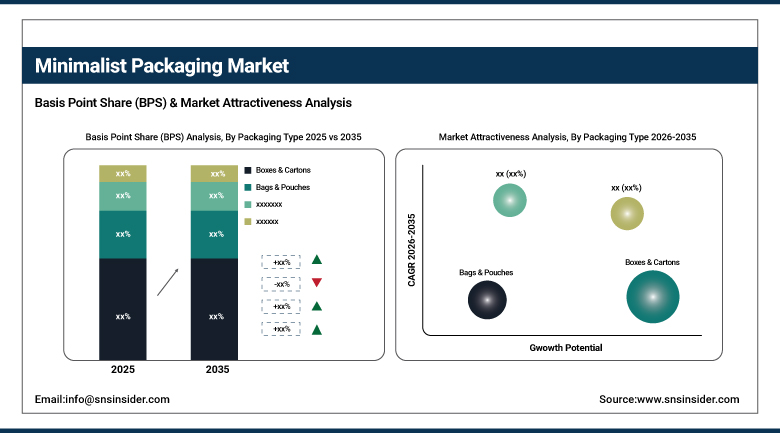
- By Packaging Type, boxes & cartons dominates the Minimalist Packaging Market with boxes & cartons holding 34% share in 2025 while bags & pouches grows fastest registering a CAGR of 8.60% from 2026 to 2035.
- By Material, paper & paperboard dominates the Minimalist Packaging Market with paper & paperboard holding 44% share in 2025 while plastics grow fastest registering a CAGR of 7.46% from 2026 to 2035.
- By End-Use Industry, food & beverage dominates the Minimalist Packaging Market with food & beverage holding 32% share in 2025 while personal care & cosmetics grows fastest registering a CAGR of 8.20% from 2026 to 2035.
- By Distribution Channel, offline dominates the Minimalist Packaging Market with offline holding 62% share in 2025 while online grows fastest registering a CAGR of 9.40% from 2026 to 2035.
By Packaging Type, Boxes & Cartons Dominates the Minimalist Packaging Market While Bags & Pouches Grows Fastest
Boxes & Cartons have 34% market share in the Minimalist Packaging Market, accounting for the biggest segment, dominating the industry due to their amazing flexibility, effective structure, and perfect fit with the principles of minimalism and sustainability. It is possible to create boxes and cartons using minimal materials yet achieving good protection for products, thus making boxes and cartons suitable for minimalist packaging in a variety of industries.
Bags & Pouches have experienced the highest compound annual growth rate of 8.60%, which is higher than any other type of packaging available in the market, as brands have started preferring flexible packaging due to its low usage of material and lighter weight than that of rigid box and jar packaging. The increase in the number of shipments through e-commerce channels has also fueled this trend.
By Material, Paper & Paperboard Dominates the Minimalist Packaging Market While Plastics Grow Fastest
Paper & Paperboard holds 44% of the market by material, the largest single category, benefiting from strong consumer trust, established recycling infrastructure, and its natural fit with the simplified, single-material design philosophy that defines minimalist packaging. Established paper converting infrastructure across the packaging industry also keeps this material the most economical option for brands scaling minimalist redesigns across their product portfolios.
Plastics are growing fastest by material, at a 7.46% CAGR, as manufacturers develop increasingly sophisticated lightweight, mono-material plastic formats that combine material efficiency with the genuine recyclability that multilayer plastic structures have historically struggled to deliver. This innovation is helping plastic maintain relevance in minimalist design even as paper and paperboard continue gaining broader adoption across the category.
By End-Use Industry, Food & Beverage Dominates the Minimalist Packaging Market While Personal Care & Cosmetics Grows Fastest
Food & Beverage accounts for 32% of end-use demand, the largest single category, reflecting the sheer scale of packaged food and beverage products moving through global retail and the category's early, widespread adoption of lightweighting and material-reduction initiatives. Cost efficiency remains a genuine driver here too, since even modest packaging-material savings translate into meaningful cost reductions at the volumes major food and beverage manufacturers operate.
Personal Care & Cosmetics is the fastest-growing end-use industry, expanding at an 8.20% CAGR, as premium and luxury beauty brands increasingly use minimalist packaging design to signal both sophistication and genuine sustainability credentials to increasingly discerning consumers. Growing consumer willingness to pay more for products with simplified, less wasteful packaging is reinforcing this segment's above-average growth trajectory.
By Distribution Channel, Offline Dominates the Minimalist Packaging Market While Online Grows Fastest
Offline distribution accounts for 62% of market share by channel, due to the prevalence of minimalist packaging purchases via conventional retailing, where customers can assess the product in relation to its simplicity and sustainability through physical touch before making a purchase decision. Retail packaging standards and consumer experience in recognizing minimalist packaging within the store environment continue to sustain this channel’s dominance.
Online distribution is expanding at the fastest rate amongst all other channels, at 9.40% CAGR, due to the continued importance of e-commerce development as one of the major factors driving the adoption of minimalist packaging solutions, giving brands an edge in terms of reduced weight and space efficiency in delivery of packaging without additional materials. Brands relying on minimalist packaging as part of the direct value proposition have relied heavily on online channels as means of reaching the market.
Regional Analysis
|
Region |
Country |
Share (2025) |
|
North America |
United States |
85.00% |
|
Asia Pacific |
China |
35.40% |
|
Europe |
Germany |
25.60% |
|
Middle East & Africa |
UAE |
17.20% |
|
Latin America |
Brazil |
26.70% |
North America Minimalist Packaging Market Insights
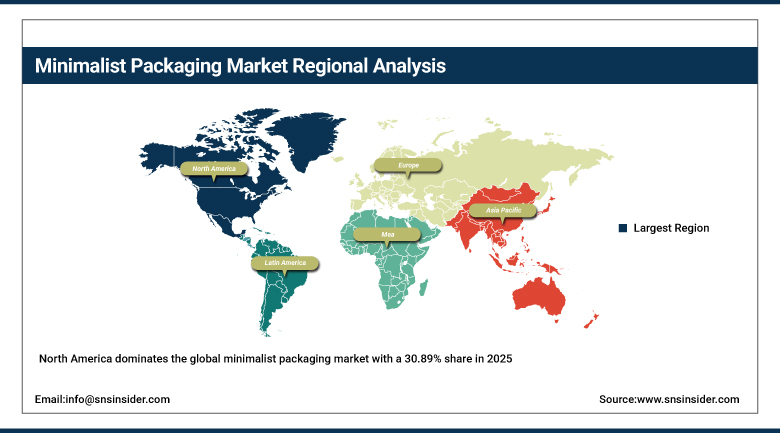
North America dominates the global minimalist packaging market with a 30.89% share in 2025, supported by stringent environmental regulations, high e-commerce penetration, and strong consumer demand for premium products packaged with genuine sustainability credentials rather than cosmetic claims. Growth here comes from continued material innovation and regulatory-driven redesign rather than first-time category adoption, since minimalist packaging principles have been steadily gaining traction across the region for years.
The United States accounts for approximately 85.00% of the North American market, reflecting its large consumer goods manufacturing base and advanced e-commerce fulfillment infrastructure. Canada contributes a smaller but steady share, tied to its own packaging waste regulations and comparable e-commerce adoption trends.
Get Customized Report as per Your Business Requirement - Enquiry Now
Europe Minimalist Packaging Market Insights
Europe's minimalist packaging market is mature and shaped heavily by some of the world's strictest packaging waste regulations, which are pushing brands toward genuinely simplified designs well ahead of most other regions. Strong consumer preference for sustainable packaging options continues reinforcing steady demand even as growth in absolute terms remains more measured than in Asia Pacific.
Germany leads the European market with a 25.60% share, supported by its large consumer goods manufacturing base and strict sustainability compliance standards. France and the United Kingdom follow, with demand in both countries tied to comprehensive packaging waste regulation and growing premium product positioning.
Asia Pacific Minimalist Packaging Market Insights
The fastest-growing region within this market is Asia Pacific, which is expected to have a CAGR of around 8.10% from 2026 to 2035. This is largely due to factors such as the fast growth of e-commerce, higher disposable incomes, and government focus on packaging waste regulations. The growing modern retail and e-commerce industry that enters markets with the concept of minimalist packaging as something new is precisely what the mature markets can no longer provide.
China has an approximate market share of 35.40%, thanks to its extensive logistics network for e-commerce and its developing consumer goods manufacturing industry. Markets in India and Southeast Asia are showing fast growth due to increased online penetration, while markets in Japan and South Korea come from their developed consumer goods industries.
Middle East & Africa and Latin America Minimalist Packaging Market Insights
Middle East & Africa will witness stable growth due to modernization in retail and e-commerce development in the Gulf countries, along with increasing disposable income and consumer awareness of sustainable packaging solutions. The growth of Latin America will be similar due to increased manufacturing of consumer goods in Brazil, along with growing adoption of e-commerce in the region.
The UAE leads the Middle East & Africa market with a 17.20% share, supported by its role as a regional retail and e-commerce distribution hub. Brazil represents 26.70% of the Latin American market, reflecting its large consumer goods manufacturing base, with Mexico also contributing through its growing e-commerce and packaged goods sectors.
Market Dynamics
Growth Drivers: E-Commerce Expansion and Environmental Regulation Fueling Market Growth
The growth of e-commerce has proved to be the most compelling factor driving the growth of this market since e-commerce provides incentives for light and compact packaging that was not provided by the conventional shelf-retailing industry, compelling manufacturers to rethink their packaging to be efficient in terms of logistics as opposed to shelf appeal. Increased environmental regulations focusing on packaging have added to this growing trend.
Rising demand for premium and luxury products is adding a meaningful additional demand line, as brands increasingly use minimalist packaging design to signal sophistication and genuine sustainability credentials to increasingly discerning consumers.
Restraints: High Initial Investment and Durability Trade-offs Limiting Market Expansion
Sustainable materials suited to minimalist packaging design often carry a genuine cost premium over conventional alternatives, and that high initial investment can be difficult for smaller brands to justify without clear near-term demand certainty. Limited durability and protection remain genuine concerns for some minimalist formats, particularly where material reduction compromises the structural integrity products need to survive shipping and handling without damage.
There is a vast variation in packaging material and recyclable claims regulations that makes it very hard for brands intending to market minimalist packages internationally to meet all the compliance obligations.
Opportunities: Smart Packaging Integration and Design Service Expansion Creating New Growth Avenues
Implementing smart packaging technologies represents a genuine growth opportunity, as brands increasingly want to enhance consumer engagement and traceability within simplified packaging formats rather than treating minimalism and smart features as competing design priorities. Manufacturers who can integrate both successfully stand to capture premium positioning as this convergence continues building momentum.
Expanding minimalist packaging design services for e-commerce businesses offers a second clear opportunity, particularly as smaller and mid-sized direct-to-consumer brands increasingly need specialized design expertise they can't justify building in-house.
Recent Developments:
- 2025: Sonoco Products Company continued scaling its Sonoco Performance Hub in Hyderabad, India, supporting packaging design and engineering services across its global minimalist and sustainable packaging portfolio.
- 2022: Reckitt Benckiser Group plc's Vanish brand introduced Vanish Multipower Tabs, using a compressed powder structure that eliminated outer shipping packaging for online shoppers.
- 2025: Frugalpac Ltd. continued its collaboration with ITC Limited to expand adoption of its paper-based bottle technology, reducing plastic content in beverage packaging.
- 2025: Notpla Ltd. continued expanding commercial applications of its seaweed-derived packaging material as a biodegradable alternative to single-use plastic films and coatings.
Minimalist Packaging Market key players are:
- Amcor plc
- Sonoco Products Company
- Mondi Group
- Smurfit Westrock plc
- International Paper Company
- Sealed Air Corporation
- Tetra Pak International S.A.
- Huhtamaki Oyj
- Graphic Packaging International, LLC
- Stora Enso Oyj
- UPM-Kymmene Corporation
- Nampak Ltd.
- Ball Corporation
- Crown Holdings, Inc.
- Ranpak Holdings Corp.
- Ecovative Design LLC
- Notpla Ltd.
- Frugalpac Ltd.
- Pratt Industries, Inc.
- Reckitt Benckiser Group plc
Minimalist Packaging Market Report Scope :
| Report Attributes | Details |
|---|---|
| Market Size in 2025 | USD 35.19 Billion |
| Market Size by 2035 | USD 71.30 Billion |
| CAGR | CAGR of 7.38% From 2026 to 2035 |
| Base Year | 2025 |
| Forecast Period | 2026-2035 |
| Historical Data | 2022-2024 |
| Report Scope & Coverage | Market Size, Segments Analysis, Competitive Landscape, Regional Analysis, DROC & SWOT Analysis, Forecast Outlook |
| Key Segments | • By Packaging Type (Boxes & Cartons, Bags & Pouches, Bottles & Jars, Trays & Clamshells, Others) • By Material (Paper & Paperboard, Plastics, Glass, Metal, Others) • By End-Use Industry (Food & Beverage, Personal Care & Cosmetics, E-commerce & Logistics, Consumer Electronics, Pharmaceuticals, Others) • By Distribution Channel (Offline, Online) |
| Regional Analysis/Coverage | North America (US, Canada), Europe (Germany, UK, France, Italy, Spain, Russia, Poland, Rest of Europe), Asia Pacific (China, India, Japan, South Korea, Australia, ASEAN Countries, Rest of Asia Pacific), Middle East & Africa (UAE, Saudi Arabia, Qatar, South Africa, Rest of Middle East & Africa), Latin America (Brazil, Argentina, Mexico, Colombia, Rest of Latin America). |
| Company Profiles | Amcor plc, Sonoco Products Company, Mondi Group, Smurfit Westrock plc, International Paper Company, Sealed Air Corporation, Tetra Pak International S.A., Huhtamaki Oyj, Graphic Packaging International, LLC, Stora Enso Oyj, UPM-Kymmene Corporation, Nampak Ltd., Ball Corporation, Crown Holdings, Inc., Ranpak Holdings Corp., Ecovative Design LLC, Notpla Ltd., Frugalpac Ltd., Pratt Industries, Inc., Reckitt Benckiser Group plc. |

Frequently Asked Questions
Key players include Amcor plc, Sonoco Products Company, Mondi Group, Smurfit Westrock plc, and Huhtamaki Oyj, alongside other established sustainable packaging manufacturers.
Key opportunities include smart packaging technology integration within simplified formats, expanding minimalist packaging design services for e-commerce businesses, and growing biodegradable material innovation.
The market is driven by growth of e-commerce, stringent environmental regulations targeting packaging waste, and rising demand for premium and luxury products with simplified design.
The Boxes & Cartons segment dominated the Minimalist Packaging Market in 2025.
The North America region dominated the Minimalist Packaging Market in 2025, accounting for approximately 30.89% of global market share.
