
Molded Plastic Packaging Market Report Scope & Overview:
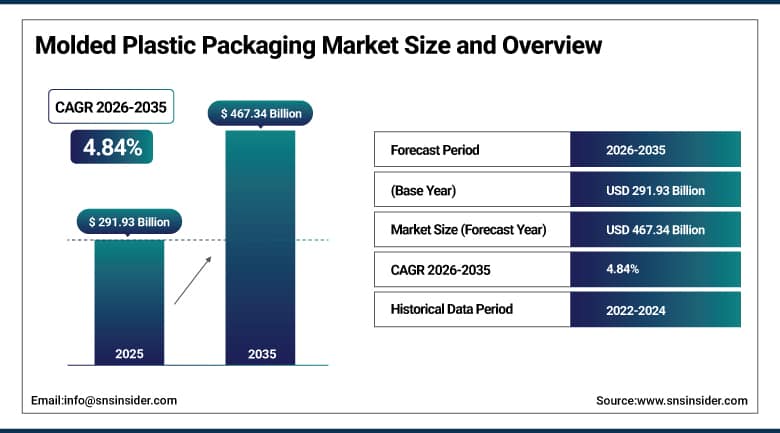
The Molded Plastic Packaging Market was valued at USD 291.93 billion in 2025 and is expected to reach USD 467.34 billion by 2035, growing at a CAGR of 4.84% from 2026–2035.
The molded plastic packaging market is witnessing steady growth in the global market owing to increasing demand for lightweight packaging solutions. Rising consumption in food and beverages and pharmaceuticals is supporting market expansion. Expanding e-commerce and logistics activities are driving packaging demand. Manufacturers are focusing on recyclable and sustainable plastic materials. Growing adoption of injection molded packaging is improving production efficiency. Increasing emphasis on cost-effective and durable packaging solutions is further accelerating market adoption.
According to the United Nations Environment Programme Global Plastics Outlook 2025, global plastic waste generation reached approximately 353 million tonnes in recent assessments, with packaging accounting for nearly 40% of total plastic use. As per OECD on plastic lifecycle indicators, only about 9% of plastic waste is recycled globally, while over 20% is mismanaged, creating strong regulatory pressure for molded plastic packaging redesign. The European Commission’s Circular Economy Action Plan reports that over 65% of EU plastic packaging is now subject to recyclability or reuse design requirements, driving adoption of molded packaging innovations with improved material efficiency and circularity.
To Get More Information On Molded Plastic Packaging Market - Request Free Sample Report
Molded Plastic Packaging Market Trends:
-
The growing trend for durable packaging products is making use of molded plastic for applications in food beverages and pharmaceuticals around the globe.
-
With the increasing use of advanced technology like injection and blow molding, the efficiency of manufacturing process is getting better with precise packaging.
-
The increasing trend for sustainable and recyclable plastic products is changing the manufacturing process with eco-friendly packaging.
-
With the rising trend of e-commerce and organized retailing networks, the requirement of protective secondary and tertiary packaging products is on the rise.
-
With the help of automation and smart manufacturing systems, the wastage of material is being minimized along with customization options for packaging manufacturing process.
-
The growing inclination of consumers towards hygienic packaging products is boosting innovations in high barrier plastic packaging products.
U.S. Molded Plastic Packaging Market Outlook:
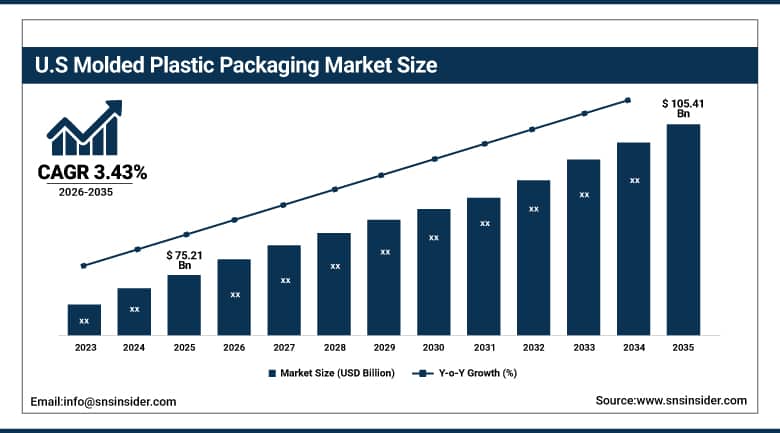
The U.S. Molded Plastic Packaging Market was valued at USD 75.21 billion in 2025 and is expected to reach around USD 105.41 billion by 2035, growing at a CAGR of 3.43% from 2026–2035.
The U.S. molded plastic packaging market is growing steadily owing to strong demand from food packaging industries. Increasing consumption of packaged and ready-to-eat food is supporting market expansion. Rising pharmaceutical packaging requirements are driving consistent adoption of molded plastics. Growth in e-commerce logistics is further increasing packaging demand across sectors. Manufacturers are focusing on recyclable and lightweight plastic solutions. Advancements in molding technologies are improving production efficiency and material performance.
As per the report by the U.S. Environmental Protection Agency Advancing Sustainable Materials Management report in 2025, plastics contribute to about 12% of municipal solid waste generation in the US, while containers and packaging are the main category accounting for more than 30% of total plastic waste. Based on the U.S. Census Bureau’s manufacturing statistics, manufacturing of plastics is one of the most extensive industries, with plastics being applied in rigid and flexible packaging.
Molded Plastic Packaging Market Segment Analysis:
-
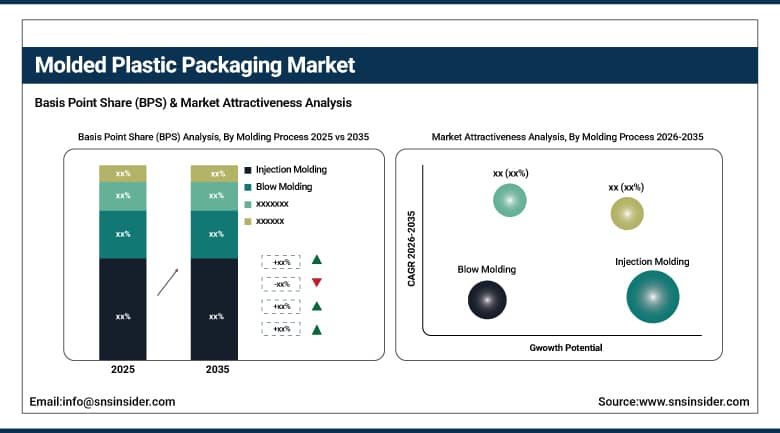
By Molding Process, injection molding dominated the market with 41.93% share in 2025; while blow molding are the fastest growing segment with CAGR of 6.89% during 2026 to 2035.
-
By Material Type, polyethylene terephthalate (PET) dominated the market with 28.46% share in 2025; while polypropylene (PP) is the fastest growing segment with CAGR of 7.29% during 2026 to 2035.
-
By End-Use Industry, food and beverages dominated the market with 44.82% share in 2025; while pharmaceuticals are the fastest growing segment with CAGR of 7.86% during 2026 to 2035.
-
By Closure Type, caps and lids dominated the market with 48.57% share in 2025; while bottles and jars are the fastest growing segment with CAGR of 6.90% during 2026 to 2035.
-
By Application, primary packaging dominated the market with 42.85% share in 2025; while secondary packaging is the fastest growing segment with CAGR of 31.46% during 2026 to 2035.
By Molding Process, injection molding dominated the molded plastic packaging market, while blow molding is the fastest growing segment.
Injection Molding segment captured leading position in the global molded plastic packaging market, owing to its highest share in terms of revenue in 2025. This technology is highly popular due to its preciseness, cost-effectiveness, and capability of producing complex shaped products on large-scale basis. It helps in mass production with high quality and less wastage of materials. Its popularity among the various industries such as food industry, pharmaceuticals and consumer goods industries further adds fuel to its popularity.
Blow Molding segment is anticipated to show fastest CAGR from 2026 to 2035, due to increasing demand for hollow plastic containers and bottles. This technology finds application in beverage and liquid packaging industries due to its light weight and durable nature. Growing adoption of blow molding technology in pharmaceuticals and personal care packaging applications is boosting the growth of this segment.
By Material Type, polyethylene terephthalate (PET) dominated the molded plastic packaging market, while polypropylene (PP) is the fastest growing segment.
The Polyethylene Terephthalate (PET) segment held the dominated share of revenue in the market in 2025. The use of PET plastic is high because of its strength, transparency, and light weight. PET plastic has good barrier properties against moisture and gases. This plastic is highly favored for packaging of foods and beverages. Good recycling potential and cost-effectiveness also contribute to the wide usage of PET across global packaging industry.
The Polypropylene (PP) segment is estimated to grow at the fastest compound annual growth rate between 2026 and 2035. This growth is driven by growing preference for flexible, durable, and heat-resistant plastics for packaging. Polypropylene plastic is mainly used for packaging of pharmaceutical products and personal care products. Low cost and recyclability add to the demand for Polypropylene plastics.
By End-Use Industry, food and beverages dominated the molded plastic packaging market, while pharmaceuticals are the fastest growing segment.
The Food & Beverages Segment led the molded plastic packaging market, holding the dominated revenue share in 2025. Such dominance is attributable to high usage of molded plastic packaging material in the packaging of bottled beverages, dairy products, processed food products and ready-to-eat meals. Convenience of packaging, requirement for extended shelf life and low-cost production process make it one of the dominant segments within the market.
The Pharmaceuticals segment is anticipated to witness the fastest CAGR over 2026 to 2035. The factors that are fueling the growth of this segment include rising demand for safer and contamination-free packaging material. High global healthcare spending, growth in the production of generic drugs along with stringent regulations for maintaining drug safety are driving segment growth. The increasing requirement for blister packs, vials and other types of packaging solutions is further propelling growth.
By Closure Type, caps and lids dominated the molded plastic packaging market, while bottles and jars are the fastest growing segment.
Caps & Lids sub-segment held a leading dominated share in terms of revenue in the molded plastic packaging market in 2025. This is owing to wide application in food and beverage packaging. Growing demand for sealed and tamper-proof packaging is propelling the growth of this sub-segment. The high compatibility with injection molding and mass production capabilities are driving its adoption. Growing consumption of bottled drinks and packaged foods is adding impetus to its dominant position in global markets.
Bottles & Jars sub-segment is projected to be the fastest-growing during 2026 to 2035. This is due to increasing demand in pharmaceuticals and personal care industries. Rising adoption of recyclable plastic material for packaging is contributing to the adoption of sustainable packaging. The expansion in e-commerce logistics is propelling the shipment of bottles products across the globe. The advancements in packaging technology for lightweight and durable packaging are improving usability.
By Application, primary packaging dominated the molded plastic packaging market, while secondary packaging is the fastest growing segment.
Primary Packaging emerged as the leading segment within the molded plastic packaging market in terms of dominated revenue share in 2025 owing to increasing demand from the sectors of food, beverages, and pharmaceuticals. This type of packaging offers direct protection against contamination, and safety while storage and transportation of the products. Increased consumption of ready-to-eat foods and medicinal products is also fuelling the growth of the sector.
Secondary Packaging is likely to witness the fastest CAGR in terms of market growth between 2026 and 2035 because of increased logistics and e-commerce operations globally. The role of secondary packaging includes grouping, protection, and branding of several primary packages. Increasing needs of efficient supply chain management and safe transportation of products is adding to the popularity of this segment.
Regional Analysis:
|
Region |
Major Country |
Share within Region, 2025(%) |
|---|---|---|
|
North America |
United States |
78.45% |
|
Europe |
Germany |
28.10% |
|
Asia Pacific |
China |
43.70% |
|
Middle East & Africa |
UAE |
17.80% |
|
Latin America |
Brazil |
48.20% |
North America Molded Plastic Packaging Market Insights.
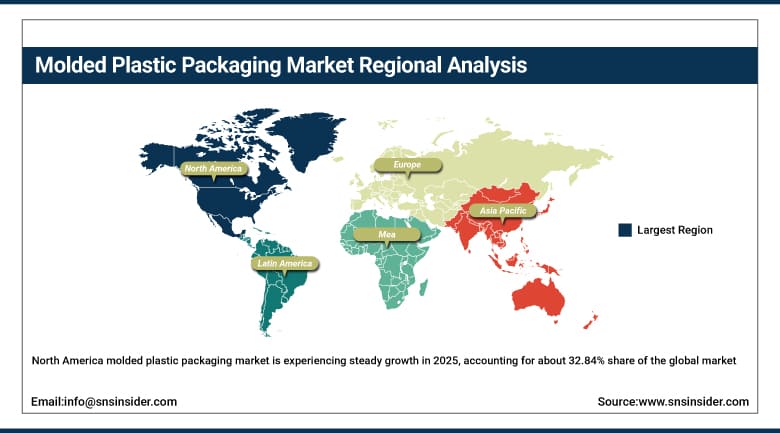
North America molded plastic packaging market is experiencing steady growth in 2025, accounting for about 32.84% share of the global market, owing to strong demand from food and beverage packaging. The region benefits from advanced manufacturing infrastructure and high consumption of packaged goods. Increasing use of lightweight and durable plastic materials is improving supply chain efficiency. Expansion of e-commerce and retail distribution networks is driving packaging demand. Strong focus on recyclable packaging solutions is further supporting market growth.
According to the U.S. Environmental Protection Agency and Statistics Canada environmental datasets, packaging remains the largest application for plastics across North America. The EPA reports that containers and packaging account for over 28% of total municipal solid waste generation in the United States, while Statistics Canada indicates that plastic packaging represents approximately 43% of all plastic products entering the Canadian market.
Get Customized Report as Per Your Business Requirement - Enquiry Now
Europe Molded Plastic Packaging Market Insights.
Europe molded plastic packaging market is characterized by stable growth in 2025 owing to strict environmental regulations and circular economy policies. Key countries include Germany, France, United Kingdom, and Italy. Rising demand for sustainable packaging solutions is driving adoption of recyclable molded plastics. Increasing focus on reducing single use plastics is boosting innovation in bio-based alternatives. Expansion of pharmaceutical and food packaging industries is further supporting market growth.
As per European Environment Agency and Eurostat circular economy indicators, packaging is responsible for almost 40% of the overall consumption of plastics in Europe, and thus is the largest segment in terms of usage of plastics. According to the latest packaging waste statistics of Eurostat, European Union generated an estimated 186.5 kg of packaging waste per capita, out of which plastic packaging made up almost 19% of overall packaging waste. In accordance with the EU Packaging and Packaging Waste Directive of 2025, all packaging introduced in the European Union market should be recyclable by 2030.
Asia Pacific Molded Plastic Packaging Market Insights.
Asia Pacific is the fastest growing region in the molded plastic packaging market, registering a CAGR of about 6.35% during 2026–2035. Rapid industrialization and growing FMCG consumption are driving strong demand across China, India, Japan, South Korea, and Southeast Asia. Expanding e-commerce platforms and manufacturing activities are boosting packaging requirements. Rising population and urbanization are further accelerating market growth.
As per the UNEP and the OECD Global Plastics Outlook, the Asia Pacific region constitutes over 50% of plastic consumption in the world because of the presence of a significant manufacturing industry as well as growing consumer bases in the region. Moreover, according to OECD reports, packaging contributes about 40% of plastic consumption in the world, and Asia Pacific economies are implementing mandatory recycled content and producer responsibility policy until 2025.
Middle East & Africa and Latin America Molded Plastic Packaging Market Insights.
The Middle East & Africa along with Latin America regions are witnessing steady growth due to rising industrialization and expanding consumer markets. Key contributing countries include Brazil, Mexico, UAE, Saudi Arabia, and South Africa. Increasing demand for packaged food and beverages is driving adoption of molded plastic packaging. Growth in retail and e commerce sectors is further supporting market expansion. Rising investments in manufacturing infrastructure are boosting regional capacity.
According to the United Nations Department of Economic and Social Affairs World Urbanization Prospects 2025 and the World Bank 2025, Latin America and the Caribbean is approximately 82% urbanized, while the Middle East and North Africa exceeds 70% urbanization and Sub-Saharan Africa is projected to remain the world’s fastest-growing urban region. Additionally, the World Bank reports that final household consumption expenditure accounts for over 60% of GDP in several Latin American economies, supporting packaged consumer goods demand. These demographic and consumption trends are increasing requirements for molded plastic packaging across food, beverage, healthcare, and personal care sectors.
Market Dynamics:
Growth Drivers: Rising demand for lightweight durable cost-effective packaging across food beverage and pharmaceutical industries globally
The growing need for durable and light weight packaging is significantly aiding the growth of molded plastic packaging within various industries. Growth in food and beverages industry and increasing use of pharmaceutical products is continuously contributing to the use of molded plastic products. Barrier protection, shelf-life extension, and economic feasibility is offered by such molded plastics. Urbanization and change in consumer lifestyle have led to an increase in demand for packaged products worldwide.
According to the United Nations Environment Programme Global Waste Management Outlook and the Food and Agriculture Organization, approximately 14% of food produced globally is lost between harvest and retail, increasing demand for durable protective packaging solutions. As per the World Health Organization, over 16 billion injections are administered annually worldwide, supporting demand for sterile pharmaceutical packaging. The OECD Global Plastics Outlook 2025 also reports that packaging accounts for about 40% of global plastic use, highlighting sustained adoption of lightweight molded plastic packaging across food, beverage, and healthcare supply chains.
Restraints: Environmental concerns and strict government regulations limiting use of conventional plastic packaging materials worldwide
The increasing concerns about environmental pollution due to plastic have become one of the biggest challenges for the growth of molded plastic packaging market. The governments in different parts of the world have enforced stringent policies for reduction of single-use plastics. Growing bans and taxation of non-recyclable plastics have affected production and consumption of such products. It has become difficult for manufacturers to comply with the environmental requirements.
Opportunities:Technological advancements in molding processes improving efficiency customization and product performance across industries
The constant advancement of molding technology is resulting in increased efficiency and flexibility in the packaging industry. High accuracy and cost-effective manufacturing are possible through the use of advanced injection and blow molding technologies. Efficiency is improving through automation and intelligent manufacturing techniques, while wastage is being reduced. Customization is providing assistance in fulfilling the requirements of various end-user industries. There is increasing importance of lightweight and strong packaging in recent times.
As per IFR World Robotics 2025 and OECD Digital Economy Indicators, automation in manufacturing has been increasing steadily across the globe, with more than 4.3 million industrial robots being used in factories across the world and around 70% of all new installations in sectors which have high manufacturing intensity. As per US Department of Energy initiatives for advanced manufacturing, digital process control, AI-enabled quality checking, and precision molding can help in reducing material wastage by around 30%.
Recent Developments:
-
2026: Huhtamaki advanced fiber and molded packaging innovation programs, scaling hybrid solutions that reduce virgin plastic use in foodservice and retail packaging.
-
2025: Sealed Air continued automation-led transformation, expanding smart protective packaging systems and improving manufacturing efficiency across global food packaging operations.
-
2025: Amcor completed acquisition of Berry Global, forming a global packaging leader with expanded recycling and mono-material innovation capabilities across 400 facilities worldwide.
-
2024: Sonoco Products Company showcased high recycled-content thermoformed trays at PACK EXPO International, advancing sustainable rigid molded plastic packaging solutions for FMCG markets.
Molded Plastic Packaging Market Key Players are:
-
Amcor
-
Berry Global
-
Sealed Air
-
Sonoco Products Company
-
AptarGroup
-
Silgan Holdings
-
Plastipak Packaging
-
Pactiv Evergreen
-
Huhtamaki
-
ALPLA
-
Coveris
-
Logoplaste
-
Pretium Packaging
-
Albéa
-
Faerch Group
-
Winpak
-
Greiner Packaging
-
Tekni-Plex
-
Inteplast Group
-
Anchor Packaging
Molded Plastic Packaging Market Report Scope:
| Report Attributes | Details |
|---|---|
| Market Size in 2025 | USD 291.93 Billion |
| Market Size by 2035 | USD 467.34 Billion |
| CAGR | CAGR of 4.84% From 2026 to 2035 |
| Base Year | 2025 |
| Forecast Period | 2026-2035 |
| Historical Data | 2022-2024 |
| Report Scope & Coverage | Market Size, Segments Analysis, Competitive Landscape, Regional Analysis, DROC & SWOT Analysis, Forecast Outlook |
| Key Segments | • By Material Type (Polyethylene Terephthalate (PET), High-Density Polyethylene (HDPE), Polypropylene (PP), Polyvinyl Chloride (PVC), Polyethylene (PE)) • By End-Use Industry (Food and Beverages, Pharmaceuticals, Personal Care and Cosmetics, Consumer Electronics, Automotive) • By Molding Process (Injection Molding, Blow Molding, Thermoforming, Rotational Molding, Extrusion Blow Molding) • By Closure Type (Caps and Lids, Bottles and Jars, Trays and Tubs, Films and Wraps, Flexible Packaging) • By Application (Primary Packaging, Secondary Packaging, Tertiary Packaging, Transportation and Logistics, Retail Display and Merchandising) |
| Regional Analysis/Coverage | North America (US, Canada), Europe (Germany, UK, France, Italy, Spain, Russia, Poland, Rest of Europe), Asia Pacific (China, India, Japan, South Korea, Australia, ASEAN Countries, Rest of Asia Pacific), Middle East & Africa (UAE, Saudi Arabia, Qatar, South Africa, Rest of Middle East & Africa), Latin America (Brazil, Argentina, Mexico, Colombia, Rest of Latin America). |
| Company Profiles | Amcor, Berry Global, Sealed Air, Sonoco Products Company, AptarGroup, Silgan Holdings, Plastipak Packaging, Pactiv Evergreen, Huhtamaki, ALPLA, Coveris, Logoplaste, Pretium Packaging, Albéa, Faerch Group, Winpak, Greiner Packaging, Tekni-Plex, Inteplast Group, Anchor Packaging |
Frequently Asked Questions
North America dominated the molded plastic packaging market in 2025 due to advanced manufacturing, packaged goods demand, and e-commerce expansion.
Major growth factors include rising demand for lightweight durable packaging, packaged food growth, e-commerce expansion, recyclable materials adoption, molding technology advancements, and cost-effective sustainable packaging solutions globally.
The Food and Beverages segment dominated the market in 2025 due to high packaged food demand, beverages, and ready-to-eat meals.
The molded plastic packaging market is expected to grow at a CAGR of 4.84% from 2026 to 2035.
The molded plastic packaging market was valued at USD 291.93 billion in 2025.
