
Needle Coke Market Report Scope & Overview:
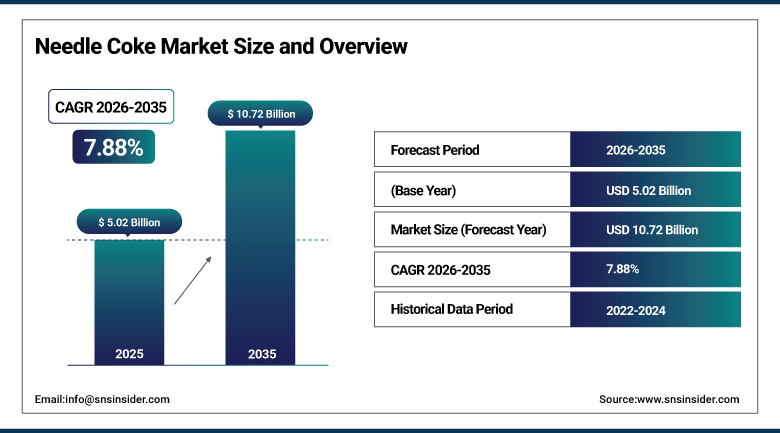
The Needle Coke Market was valued at USD 5.02 Billion in 2025 and is expected to reach USD 10.72 Billion by 2035, growing at a CAGR of 7.88% from 2026-2035.
The Needle Coke Market is expanding as electric arc furnace steelmaking and lithium-ion battery production both raise demand for high-purity synthetic graphite. Needle coke is a premium carbon material made from refinery decant oil or coal-tar pitch, and it is the main raw material for ultra-high-power graphite electrodes and a leading feedstock for artificial graphite anodes. Supply is concentrated among a few producers, and China holds the largest share of capacity. Prices respond to feedstock cost, trade duties and electrode demand. Battery producers outside China are seeking qualified local supply. Producers are investing in calcination, purification and feedstock access.
⮞In June 2026, the World Steel Association reported that electric arc furnaces accounted for 30.30% of global crude steel production in 2025, up 1.20 percentage points. The rising furnace share supports long-term demand for needle coke-based graphite electrodes.
To Get more information Needle Coke Market - Request Free Sample Report
Needle Coke Market Trends:
-
Rising demand for needle coke as a feedstock for synthetic graphite anodes
-
Growth of electric arc furnace steelmaking supporting graphite electrode use
-
Trade duties on graphite electrodes reshaping regional supply chains
-
Investment in battery-grade needle coke capacity outside China
-
Rationalization of older needle coke and electrode plants amid oversupply
U.S. Needle Coke Market Outlook:
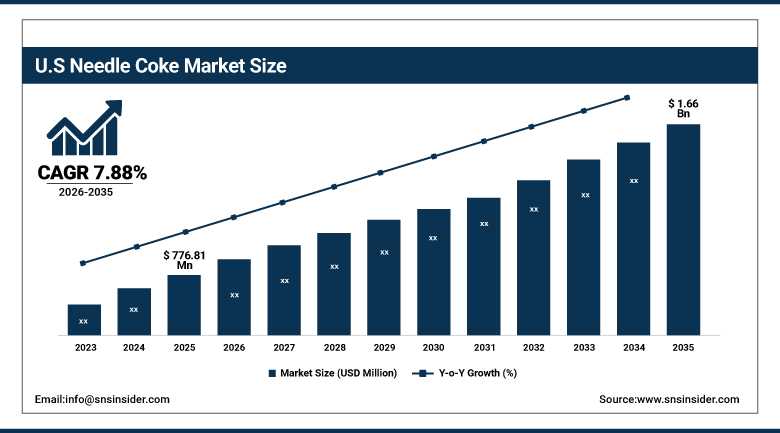
The U.S. Needle Coke Market was valued at USD 776.81 Million in 2025 and is expected to reach USD 1.66 Billion by 2035, growing at a CAGR of 7.88% from 2026-2035.
The U.S. Needle Coke Market is the largest national market in North America and is built around a small group of refinery-linked producers. Needle coke made in Louisiana and Texas supplies graphite electrode plants and, increasingly, planned anode material facilities. Electric arc furnaces make up a high share of U.S. steel output, which supports steady electrode demand. Anti-dumping and countervailing duty cases on electrodes have strengthened local producers. Federal incentives for battery supply chains encourage U.S. anode projects.
⮞In July 2026, GrafTech reported second quarter capacity utilization of 74%, the highest since 2022, with sales volume up 8% from a year earlier. The result shows improving demand for electrodes and the needle coke used to make them.
Needle Coke Market Segment Analysis:
-
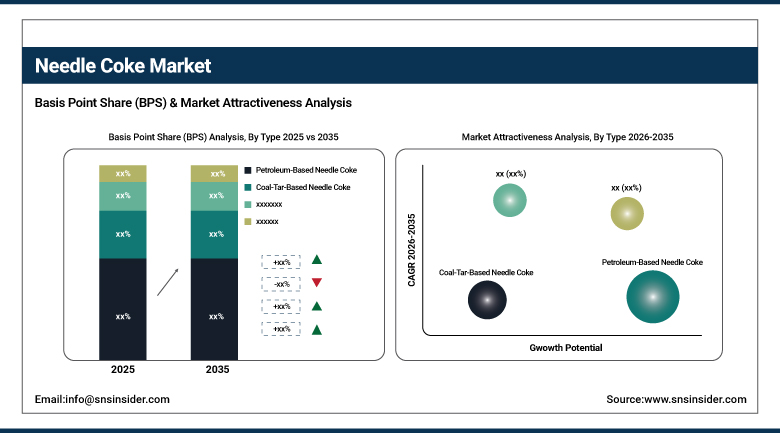
By Type, the Petroleum-Based Needle Coke segment dominated the Needle Coke Market with approximately 66.23% share in 2025, while the Coal-Tar-Based Needle Coke segment is the fastest growing with a CAGR of approximately 8.78%.
-
By Grade, the Super-Premium segment dominated the Needle Coke Market with approximately 47.20% share in 2025, and is also the fastest growing with a CAGR of approximately 10.33%.
-
By Application, the Graphite Electrodes segment dominated the Needle Coke Market with approximately 55.03% share in 2025, while the Lithium-Ion Battery Anode Materials segment is the fastest growing with a CAGR of approximately 12.62%.
-
By End-Use Industry, the Aluminum and Steel segment dominated the Needle Coke Market with approximately 58.00% share in 2025, while the Automotive segment is the fastest growing with a CAGR of approximately 10.57%.
By Type, Petroleum-Based Needle Coke Dominates the Needle Coke Market and Coal-Tar-Based Needle Coke Grows Fastest
Petroleum-based needle coke leads because most large producers process refinery decant oil in delayed coking units, and the resulting product has low sulfur, low metal content and a highly ordered crystal structure. These properties suit ultra-high-power electrodes and battery anodes. Refiners in the United States, Japan and China have developed long operating experience, and qualified grades are accepted by major electrode makers. Supply is tied to refinery configuration and the availability of clean decant oil, which gives established producers a strong position against new entrants.
Coal-tar-based needle coke is growing fastest as steelmakers and chemical companies in China, India and Europe expand coal-tar pitch distillation and look for high-value uses of pitch. Coal-derived coke offers different thermal and structural properties and suits certain anode and specialty carbon uses. Producers can use local coal-tar supplies, which reduces exposure to oil-based feedstock. New plants are being built in Asia, and some Indian and Chinese groups are integrating pitch and coke production. Growth starts from a smaller base and depends on consistent quality.
⮞In February 2025, Rain Carbon announced a coal-tar distillation facility in Andhra Pradesh, India, with first-phase capacity of 50,000 tons of pitch a year. The project shows investment in coal-tar processing that can support carbon material supply in Asia.
By Grade, Super-Premium Dominates the Needle Coke Market and Is Also the Fastest Growing
Super-premium grade leads because ultra-high-power electrodes used in large electric arc furnaces require needle coke with very low coefficient of thermal expansion. These electrodes carry extreme current, and any weakness can cause breakage that halts a furnace. Steelmakers therefore pay a premium for reliable quality. Only a limited number of producers can make consistent super-premium coke, which supports pricing. The same properties are valuable in high-performance anode materials, which adds a second source of demand for the highest grades.
Super-premium is also the fastest growing grade as electrode makers shift toward larger diameter products and battery producers seek anode material with high capacity and stable cycling. Producers are upgrading calcining and purification equipment to raise yield of the top grade. Long-term supply agreements allow customers to secure volume and give producers confidence to invest. Limited capacity outside China means that qualified material commands attractive prices. Because grade upgrades require careful feedstock selection and process control, growth is expected to favor integrated and experienced suppliers. Battery customers add testing for capacity, first-cycle efficiency and impurity levels, which raises the bar for new suppliers seeking approval of top-grade material.
⮞In April 2025, S&P Global Platts assessed low-sulfur needle coke at 6,350 yuan per ton delivered Qingdao, up 21% since February. The price gain shows how trade measures and tight supply affect premium grades.
By Application, Graphite Electrodes Dominates the Needle Coke Market and Lithium-Ion Battery Anode Materials Grows Fastest
Graphite electrodes lead because electric arc furnaces melt scrap and direct reduced iron using large graphite electrodes, and needle coke is the key raw material for the ultra-high-power type. Steel recycling is rising, and governments are encouraging lower-emission steelmaking. Each furnace consumes electrodes continuously, which creates steady replacement demand. Electrode makers sign multi-year supply arrangements with coke producers to protect quality. Even as batteries grow, the electrode business remains the largest single user of needle coke by volume. Large furnaces with higher power ratings use bigger electrodes, which raises the consumption of high-quality coke per ton of steel produced.
Lithium-ion battery anode materials are growing fastest as electric vehicle and energy storage production expand. Artificial graphite anodes use needle coke as a feedstock, and manufacturers favor it for fast charging and long cycle life. Anode plants are being built in China, South Korea, the United States and Europe. Policies that promote local battery supply chains are driving interest in coke produced outside China.
⮞In June 2026, Mysteel reported that China's synthetic graphite exports reached 50,037.79 tons in May, attributed to robust demand for anode materials. The figure shows the pull of battery makers on the graphite supply chain.
By End-Use Industry, Aluminum and Steel Dominates the Needle Coke Market and Automotive Grows Fastest
Aluminum and steel lead because graphite electrodes made from needle coke are consumed in electric arc furnaces and in ladle refining and, to a lesser extent, in aluminum and ferroalloy smelting. Steelmakers are replacing blast furnaces with electric routes to cut emissions, and scrap availability supports the move. Trade protection in the United States and Europe is encouraging local steel and electrode production. Because electrodes are consumables, demand is recurring and follows steel output. This broad industrial base keeps metals the largest end-use sector. Global steel recycling targets and carbon pricing in several economies also give electric furnace operators an incentive to expand and upgrade electrode supply contracts.
Automotive is growing fastest because it captures demand for electric vehicle battery anodes and for lightweight components that use carbon materials. Automakers want secure supply of battery materials and are signing long-term contracts with cell and anode suppliers. Rising electric vehicle output in China, Europe and North America increases requirements for high-quality graphite. Safety, range and charging speed targets lead manufacturers to specify premium synthetic graphite.
⮞In August 2026, Tokai Carbon raised its full-year sales forecast to JPY 386.0 billion, citing strong semiconductor and graphite electrode markets. The revision shows firm demand across carbon products used in industrial and automotive supply chains.
Regional Analysis:
|
Region |
Major Country |
Share within Region, 2025 (%) |
|---|---|---|
|
Asia Pacific |
China |
64.16 |
|
Europe |
Germany |
27.03 |
|
North America |
U.S. |
84.56 |
|
Latin America |
Brazil |
51.84 |
|
Middle East & Africa |
Saudi Arabia |
38.27 |
North America Needle Coke Market Insights
North America accounted for 18.30% of the global Needle Coke Market in 2025. The United States holds nearly all regional capacity, with producers in Louisiana and Texas serving local electrode makers and exporters. Canada and Mexico contribute through steel and aluminum demand. A large electric arc furnace sector and growing battery manufacturing keep demand strong, and the region is one of the few outside Asia with significant needle coke production capacity.
Trade cases have changed the competitive field. Electrode makers filed petitions on imports of large-diameter graphite electrodes from China and India, and authorities are applying preliminary duties. Higher import prices help local electrode makers and support local needle coke consumption. At the same time, new anode material projects in the Southeast are seeking supply of locally produced coke, which could take volume from the electrode market.
⮞In March 2026, the U.S. Department of Commerce initiated antidumping and countervailing duty investigations on large-diameter graphite electrodes from China and India, with alleged dumping margins of up to 146.72% for China. The cases show strong policy support for the North American electrode chain.
Europe Needle Coke Market Insights
Europe is the second largest region and is led by Germany, the United Kingdom, Italy, Spain and France. The region has a large electric arc furnace sector and electrode plants in Austria, Spain and Germany, but it relies on imported needle coke because only limited local capacity exists. Phillips 66 supplies battery-grade coke from its Humber refinery in the United Kingdom. Battery plants in Germany, Hungary and Poland add to demand for anode materials.
Policy is a central theme. The European Union Critical Raw Materials Act aims to reduce dependence on single suppliers, and steel safeguards are being tightened to protect local mills. Electrode makers have closed some plants as demand and import competition shifted, and coal-tar pitch supply is shrinking as blast furnaces close. Producers and users are therefore looking at imported supply from the United States and Japan, and at new routes using alternative feedstocks and recycled graphite.
⮞In June 2026, the European Commission adopted Regulation (EU) 2026/1384, which cuts duty-free steel import quotas by about 47% and sets a 50% out-of-quota tariff from 1 July 2026. The regulation supports local steel output and electrode demand in Europe.
Asia Pacific Needle Coke Market Insights
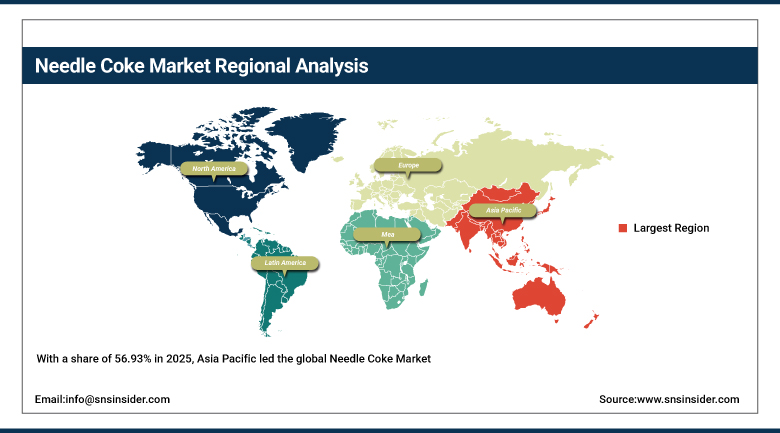
With a share of 56.93% in 2025, Asia Pacific led the global Needle Coke Market and is also projected to be the fastest growing region, with a CAGR of 8.61% during 2026-2035. China is the largest producer and consumer, supported by large electrode and anode industries. Japan hosts specialist producers such as ENEOS and Petrocokes Japan, while South Korea and India are building battery material capacity. Rising steel recycling and electric vehicle output underpin regional demand. Southeast Asian countries are adding steel and battery projects, and Vietnam, Indonesia and Malaysia are increasingly important for electrode and anode production.
Trade policy and oversupply are shaping the regional outlook. Chinese producers have expanded capacity quickly, which has pressured prices and led to plant rationalization elsewhere in the region. Japan has imposed anti-dumping duties on Chinese graphite electrodes, and several governments are encouraging local battery supply chains. Indian Oil and other Indian groups are planning calcined needle coke units to reduce imports.
⮞In March 2025, the Japanese government imposed a provisional anti-dumping duty of 95.20% on graphite electrodes from China for four months. The measure shows how trade policy is reshaping electrode and needle coke supply in Asia.
Get Customized Report as per Your Business Requirement - Enquiry Now
MEA & Latin America Needle Coke Market Insights
In Latin America, Brazil and Mexico are the main markets, driven by steel and aluminum production and a growing interest in battery materials. Neither region has significant needle coke capacity, so users rely on imports from the United States, Japan and China. Brazil's steel industry uses electric arc furnaces, and the country has large graphite resources that may support anode production. Currency swings and logistics costs affect import competitiveness.
In the Middle East and Africa, Saudi Arabia, the United Arab Emirates, Iran and South Africa are the main markets. Large refineries and growing steel and aluminum capacity create a basis for local carbon materials. Iran has announced plans for a needle coke plant, although status is unclear. Gulf countries are building industrial clusters and are seeking value-added products from refinery streams. Limited technology and high capital cost mean growth will be gradual during the forecast period. Interest in graphite mining and processing in Brazil and parts of Africa could create future links between raw graphite, needle coke and battery material production.
⮞In July 2021, Trend reported that Iran planned a 90,000 ton per year needle coke plant at Shazand, targeted for completion by March 2025. The plan shows regional interest in producing needle coke from refinery streams.
Market Dynamics:
Growth Drivers: Electric Arc Furnace Steelmaking and Battery Anode Demand
Electric arc furnace steelmaking is the primary driver of the market. Steelmakers are shifting from blast furnaces to scrap-based electric furnaces to reduce emissions and capital cost, and government policy in Europe, India and the United States supports this move. Each furnace consumes graphite electrodes continuously, and ultra-high-power electrodes require premium needle coke. As steel recycling rates rise and new furnaces are commissioned, electrode demand grows, which pulls coke suppliers into long-term contracts. Government incentives for scrap-based steelmaking and carbon reduction targets continue to support new furnace investment.
Battery anode demand is the second major driver. Electric vehicles and energy storage systems are growing quickly, and artificial graphite anodes remain the dominant choice for performance and cycle life. Cell makers are building plants in Asia, Europe and North America, and governments are encouraging local material supply. Each additional gigafactory requires large volumes of graphite, much of it based on needle coke.
⮞In November 2025, HEG Limited reported second quarter fiscal 2026 net profit of INR 143.30 crore, up 74.20% from the prior year. The result shows improving earnings for graphite electrode makers that depend on needle coke.
Restraints: Oversupply, Feedstock Volatility and Trade Barriers
Oversupply is a major restraint. Chinese capacity has expanded quickly while demand from steel and some overseas markets has been weak, which pressures prices and margins. Some established producers are rationalizing plants and exiting needle coke. New Southeast Asian capacity adds to competition. Under these conditions, producers outside China must differentiate through quality, localized supply and long-term contracts, and weaker players find it difficult to justify the cost of maintaining specialized equipment. Pricing for coke and electrodes can therefore swing sharply, making it difficult for producers to plan investments and customers to sign long contracts.
Feedstock volatility and trade barriers add further risk. Needle coke requires clean decant oil or coal-tar pitch, and supply depends on refinery operations and steelmaking trends. Geopolitical disruptions can raise oil-related costs. Tariffs, anti-dumping duties and export controls on graphite materials change trade flows quickly and create uncertainty for buyers and sellers. Long qualification periods for battery-grade material also slow adoption of new supply, so producers must plan years in advance for new capacity. Producers of coal-tar-based coke also face environmental rules on tar processing, which add cost and compliance work.
⮞In February 2026, Mitsubishi Chemical Group announced it would exit needle coke and pitch coke production at its Kagawa Plant in Sakaide, with production ending in the second half of fiscal 2027. The company cited persistent oversupply and weak overseas demand.
Opportunities: Battery-Grade Supply Outside China and Integrated Anode Chains
Battery-grade needle coke supply outside China is a clear opportunity. Governments in North America, Europe and Asia want secure material chains for electric vehicles, and cell makers want to diversify sources. Producers that can qualify low-sulfur, high-purity coke with battery customers can sign long-term offtake agreements at attractive prices. Refiners with suitable decant oil can add coking and calcining capacity, while joint ventures with anode makers can reduce risk for both parties. Governments are offering grants and tax credits for critical mineral processing, and these programs can reduce investment risk for new coke and anode plants.
Integrated anode chains are a second opportunity. Anode producers are seeking to control feedstock supply, and coke producers are moving into graphitization and anode production. Automotive customers are signing multi-year purchase agreements that bring stable demand. New technologies for using lower-value heavy hydrocarbons and recycled graphite could widen supply.
⮞In March 2026, POSCO Future M secured a KRW 1.0149 trillion artificial graphite anode supply deal with a global automaker covering 2027 to 2032. The contract shows the scale of long-term demand for anode material feedstocks.
Recent Developments:
-
2025, Phillips 66 reached an agreement in principle to supply needle coke from its Lake Charles refinery to Epsilon Advanced Materials. The supply would start at 30,000 tons a year in 2027 and rise to 60,000 tons by 2030 for an anode plant in North Carolina.
-
2025, Resonac announced it would shut graphite electrode production units in China and Malaysia. The move reduces global capacity from 210,000 tons a year across six plants and leaves four sites in Japan, the United States, Austria and Spain.
-
2026, Qingdao Haida Ruiyuan unveiled a CNY 117 million project in Pingdu, Shandong, to produce 80,000 tons a year of lithium-ion battery anode material. The project expands anode capacity in China.
Needle Coke Market Key Players:
-
Phillips 66
-
GrafTech International Ltd. (Seadrift Coke)
-
ENEOS Corporation
-
Petrocokes Japan Ltd.
-
China National Petroleum Corporation (PetroChina Jinzhou Petrochemical)
-
Baowu Steel Group (Baosteel)
-
Shandong Yida New Materials Co., Ltd.
-
Mitsubishi Chemical Corporation
-
C-Chem Co., Ltd.
-
POSCO MC Materials
-
Indian Oil Corporation Limited
Needle Coke Market Report Scope:
| Report Attributes | Details |
|---|---|
| Market Size in 2025 | USD 5.02 Billion |
| Market Size by 2035 | USD 10.72 Billion |
| CAGR | CAGR of 7.88% From 2026 to 2035 |
| Base Year | 2025 |
| Forecast Period | 2026-2035 |
| Historical Data | 2022-2024 |
| Report Scope & Coverage | Market Size, Segments Analysis, Competitive Landscape, Regional Analysis, DROC & SWOT Analysis, Forecast Outlook |
| Key Segments | • By Type (Petroleum-Based Needle Coke, Coal-Tar-Based Needle Coke) • By Grade (Super-Premium, Premium, Intermediate) • By Application (Graphite Electrodes, Lithium-Ion Battery Anode Materials, Silicon Metal and Ferroalloys, Carbon Black and Rubber Compounds, Others) • By End-Use Industry (Aluminum and Steel, Automotive, Aerospace and Defense, Semiconductor, Others) |
| Regional Analysis/Coverage | North America (US, Canada), Europe (Germany, UK, France, Italy, Spain, Russia, Poland, Rest of Europe), Asia Pacific (China, India, Japan, South Korea, Australia, ASEAN Countries, Rest of Asia Pacific), Middle East & Africa (UAE, Saudi Arabia, Qatar, South Africa, Rest of Middle East & Africa), Latin America (Brazil, Argentina, Mexico, Colombia, Rest of Latin America). |
| Company Profiles | Phillips 66, GrafTech International Ltd. (Seadrift Coke), ENEOS Corporation, Petrocokes Japan Ltd., China National Petroleum Corporation (PetroChina Jinzhou Petrochemical), Baowu Steel Group (Baosteel), Shandong Yida New Materials Co., Ltd., Mitsubishi Chemical Corporation, C-Chem Co., Ltd., POSCO MC Materials, Indian Oil Corporation Limited |

Frequently Asked Questions
Key players include Phillips 66, GrafTech International (Seadrift Coke), ENEOS, Petrocokes Japan, PetroChina Jinzhou Petrochemical, Baowu Steel Group and Shandong Yida New Materials.
Key opportunities include battery-grade needle coke outside China, integrated anode material chains, long-term offtake agreements and growth in India and the Middle East.
Growth in electric arc furnace steelmaking and lithium-ion battery anode demand are the main growth factors.
By Application, the Graphite Electrodes segment dominated the market in 2025 with an estimated 55.03% share, supported by electric arc furnace steel production.
Asia Pacific dominated the market with a share of 56.93% in 2025, driven by China's large electrode and anode industries.
