
Non-Woven Adhesives Market Report Scope & Overview:
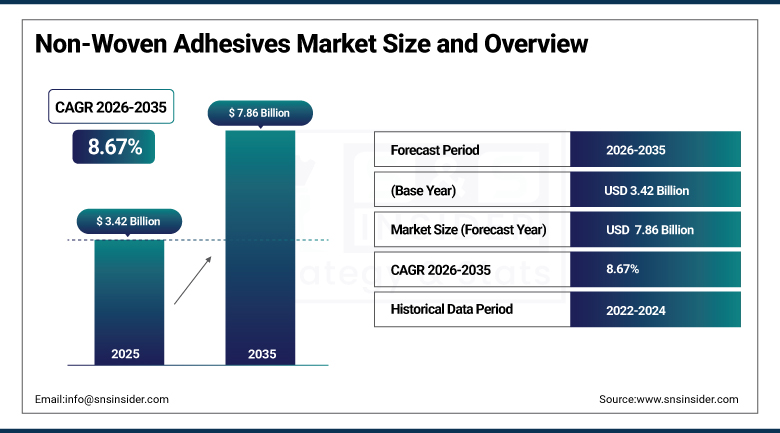
The Non-Woven Adhesives Market was valued at USD 3.42 Billion in 2025 and is expected to reach USD 7.86 Billion by 2035, growing at a CAGR of 8.67% from 2026 to 2035.
The Non-woven Adhesives Market is exhibiting steady growth, owing to increasing demands for hygiene and personal care products across the globe. Increasing birth rate in emerging nations, high population growth, better standards of living, and increasing personal well-being are driving the market growth. The non-woven adhesives market comprises mainly hot melt adhesives made up of amorphous poly alpha olefin, styrenic block copolymer, and ethylene vinyl acetate, which find wide application in baby nappies, feminine hygiene products, adult incontinence products, and medical fabrics. The high strength, softness, and flexibility of non-woven adhesives make them extremely valuable. Moreover, increasing disposable incomes in Asia-Pacific, high demands for medical and surgical adhesives, and innovations are generating numerous growth opportunities for the non-woven adhesives market.
Henkel and Bostik both expanded their hot-melt non-woven adhesive production capacity in 2026 to meet growing demand from hygiene product manufacturers amid rising birth rates and expanding disposable income across North America, Europe, and Asia Pacific hygiene product manufacturing hubs.
To Get more information On Non-Woven Adhesives Market - Request Free Sample Report
Non-Woven Adhesives Market Trends:
-
Rising demand for skin-friendly, low-odor hot-melt formulations is improving comfort in disposable hygiene products.
-
Growing adoption of bio-based and sustainable adhesive resins is reshaping hygiene product manufacturer sourcing decisions.
-
Increasing use of non-woven adhesives in medical and surgical applications is expanding beyond core hygiene categories.
-
Expanding disposable hygiene product manufacturing across Asia Pacific is strengthening regional adhesive consumption.
-
Strategic capacity expansions by major adhesive producers are strengthening supply reliability for hygiene product manufacturers.
U.S. Non-Woven Adhesives Market Outlook:
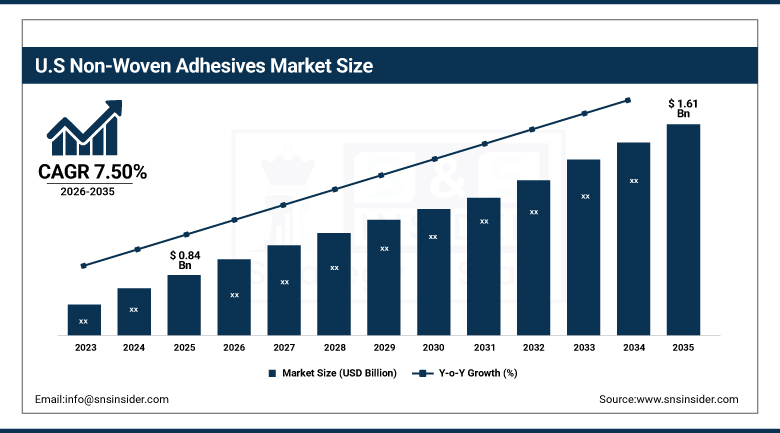
The U.S. Non-Woven Adhesives Market was valued at USD 0.84 Billion in 2025 and is projected to reach USD 1.61 Billion by 2035, growing at a CAGR of 7.50% during 2026-2035.
The major producers of hygiene products, medical devices, and specialty adhesives in the country continue to make efforts in the purchase of non-woven adhesives due to consistent demand for baby care and incontinence adult products, increasing usage in medical textiles, and investments in faster production lines. The rising importance of skin-friendly and dermatologically tested adhesives formulation with the aid of increasing demands from retail and institutional health care contributes to the assurance of consistent demand for non-woven adhesives. Private investments in the production of hot-melt adhesives within the country contribute significantly to the dominant participation in the North America Non-Woven Adhesives Market.
In 2026, H.B. Fuller expanded its U.S. manufacturing capacity for hot-melt non-woven adhesives through the addition of a new production line, strengthening its ability to supply hygiene product manufacturers seeking high-speed, skin-friendly bonding solutions.
Non-Woven Adhesives Market Segment Analysis:
-
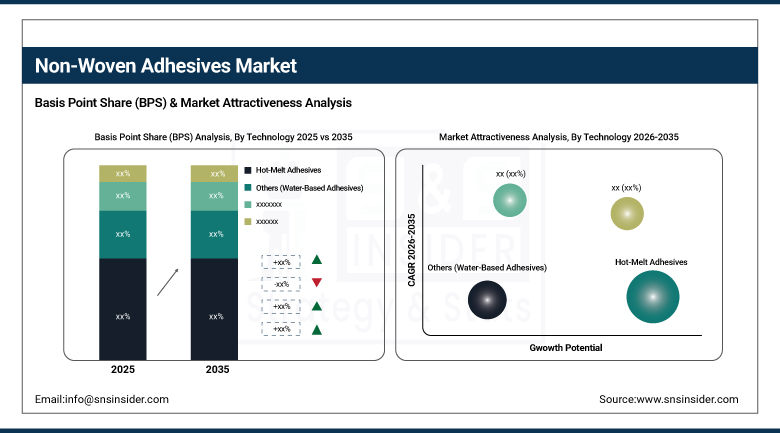
By Technology, Hot-Melt Adhesives dominated the Non-Woven Adhesives Market with a 78.40% share in 2025, while Others (Water-Based Adhesives) is the fastest-growing technology segment with a CAGR of 9.20% from 2026-2035.
-
By Polymer Type, Amorphous Poly Alpha Olefin dominated the Non-Woven Adhesives Market with a 42.60% share in 2025, while Styrenic Block Copolymers is the fastest-growing polymer type segment with a CAGR of 9.40% from 2026-2035.
-
By Application, Baby Care dominated the Non-Woven Adhesives Market with a 46.00% share in 2025, while Adult Incontinence is the fastest-growing application segment with a CAGR of 9.80% from 2026-2035.
By Technology, Hot-Melt Adhesives dominated the market, while Others (Water-Based Adhesives) is the fastest-growing segment.
The Hot-Melt Adhesives segment was the leading contributor to the Non-Woven Adhesives Market. This technology category accounts for being the largest segment due to its solvent-free application process, rapid setting time, and excellent compatibility with high-speed disposable hygiene product manufacturing lines, where hot-melt adhesives are dispensed as heated liquid that solidifies almost instantly upon cooling, enabling continuous, high-throughput production of diapers, feminine hygiene products, and adult incontinence items. Its outstanding performance record throughout decades of industry use, together with an already well-developed chain of supplies linking resin suppliers with hygiene products manufacturers, have made sure that hot melt technology remains dominant in both traditional and new regions for producing hygiene products.
The Others (Water-Based Adhesives) segment is expected to witness the highest CAGR of 9.20% during the forecast period 2026-2035. The increasing demand for eco-friendly, low-VOC adhesives for sustainable hygiene products has been driving up the consumption of water-based adhesives at an increased rate. The increasing focus on lowering the release of volatile organic compounds from production facilities and increased demand for eco-friendly personal care products has been contributing additionally to segment demand. The consistent improvement in the performance of water-based adhesives has been resulting in the above average growth rate of the segment.
By Polymer Type, Amorphous Poly Alpha Olefin dominated the market, while Styrenic Block Copolymers is the fastest-growing segment.
The Amorphous Poly Alpha Olefin category held the leading position in the Non-Woven Adhesives Market in 2025. Adhesives based on APAO are still prevailing because of their exceptional solvent and acid resistance, thermal stability, and cost-effective nature in comparison with the other kinds of polymer chemistry, thus providing the most suitable materials for construction and flexible bonding of disposable hygiene products. APAO is compatible with fast converting equipment, and its constant improvement in terms of increasing bonding efficiency makes it the polymer chemistry that is always chosen.
The Styrenic Block Copolymers segment is anticipated to grow at the fastest rate during the forecast period 2026-2035, at a CAGR of 9.40%. Growing preference towards more elastic and superior bonding adhesives that are well suited to premium hygiene products and elastic bonding applications is encouraging the use by hygiene products manufacturers.Growing investment in advanced SBC formulation technology that improves adhesion consistency and reduces coat weight requirements is further accelerating segment growth across premium disposable hygiene product categories worldwide.
By Application, Baby Care dominated the market, while Adult Incontinence is the fastest-growing segment.
The Baby Care segment dominated the Non-Woven Adhesives Market in 2025. Baby care applications remain the largest category owing to sustained global demand for disposable diapers, which require multiple adhesive bonding points for core construction, elastic attachment, and closure systems, driving substantial recurring adhesive consumption per unit produced, particularly across densely populated, high-birth-rate regions including China, India, and Southeast Asia where diaper penetration continues expanding alongside rising disposable incomes and hygiene awareness.
The Adult Incontinence segment is expected to register the fastest CAGR of 9.80% during the forecast period 2026-2035. The increased aging population across the globe along with the increased awareness regarding the use of adult incontinence products is leading to increased demand for such adult incontinence products and also their adhesive bond requirements. The increased investments being made towards the design and development of high-end adult incontinence products will also be contributing to the growth of the market.
Regional Analysis:
|
Region |
Major Country |
Share within Region, 2025 (%) |
|---|---|---|
|
North America |
United States |
85.60% |
|
Europe |
Germany |
24.60% |
|
Asia-Pacific |
China |
44.60% |
|
South America |
Brazil |
41.20% |
|
Middle East and Africa |
Saudi Arabia |
27.40% |
North America Non-Woven Adhesives Market Insights
The North America Non-Woven Adhesives Market was a major contributor to the market in 2025, supported by well-established hygiene product manufacturing infrastructure, strong consumer spending on premium disposable hygiene products and growing medical and surgical adhesive applications across the United States and Canada. The region's advanced manufacturing base, combined with substantial private investment in high-speed production technology, continues to support strong non-woven adhesive consumption across hygiene and medical applications.
The US was the leading country within the North America Non-Woven Adhesives Market in 2025 with a market share of 85.60% of the regional market, driven by extensive hygiene product manufacturing infrastructure and strong domestic adhesive production capability. Canada is contributing to regional growth through its own expanding hygiene product distribution and growing adoption of premium adhesive formulations.
Europe Non-Woven Adhesives Market Insights
The Europe region was a major contributor to the Non-Woven Adhesives Market in 2025, expected to register comparatively steady demand for sustainable and low-VOC adhesive formulations during the forecast period. This is attributed to the region's strong regulatory emphasis on environmental compliance, well-established hygiene product manufacturing base, and growing consumer preference for eco-friendly personal care products pursued across member states focused on sustainability objectives.
Germany is one of the major markets in Europe owing to its extensive specialty chemical and hygiene product manufacturing base, in addition to the availability of top manufacturers like Henkel, who cater to both local and foreign customers. In other countries like France, Italy, and the UK, which have well-developed hygiene products manufacturing setup, are also playing their part in the market’s growth through continuous investments in green adhesives.
Asia-Pacific Non-Woven Adhesives Market Insights
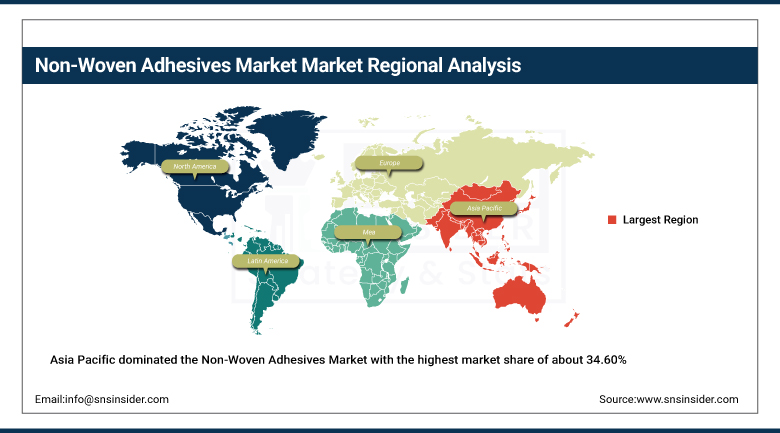
Asia Pacific dominated the Non-Woven Adhesives Market with the highest market share of about 34.60% in 2025, owing to the region's massive population base, rising birth rates, and rapidly expanding disposable hygiene product manufacturing infrastructure across China, India, and Southeast Asia. The region's cost-competitive manufacturing base, combined with substantial investment in hygiene product production capacity, continues to support strong non-woven adhesive consumption across both domestic and export-oriented hygiene product manufacturing operations. Asia-Pacific is also expected to register the fastest growth rate during the forecast period 2026-2035, registering a CAGR of 9.60%, driven by rising birth rates, improving hygiene awareness, and expanding disposable incomes.
China was the leading country within the Asia-Pacific Non-Woven Adhesives Market in 2025 with a market share of 44.60% of the regional market, driven by extensive hygiene product manufacturing capabilities, robust production infrastructure, and significant demand from both domestic and export markets. India is contributing to regional growth through its own expanding hygiene product manufacturing base and rising government healthcare budget allocation supporting sustained regional demand.
Get Customized Report as per Your Business Requirement - Enquiry Now
South America and Middle East and Africa Non-Woven Adhesives Market Insights
South America and Middle East and Africa regions are gradually expanding non-woven adhesive adoption as hygiene product manufacturing and healthcare infrastructure investment grow across both regions, supported by increasing birth rates and growing government focus on strengthening domestic hygiene product manufacturing capability.
Brazil is set to be a prominent South American market fueled by its substantial hygiene product manufacturing base requiring extensive adhesive supply and growing domestic production investment. The Middle East and Africa region has Saudi Arabia and the UAE investing in modern hygiene product manufacturing infrastructure that is gradually increasing demand for non-woven adhesives across their expanding personal care and healthcare markets.
Market Dynamics:
Growth Drivers: Rising hygiene product demand and expanding medical applications driving market growth
The rising global demand for hygiene and personal care products, fueled by increasing birth rates in developing regions and growing awareness of personal health and wellness, is among the primary drivers of the Non-Woven Adhesives Market. Non-woven adhesives provide hygiene product manufacturers with the bonding strength, flexibility, and skin-friendliness required for high-speed disposable product manufacturing, improving product comfort and manufacturing efficiency across virtually every major baby care, feminine hygiene, adult incontinence, and medical application requiring reliable adhesive bonding, from core construction through elastic attachment and closure systems.
Technological advancements in adhesive formulation have significantly increased bonding performance, with recent innovations improving skin compatibility and reducing coat weight requirements across commercial hygiene product manufacturing operations. Rising private-sector investment in dedicated hot-melt and water-based adhesive production capacity, growing integration of sustainable and low-VOC formulations into premium product lines, and continued expansion of medical and surgical adhesive applications are further supporting demand across the forecast period, as manufacturers continue strengthening capability against increasingly stringent performance and sustainability requirements.
Restraints: Raw material price volatility and environmental regulation limiting market expansion
One of the most critical obstacles in terms of market growth comes in the form of the volatility of petrochemical feedstock pricing used in APAO, SBC, and EVA resin production, which directly impacts non-woven adhesive production costs and complicates long-term procurement planning for both manufacturers and downstream hygiene product buyers. This comes down to the fact that adhesive formulations rely heavily on specialty polymer pricing subject to fluctuating global commodity markets, which limits smaller manufacturers from securing stable, cost-predictable production without substantial long-term contractual commitment.
Moreover, tightening environmental regulations governing volatile organic compound emissions and hazardous chemical handling across different jurisdictions directly impact product formulation requirements and cause compliance-related reformulation costs for manufacturers. Besides, the high technical requirements in terms of maintaining consistent bonding performance across varying non-woven substrate types require considerable ongoing research and development investment from non-woven adhesive producers.
Opportunities: Expansion of sustainable formulations and medical applications creating new growth avenues
The increasing need for sustainable, low-VOC adhesive formulations across expanding hygiene product manufacturing operations, the rise of medical and surgical adhesive applications, and greater emphasis on skin-friendly formulation innovation due to growing consumer health awareness will provide ample growth opportunities in the Non-Woven Adhesives Market. The need for compliance-driven, high-performance adhesive capability across hygiene, medical, and industrial operations will ensure future growth due to strict quality and sustainability regulations worldwide.
There are great opportunities for development in the field of the production of biodegradable and environmentally friendly adhesives based on renewable feedstock. The rise in the number of investments in the production of hygienic products and healthcare facilities in emerging markets of Asia-Pacific and South America regions, as well as manufacturer’s efforts to improve the capacity of sustainable production, will promote growth of demand for non-woven adhesives.
Recent Developments:
-
2025: Beardow Adams announced a strategic supply partnership with a major Asian hygiene products manufacturer to provide hot-melt non-woven adhesives, supporting expansion in the fast-growing Asia-Pacific hygiene market.
-
2025: H.B. Fuller launched its new Full-Care skin-friendly hot-melt adhesive formulation, targeting hygiene product manufacturers seeking dermatologically tested bonding solutions for premium baby care products.
-
2026: Bostik expanded its APAO adhesive production capacity with a new manufacturing line dedicated to elastic attachment applications for adult incontinence product manufacturers.
-
2026: Henkel partnered with a leading disposable hygiene product manufacturer to co-develop a bio-based hot-melt adhesive formulation for sustainable baby care product lines.
Non-Woven Adhesives Market key players are:
-
Henkel AG & Co. KGaA
-
Bostik SA (Arkema Group)
-
H.B. Fuller Company
-
Avery Dennison Corporation
-
3M Company
-
Arkema Group
-
Dow Inc.
-
Eastman Chemical Company
-
Sika AG
-
Paramelt B.V.
-
Beardow Adams
-
Michelman, Inc.
-
Cattie Adhesives Solutions LLC
-
Palmetto Adhesives Company, Inc.
-
Forbo Group
-
Ashland Inc.
-
Huntsman Corporation
-
Kraton Corporation
-
Wacker Chemie AG
-
Nan Pao Resins Chemical Co., Ltd.
Non-Woven Adhesives Market Report Scope:
| Report Attributes | Details |
|---|---|
| Market Size in 2025 | USD 3.42 Billion |
| Market Size by 2035 | USD 7.86 Billion |
| CAGR | CAGR of 8.67% From 2026 to 2035 |
| Base Year | 2025 |
| Forecast Period | 2026-2035 |
| Historical Data | 2022-2024 |
| Report Scope & Coverage | Market Size, Segments Analysis, Competitive Landscape, Regional Analysis, DROC & SWOT Analysis, Forecast Outlook |
| Key Segments | • By Technology (Hot-Melt Adhesives & Others (Water-Based Adhesives)) • By Polymer Type (Amorphous Poly Alpha Olefin (APAO), Styrenic Block Copolymers (SBC) & Ethylene Vinyl Acetate (EVA)) • By Application (Baby Care, Feminine Hygiene, Adult Incontinence, Medical & Others (Meat Pads, Poultry Pads, Pet Care, Bath Tissue & Paper Towels)) |
| Regional Analysis/Coverage | North America (US, Canada), Europe (Germany, UK, France, Italy, Spain, Russia, Poland, Rest of Europe), Asia Pacific (China, India, Japan, South Korea, Australia, ASEAN Countries, Rest of Asia Pacific), Middle East & Africa (UAE, Saudi Arabia, Qatar, South Africa, Rest of Middle East & Africa), Latin America (Brazil, Argentina, Mexico, Colombia, Rest of Latin America). |
| Company Profiles | Henkel AG & Co. KGaA, Bostik SA (Arkema Group), H.B. Fuller Company, Avery Dennison Corporation, 3M Company, Arkema Group, Dow Inc., Eastman Chemical Company, Sika AG, Paramelt B.V., Beardow Adams, Michelman, Inc., Cattie Adhesives Solutions LLC, Palmetto Adhesives Company, Inc., Forbo Group, Ashland Inc., Huntsman Corporation, Kraton Corporation, Wacker Chemie AG, Nan Pao Resins Chemical Co., Ltd. |
Frequently Asked Questions
Key players in the Non-Woven Adhesives Market include Henkel, Bostik SA, H.B. Fuller Company, Avery Dennison Corporation, and 3M Company, among others.
Key opportunities include expansion of sustainable, low-VOC adhesive formulations and growing medical and surgical adhesive applications beyond core hygiene product categories.
The market is driven by rising global demand for hygiene products, increasing birth rates, and growing awareness of personal health and wellness.
The Baby Care segment dominated the Non-Woven Adhesives Market, accounting for approximately 46.00% market share, driven by sustained global disposable diaper demand.
The Asia-Pacific region dominated the Non-Woven Adhesives Market in 2025 with a 34.60% share, driven by rising birth rates and manufacturing expansion.
