
Non-Terrestrial Network Infrastructure Market Report Scope & Overview:
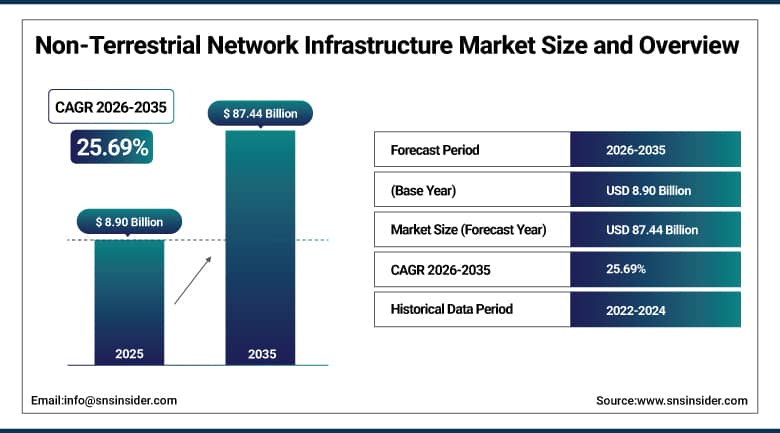
The Non-Terrestrial Network Infrastructure Market was valued at USD 8.90 Billion in 2025 and is expected to reach USD 87.44 Billion by 2035, growing at a CAGR of 25.69% from 2026–2035.
The non-terrestrial network infrastructure market is experiencing strong growth due to increasing demand for reliable, high-capacity, low-latency connectivity across remote, underserved, and mobility-intensive environments. The expansion of 5G networks, direct-to-device connectivity, satellite broadband, Internet of Things applications, and resilient communication infrastructure is driving investments in non-terrestrial network infrastructure. Advancements in LEO, MEO, and GEO satellite systems, along with HAPS and UAV platforms, are improving network coverage, capacity, flexibility, and service continuity. Companies are focusing on enhancing satellite infrastructure, ground infrastructure, antenna systems, network equipment, user terminals, and network software to support seamless integration between terrestrial and non-terrestrial networks.
In July 2026, GSMA Intelligence reported that satellite connectivity and non-terrestrial networks (NTN) were becoming a major strategic focus, with telco-satellite convergence expanding rapidly and 91 telecom operators having signed partnerships with satellite companies. The development is expected to accelerate global NTN infrastructure deployment by expanding hybrid terrestrial-satellite connectivity, direct-to-device services, IoT applications, and coverage in underserved and remote areas.
To Get More Information On Non-Terrestrial Network Infrastructure Market - Request Free Sample Report
Non-Terrestrial Network Infrastructure Market Trends
-
Growing demand for reliable and ubiquitous connectivity is driving the adoption of non-terrestrial network infrastructure to extend coverage across remote, rural, maritime, aviation, and underserved areas.
-
Rising deployment of 5G networks, direct-to-device connectivity, satellite broadband, and IoT applications is increasing demand for high-capacity and resilient non-terrestrial communication infrastructure.
-
Increasing adoption of LEO, MEO, and GEO satellite systems, along with HAPS and UAV platforms, is supporting the development of flexible, scalable, and globally accessible network infrastructure.
-
Growing focus on improving network coverage, connectivity reliability, low latency, interoperability, network resilience, and operational efficiency is creating opportunities for non-terrestrial network infrastructure providers.
-
Advancements in satellite technologies, antenna systems, ground infrastructure, user terminals, network equipment, and software-defined architectures are improving network performance and supporting the adoption of non-terrestrial network infrastructure solutions.
U.S. Non-Terrestrial Network Infrastructure Market Outlook
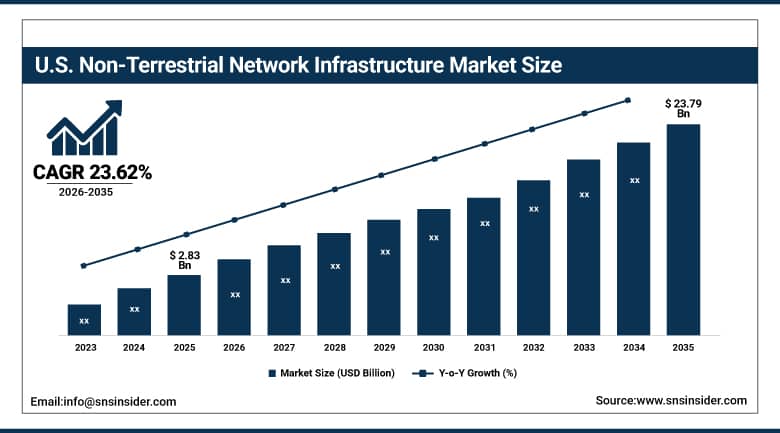
The U.S. Non-Terrestrial Network Infrastructure Market was valued at USD 2.83 Billion in 2025 and is expected to reach around USD 23.79 Billion by 2035, growing at a CAGR of 23.62% from 2026–2035.
The U.S. non-terrestrial network infrastructure market is growing steadily due to rising demand for reliable, high-capacity, low-latency connectivity across remote, rural, maritime, aviation, and underserved areas. The expansion of 5G networks, direct-to-device connectivity, satellite broadband, and IoT applications is driving investments in advanced NTN infrastructure. Increasing deployment of LEO, MEO, and GEO satellite systems, along with HAPS and UAV platforms, is improving network coverage, scalability, resilience, and connectivity continuity across the U.S. Growing investments in satellite infrastructure, ground infrastructure, antenna systems, network equipment, user terminals, and network software are supporting market demand. Companies are focusing on 5G NTN, satellite broadband, direct-to-device connectivity, NTN IoT, and NTN backhaul solutions to enhance network reach, interoperability, and service reliability.
In 2026, the United States continued to strengthen its non-terrestrial network ecosystem through growing investments and partnerships involving satellite operators, telecommunications companies, and technology providers. The increasing focus on direct-to-device connectivity, LEO satellite networks, and integration with terrestrial 5G is expected to accelerate NTN infrastructure deployment across the U.S., improving nationwide coverage, network resilience, and connectivity for remote and underserved locations.
Non-Terrestrial Network Infrastructure Market Segment Analysis
-
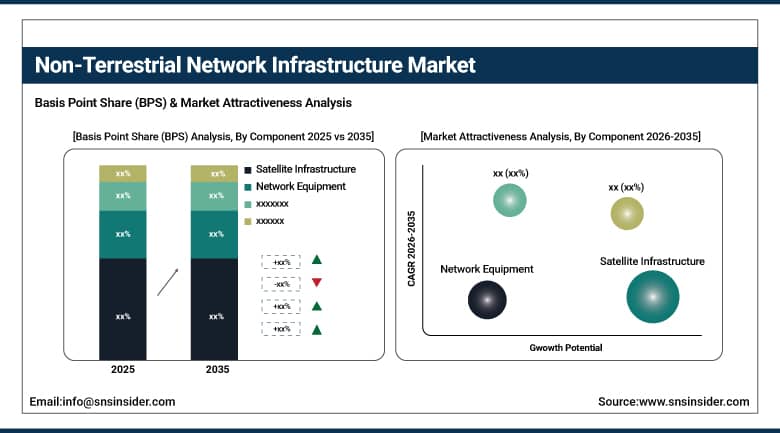
By Component, satellite infrastructure dominated the non-terrestrial network infrastructure market with a 38.40% share in 2025, while network software is projected to be the fastest-growing segment, registering a 36.13% CAGR during 2026–2035.
-
By Orbit Type, low earth orbit (LEO) dominated the non-terrestrial network infrastructure market with a 54.20% share in 2025, while LEO is projected to be the fastest-growing segment, registering a 27.10% CAGR during 2026–2035.
-
By Platform, satellite dominated the non-terrestrial network infrastructure market with a 78.60% share in 2025, while high-altitude platform station (HAPS) is projected to be the fastest-growing segment, registering a 30.77% CAGR during 2026–2035.
-
By Deployment, space-based dominated the non-terrestrial network infrastructure market with a 62.40% share in 2025, while airborne is projected to be the fastest-growing segment, registering a 31.59% CAGR during 2026–2035.
-
By Network Type, 5G NTN dominated the non-terrestrial network infrastructure market with a 32.60% share in 2025, while direct-to-device is projected to be the fastest-growing segment, registering a 34.85% CAGR during 2026–2035.
-
By End Use, telecommunications dominated the non-terrestrial network infrastructure market with a 38.70% share in 2025, while government & defense is projected to be the fastest-growing segment, registering a 29.99% CAGR during 2026–2035.
By Component, satellite infrastructure dominated the non-terrestrial network infrastructure market, while network software is expected to grow fastest.
Satellite infrastructure held the leading position in the non-terrestrial network infrastructure market in 2025, supported by the continued expansion of satellite-based communication systems and the growing need for reliable global connectivity. Increasing deployment of LEO, MEO, and GEO satellite systems, rising demand for high-capacity connectivity, and the integration of satellite networks with terrestrial communication infrastructure are driving demand for satellite infrastructure.
Network software is anticipated to register the highest CAGR during the forecast period from 2026 to 2035, Increasing adoption of software-defined satellite architectures, network automation, intelligent traffic management, virtualization, and cloud-native network technologies is driving demand for advanced NTN software solutions. Growing requirements for interoperability between satellite and terrestrial networks, dynamic resource allocation, network optimization, and seamless connectivity are expected to further accelerate the adoption of network software.
By Network Type, 5G NTN dominated the non-terrestrial network infrastructure market, while direct-to-device is expected to grow fastest.
5G NTN accounted for the dominant share of the non-terrestrial network infrastructure market in 2025, with a 32.60% share, driven by the growing integration of satellite connectivity with terrestrial 5G networks. Increasing demand for continuous connectivity, expanded network coverage, improved resilience, and connectivity in remote and underserved areas is encouraging the deployment of 5G NTN infrastructure.
Direct-to-device is projected to exhibit the highest growth rate during 2026–2035, The growing demand for ubiquitous mobile connectivity without specialized user terminals is accelerating the development of direct-to-device satellite communication. Increasing deployment of satellite-to-smartphone connectivity, expansion of LEO satellite constellations, and growing demand for connectivity in remote, rural, maritime, and emergency environments are expected to strengthen direct-to-device adoption
By End Use, telecommunications dominated the non-terrestrial network infrastructure market, while government & defense is expected to grow fastest.
Telecommunications held the dominant position in the non-terrestrial network infrastructure market in 2025. The expansion of 5G networks, broadband connectivity, direct-to-device services, satellite backhaul, and coverage-extension initiatives is increasing demand for NTN infrastructure among telecommunications operators. Growing requirements for reliable connectivity across remote and underserved locations, combined with the integration of satellite and terrestrial networks, are supporting continued infrastructure deployment.
Government & defense is expected to register the highest CAGR during the forecast period from 2026 to 2035. Increasing requirements for secure, resilient, and geographically independent communications are driving the adoption of non-terrestrial network infrastructure across government and defense applications. Growing demand for mission-critical connectivity, secure satellite communications, surveillance, disaster response, and communications continuity is expected to accelerate deployment.
Regional Analysis
|
Region |
Major Country |
Share within Region, 2025(%) |
|---|---|---|
|
North America |
United States |
82.40% |
|
Europe |
Germany |
34.30% |
|
Asia Pacific |
China |
48.54% |
|
Middle East & Africa |
Saudi Arabia |
23.50% |
|
Latin America |
Brazil |
23.00% |
North America Non-Terrestrial Network Infrastructure Market Insights
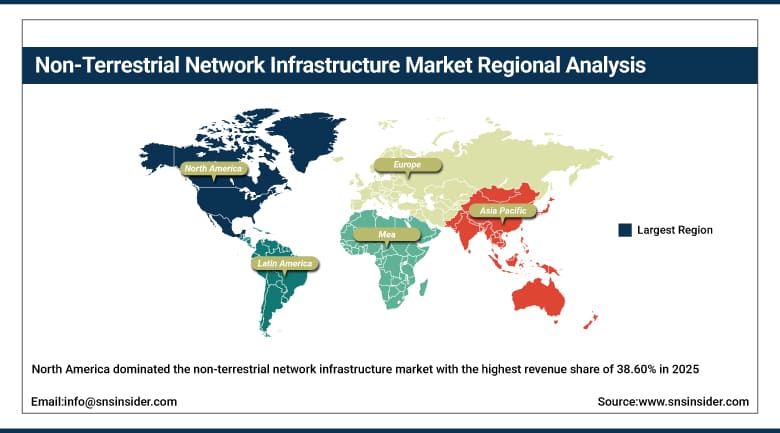
North America dominated the non-terrestrial network infrastructure market with the highest revenue share of 38.60% in 2025. The region is supported by its advanced telecommunications infrastructure, extensive satellite communication capabilities, strong presence of leading satellite operators and technology providers, and significant investments in 5G, direct-to-device connectivity, satellite broadband, and next-generation network infrastructure. Growing demand for reliable connectivity across remote, rural, maritime, aviation, and underserved areas is increasing the deployment of non-terrestrial network infrastructure across the region. The U.S. represents the largest country-level market in North America, supported by substantial investments in satellite systems, ground infrastructure, antenna technologies, network equipment, user terminals, and network software.
Get Customized Report as Per Your Business Requirement - Enquiry Now
Europe Non-Terrestrial Network Infrastructure Market Insights
The non-terrestrial network infrastructure market in Europe is expected to witness steady growth over the forecast period, supported by increasing deployment of satellite communication systems, 5G NTN, satellite broadband, direct-to-device connectivity, and hybrid satellite-terrestrial networks. Rising demand for reliable connectivity across rural, remote, maritime, aviation, and underserved areas is encouraging telecommunications operators, satellite companies, governments, and enterprises to invest in advanced NTN infrastructure. Increasing adoption of LEO satellite systems, ground infrastructure, antenna systems, network equipment, user terminals, and network software is further supporting regional market development.
Asia Pacific Non-Terrestrial Network Infrastructure Market Insights
Asia Pacific is expected to grow at the fastest CAGR of 29.18% from 2026 to 2035, driven by rapid digital transformation, expanding telecommunications infrastructure, increasing 5G deployment, and growing demand for reliable connectivity across remote and underserved locations. representing a market value of Countries including China, Japan, South Korea, India, Singapore, and other Southeast Asian economies are investing in satellite communication infrastructure, 5G networks, broadband connectivity, and emerging direct-to-device technologies. Increasing smartphone adoption, IoT deployment, digital services, maritime connectivity, and demand for continuous network coverage are creating substantial opportunities for NTN infrastructure providers.
Asia Pacific region rapid growth is supported by expanding LEO satellite constellations, direct-to-device connectivity, NTN IoT, satellite broadband, and integration between satellite and terrestrial networks. Government initiatives, telecommunications partnerships, increasing investments in satellite infrastructure, and growing demand for connectivity across rural, remote, maritime, and disaster-prone areas are expected to accelerate regional deployment through 2035.
Middle East & Africa and Latin America Non-Terrestrial Network Infrastructure Market Insights
The non-terrestrial network infrastructure market in the Middle East & Africa and Latin America is expected to witness consistent growth from 2026 to 2035, supported by expanding telecommunications infrastructure, increasing demand for broadband connectivity, 5G deployment, satellite communications, and investments in reliable connectivity for remote and underserved areas
Saudi Arabia is expected to remain an important market in the Middle East & Africa, supported by investments in digital infrastructure, 5G networks, satellite communications, cloud computing, and national digital transformation initiatives. In Latin America, Brazil is anticipated to remain a key country-level market due to its large telecommunications sector, extensive geographic coverage requirements, growing demand for broadband connectivity, and increasing adoption of satellite-based communications.
Growth Driver: Increasing demand for reliable and ubiquitous connectivity is driving market growth
One of the key factors driving the growth of the global non-terrestrial network infrastructure market is the increasing demand for reliable and continuous connectivity across remote, rural, maritime, aviation, and underserved areas. The expansion of 5G networks, direct-to-device connectivity, satellite broadband, NTN IoT, and satellite backhaul is creating substantial demand for advanced infrastructure capable of extending network coverage beyond conventional terrestrial systems. As telecommunications operators and enterprises seek to improve connectivity reach, network resilience, and service continuity, investments in satellite infrastructure, ground infrastructure, antenna systems, network equipment, user terminals, and network software are increasing.
In addition, the rapid deployment of LEO satellite constellations, advancements in HAPS and UAV platforms, and increasing integration between satellite and terrestrial networks are improving the scalability, flexibility, and availability of NTN connectivity. Growing requirements for continuous communications, low-latency connectivity, disaster recovery, emergency communications, and network coverage in geographically challenging locations are further encouraging the deployment of non-terrestrial network infrastructure.
Restraint: High deployment costs and technological complexity can limit market adoption
The high capital investment and technical complexity associated with deploying non-terrestrial network infrastructure can restrict market adoption, particularly among smaller telecommunications operators, enterprises, and organizations operating in cost-sensitive markets. Satellite infrastructure, ground stations, antenna systems, network equipment, user terminals, and supporting network software require significant investments in deployment, integration, maintenance, and network management. The development and operation of large satellite constellations can also involve substantial launch, manufacturing, and operational costs.
Moreover, integrating satellite networks with terrestrial 5G infrastructure requires sophisticated network management, interoperability, spectrum coordination, and specialized technical expertise. Compatibility challenges across satellite and terrestrial systems, evolving standards, regulatory requirements, power constraints, and the need for continuous technology upgrades can further increase deployment complexity. These factors may delay infrastructure modernization projects and limit adoption where investment capacity or technical capabilities are constrained.
Opportunity: Rapid expansion of direct-to-device connectivity and hybrid networks creates new market opportunities
The rapid expansion of direct-to-device connectivity presents significant opportunities for non-terrestrial network infrastructure providers. Increasing demand for mobile connectivity without specialized satellite terminals is accelerating the development of satellite-to-smartphone communication and creating new requirements for satellite infrastructure, ground systems, antennas, network equipment, and network software. The expansion of LEO satellite constellations and growing partnerships between satellite operators and telecommunications companies are further creating opportunities for seamless integration between satellite and terrestrial mobile networks.
Furthermore, the increasing adoption of 5G NTN, satellite broadband, NTN IoT, and hybrid satellite-terrestrial networks is creating opportunities across telecommunications, government and defense, commercial and enterprise, maritime and aviation, industrial, and emergency and disaster management applications. Growing investments in resilient communications, remote-area connectivity, disaster response, and next-generation satellite systems are expected to accelerate NTN infrastructure deployment and create additional market opportunities through 2035.
Recent Developments
-
2026: SpaceX continued expanding its Starlink satellite network and advancing direct-to-device connectivity, supporting the development of LEO-based non-terrestrial network infrastructure for broadband and mobile connectivity applications.
-
2026: Amazon continued advancing Project Kuiper, now Amazon Leo, with satellite constellation deployment and supporting ground infrastructure to expand high-speed satellite connectivity and strengthen global NTN infrastructure capabilities.
-
2026: Eutelsat Group continued expanding its OneWeb LEO satellite network and related ground infrastructure to support broadband connectivity, enterprise communications, government applications, and integration with terrestrial networks.
-
2026: SES continued advancing its multi-orbit satellite infrastructure and connectivity solutions, combining GEO and MEO satellite capabilities to support resilient broadband, enterprise, government, mobility, and hybrid network applications.
-
2026: AST SpaceMobile continued developing its space-based cellular broadband network, advancing direct-to-device satellite connectivity designed to connect standard mobile devices through satellite infrastructure and terrestrial mobile networks.
Non-Terrestrial Network Infrastructure Market Key Players are:
-
SpaceX (Starlink)
-
Amazon (Project Kuiper / Amazon Leo)
-
Eutelsat Group (OneWeb)
-
SES S.A.
-
Viasat Inc.
-
EchoStar Corporation
-
Iridium Communications Inc.
-
Intelsat
-
AST SpaceMobile
-
Thales Group
-
Qualcomm Technologies, Inc.
-
MediaTek Inc.
-
Nokia Corporation
-
Ericsson
-
ZTE Corporation
-
Gilat Satellite Networks
-
Keysight Technologies, Inc.
-
Rohde & Schwarz.
Non-Terrestrial Network Infrastructure Market Report Scope:
| Report Attributes | Details |
|---|---|
| Market Size in 2025 | USD 8.90 Billion |
| Market Size by 2035 | USD 87.44 Billion |
| CAGR | CAGR of 25.69% From 2026 to 2035 |
| Base Year | 2025 |
| Forecast Period | 2026-2035 |
| Historical Data | 2022-2024 |
| Report Scope & Coverage | Market Size, Segments Analysis, Competitive Landscape, Regional Analysis, DROC & SWOT Analysis, Forecast Outlook |
| Key Segments | • By Component (Satellite Infrastructure, Ground Infrastructure, Antenna Systems, Network Equipment, User Terminals, Network Software) • By Orbit Type (Low Earth Orbit (LEO), Medium Earth Orbit (MEO), Geostationary Earth Orbit (GEO)) • By Platform (Satellite, High-Altitude Platform Station (HAPS), Unmanned Aerial Vehicle (UAV)) • By Deployment (Space-Based, Airborne, Ground-Based) • By Network Type (5G NTN, Satellite Broadband, Direct-to-Device, NTN IoT, NTN Backhaul) • By End Use (Telecommunications, Government & Defense, Commercial & Enterprise, Maritime & Aviation, Industrial, Emergency & Disaster Management) |
| Regional Analysis/Coverage | North America (US, Canada), Europe (Germany, UK, France, Italy, Spain, Russia, Poland, Rest of Europe), Asia Pacific (China, India, Japan, South Korea, Australia, ASEAN Countries, Rest of Asia Pacific), Middle East & Africa (UAE, Saudi Arabia, Qatar, South Africa, Rest of Middle East & Africa), Latin America (Brazil, Argentina, Mexico, Colombia, Rest of Latin America) |
| Company Profiles | SpaceX (Starlink), Amazon (Project Kuiper / Amazon Leo), Eutelsat Group (OneWeb), SES S.A., Viasat Inc., Telesat, EchoStar Corporation, Iridium Communications Inc., Intelsat, AST SpaceMobile, Thales Group, Airbus Defence and Space, Qualcomm Technologies, Inc., MediaTek Inc., Nokia Corporation, Ericsson, ZTE Corporation, Gilat Satellite Networks, Keysight Technologies, Inc., Rohde & Schwarz. |

Frequently Asked Questions
Key players include SpaceX, Amazon, Eutelsat Group, SES, Viasat, Telesat, AST SpaceMobile, Thales, Airbus, Qualcomm, Nokia, Ericsson, ZTE, Gilat, Keysight, and Rohde & Schwarz.
Key opportunities include direct-to-device connectivity, LEO satellite deployment, 5G NTN, satellite broadband, and hybrid satellite-terrestrial networks.
The market is driven by rising demand for reliable connectivity in remote and underserved areas and increasing adoption of 5G NTN, satellite broadband, and direct-to-device services.
The Satellite Infrastructure segment dominated the non-terrestrial network infrastructure market, accounting for approximately 38.40% market share.
North America dominated the non-terrestrial network infrastructure market in 2025 with a 38.60% share.
