
Oxygen Market Report Scope & Overview:
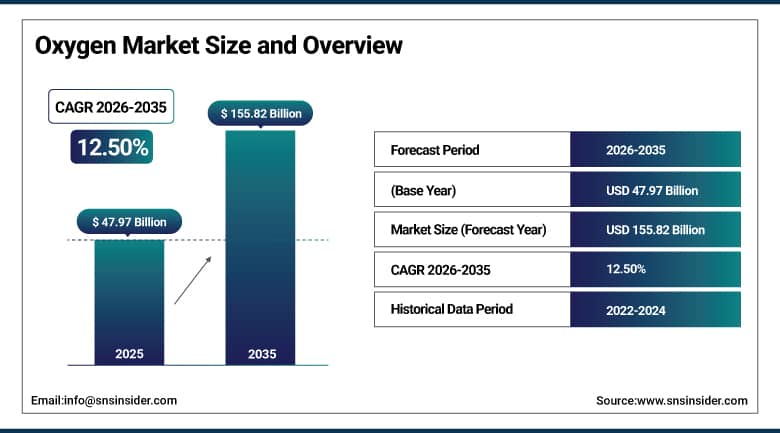
Oxygen Market was valued at USD 47.97 billion in 2025 and is expected to reach USD 155.82 billion by 2035, growing at a CAGR of 12.50% from 2026-2035.
The global oxygen market is experiencing significant growth owing to rising demand in healthcare sector, growing industrial output, and increasing preference for sustainable methods of oxygen generation. Oxygen is an extremely important ingredient for its various applications in the fields of healthcare, steel making, chemicals, glass making, water treatment, etc. The increasing interest of government agencies in investing in production facilities and distribution networks is contributing to the growth of this industry.
In addition, the U.S. Food and Drug Administration (FDA) classifies medical oxygen as a prescription drug, maintaining rigorous quality standards that have been progressively harmonized across international markets.
Oxygen Market Size and Forecast
-
Market Size in 2026E: USD 53.97 Billion
-
Market Size by 2035: USD 155.82 Billion
-
CAGR: 12.50% from 2026 to 2035
-
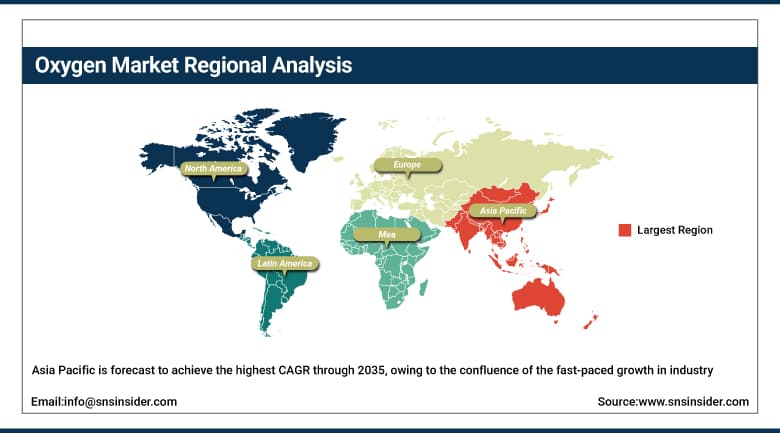
Fastest Growing Region: Asia Pacific
- Largest Region: Asia Pacific
To Get More Information On Oxygen Market - Request Free Sample Report
Oxygen Market Trends
-
Rising adoption of Pressure Swing Adsorption (PSA) on-site oxygen generation systems in hospitals and industrial facilities is reducing dependence on centralized bulk supply and cylinder logistics.
-
Growing deployment of portable and home-use oxygen concentrators is expanding the addressable medical oxygen market as respiratory disease prevalence rises globally.
-
Increasing use of oxy-fuel combustion technology in glassmaking, cement, and metals processing is improving energy efficiency and reducing carbon emissions.
-
Electrolysis-based oxygen generation is gaining momentum as a co-product of green hydrogen production, linking the oxygen market to the global clean energy transition.
-
Government-led investments in medical oxygen infrastructure across sub-Saharan Africa and South Asia are opening significant new markets for gas equipment manufacturers and suppliers.
-
Rising demand for oxygen in aquaculture, water treatment, and food preservation applications is diversifying the end-use base beyond traditional healthcare and metallurgy sectors.
U.S. Oxygen Market Outlook
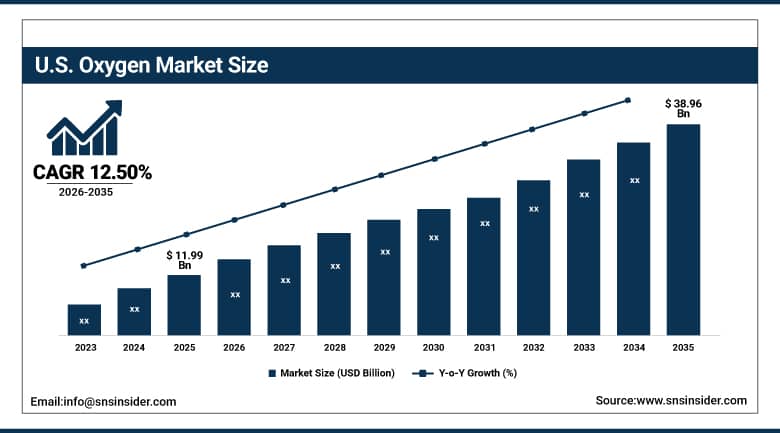
The U.S. Oxygen Market was valued at USD 11.99 billion in 2025 and is expected to reach USD 38.96 billion by 2035, growing at a CAGR of 12.50% from 2026-2035.
The U.S. oxygen market is witnessing rapid growth as a result of increased healthcare requirements, widening industrial uses, and greater reliance on oxygen generating plants. Significant spending on health care facilities, the production of steel and chemicals, and a focus on supply stability are fueling this market growth.
Supporting this, the U.S. Centers for Disease Control and Prevention (CDC) estimates that approximately 16 million Americans are diagnosed with COPD, making it the fourth leading cause of death in the United States.
This large chronic respiratory disease population generates sustained, long-term demand for home oxygen therapy services and medical oxygen supply, providing a stable structural demand driver for the U.S. oxygen market through the forecast period.
Oxygen Market Segment Analysis
-
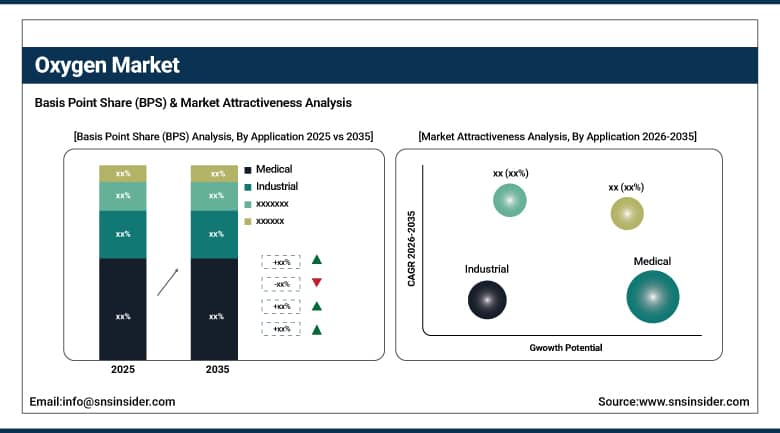
By Application, the Medical segment dominated the Oxygen Market with approximately 45.38% share in 2025, while the Industrial segment is the fastest growing with an estimated CAGR of approximately 13.72% during 2026–2035.
-
By Form, the Gas segment dominated the Oxygen Market with approximately 87.68% share in 2025, while the Liquid segment is the fastest growing with an estimated CAGR of approximately 14.26% during 2026–2035. The 87.68% share is independently reported for gaseous oxygen.
-
By Distribution Mode, the Cylinder Gas Distribution segment dominated the Oxygen Market with approximately 40.37% share in 2025, while the On-Site Generation segment is the fastest growing with an estimated CAGR of approximately 14.81% during 2026–2035. SNS Insider identifies these as the dominant and fastest-growing segments but only reports the dominant share as approximately 40%.
-
By End-use, the Metals and Mining segment dominated the Oxygen Market with approximately 32.67% share in 2025, while the Healthcare segment is the fastest growing with an estimated CAGR of approximately 13.94% during 2026–2035. The 32.67% Metals and Mining share is independently reported for 2025.
By Application, Medical segment dominates the Oxygen Market, Industrial segment expected to grow fastest
The Medical Application segment held the dominant share in the Oxygen Market in 2025. Oxygen is a non-negotiable component in critical care, anesthesia, emergency treatments, and respiratory therapy. Increasing prevalence of respiratory ailments such as COPD, asthma, and sleep apnea coupled with the aging population will continue to drive demand for oxygen therapy in hospitals as well as at homes. Pandemic-induced global realization that oxygen is an indispensable medicine for saving lives has motivated governments to invest in oxygen manufacturing and distribution facilities, especially in developing nations with a history of oxygen supply shortages.
The Industrial Application segment is projected to record the highest CAGR through 2035, owing to the rising manufacturing capacities of steel, chemicals, and petrochemicals, coupled with increased use of oxy-fuel combustion technology for efficient energy consumption and reduced carbon emissions. Oxygen used in industrial applications helps improve the efficiency of fuel combustion processes in glass melting, cement manufacturing, and waste incineration facilities.
By End-use, Metals and Mining segment dominates the Oxygen Market, Healthcare segment expected to grow fastest
The Metals and Mining segment held the dominant share in the Oxygen Market in 2025. Oxygen is vital for steel manufacturing, refining, and smelting processes in order to improve the efficiency of burning process and carry out metallurgical operations at very high temperatures. Growing steel manufacturing activities, infrastructural development, and increasing demand for quality metals in the construction, automotive, and manufacturing industries drive oxygen consumption in this segment.
The Healthcare segment is projected to record the highest CAGR through 2035, due to the growing number of respiratory illnesses, rising number of surgeries being performed worldwide, and increased healthcare facilities. Oxygen is extremely important in healthcare settings for performing life-saving treatments and procedures. Increasing aged population along with the increased consciousness about oxygen availability owing to recent global health situations is encouraging investment in the oxygen industry, especially in developing countries.
By Form, Gas segment dominates the Oxygen Market, Liquid segment expected to grow fastest
The Gas segment dominated the market with a major market share in 2025. This can be attributed to the extensive use of gaseous oxygen in various industrial processes as well as medical treatment purposes. Gaseous oxygen is used because of its ease of storage, transportation via cylinders and pipelines, and immediate availability for continuous operations, such as metal manufacturing, chemical production, and oxygen supply systems in hospitals.
The Liquid segment will grow at the highest rate with a CAGR during 2026-2035. Liquid oxygen has high storage capacity compared to other forms and is widely used in industries that require a larger volume of oxygen supply. The growing demand for bulk oxygen supply in industries and health care sector along with developments in cryogenic technology are expected to drive the demand for liquid
By Distribution Mode, Cylinder Gas Distribution segment dominates the Oxygen Market, On-Site Generation segment expected to grow fastest
Cylinder Gas Distribution is expected to capture the largest market share in the Oxygen Market in 2025. Cylinders continue to be utilized extensively owing to their flexibility, easy transportability, and appropriateness for small to moderate consumption at healthcare institutions such as hospitals and clinics and manufacturing plants. This form of distribution is especially significant in areas that lack pipelines and large-scale storage facilities.
The On-Site Generation segment is projected to record the highest CAGR through 2035, due to growing requirements for effective and constant oxygen delivery. On-site generation technologies like pressure swing adsorption (PSA) technology allow consumers to generate oxygen at the site itself without being dependent on third-party suppliers.Top of Form
Bottom of Form
Regional Analysis
|
Region |
Major Country |
Share within Region, 2025 (%) |
|---|---|---|
|
North America |
United States |
75.01% |
|
Europe |
Germany |
25.10% |
|
Asia Pacific |
China |
52.03% |
|
Middle East & Africa |
Saudi Arabia |
35.02% |
|
Latin America |
Brazil |
55.04% |
Asia Pacific Oxygen Market Insights
Asia Pacific is forecast to achieve the highest CAGR through 2035, owing to the confluence of the fast-paced growth in industry, the largest and fastest-growing healthcare markets in the world, and extensive government spending on oxygen systems in the healthcare sector. China contributes nearly 52% of the revenues generated in the region due to its supremacy in steel manufacturing, which consumes the most amount of oxygen globally, and its extensive healthcare system that is undergoing rapid modernization. The Indian market is one of the key high-potential markets, where the government’s universal healthcare initiatives have led to large-scale investments in oxygen infrastructure at hospitals.
India's Ministry of Health and Family Welfare launched the Pradhan Mantri Atmanirbhar Swasth Bharat Yojana (PM-ASBY) scheme, which allocated funding for 1,500 health and wellness centers and medical oxygen production infrastructure across public hospitals nationwide, directly expanding the addressable market for oxygen equipment and supply services in one of the world's fastest-growing healthcare economies.
Get Customized Report as Per Your Business Requirement - Enquiry Now
Europe Oxygen Market Insights
In 2025, Europe accounted for a considerable market share of about 28% in the worldwide Oxygen Market, driven by an established industrial gases sector, a well-developed health care system, and increasing attention towards green gas production. Germany, France, the United Kingdom, and Benelux countries form the backbone of oxygen manufacturing and consumption in Europe. The European steel sector, which is based mainly in Germany, Belgium, and Eastern Europe, contributes to high oxygen usage in industrial settings, whereas Europe's sophisticated hospitals ensure constant oxygen consumption for medical purposes.
The European Commission's REPowerEU plan and Green Deal industrial strategy promote investment in clean industrial processes including oxy-fuel combustion and green hydrogen production via electrolysis both of which drive incremental oxygen demand.
EU regulations on industrial emissions are also incentivizing steel and glass manufacturers to adopt oxygen-enriched combustion systems that reduce fuel consumption and CO2 emissions per tonne of output.
North America Oxygen Market Insights
The North American region occupies a prominent position in the world oxygen market, with the USA contributing up to 75% towards regional revenues. Distribution channels developed by Linde plc, Air Products and Chemicals, Inc., and Air Liquide have been the major driving forces behind the market growth. Rising demands for domestic oxygen therapy due to COPD and sleep apnea, as well as increased industrial use in aerospace and electronics industries, have spurred growth.
Middle East & Africa and Latin America Oxygen Market Insights
Middle East & Africa and Latin American oxygen markets are experiencing an above-average growth rate owing to development in healthcare infrastructure, increased industrialization activities, and the growing emphasis of governments on providing universal health care facilities to their populations. The Vision 2030 strategy of Saudi Arabia and UAE health policies are contributing to higher oxygen demands in medical applications. In Latin America, Brazil is the leader, followed by Mexico, Colombia, and Argentina.
Market Dynamics
Growth Drivers: Rising global burden of chronic respiratory diseases and aging populations driving sustained structural demand growth for medical oxygen across hospital, emergency, and homecare applications
The growing prevalence of COPD, asthma, respiratory illnesses, and sleep apnea, as well as air pollution and smoke-induced lung problems, will increase the number of patients who require oxygen therapy. This is made worse by the aging of the population since these two ailments affect the elderly more often than other groups. Homecare services provided by the government in America, Europe, Japan, and Australia are driving the adoption of mobile concentrators, liquid oxygen equipment, and cylinder deliveries.
The World Health Organization (WHO) reports that COPD is the third leading cause of death globally, killing approximately 3.23 million people annually, and that an estimated 300 million people worldwide suffer from asthma.
Restraints: High infrastructure costs and logistical challenges associated with oxygen storage, transport, and distribution constraining market penetration in remote regions and smaller healthcare facilities
The characteristics of oxygen as a compressed gas necessitating special high-pressure cylinders, cold liquid storage, or local production plants place considerable infrastructure costs that limit market penetration, especially in rural or distant locations and economically disadvantaged healthcare environments. The need for cold chain transport of liquid oxygen, the expensive nature of air separation plants, and the continuous operating expenses involved in cylinder supply chains constitute considerable obstacles to ensuring global oxygen availability in less developed countries. Oxygen storage and handling safety guidelines incur compliance and training expenses that add more hurdles to accessing oxygen in less economically developed countries.
Opportunities: Rapid expansion of on-site PSA oxygen generation and portable concentrator technologies creating transformative access opportunities in underserved healthcare markets globally
The technological maturity of PSA oxygen production systems and portable oxygen concentrators is transforming the economic feasibility of oxygen delivery for hospitals and patients in rural or underdeveloped regions. These technological developments reduce the reliance on cylinders and liquid oxygen delivery, thus providing a constant source of oxygen for hospitals in areas that used to receive cylinder deliveries at a high cost. International organizations such as governments' purchasing schemes and multinational development banks along with World Health Organization (WHO) are installing PSAs in public hospitals throughout Africa, South Asia, and Southeast Asia, which results in rapid growth of PSA equipment installation and maintenance services industry. The advancement of the technology has enabled the development of smaller portable oxygen concentrators with improved battery performance.
Recent Developments:
-
2025: Linde plc announced expansion of its medical oxygen production and distribution capacity in Southeast Asia, targeting growing hospital network demand in Vietnam, Indonesia, and the Philippines, with investment in new bulk liquid storage facilities and PSA system supply programs.
-
2025: Air Products commenced operations at a new large-scale air separation unit in Saudi Arabia under a long-term supply agreement supporting industrial oxygen demand from the kingdom's expanding petrochemical and steel sectors under Vision 2030.
-
2024: Air Liquide expanded its Healthcare business unit's on-site oxygen generation portfolio for hospitals in Africa and Latin America, deploying PSA oxygen systems in over 50 public hospitals across Nigeria, Kenya, and Colombia under public-private partnership frameworks.
-
2024: Inogen Inc. received FDA 510(k) clearance for a new lightweight portable oxygen concentrator designed for long-term home use, offering improved battery life and oxygen delivery efficiency for COPD patients requiring continuous supplemental oxygen therapy.
-
2023: Taiyo Nippon Sanso expanded oxygen production capacity at its air separation complex in Japan, investing in energy-efficient ASU upgrades designed to reduce electricity consumption per tonne of oxygen produced and lower the carbon footprint of industrial oxygen supply.
-
2022: Messer Group completed acquisition of industrial gas assets in North America, strengthening its oxygen production and distribution network in the U.S. and establishing a competitive platform for growth across healthcare and industrial oxygen markets.
Oxygen Market Key Players
-
Linde plc
-
Air Products and Chemicals, Inc.
-
Air Liquide S.A.
-
Messer Group GmbH
-
Taiyo Nippon Sanso Corporation
-
Praxair Technology, Inc. (Linde)
-
Matheson Tri-Gas, Inc.
-
Gulf Cryo
-
Inogen, Inc.
-
Philips Respironics
-
CAIRE Inc.
-
Invacare Corporation
-
Drive DeVilbiss Healthcare
-
Nidek Medical Products
-
Chart Industries, Inc.
-
SOL Group
-
Nippon Sanso Holdings Corporation
-
Ellenbarrie Industrial Gases Ltd.
-
Universal Industrial Gases, Inc.
-
Cryoin Engineering Ltd.
| Report Attributes | Details |
|---|---|
| Market Size in 2025 | USD 47.97 Billion |
| Market Size by 2035 | USD 155.82 Billion |
| CAGR | CAGR of 12.50% From 2026 to 2035 |
| Base Year | 2025 |
| Forecast Period | 2026-2035 |
| Historical Data | 2022-2024 |
| Report Scope & Coverage | Market Size, Segments Analysis, Competitive Landscape, Regional Analysis, DROC & SWOT Analysis, Forecast Outlook |
| Key Segments | •By Form (Solid, Liquid, Gas) •By Application (Medical [Hospital Use, Homecare], Industrial [Welding, Cutting, Chemical Process, Aerospace, Others], Others) •By Distribution Mode (Onsite Gas Generation, Cylinder Gas Distribution, Bulk Tank Distribution) •By End-use (Metals and Mining, Chemical Industry, Oil and Gas, Healthcare, Others) |
| Regional Analysis/Coverage | North America (US, Canada), Europe (Germany, UK, France, Italy, Spain, Russia, Poland, Rest of Europe), Asia Pacific (China, India, Japan, South Korea, Australia, ASEAN Countries, Rest of Asia Pacific), Middle East & Africa (UAE, Saudi Arabia, Qatar, South Africa, Rest of Middle East & Africa), Latin America (Brazil, Argentina, Mexico, Colombia, Rest of Latin America). |
| Company Profiles |
Linde plc, Air Products and Chemicals, Inc., Air Liquide S.A., Messer Group GmbH, Taiyo Nippon Sanso Corporation, Praxair Technology, Inc. (Linde), Matheson Tri-Gas, Inc., Gulf Cryo, Inogen, Inc., Philips Respironics, CAIRE Inc., Invacare Corporation, Drive DeVilbiss Healthcare, Nidek Medical Products, Chart Industries, Inc., SOL Group, Nippon Sanso Holdings Corporation, Ellenbarrie Industrial Gases Ltd., Universal Industrial Gases, Inc., Cryoin Engineering Ltd. |
Frequently Asked Questions
Key players include Linde, Air Liquide, Air Products, Messer Group, and Nippon Sanso Holdings.
Key opportunities include healthcare expansion, on-site generation, steelmaking demand, and high-purity oxygen applications.
Market growth is driven by healthcare demand, industrial processing, steel production, and oxygen infrastructure expansion.
Medical applications dominated the Oxygen Market due to strong hospital and respiratory care demand.
Asia Pacific dominated in 2025, supported by industrialization, healthcare expansion, and steel production growth.
