
Di Nitro Toluene Market Report Scope & Overview:
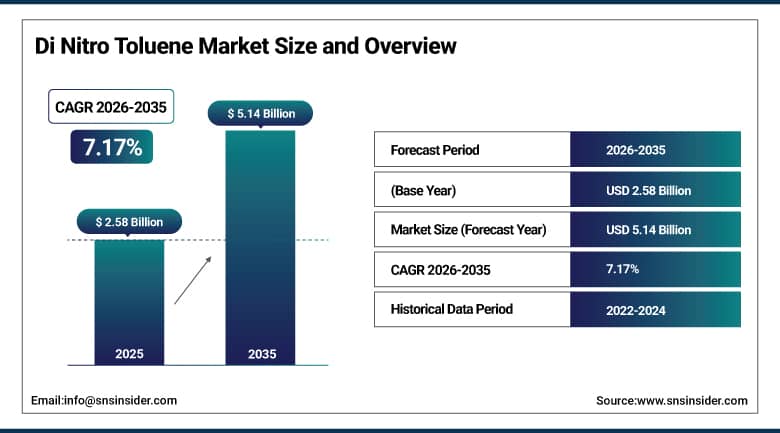
The Di Nitro Toluene Market was valued at USD 2.58 Billion in 2025 and is expected to reach USD 5.14 Billion by 2035, growing at a CAGR of 7.17% from 2026–2035.
The Di Nitro Toluene Market is witnessing robust growth on account of growing demand for dinitrotoluene (DNT), which is considered an essential intermediate in the manufacture of toluene diisocyanate (TDI), polyurethane foam, dyes, pigments, and specialty chemicals. Higher levels of construction, automotive, furniture, and insulation activity are fueling the demand for polyurethane-based products, thereby driving up the DNT demand. Furthermore, growth in the chemicals manufacturing sector along with investments being made in industries in emerging markets is helping drive market growth. Moreover, developments in chemical processing techniques, in order to enhance efficiencies in terms of production and environmental impact, are motivating companies to optimize their DNT manufacturing process.
In 2026, researchers developed a ruthenium-based catalyst for greener and safer hydrogenation of 2,4-dinitrotoluene, demonstrating improved catalyst stability and environmental compatibility.
To Get More Information On Di Nitro Toluene Market - Request Free Sample Report
Di Nitro Toluene Market Trends:
-
Increasing demand for explosives, chemical intermediates, and specialty chemicals is driving the growth of the Di Nitro Toluene Market.
-
Growing utilization of di nitro toluene in explosives manufacturing, dyes, and chemical synthesis applications is accelerating market growth.
-
Advancements in chemical processing technologies, production optimization, and sustainable manufacturing methods are improving di nitro toluene production efficiency and supply reliability.
-
Increasing investments in chemical manufacturing capacity expansion, industrial infrastructure, and advanced material development are supporting market innovation.
-
Growing adoption across chemical manufacturers, explosives producers, automotive suppliers, and industrial end users is supporting sustained market growth.
U.S. Di Nitro Toluene Market Outlook:
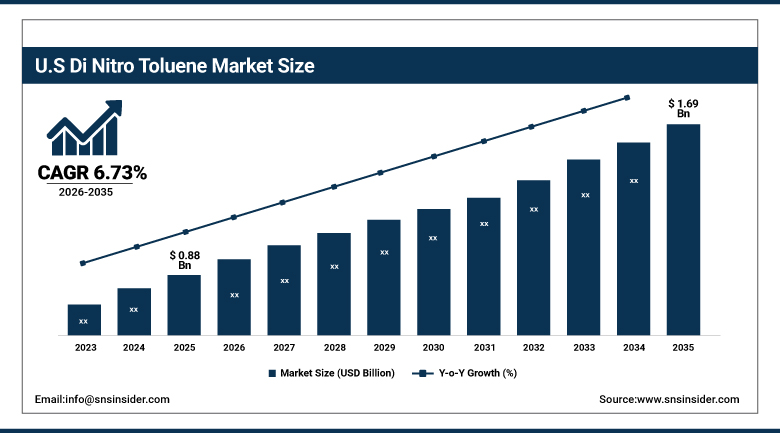
The U.S. Di Nitro Toluene Market was valued at USD 0.88 Billion in 2025 and is expected to reach around USD 1.69 Billion by 2035, growing at a CAGR of 6.73% from 2026–2035.
The U.S. Di Nitro Toluene Market is driven by the presence of an advanced chemical industry, polyurethane manufacturing and consumption, and demand for specialty chemical intermediates. Dinitrotoluene is mainly used in the manufacturing of toluene diisocyanate (TDI), which is further employed in flexible polyurethane foams used in various applications including furniture, bedding, and auto seats. Hence, the need from automotive, construction, furniture, and insulation sectors drives market growth. The presence of an advanced petrochemical and specialty chemicals industry, coupled with efforts made towards efficiency improvement through manufacturing process innovations, drives domestic consumption of the product. Moreover, increased focus of regulations on chemical management, workplace safety, emission controls, and sustainable manufacturing is propelling manufacturers to innovate production processes.
In 2026, The U.S. EPA updated its regulatory assessment of 2,4- and 2,6-dinitrotoluene, publishing supporting documents for its Regulatory Determination 2 process and reinforcing regulatory scrutiny of DNT exposure and environmental impacts.
Di Nitro Toluene Market Segment Analysis:
-
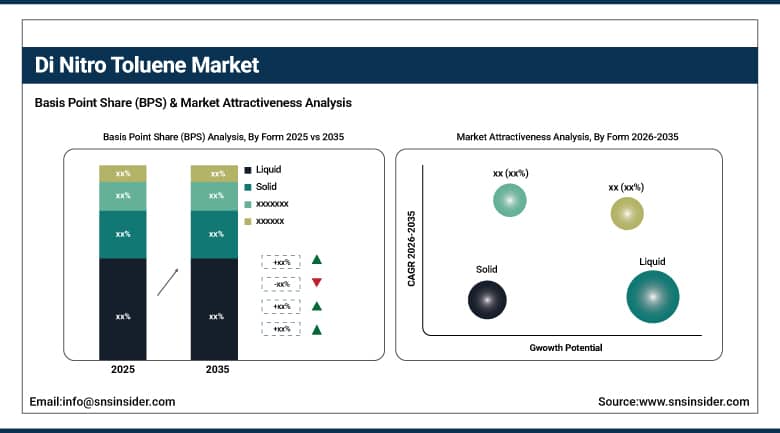
By form, liquid dominated the di nitro toluene market with a 62.00% share in 2025, while solid is projected to be the fastest-growing segment, reaching a 8.11% share by 2035.
-
By product, 2,4 Di Nitro Toluene dominated the di nitro toluene market with a 70.00% share in 2025, while mixed di nitro toluene is projected to be the fastest-growing segment, reaching an 8.64% share by 2035.
-
By purity, high purity dominated the di nitro toluene market with a 35.00% share in 2025, while low purity is projected to be the fastest-growing segment, reaching a 7.30% share by 2035.
-
By application, explosives dominated the di nitro toluene market with a 34.00% share in 2025, while chemical is projected to be the fastest-growing segment, reaching a 8.09% share by 2035.
-
By end use industry, manufacturing dominated the di nitro toluene market with a 40.00% share in 2025, while chemical industry is projected to be the fastest-growing segment, reaching a 8.44% share by 2035.
By form, liquid dominated the di nitro toluene market, while Solid is expected to grow fastest
Liquid held the leading position in the Di Nitro Toluene Market in 2025 due to its easy handleability, efficient processability, and suitability for continuous industrial processes. Extensive usage in chemical processing and intermediates also increases demand for liquid. Liquid is likely to hold the dominant position in the forecast period owing to continuous consumption in large-scale industrial processes.
Solid is anticipated to be the fastest-growing segment in terms of form. Solid DNT has benefits with respect to storage, transport, handling, and processing within industrial facilities. The rising demand for solid DNT for polyurethane, chemical intermediate, and specialty chemicals is aiding its adoption. Efficient packaging and material handling have become the focus of manufacturers as well.
By product, 2,4 di nitro toluene dominated the di nitro toluene market, while mixed di nitro toluene is expected to grow fastest
The 2,4 Di Nitro Toluene led the market for di nitro toluene in 2025 owing to its large-scale adoption as a primary chemical intermediate in manufacturing of explosives, specialty chemicals, and industrials. The segment thrives on existing production abilities, constant availability of raw materials and high demand from sectors which require efficient chemical intermediates. The extensive usage in the production of explosive compounds, dyes and various chemical derivatives has ensured the large-scale acceptance of the chemical among manufacturers. Moreover, the availability of standardized production methods and established supply chains adds up to the dominance of 2,4 Di Nitro Toluene.
Mixed Di Nitro Toluene is likely to grow at a rapid pace over the forecast period, owing to the wide scope of its use as an intermediary in the production of TDI, polyurethane, dye, pigment, and other specialty chemicals. The rising demand for polyurethane products in various end-use industries such as automotive, construction, furniture, and insulation is expected to drive consumption.
By application, explosives dominated the di nitro toluene market, while chemical is expected to grow fastest
Explosives was the dominant application segment in 2025 owing to its largest market share owing to the importance of di nitro toluene as an intermediate in the manufacture of explosive substances. This segment was driven by the growing demand from the mining, construction, infrastructure development, and defense industries that use explosive substances for purposes of digging and destruction. Infrastructure project investment, as well as modernization of the defense industry, has also been responsible for increasing the demand for explosives intermediates manufactured using di nitro toluene.
The chemical segment is likely to be the fastest-growing application segment during the forecast period because of the growing application of di nitro toluene in chemical synthesis, production of specialty chemicals, and industrial production. Growth will be driven by increasing investments and growing demand for advanced chemical intermediates.
By end use industry, manufacturing dominated the di nitro toluene market, while Chemical Industry is expected to grow fastest
The manufacturing industry segment dominated the end use industry segment in 2025 as a result of the extensive usage of di-nitro toluene in the production of explosives, dyes, plastics and industrial chemicals. The segment is driven by the availability of existing industrial infrastructure, large scale production and constant demand for chemical intermediates across several industrial processes. Expansion in the level of industrialization, growth in production and rising demand for specialty materials will further enhance the importance of the manufacturing industries in the market for di nitro toluene.
Chemical Industry segment is projected to be the fastest growing end use segment during the forecast period backed by rising demand for specialty chemicals, advanced materials and chemical synthesis applications. Constant investments made in the chemical manufacturing capacity and technology are promoting the use of di-nitro toluene across chemical industries.
Regional Analysis:
|
Region |
Major Country |
Share within Region, 2025(%) |
|---|---|---|
|
North America |
United States |
88.40% |
|
Europe |
Germany |
24.50% |
|
Asia Pacific |
China |
42.00% |
|
Middle East & Africa |
Saudi Arabia |
29.50% |
|
Latin America |
Brazil |
46.00% |
North America Di Nitro Toluene Market Insights
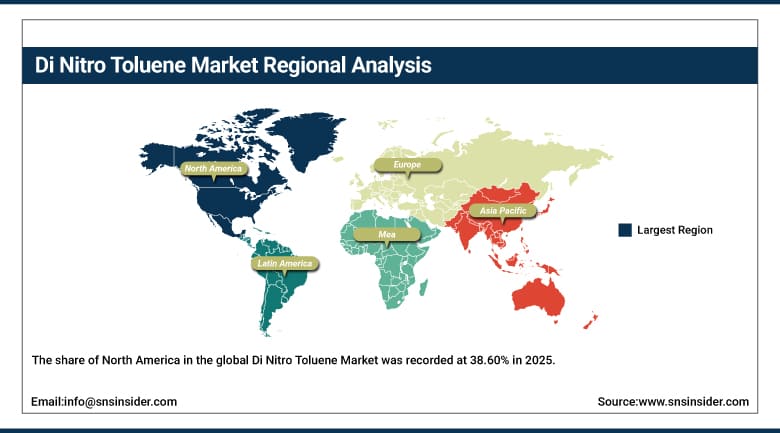
The share of North America in the global Di Nitro Toluene Market was recorded at 38.60% in 2025. The market in the region is mainly fueled by high demand from the explosives manufacturing, chemicals, and industrial sectors. Availability of matured chemical manufacturing players, robust manufacturing infrastructure, and increasing investments in specialty chemical manufacturing have been playing a pivotal role in driving the market forward. In 2025, the US will hold major share of the North America Di Nitro Toluene Market, owing to its matured chemical industry and high demand from its defense industry.
Other factors contributing to the growth of this market include rising demand for Di Nitro Toluene as intermediate chemical for explosives, dyes, plastic, and specialty chemical manufacturing. Increasing investments in the development of efficient chemical manufacturing technologies and manufacturing processes have been encouraging the market players to go green with their operations. In addition, high demand from construction, mining, defense, and industrial sectors has been adding fuel to the fire. The presence of key chemical manufacturing companies in the region has also been boosting its presence in the global Di Nitro Toluene Market.
Get Customized Report as Per Your Business Requirement - Enquiry Now
Europe Di Nitro Toluene Market Insights
Europe Di Nitro Toluene Market is developing at a steady pace due to the availability of existing chemical manufacturing industries, requirement for intermediaries of polyurethanes, and usage of specialty chemicals. The rising consumption of di nitro toluene in the process of production of TDI, polyurethane, dyes, pigments, and chemical intermediaries is contributing to the growth of the market in Europe.
Moreover, the focus on chemical processing, manufacturing, and environment is also playing a role in driving the market growth. It is estimated that Germany will prove to be a key contributor to the Di Nitro Toluene Market in Europe due to the existing chemical manufacturing industries in the country.
Asia Pacific Di Nitro Toluene Market Insights
The Asia Pacific Di Nitro Toluene Market is growing due to the high rate of industrialization, increased capacity of production in the chemicals industry, and increasing demand for polyurethane material. The increased demand for TDI, flexible polyurethane foam, coatings, dyes, pigments, and other specialty chemicals is driving the application of di nitro toluene in many regional markets.
The growth of the automotive, construction, furniture, and manufacturing industry is further boosting the demand for downstream polyurethane products. China is forecasted to be the biggest driver for this market in Asia Pacific due to its large manufacturing and chemicals capacity, along with demand for chemical intermediates.
Middle East & Africa and Latin America Insights
The Middle East & Africa Di Nitro Toluene market is evolving gradually due to an increase in chemical production operations, diversification of the industry, and increased demand for specialty chemicals. There is increased activity in the construction, automotive, furniture, and insulation sectors that has increased the demand for polyurethane-based products and chemicals.
Investment in the petrochemical and downstream chemical industries is also presenting more growth opportunities within the market, especially in the Gulf region. Saudi Arabia is anticipated to contribute greatly to the regional market due to the well-established petrochemical industry and growing investments into downstream chemical production operations.
Market Dynamic:
Growth Driver: Rising demand for chemical manufacturing and explosives applications accelerating di nitro toluene market growth
The rising demand for explosives, chemical intermediates, dyes, plastics, and specialty chemicals is fueling the expansion of the Di Nitro Toluene Market. The application of Di Nitro Toluene as a significant raw material for the preparation of explosives, aromatic compounds, dyes, and other chemicals is quite popular in several industries. The rising demand for Di Nitro Toluene is being observed in the global market owing to the increased construction activities, mining activities, demand from the defense sector, and expansion in the manufacture of chemicals. Improvements in the technology of chemical processing and manufacturing processes are leading to the enhancement in the quality of the products available.
Growing investments from the part of chemical manufacturers, increasing demand for high-end industrial chemicals, and expansion in the end-use industries including construction, automotive, and manufacturing are also adding momentum to the expansion of the Di Nitro Toluene Market.
Restraints: Stringent environmental regulations and production complexities may Factors That May Restrict di nitro toluene market growth
Regulations related to the production, storage, and disposal of nitro aromatic compounds can restrict the growth of Di Nitro Toluene market. The issues faced by the producers include those related to safety and emission control norms along with waste management. Moreover, complexity in manufacturing processes, reliance on raw material and their fluctuating prices can have an effect on profitability.
The requirement of technological advancements along with pollution control system and adherence to strict regulatory structure can be considered as barriers for small and medium scale producers. Furthermore, there is rising pressure on development of eco-friendly alternative chemicals.
Opportunities: Advancements in chemical processing technologies and expanding industrial applications
Opportunities for growth in the Di Nitro Toluene Market are plenty due to the latest developments in chemical manufacturing technologies, improvements in chemical processes and sustainable manufacturing. Developments in the process of nitration, automation, and chemical processing systems have enabled manufacturers to increase their production capacity and improve efficiency.
Growing demand from innovative applications like specialty chemicals, materials, dyes, and industrial intermediates is likely to offer many growth opportunities to the market players. Also, rising activities in construction, infrastructural development, mining, and defense spending in developing nations are fueling the demand for Di Nitro Toluene. Investments in R&D activities and sustainable manufacturing processes are other factors that would drive the growth of the market during the forecast period.
Recent Developments:
-
2026: Covestro completed a 20% expansion of its TDI production capacity at the Shanghai Chemical Industry Park, increasing annual capacity from 310,000 to 370,000 metric tons to meet growing demand from furniture, mattress, and automotive applications.
-
2026: Covestro completed the modernization of its Dormagen TDI plant in Germany, introducing process improvements that reduce energy consumption and cut CO₂ emissions by approximately 22,000 tons annually, strengthening the competitiveness of European TDI production.
-
2026: BASF increased prices for its TDI products by USD 250 per metric ton across ASEAN and South Asian markets, citing higher raw-material, transportation, and energy costs, highlighting continued cost pressures across the DNT–TDI value chain.
Di Nitro Toluene Market Key Players are:
-
Kraton Corporation
-
Lanxess AG
-
Mitsubishi Gas Chemical Company, Inc.
-
Nippon Steel Corporation
-
SABIC
-
Solvay S.A.
-
Gujarat Aromatic Pvt. Ltd.
-
Karnavati Chemicals Pvt. Ltd.
-
NITRO-CHEM S.A.
-
Atul Ltd.
-
Aarti Industries Limited
-
Deepak Nitrite Limited
-
Jiangsu Yangnong Chemical Co., Ltd.
-
Jinan Chenghui Shuangda Chemical Co., Ltd.
-
Shandong Jinyimeng Group Co., Ltd.
-
Tosoh Corporation
-
Nantong Xingchen Synthetic Material Co., Ltd.
Di Nitro Toluene Market Report Scope:
| Report Attributes | Details |
|---|---|
| Market Size in 2025 | USD 2.58 Billion |
| Market Size by 2035 | USD 5.14 Billion |
| CAGR | CAGR of 7.17% From 2026 to 2035 |
| Base Year | 2025 |
| Forecast Period | 2026-2035 |
| Historical Data | 2022-2024 |
| Report Scope & Coverage | Market Size, Segments Analysis, Competitive Landscape, Regional Analysis, DROC & SWOT Analysis, Forecast Outlook |
| Key Segments | • By form(Liquid; Solid) • By product(2,4 Di Nitro Toluene,2,6 Di Nitro Toluene, Mixed Di Nitro Toluene) • By purity(Low purity, High purity) • By application(Explosives, Chemical, Plastics; Automotive,Dyes) • By end use industry(Chemical Industry, Manufacturing ,Automotive Industry, Construction Industry,Defense Industry) |
| Regional Analysis/Coverage | North America (US, Canada), Europe (Germany, France, UK, Italy, Spain, Russia, Poland, Rest of Europe]), Asia Pacific (China, India, Japan, South Korea, Australia, ASEAN Countries, Rest of Asia Pacific), Middle East & Africa (UAE, Saudi Arabia, Qatar, South Africa, Rest of Middle East & Africa], Latin America (Brazil, Argentina, Mexico, Colombia, Rest of Latin America) |
| Company Profiles | BASF SE, Eastman Chemical Company, Huntsman Corporation, Kraton Corporation, Lanxess AG, Mitsubishi Gas Chemical Company, Inc., Nippon Steel Corporation, SABIC, Solvay S.A., Gujarat Aromatic Pvt. Ltd., Karnavati Chemicals Pvt. Ltd., NITRO-CHEM S.A., Atul Ltd., Aarti Industries Limited, Deepak Nitrite Limited, Jiangsu Yangnong Chemical Co., Ltd., Jinan Chenghui Shuangda Chemical Co., Ltd., Shandong Jinyimeng Group Co., Ltd., Tosoh Corporation, Nantong Xingchen Synthetic Material Co., Ltd. |
Frequently Asked Questions
The market is driven by rising demand for oncology therapeutics, pharmaceutical manufacturing, and advancements in biotechnology and synthetic production methods.
North America dominated the Di Nitro Toluene Market in 2025 with a 38.60% share
Key opportunities include TDI production, polyurethane demand, specialty chemicals, advanced processing, and capacity expansion in emerging markets.
