
Phytogenic Feed Additives Market Report Scope & Overview:
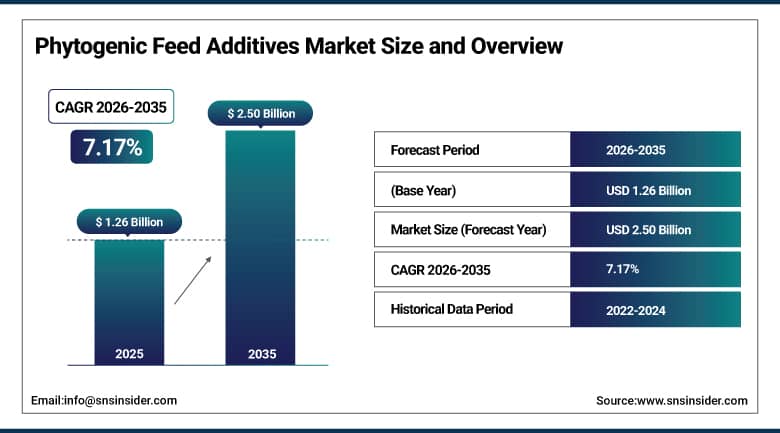
The Phytogenic Feed Additives Market was valued at USD 1.26 Billion in 2025 and is expected to reach USD 2.50 Billion by 2035, growing at a CAGR of 7.17% from 2026–2035.
The global phytogenic feed additives market is being driven by the increasing demand for natural, organic, and sustainable feed additives across the livestock industry. Growing regulatory restrictions on the use of antibiotic growth promoters, coupled with rising consumer preference for antibiotic-free meat, dairy, and poultry products, are accelerating the adoption of phytogenic solutions. Expanding livestock production, increasing awareness of animal health and nutrition, and the need to improve feed efficiency and productivity are further supporting market growth. In addition, continuous advancements in plant-based feed ingredients, including encapsulation technologies, synergistic botanical formulations, and enhanced bioavailability, are improving product efficacy and strengthening the adoption of phytogenic feed additives worldwide.
In January 2025, EW Nutrition appointed Nadia Yacoubi as Phytogenic Products Manager and Marie Gallissot as Category Manager Feed Quality Solutions to strengthen its global expertise in phytogenic feed additives and animal nutrition solutions.
To Get More Information On Phytogenic Feed Additives Market - Request Free Sample Report
Phytogenic Feed Additives Market Trends:
-
Increasing demand for natural and sustainable feed additives is driving the phytogenic feed additives market.
-
Increasing adoption of phytogenic feed additives as alternatives to antibiotic growth promoters is accelerating market growth.
-
Advancements in encapsulation technologies and plant-based formulations are enhancing product efficacy and feed performance.
-
Growing investments in animal nutrition research and sustainable livestock production are supporting market innovation.
-
Increasing use across poultry, swine, ruminants, and aquaculture is strengthening market demand.
U.S. Phytogenic Feed Additives Market Outlook:
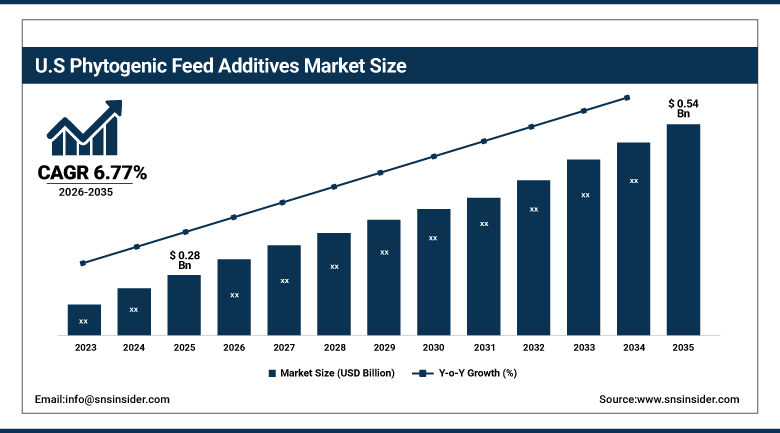
The U.S. Phytogenic Feed Additives Market was valued at USD 0.28 Billion in 2025 and is expected to reach around USD 0.54 Billion by 2035, growing at a CAGR of 6.77% from 2026–2035.
The rise in the need for organic and sustainable feed additives in the poultry, swine, ruminant, and aquaculture sectors will impact the phytogenic feed additives market in the U.S. The growing prohibition on antibiotic growth promoters, increased consumer preference for meat without antibiotics, and increased attention on the well-being and efficiency of feeds have promoted the use of phytogenic feed additives. There is increasing investment in advanced botanical products, encapsulation technology, and botanical ingredients that improve the efficacy of the products and adhere to the changing regulatory norms. Also, ongoing R&D into essential oils, herbs & spices, oleoresins, and other phytogenic additives has enhanced the performance of animals.
In November 2025, Cargill expanded its Micronutrition & Health Solutions portfolio in the U.S. by highlighting phytogenic feed additives such as Delacon products for poultry, swine, ruminants, and aquaculture, supporting improved feed efficiency, gut health, and antibiotic reduction in livestock production.
Phytogenic Feed Additives Market Segment Analysis:
-
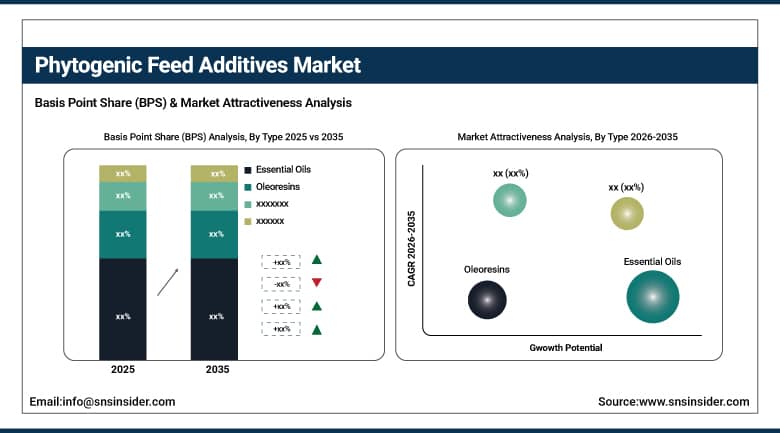
By type, Essential Oils dominated the phytogenic feed additives market with a 38.52% share in 2025, while Oleoresins are projected to be the fastest-growing segment, registering a 9.88% CAGR during 2026–2035.
-
By function, Performance Enhancers dominated the phytogenic feed additives market with a 34.86% share in 2025, while Digestive Stimulants are projected to be the fastest-growing segment, registering a 10.31% CAGR during 2026–2035.
-
By livestock, Poultry dominated the phytogenic feed additives market with a 44.18% share in 2025, while Aquatic Animals are projected to be the fastest-growing segment, registering a 12.78% CAGR during 2026–2035.
-
By form, Dry dominated the phytogenic feed additives market with a 68.47% share in 2025, while Liquid is projected to be the fastest-growing segment, registering a 8.61% CAGR during 2026–2035.
-
By distribution channel, Animal Production Operations dominated the phytogenic feed additives market with a 61.38% share in 2025, while E-commerce is projected to be the fastest-growing segment, registering a 15.06% CAGR during 2026–2035.
By Type, Essential Oils dominated the phytogenic feed additives market, while Oleoresins are expected to grow fastest.
Essential oils have gained dominance in the market for phytogenic feed additives in 2025 owing to their potent antimicrobial, antioxidant, anti-inflammatory, and digestive enhancing properties. Essential oils find application in nutritional needs of poultry, swine, and ruminants for improving gut health, improving nutrient absorption, boosting immunity, enhancing the efficiency of feed conversion, and acting as an alternative to antibiotics. The popularity of essential oils such as those sourced from oregano, thyme, cinnamon, garlic, and cloves is on account of their effectiveness in reducing pathogenic bacteria and improving animal performance without leaving any toxic residue. The growing constraints against the use of antibiotics, increasing consumer preference for natural animal products, and innovations in encapsulation technology further favor the usage of essential oils.
The oleoresin market segment is expected to experience the highest growth during the forecast period due to the presence of high levels of bioactive substances, better stability, and prolonged biological activity in comparison to traditional botanical extracts. The increased use of oleoresins in animal feeds for ruminants and aquaculture is attributed to the capability of oleoresins to increase palatability and digestive efficiency as well as improve the oxidative stability and overall health of the animals.
By Livestock, Poultry dominated the phytogenic feed additives market, while Aquatic Animals are expected to grow fastest.
The Poultry segment was the largest contributor to the phytogenic feed additives market share in 2025 owing to large scale production of broilers and layers globally, shorter production cycle, and increasing efforts to increase feed conversion ratio, weight gain, and disease resistance. The use of phytogenic feed additives by the poultry industry has increased to boost digestive health, reduce pathogenic microorganism population, increase nutrient absorption, and reduce dependency on antibiotic growth promoters. Increasing consumption of poultry meat and eggs without antibiotics, rising commercialization of poultry farming, and supportive government policies for sustainable animal nutrition are some of the key factors driving the dominance of this segment.
Aquatic Animals is expected to grow at a considerable CAGR during the forecast period owing to increasing aquaculture industry, increasing consumption of seafood across the globe, and increasing focus on sustainable fish/shrimp farming. The increasing use of phytogenic feed additives in aquaculture has been witnessed to boost digestive activity, immune response, stress resistance, growth rate, feed utilization, and prevention of disease outbreaks. Increased investment in quality aquafeed and pressure from regulations on reduced antibiotic usage in aquatic farming will drive the growth of this segment.
By Distribution Channel, Animal Production Operations dominated the phytogenic feed additives market, while E-commerce is expected to grow fastest.
Animal Production Operations led the market for phytogenic feed additives in 2025 owing to the fact that commercial livestock farms, integrated poultry farms, swine operations, and dairy farms source their feed additives directly from manufacturers through supply agreements. Consistency in terms of quality, technical assistance, and customizing feed mixtures are essential for achieving optimal production levels. Precision Livestock Farming and Commercial Feed Management Systems have further ensured the dominance of this distribution channel.
E-commerce is anticipated to witness the fastest growth throughout the forecast period as a result of growing digitization of agricultural procurement activities along with the increased availability of online animal nutrition products. E-commerce websites offer livestock producers, feed producers, veterinarians, and distributors an opportunity to source a wide array of feed additives at competitive prices, technical information about the products, and even doorstep delivery service. Increased internet connectivity in developing economies, increased adoption of digital purchasing platforms, and business-to-business online marketplaces are expected to boost the growth of the e-commerce distribution channel.
Regional Analysis:
|
Region |
Major Country |
Share within Region, 2025(%) |
|---|---|---|
|
North America |
United States |
88.90% |
|
Europe |
Germany |
22.80% |
|
Asia Pacific |
China |
41.70% |
|
Middle East & Africa |
Saudi Arabia |
24.60% |
|
Latin America |
Brazil |
47.30% |
Europe phytogenic feed additives market insights
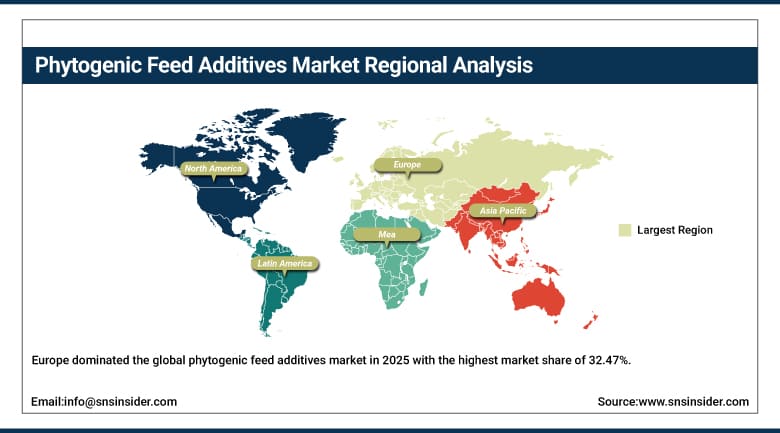
Europe dominated the global phytogenic feed additives market in 2025 with the highest market share of 32.47% and is also expected to grow at the fastest CAGR of 8.53% during the forecast period. The reason behind Europe’s dominance in the market includes strict regulatory environment restricting antibiotic growth promoters, high demand for natural feed additives, and growing sustainability in livestock farming. Growing investment in animal nutrition research, high adoption rate of phytogenic feed additives in poultry, swine, and dairy farms, and established feed safety standards will keep fueling market growth.
Increasing preference for organic and clean-label animal products is leading livestock farmers to use plant-based feed additives over traditional growth promoters. In addition, innovations in botanically formulated feed additives, feed additive encapsulation, and precision feed additives will also help in expanding the market in the region. Germany contributed majority of the Europe market share in 2025 owing to its developed animal feed industry, livestock production, extensive research activities, and presence of feed additives manufacturers in the region.
Get Customized Report as Per Your Business Requirement - Enquiry Now
North America phytogenic feed additives market insights
In 2025, North America held significant share in the global phytogenic feed additives market. Increasing demand for animal feed without any antibiotics, strict regulations on antibiotic growth promoters, and availability of a well-established livestock industry are some factors responsible for growth in the market. Growing use of natural feed additives in poultry farming, swine and ruminant farming, and increased consumer preference for organic meat, dairy, and eggs are boosting the market growth. Investment of feed manufacturers in feed formulation using plants, precision nutrition technologies, and research aimed at improving gut health and feed conversion efficiency.
The region also offers developed infrastructure for veterinary healthcare, knowledge about antimicrobial resistance, and presence of leading global players in animal nutrition. The U.S. was the largest market in North America in 2025, owing to its vast commercial poultry and swine farms, developed feed manufacturing industry, research capabilities, and extensive use of innovative phytogenic feed additives.
Asia-Pacific phytogenic feed additives market insights
In Asia-Pacific, the growth can be attributed to the rapid growth in livestock industry, increase in feed production, rise in the knowledge about antimicrobial resistance, and support from the government in favor of sustainable animal nutrition. Growth in meat consumption, rise in disposable incomes, and expansion in commercial poultry, swine, and aquaculture production are generating high demands for phytogenic feed additives in this region. The governments are promoting the use of non-antibiotic drugs in livestock production; thus, the market for natural feed additives is witnessing positive prospects.
Growing investment in feed production infrastructure and distribution network is also driving market growth. China constituted majority of the total market share of Asia-Pacific in the year 2025 due to high poultry and swine industries, high feed production capacity, strong aquaculture industry, and rising adoption of phytogenic feed additives.
Middle East & Africa and Latin America insights
In Middle East & Africa, market growth drivers include investments in poultry production, expansion in aquaculture output, improved feed production infrastructure, and increased awareness about antibiotic-free livestock feed. Market growth is fuelled by growing governmental initiatives towards food security, rising demand for high-quality livestock product, and growing commercial poultry output. Feed additives manufacturers from other countries are also increasing their presence through various alliances and agreements in the region. The contribution of Saudi Arabia to the market was due to its commercial poultry production, feed industry growth, and adoption of advanced phytogenic feed additives.
In Latin American factors such as rising poultry and cattle production, increasing meat product exports, and growing demand for natural feed additives due to enhanced efficiency and health benefits associated with phytogenic feed additives fuel the growth of this market. Growing awareness about sustainable livestock farming, investment in commercial feed production, and focus on minimizing the use of antibiotics have contributed positively towards the growth of the market. Moreover, the agricultural strength of the region along with increasing animal protein exports provides excellent opportunities for the companies operating in phytogenic feed additives market. The Brazilian market accounted for the majorit of share of in 2025, owing to strong poultry and beef industry, feed manufacturing segment, export-based livestock production, and adoption of phytogenic feed additives.
Market Dynamic:
Growth Driver: Rising demand for natural alternatives to antibiotic growth promoters accelerating phytogenic feed additives market growth
The rising preference for natural alternatives to antibiotic growth promoters is also contributing to the rapid adoption of phytogenic feed additives. Antibiotic resistance, which demands the implementation of stricter guidelines concerning the usage of antibiotics in animal feeds, has prompted producers to search for other alternatives. There has also been an increase in consumer preferences for organic food products, which has prompted producers to employ natural additives that would help minimize the level of antibiotics in meat, milk, and eggs. Phytogenic feed additives, containing essential oils, herbs, spices, and oleoresins, possess certain functionalities, such as maintaining gut health and enhancing digestibility of nutrients and feed utilization.
The trend towards sustainable and healthier livestock farming continues to provide increasing possibilities in relation to the use of phytogenic feed additives in the poultry, swine, ruminant, and aquaculture sectors. The producers seek products which would enable them to achieve good performance in the animals by decreasing reliance on traditional antibiotics. Phytogenic additives can be involved in providing better microbial balance in the intestines, improving immunity, feed utilization, and the overall health of the animals, and thus they become important ingredients in the prevention nutrition strategy. Moreover, modern technology advances facilitate the production of more stable and effective plant-based additives.
Restraints: Variability in raw material quality and high production costs may restrict phytogenic feed additives market growth
The inconsistency in the quality of the raw materials and comparatively high production costs could be limiting the phytogenic feed additives market from experiencing further development. The phytogenic feed additives have their level of effectiveness, stability, and performance determined by the nature and levels of the compounds contained within the ingredients. The inconsistency in the level of active compounds in the feed could arise due to the nature of the plants used, geographical conditions, cultivation, harvesting seasons, storage, and extraction processes. Moreover, the process of sourcing, processing, extraction, purification, formulation, and quality testing of phytogenic additives is more costly than that of synthetic substitutes. This cost implication could affect the uptake by the feed producers, especially in developing countries.
Opportunities: Expansion of sustainable livestock production and aquaculture creating new growth opportunities
Increasing sustainable livestock production and aquaculture will offer many growth opportunities in the phytogenic feed additives market. Consumer preference for organic and clean-label animal products, without the use of antibiotics, has motivated the use of plant-based feed additives, which will help in enhancing the performance of animals with minimal reliance on antibiotics. Rapid development in the sector of aquaculture will also drive the demand for feed additives, which will aid in promoting the health of the gut and immunity, improving feed efficiency, and providing disease resistance capabilities among aquatic animals.
Innovations in terms of micelle formation, precision feeding, and additives for individual species have increased the stability and efficacy of these additives. Furthermore, besides these factors, the increase in R&D activities in animal nutrition, increase in production of commercial feeds in emerging countries, and government initiatives for encouraging sustainable farming practices will be favorable for the demand for feed additives.
Recent Developments:
-
2026: ADM expanded its animal nutrition portfolio, emphasizing feed additives and functional nutrition solutions designed to improve livestock performance, feed efficiency, and animal health amid rising demand for sustainable production systems.
-
2026: DSM-Firmenich and its Delacon business expanded their phytogenic feed additive portfolio with a stronger focus on plant-based solutions for gut health and antibiotic-free livestock production, reinforcing innovation in natural animal nutrition.
-
2026: DSM-Firmenich announced the planned divestment of its Animal Nutrition & Health business, including its feed additive portfolio, a move expected to reshape the competitive landscape for phytogenic feed additives.
Phytogenic Feed Additives Market Key Players are:
-
Cargill, Incorporated
-
Delacon Biotechnik GmbH
-
DSM-Firmenich AG
-
ADM (Archer Daniels Midland Company)
-
Kemin Industries, Inc.
-
Phytobiotics Futterzusatzstoffe GmbH
-
Ayurvet Limited
-
EW Nutrition GmbH
-
Nor-Feed SAS
-
BIOMIN Holding GmbH
-
Adisseo
-
Novus International, Inc.
-
Orffa International Holding B.V.
-
MiXscience (Avril Group)
-
Igusol Advance S.L.
-
Dostofarm GmbH
-
Anpario plc
-
Natural Remedies Pvt. Ltd.
-
Silvateam S.p.A.
-
Trouw Nutrition (Nutreco N.V.).
Phytogenic Feed Additives Market Report Scope:
| Report Attributes | Details |
|---|---|
| Market Size in 2025 | USD 1.26 Billion |
| Market Size by 2035 | USD 2.50 Billion |
| CAGR | CAGR of 7.17% From 2026 to 2035 |
| Base Year | 2025 |
| Forecast Period | 2026-2035 |
| Historical Data | 2022-2024 |
| Report Scope & Coverage | Market Size, Segments Analysis, Competitive Landscape, Regional Analysis, DROC & SWOT Analysis, Forecast Outlook |
| Key Segments | • By Type (Essential Oils, Herbs & Spices, Oleoresins, Others) • By Function (Performance Enhancers, Flavoring Agents, Antimicrobial Agents, Digestive Stimulants) • By Form (Dry, Liquid) • By Livestock (Poultry, Swine, Ruminants, Aquatic Animals, Others) • By Distribution Channel (Animal Production Operations, Research / Academic Institutions, E-commerce, Retail) |
| Regional Analysis/Coverage | North America (US, Canada), Europe (Germany, France, UK, Italy, Spain, Russia, Poland, Rest of Europe), Asia Pacific (China, India, Japan, South Korea, Australia, ASEAN Countries, Rest of Asia Pacific), Latin America (Brazil, Argentina, Colombia, Mexico, Rest of Latin America), Middle East & Africa (UAE, Saudi Arabia, Qatar, South Africa, Rest of Middle East & Africa) |
| Company Profiles | Cargill, Incorporated, Delacon Biotechnik GmbH, DSM-Firmenich AG, ADM (Archer Daniels Midland Company), Kemin Industries, Inc., Phytobiotics Futterzusatzstoffe GmbH, Ayurvet Limited, EW Nutrition GmbH, Nor-Feed SAS, BIOMIN Holding GmbH, Adisseo, Novus International, Inc., Orffa International Holding B.V., MiXscience (Avril Group), Igusol Advance S.L., Dostofarm GmbH, Anpario plc, Natural Remedies Pvt. Ltd., Silvateam S.p.A., Trouw Nutrition (Nutreco N.V.) |
Frequently Asked Questions
Key players include Cargill, Incorporated, Delacon Biotechnik GmbH, DSM-Firmenich AG, ADM (Archer Daniels Midland Company), and Kemin Industries, Inc., among others.
Key opportunities include rising demand for antibiotic-free animal nutrition, expansion of sustainable livestock farming, growing aquaculture production, and increasing adoption of natural feed additives.
The market is driven by rising demand for natural antibiotic alternatives and improved livestock health and feed efficiency.
Essential Oils dominated the phytogenic feed additives market in 2025 with a 38.52% share.
Europe dominated the phytogenic feed additives market in 2025 with a 32.47% share.
