
Dry Electrode Materials Market Report Scope & Overview:
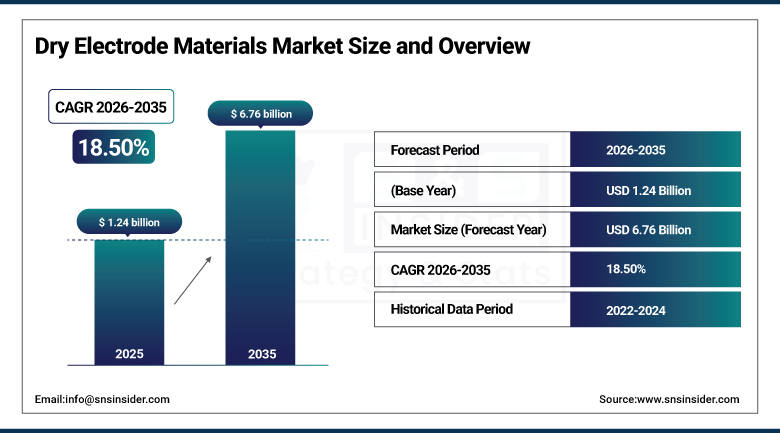
The Dry Electrode Materials Market was valued at USD 1.24 Billion in 2025 and is expected to reach USD 6.76 Billion by 2035, growing at a CAGR of 18.50% from 2026–2035.
The key drivers for the growth of the global market for dry electrode materials are rapid adoption of electric vehicles (EVs), growing demand for high-performance batteries, BESS expansion, and increasing investments in battery manufacturing technologies. The growing demand for dry electrode materials is expected to be driven by the increased usage of dry electrodes in lithium-ion and next generation batteries since dry electrode manufacturing process helps to minimize solvent usage, energy consumption, cost of production, and production area. Additionally, growing attention to improving the energy density, production efficiency, and sustainability of batteries is expected to increase the demand for advanced cathode and anode materials, conductive additives, and binders.
Moreover, there is a huge potential for growth of the market as a result of the introduction of silicon anode materials, solid-state battery technology, advanced conductive additives, and novel binders to dry electrode manufacturing process. Growing investments of battery manufacturers into dry coating technologies and solvent-free electrodes are expected to create new opportunities for dry electrode materials market. Expansion of EVs, grid-scale energy storage, consumer electronics, and industrial battery markets is expected to generate additional opportunities for the market under study.
In January 2026, IEEE Spectrum highlighted advances in dry battery electrode coating technology, which eliminates or reduces the use of conventional solvents during electrode production. The technology can improve energy density while reducing manufacturing costs and supporting more efficient battery production for electric vehicles.
To Get more information Dry Electrode Materials Market - Request Free Sample Report
Dry Electrode Materials Market Trends:
-
Increasing adoption of electric vehicles (EVs) and advanced battery technologies is driving the dry electrode materials market.
-
Rising demand for energy-efficient and cost-effective battery manufacturing is accelerating the adoption of dry electrode materials.
-
Growing investments in battery energy storage systems (BESS) and next-generation batteries are boosting market growth.
-
Increasing focus on reducing battery manufacturing energy consumption, solvent use, and production costs is supporting dry electrode technology adoption.
-
Expanding deployment of dry electrode manufacturing across automotive, energy & utilities, consumer electronics, and industrial sectors is strengthening market demand.
U.S. Dry Electrode Materials Market Outlook:
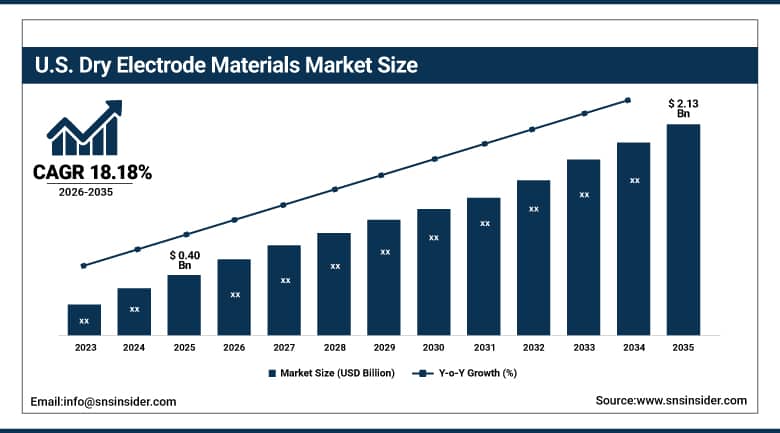
The U.S. Dry Electrode Materials Market was valued at USD 0.40 Billion in 2025 and is expected to reach around USD 2.13 Billion by 2035, growing at a CAGR of 18.18% from 2026–2035.
Growing adoption of electric vehicles (EVs), lithium-ion batteries, and advanced battery technologies is expected to play an important role in driving the growth of the dry electrode materials market in the US during the forecast period. Rising demand for efficient, cost-effective, and sustainable battery manufacturing is increasing the adoption of dry electrode processes, which can reduce solvent consumption, energy requirements, and production complexity. The presence of major automotive manufacturers, battery producers, technology companies, and advanced manufacturing facilities, coupled with increasing investments in domestic battery production, is expected to support market growth.
Moreover, developments in dry coating processes, solvent-free electrode manufacturing, silicon-based anode materials, advanced binders, conductive additives, and next-generation battery technologies are expected to enhance the performance and efficiency of dry electrodes. Investments in battery manufacturing capacity, electric mobility, energy storage systems, and advanced electrode technologies are creating lucrative opportunities. Growing emphasis on reducing battery production costs, improving energy density, strengthening domestic battery supply chains, and achieving sustainable manufacturing is expected to accelerate the adoption of dry electrode materials in the US during the forecast period.
In February 2026, AM Batteries appointed former Maxwell Technologies CEO Dr. Franz Fink as Chief Commercial Officer to accelerate commercialization of its Powder-to-Electrode dry battery electrode technology. The Massachusetts-based company is advancing solvent-free electrode manufacturing designed to reduce energy consumption, manufacturing costs, and factory footprint, supporting the growing adoption of dry electrode processes in the U.S. battery industry.
Dry Electrode Materials Market Segment Analysis:
-
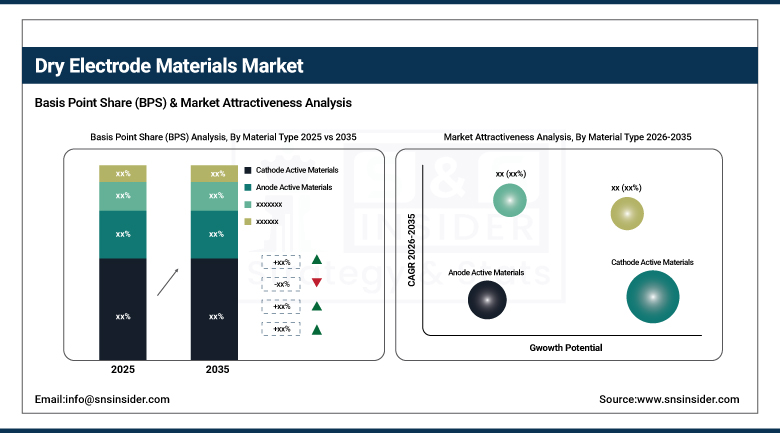
By Material Type, cathode active materials dominated the dry electrode materials market with a 43.27% share in 2025, while conductive additives are projected to be the fastest-growing segment, registering a 22.25% CAGR during 2025–2035.
-
By Electrode Type, cathode materials dominated the dry electrode materials market with a 57.63% share in 2025, while anode materials are projected to be the fastest-growing segment, registering a 19.88% CAGR during 2025–2035.
-
By Material Composition, NMC dominated the dry electrode materials market with a 32.81% share in 2025, while silicon-based materials are projected to be the fastest-growing segment, registering a 28.66% CAGR during 2025–2035.
-
By Application, electric vehicles (EVs) dominated the dry electrode materials market with a 54.68% share in 2025, while energy storage systems (ESS) are projected to be the fastest-growing segment, registering a 24.02% CAGR during 2025–2035.
-
By End-Use Industry, automotive dominated the dry electrode materials market with a 53.84% share in 2025, while energy & utilities are projected to be the fastest-growing segment, registering a 25.87% CAGR during 2025–2035.
By Material Type, cathode active materials dominated the dry electrode materials market, while conductive additives are expected to grow fastest.
Cathode active materials constituted the largest share of the dry electrode materials market in 2025, accounting for 43.27%, owing to their extensive use in lithium-ion battery electrodes and growing demand for high-performance batteries. Increasing electric vehicle production, expansion of battery energy storage systems, and investments in advanced battery manufacturing are driving demand for cathode materials compatible with dry electrode processing. The growing adoption of lithium iron phosphate (LFP), nickel manganese cobalt (NMC), and other advanced cathode chemistries is further supporting market growth. In addition, the increasing focus on improving energy density, battery safety, cycle life, and manufacturing efficiency is strengthening demand for cathode active materials.
The conductive additives segment is expected to experience the fastest growth during the forecast period, registering a 22.25% CAGR from 2025 to 2035. Increasing adoption of dry electrode manufacturing is creating demand for conductive additives that can provide efficient electrical conductivity and uniform electrode performance without conventional solvent-based slurry processing. Advancements in carbon-based conductive materials and their increasing use in high-performance batteries are expected to create significant growth opportunities.
By Electrode Type, cathode materials dominated the dry electrode materials market, while anode materials are expected to grow fastest.
Cathode materials accounted for the largest share of the dry electrode materials market in 2025, with a 57.63% share, supported by their significant material requirements in lithium-ion battery manufacturing and increasing demand from electric vehicles and energy storage applications. The expansion of battery production capacity and growing use of advanced cathode chemistries are increasing demand for cathode materials in dry electrode manufacturing. Improvements in energy density, thermal stability, and battery performance are further supporting the adoption of advanced cathode materials.
Anode materials are expected to register the fastest growth during the forecast period, with a 19.88% CAGR from 2025 to 2035. Growing interest in silicon-based anodes, high-capacity graphite materials, and next-generation battery technologies is increasing demand for advanced anode materials. The development of dry electrode processes that can accommodate high-loading and high-performance anode materials is further supporting segment growth.
By Material Composition, NMC dominated the dry electrode materials market, while silicon-based is expected to grow fastest.
NMC accounted for the largest share of the dry electrode materials market in 2025, with a 32.81% share, supported by its established use in lithium-ion batteries and strong demand for high-energy-density applications. NMC materials are widely used in electric vehicles and other applications requiring a balance of energy density, power performance, and driving range. Continued investments in advanced battery manufacturing and improvements in NMC electrode formulations are supporting demand.
Silicon-based materials are projected to be the fastest-growing segment, registering a 28.66% CAGR during 2025–2035. Their high theoretical capacity compared with conventional graphite makes silicon-based materials attractive for increasing battery energy density. Growing investment in next-generation batteries, electric vehicles, and high-performance energy storage is expected to accelerate the adoption of silicon-based materials in dry electrode manufacturing.
Regional Analysis:
|
Region |
Major Country |
Share within Region, 2025(%) |
|---|---|---|
|
North America |
United States |
90.86% |
|
Europe |
Germany |
25.65% |
|
Asia Pacific |
China |
42.42% |
|
Middle East & Africa |
Saudi Arabia |
25.24% |
|
Latin America |
Brazil |
47.58% |
North America Dry Electrode Materials Market insights
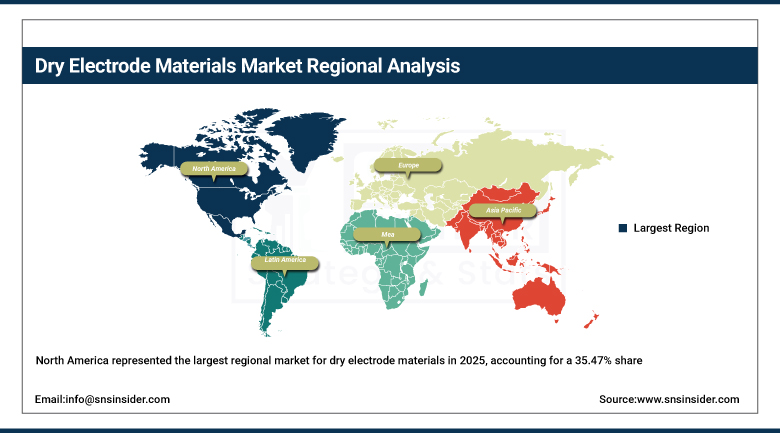
North America represented the largest regional market for dry electrode materials in 2025, accounting for a 35.47% share, supported by the region’s strong battery manufacturing ecosystem, growing electric vehicle production, and increasing investments in advanced battery technologies. The United States is witnessing significant investments in domestic battery manufacturing capacity, battery materials, and next-generation electrode technologies, supporting the adoption of dry electrode manufacturing processes.
The growing focus on reducing battery production costs, energy consumption, and manufacturing emissions is further encouraging manufacturers to explore solvent-free electrode production. Canada is also expanding its battery and electric vehicle supply chain, creating additional opportunities for dry electrode materials. The United States held the largest share of the North American dry electrode materials market in 2025 due to its established automotive industry, expanding battery manufacturing infrastructure, and strong investments in advanced energy technologies.
Get Customized Report as per Your Business Requirement - Enquiry Now
Europe Dry Electrode Materials Market insights
The growth of the dry electrode materials market in Europe is supported by increasing electric vehicle adoption, expansion of battery manufacturing capacity, and growing investments in sustainable and energy-efficient battery production. European battery manufacturers and automotive companies are increasingly exploring dry electrode technologies to reduce solvent consumption, manufacturing energy requirements, production costs, and environmental impact. The region's focus on strengthening domestic battery supply chains and reducing dependence on imported battery technologies is also creating opportunities for advanced electrode materials.
Germany accounted for the largest share of the European dry electrode materials market in 2025 due to its strong automotive manufacturing base, established battery industry, advanced industrial infrastructure, and significant investments in electric mobility and battery technologies. Growing demand for high-performance batteries across automotive and energy storage applications is expected to support regional market growth.
Asia Pacific Dry Electrode Materials Market insights
Asia Pacific is expected to register the highest growth rate in the dry electrode materials market during the forecast period, supported by rapid electric vehicle adoption, expanding battery manufacturing capacity, increasing investments in energy storage, and technological advancements in battery production. Countries including China, Japan, South Korea, and India are strengthening their battery supply chains and investing in advanced electrode manufacturing technologies.
The increasing focus on improving battery energy density, reducing manufacturing costs, and enhancing production efficiency is encouraging the adoption of dry electrode processes. China held the largest share of the Asia Pacific dry electrode materials market in 2025 due to its extensive battery manufacturing ecosystem, large electric vehicle market, strong domestic supply chain, and significant investments in lithium-ion and next-generation battery technologies. The region's expanding energy storage industry is expected to create additional opportunities for dry electrode materials.
Middle East & Africa and Latin America Dry Electrode Materials Market insights
The dry electrode materials market in the Middle East & Africa is expected to experience steady growth owing to increasing investments in electric mobility, renewable energy, battery energy storage, and industrial diversification. Countries in the region are investing in energy storage infrastructure and advanced energy technologies as they seek to support renewable energy integration and reduce dependence on conventional energy systems. Saudi Arabia held the largest share of the Middle East & Africa dry electrode materials market in 2025, supported by its large-scale economic diversification initiatives, investments in electric mobility, renewable energy projects, and emerging battery manufacturing ecosystem.
The dry electrode materials market in Latin America is witnessing consistent growth due to increasing electric vehicle adoption, renewable energy development, and rising demand for battery energy storage systems. Brazil held the largest share of the Latin American dry electrode materials market in 2025 owing to its large automotive industry, growing clean energy sector, developing battery supply chain, and substantial demand for energy storage technologies. Increasing investments in electric mobility, renewable energy integration, and advanced battery manufacturing are expected to create further opportunities for dry electrode materials across the region.
Market Dynamic:
Growth Driver: Rising adoption of electric vehicles and advanced battery manufacturing driving dry electrode materials market growth
The rapid adoption of electric vehicles (EVs), lithium-ion batteries, and advanced battery technologies is one of the key factors driving demand for dry electrode materials. As battery manufacturers expand production capacity to meet growing EV demand, there is increasing focus on improving manufacturing efficiency, reducing production costs, and minimizing energy consumption. Dry electrode manufacturing can eliminate or significantly reduce the use of solvents and energy-intensive drying processes, making it an attractive approach for large-scale battery production.
Growing investments in battery gigafactories, energy storage systems, and next-generation batteries are further supporting market growth. In addition, increasing demand for higher energy density, improved battery performance, and sustainable manufacturing is encouraging the development and adoption of advanced cathode and anode materials compatible with dry processing.
Restraints: High initial investment and technical challenges may restrict dry electrode materials market growth
Although dry electrode manufacturing offers significant efficiency and sustainability benefits, high initial investment requirements and technical challenges may restrict market growth. Transitioning from conventional wet electrode manufacturing to dry processing can require specialized coating equipment, process modifications, and extensive testing, increasing capital expenditure for battery manufacturers. Achieving consistent electrode thickness, uniform material distribution, strong adhesion, and reliable electrochemical performance can also be technically challenging.
In addition, differences in material properties, binder behavior, particle morphology, and processing conditions can affect the quality and scalability of dry electrodes. Limited availability of specialized manufacturing expertise and the need to optimize dry electrode processes for different battery chemistries may further slow adoption. These challenges could particularly affect smaller battery manufacturers with limited financial and technical resources.
Opportunities: Growing investments in advanced batteries and energy storage creating new growth opportunities
The increasing focus on advanced battery technologies, energy storage systems, and sustainable battery manufacturing is creating significant growth opportunities for the dry electrode materials market. Battery manufacturers are investing in dry coating technologies to reduce manufacturing costs, energy consumption, solvent use, and production footprint while increasing production efficiency.
The growing development of silicon-based anodes, solid-state batteries, high-nickel cathodes, and advanced conductive additives is also creating demand for materials that can deliver improved performance through dry processing. In addition, rising investments in grid-scale energy storage and renewable energy integration are expected to increase demand for high-performance batteries. Expanding battery manufacturing capacity across North America, Europe, and Asia Pacific, together with increasing investments in electric mobility and next-generation battery technologies, is expected to provide substantial opportunities for dry electrode materials manufacturers.
Recent Developments:
-
2026: Tesla expanded its battery manufacturing and energy storage initiatives, supporting demand for advanced electrode materials and dry electrode manufacturing technologies.
-
2026: Panasonic Energy advanced its battery manufacturing and next-generation cell development activities, supporting the adoption of high-performance electrode materials and efficient electrode production processes.
-
2026: LG Energy Solution expanded its advanced battery manufacturing capabilities, increasing demand for innovative cathode and anode materials and dry electrode processing technologies.
-
2026: Samsung SDI strengthened its next-generation battery development and manufacturing initiatives, supporting demand for advanced electrode materials for electric vehicles and energy storage applications.
-
2026: CATL advanced its battery technology and manufacturing capabilities, supporting the development and adoption of high-performance electrode materials and more efficient battery production processes.
Dry Electrode Materials Market Key Players are:
-
AM Batteries
-
Tesla
-
Panasonic Energy
-
LG Energy Solution
-
Samsung SDI
-
Contemporary Amperex Technology Co. Limited (CATL)
-
BYD
-
SK On
-
BASF
-
Umicore
-
POSCO Future M
-
EcoPro BM
-
Sila Nanotechnologies
-
Group14 Technologies
-
Nexeon
-
Birla Carbon
-
Cabot Corporation
-
Arkema
-
Solvay
-
Mitsubishi Chemical Group
Dry Electrode Materials Market Report Scope:
| Report Attributes | Details |
|---|---|
| Market Size in 2025 | USD 1.24 Billion |
| Market Size by 2035 | USD 6.76 Billion |
| CAGR | CAGR of 18.50% From 2026 to 2035 |
| Base Year | 2025 |
| Forecast Period | 2026-2035 |
| Historical Data | 2022-2024 |
| Report Scope & Coverage | Market Size, Segments Analysis, Competitive Landscape, Regional Analysis, DROC & SWOT Analysis, Forecast Outlook |
| Key Segments | • By Material Type (Cathode Materials, Anode Materials, Binders, Conductive Additives, Others) • By Battery Type (Lithium-Ion Batteries, Solid-State Batteries, Others) • By Electrode Type (Dry Cathode Electrode, Dry Anode Electrode) • By Manufacturing Process (Dry Mixing, Dry Coating, Calendering, Other Processes) • By Application (Electric Vehicles, Energy Storage Systems, Portable Electronics Batteries, Industrial and Specialty Battery Applications, Aerospace & Defense Battery Systems, Others) • By End-User Industry (Automotive, Energy & Utilities, Electronics, Industrial, Aerospace & Defense, Others) |
| Regional Analysis/Coverage | North America (US, Canada), Europe (Germany, UK, France, Italy, Spain, Russia, Poland, Rest of Europe), Asia Pacific (China, India, Japan, South Korea, Australia, ASEAN Countries, Rest of Asia Pacific), Middle East & Africa (UAE, Saudi Arabia, Qatar, South Africa, Rest of Middle East & Africa), Latin America (Brazil, Argentina, Mexico, Colombia, Rest of Latin America) |
| Company Profiles | AM Batteries, Tesla, Panasonic Energy, LG Energy Solution, Samsung SDI, Contemporary Amperex Technology Co. Limited (CATL), BYD, SK On, BASF, Umicore, POSCO Future M, EcoPro BM, Sila Nanotechnologies, Group14 Technologies, Nexeon, Birla Carbon, Cabot Corporation, Arkema, Solvay, Mitsubishi Chemical Group |
Frequently Asked Questions
The Dry Electrode Materials Market is expected to grow at a CAGR of approximately 12.60% from 2026 to 2035.
The Dry Electrode Materials Market was valued at approximately USD 2.06 billion in 2025.
The market is driven by rising electric vehicle adoption, expanding battery manufacturing capacity, and growing demand for energy-efficient and cost-effective electrode production.
Cathode Active Materials dominated the Dry Electrode Materials Market in 2025 with a 43.27% share.
North America dominated the Dry Electrode Materials Market in 2025 with a 35.47% share.
