
Payment as a Service (PaaS) Market Report Scope & Overview:
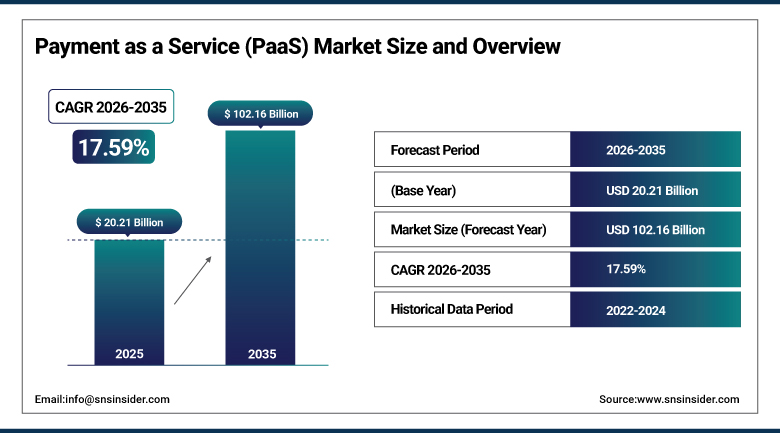
The Payment as a Service (PaaS) Market was valued at USD 20.21 Billion in 2025 and is expected to reach USD 102.16 Billion by 2035, growing at a CAGR of 17.59% from 2026 to 2035.
The Payment as a Service (PaaS) Market is growing significantly because of the rise in use of digital payments, embedded finance, and cloud-based payment infrastructure. PaaS is being adopted by various businesses to streamline payment processing, cut down costs, and increase security in transactions. Rise in the number of online transactions, development of fintech ecosystems, and need for seamless omnichannel payment experience are contributing towards market growth. Moreover, innovations in areas of artificial intelligence, fraud detection, real-time payment systems, and increased adoption by small and medium-sized organizations, as well as enterprises, are further propelling the adoption of Payment as a Service.
Cloud-based PaaS platforms accounted for nearly 62% of deployments in 2025, driven by scalability and ease of integration for enterprises and SMEs, with PaaS-based transaction volume throughput in BFSI, retail, and e-commerce expected to reach 1.2 billion transactions worldwide by 2025 alone.
To Get more information Payment as a Service (PaaS) Market - Request Free Sample Report
Payment as a Service Market Trends
-
The Payment as a Service market is growing rapidly as businesses increasingly adopt digital and contactless payment solutions for efficiency and convenience.
-
Fintech innovation, frictionless APIs, and rolling mobile wallet adoption keep empowering the digitalization of businesses and SMEs alike.
-
AI-powered analytics, blockchain security, and API-driven solutions are improving transaction transparency, operational efficiency, and compliance with international payment standards.
-
Financial institutions are integrating PaaS platforms for real-time payments, fraud prevention, and enhanced analytics across their operations.
-
Businesses are leveraging PaaS to enable fast, secure, and convenient payment processing that reduces cart abandonment and improves customer experience.
U.S. Payment as a Service Market Outlook
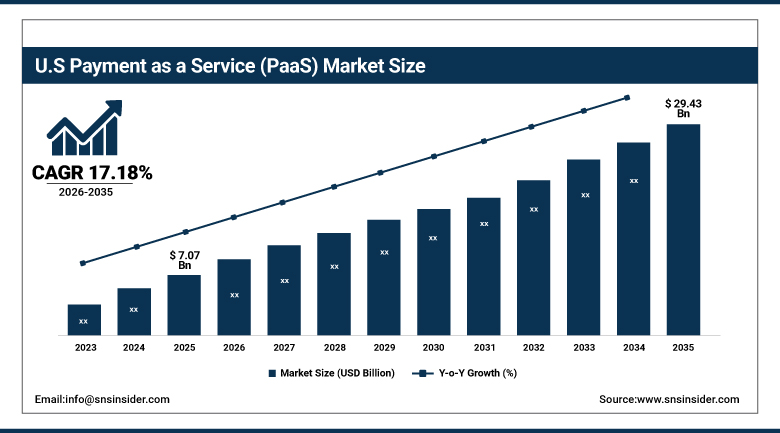
The U.S. Payment as a Service Market was valued at approximately USD 7.07 Billion in 2026 and is expected to reach approximately USD 29.43 Billion by 2035, growing at a CAGR of approximately 17.18%.
Growth in the U.S. market is accelerated by cloud platforms, digital wallets, increasing e-commerce penetration, and the need for frictionless, secure, and contactless payment services across every sector of the economy. The rapid take-up of mobile and digital wallet services, as consumers seek super-fast, convenient transaction experiences, keeps boosting PaaS market growth throughout the country. American businesses across e-commerce, banking, and fintech have been particularly aggressive adopters, using PaaS to enable fast, secure payment processing while financial institutions integrate PaaS platforms for real-time payments, fraud prevention, and enhanced analytics that would be prohibitively expensive to build entirely in-house.
AI-powered analytics, blockchain security, and API-driven solutions continue improving transaction transparency, operational efficiency, and compliance with international payment standards across the U.S. financial technology sector, as banks and fintech firms increasingly integrate PaaS platforms specifically to strengthen real-time payments and fraud-prevention capability.
Payment as a Service Market Segment Analysis
-
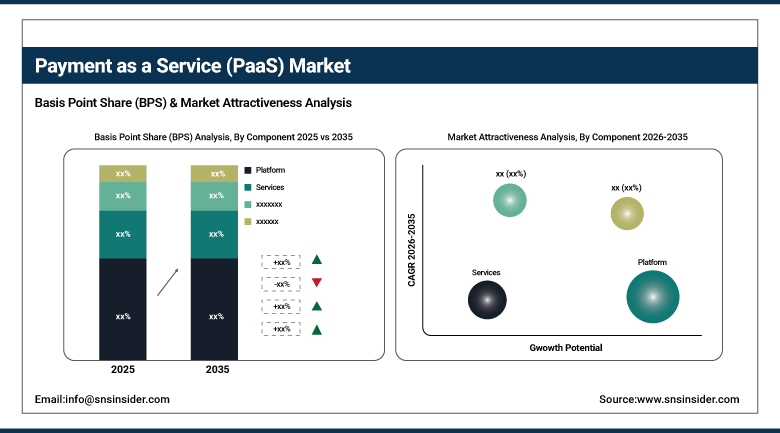
By Component, Platform segment dominated the Payment as a Service (PaaS) Market in 2025 with 56% share; Managed Services segment is the fastest growing segment.
-
By Deployment Mode, Cloud segment dominated the market in 2025 with 68% share; Cloud segment is also the fastest growing segment.
-
By Organization Size, Large Enterprises segment dominated the market in 2025 with 62% share; SMEs segment is the fastest growing segment.
-
By Industry Vertical, BFSI segment dominated the market in 2025 with 35% share; Retail & E-commerce segment is the fastest growing segment.
-
By Payment Method, Credit/Debit Cards segment dominated the market in 2025 with 42% share; Digital Wallets segment is the fastest growing segment.
By Component, Platform Dominates the Payment as a Service (PaaS) Market While Managed Services Emerges as the Fastest-Growing Component
Platform dominates the Payment as a Service (PaaS) Market because of its importance in offering payment infrastructure, payment transactions, API connectivity, security management, and payment orchestration. More companies have realized the importance of a centralized payment platform for enabling different payment methods, increasing transaction efficiency, and enhancing customer experience. With an increase in embedded finance, real-time payments, and digital commerce, there has been a high need for scalable payment platforms in the market, which is currently the largest revenue generator in the market.
Services is the fastest-growing component due to the outsourcing of the payment processes as more companies look for improved efficiency, security, compliance, and greater flexibility. Managed service providers provide assistance in transaction monitoring, fraud prevention, systems management, regulation management, and payment optimization. Increased volume of payments made using the Internet, increasing cybersecurity risks, and complex compliance obligations are driving companies to seek professional help.
By Deployment Mode, Cloud Dominates the Payment as a Service (PaaS) Market and Registers the Fastest Growth
Cloud dominates the Payment as a Service (PaaS) Market because the cloud-based system offers scalability, cost-effectiveness, quick deployment, and easy integration with digital payment systems. Companies are moving their payment infrastructure to the cloud in order to cope with increased transactions, international presence, and real-time payments. The use of advanced security technology, automatic updates, and resource allocation makes the cloud system more advantageous than others, making it the preferred deployment method among companies. Cloud is the fastest-growing deployment method as companies require a flexible and scalable payment infrastructure for their digital transformation process.
By Organization Size, Large Enterprises Lead the Payment as a Service (PaaS) Market While SMEs Witness the Fastest Growth
Large Enterprises dominate the Payment as a Service (PaaS) Market owing to high volume of payments, complicated payment needs, and substantial digital payment investments. Large Enterprises need advanced payment capabilities for processing, payment security, compliance, and global transactions. Their financial strength and customer payment experience improvement drive the adoption of Payment as a Service, thus, Large Enterprises constitute the highest revenue earning organization size segment in the market.
SMEs are the fastest-growing organization size owing to the increased use of payment-as-a-service platforms by small and medium-sized enterprises to provide secure payment features without investing in an expensive system. Cost-effective cloud platform solutions, subscription models, and easy integration make SMEs leverage PaaS to improve their digital payment acceptance. Increasing online businesses, customer preference for digital payments, and growing Fintech make smaller enterprises opt for scalable payment solutions.
By Industry Vertical, BFSI Dominates the Payment as a Service (PaaS) Market While Retail & E-commerce Records the Fastest Growth
BFSI dominates the Payment as a Service (PaaS) Market because of the transaction-intensive nature, security considerations, and the continuous requirement of reliable payment infrastructures in the industry. The use of PaaS is gaining popularity among banks and financial institutions because of the need to modernize their payment systems, streamline the process of managing fraudulent transactions, and offer digital banking services. Real-time payments, compliance issues, and increased customer expectations have put the BFSI industry vertical at the top spot in the PaaS market.
Retail & E-commerce is the fastest-growing industry vertical because more and more companies are now implementing payment-as-a-service in order to facilitate online payments and smooth checkout. The factors that are contributing to such high demand for payment-as-a-service include increasing number of online transactions, growing mobile commerce, and convenience of payment methods.
By Payment Method, Credit/Debit Cards Dominate the Payment as a Service (PaaS) Market While Digital Wallets Experience the Fastest Growth
Credit/Debit Cards dominate the Payment as a Service (PaaS) Market due to their universal acceptance, infrastructure, and reliability from the side of the customers around the world. Payments with cards remain the most preferable choice for retail purchases, online sales, banking and subscription services owing to high security and convenience of use. The increasing usage of contactless payments, tokenization systems, and digital cards will help to maintain the leadership of card payments.
Digital Wallets are the fastest-growing payment method as consumers tend to choose mobile and easy-to-use payment options. The rising number of smartphone users, innovations in fintech sphere and the usage of mobile payment apps will increase the popularity of wallets among individuals and businesses. Digital wallets enable fast payment, increased security using authentication techniques and participation in loyalty programs.
Regional Insights
|
Region |
Major Country |
Share within Region, 2025 (%) |
|---|---|---|
|
North America |
United States |
80.15% |
|
Europe |
United Kingdom |
25.35% |
|
Asia Pacific |
China |
38.90% |
|
Middle East & Africa |
UAE |
27.20% |
|
Latin America |
Brazil |
36.55% |
North America Payment as a Service Market Insights
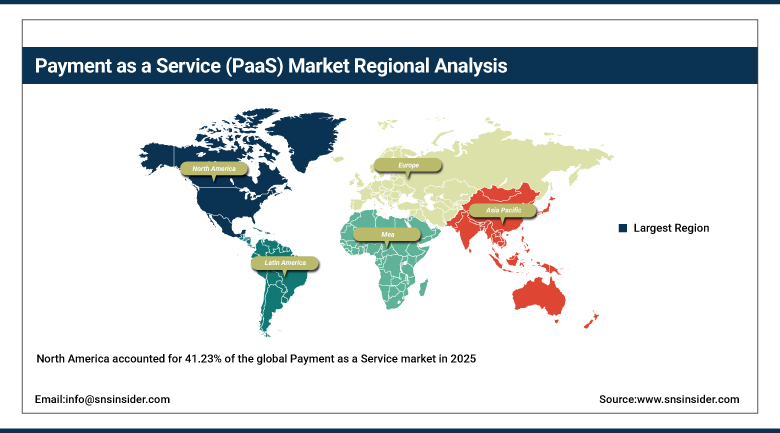
North America accounted for 41.23% of the global Payment as a Service market in 2025, serving over 420,000 enterprises across the region, supported by continued fintech advancements and mature e-commerce infrastructure. The region's growth is projected to continue expanding at a moderate but steady pace through the forecast period, supported by ongoing digital transformation investment across BFSI, retail, and healthcare sectors.
The United States accounts for roughly 80.15% of regional revenue, anchored by cloud platforms, digital wallets, increasing e-commerce penetration, and strong demand for frictionless, secure payment services. Canada adds further regional demand through its own growing fintech ecosystem, and that combined regional strength should keep North America the largest addressable market for PaaS vendors through the forecast period.
Get Customized Report as per Your Business Requirement - Enquiry Now
Europe Payment as a Service Market Insights
Europe holds a meaningful share of the global PaaS market, supported by strong regulatory frameworks around open banking and payment services, including the EU's Payment Services Directive, which has actively encouraged third-party payment innovation across the region. Countries with mature fintech ecosystems have proven particularly consistent adopters of cloud-based payment infrastructure.
The United Kingdom leads regional demand at roughly 25.35% of European revenue, supported by London's position as a global fintech hub and a comparatively mature open banking regulatory environment. Germany and France contribute substantial additional demand, and continued EU-level regulatory support for payment innovation should keep European demand for PaaS climbing steadily through the forecast period.
Asia Pacific Payment as a Service Market Insights
The Asia Pacific Payment as a Service market is the fastest-growing region, projected to expand at a CAGR of approximately 18.80% through 2035. In 2025, PaaS adoption exceeded 360,000 companies across the region, with China leading at roughly 140,000 companies, followed by India at around 110,000 and Japan at approximately 45,000. Digital payments are rapidly expanding across the region, prompted by increasing e-commerce sales, fintech innovation, and mobile payment uptake across virtually every major economy.
China leads the region, accounting for roughly 38.90% of regional revenue, with the country's PaaS ecosystem including about 70,000 large firms and around 70,000 SMEs, supported by cloud platforms used by 90,000 organizations and digital wallets processing 65 million transactions. India and Japan contribute meaningful additional demand, and adoption across the region has been further buoyed by e-commerce penetration, mobile payments, and API-led integrations laying the groundwork for continued massive market growth.
MEA & Latin America Payment as a Service Market Insights
The Middle East & Africa and Latin America are both showing steady growth in PaaS adoption, driven by expanding digital payment infrastructure, growing fintech investment, and rising government support for cashless economy initiatives across both regions. As these markets continue building out modern payment infrastructure, PaaS is proving an efficient way to leapfrog legacy banking systems entirely.
The UAE leads Middle East & Africa demand at roughly 27.20% of regional revenue, supported by the country's fast-growing fintech sector and government-backed digital payment initiatives. Saudi Arabia and South Africa contribute further regional demand through their own financial-modernization programs. In Latin America, Brazil accounts for approximately 36.55% of regional revenue, with the country's expanding fintech ecosystem continuing to anchor regional demand for PaaS solutions.
Growth Drivers: Rapid shift toward digital and contactless payments
The Payment as a Service market is growing rapidly as businesses increasingly adopt digital and contactless payment solutions for efficiency and convenience. This expansion is being powered by healthy fintech innovation, frictionless APIs, and rolling mobile wallet adoption, all further empowering the digitalization of businesses and SMEs, helping them modernize operations and adjust overheads in line with increasing consumer focus on fast and secure payments.
Rising digital transaction volumes and e-commerce growth are reinforcing this driver further, as businesses across e-commerce and retail leverage PaaS to enable fast, secure, and convenient payment processing that reduces cart abandonment and improves customer experience. With innovations in AI, blockchain, and API-driven platforms, PaaS is set to keep revolutionizing how businesses and consumers handle payments globally, offering secure, scalable, and efficient financial solutions that traditional in-house infrastructure could never match on speed of deployment alone.
Restraints: Data security concerns and regulatory complexity
Handling sensitive payment and financial data through third-party PaaS providers raises genuine security and compliance concerns, particularly for organizations operating across multiple regulatory jurisdictions with differing data protection and financial services requirements. Businesses in heavily regulated industries sometimes find the compliance burden of vetting and monitoring third-party payment providers genuinely significant.
Integration complexity with existing enterprise systems, particularly legacy banking and ERP infrastructure, adds a further restraint, since migrating payment processing to a new provider without disrupting live business operations carries real operational risk. These security and integration concerns help explain why PaaS adoption, while accelerating quickly overall, moves more cautiously across large, heavily regulated financial institutions than among smaller, more agile businesses.
Opportunities: Instant payment networks and emerging market expansion
The rise of instant payment networks and open banking initiatives represents a genuinely significant opportunity for PaaS vendors able to build genuinely fast, secure bank-transfer capability into their platforms. As open banking regulation keeps expanding globally and consumers increasingly expect near-instant payment settlement, vendors offering sophisticated bank-transfer integration stand to capture meaningful share of this rapidly growing payment method.
Continued expansion into emerging markets, particularly across Asia Pacific and Latin America where digital payment infrastructure is still being built out, offers a second substantial opportunity for PaaS providers. With China, India, and Japan already collectively supporting hundreds of thousands of PaaS-enabled companies, and with e-commerce penetration and mobile payment adoption still climbing rapidly across these markets, vendors with strong regional presence stand to capture a meaningfully larger addressable market than mature Western economies alone represent.
Recent Developments:
-
2025: PaaS-based transaction volume throughput across BFSI, retail, and e-commerce reached an estimated 1.2 billion transactions worldwide, reflecting rapidly accelerating enterprise reliance on cloud-based payment infrastructure.
-
2025: China's Payment as a Service market surpassed 140,000 participating companies, including roughly 70,000 large firms and 70,000 SMEs, supported by 90,000 organizations using cloud platforms.
-
2025: Square announced “Square Releases,” which included its pocket-size Square Handheld device for mobile sales and inventory management. It also offered a new version of Square Online to help businesses more effectively manage their e-commerce presence.
Payment as a Service (PaaS) Market Key Players:
-
PayPal
-
Square (Block, Inc.)
-
Adyen
-
Worldpay (Global Payments)
-
FIS
-
Visa
-
Mastercard
-
American Express
-
Google Pay
-
Alipay
-
WeChat Pay
-
Klarna
-
Affirm
-
Braintree (a PayPal service)
-
Toast
-
Remitly
-
ACI Worldwide
-
Paysafe
Payment as a Service (PaaS) Market Report Scope:
| Report Attributes | Details |
|---|---|
| Market Size in 2025 | USD 20.21 Billion |
| Market Size by 2035 | USD 102.16 Billion |
| CAGR | CAGR of 17.59% From 2026 to 2035 |
| Base Year | 2025 |
| Forecast Period | 2026-2035 |
| Historical Data | 2022-2024 |
| Report Scope & Coverage | Market Size, Segments Analysis, Competitive Landscape, Regional Analysis, DROC & SWOT Analysis, Forecast Outlook |
| Key Segments | • By Component (Platform, Services) • By Deployment Mode (Cloud, On-Premises, Others) • By Organization Size (Large Enterprises, SMEs, Others) • By Industry Vertical (BFSI, Retail & E-commerce, Healthcare, Travel & Hospitality, Government, Others) • By Payment Method (Credit/Debit Cards, Digital Wallets, Bank Transfers, Others) |
| Regional Analysis/Coverage | North America (US, Canada), Europe (Germany, UK, France, Italy, Spain, Russia, Poland, Rest of Europe), Asia Pacific (China, India, Japan, South Korea, Australia, ASEAN Countries, Rest of Asia Pacific), Middle East & Africa (UAE, Saudi Arabia, Qatar, South Africa, Rest of Middle East & Africa), Latin America (Brazil, Argentina, Mexico, Colombia, Rest of Latin America). |
| Company Profiles | PayPal, Stripe, Square (Block, Inc.), Adyen, Worldpay (Global Payments), FIS, Visa, Mastercard, American Express, Apple Pay, Google Pay, Alipay, WeChat Pay, Klarna, Affirm, Braintree (a PayPal service), Toast, Remitly, ACI Worldwide, Paysafe |
Frequently Asked Questions
The Payment as a Service Market is expected to grow at a CAGR of 17.59% from 2026 to 2035.
The Payment as a Service Market was valued at USD 20.21 Billion in 2025.
The major growth factor is the rapid shift toward digital and contactless payments, along with rapid adoption of cloud-based payment platforms by large corporations and SMEs.
The Platform segment dominated the Payment as a Service Market with a 56% share by component in 2025.
North America dominated the Payment as a Service Market in 2025 with a 41.23% share of total global market revenue.
