
Perfume and Fragrance Market Report Scope & Overview:
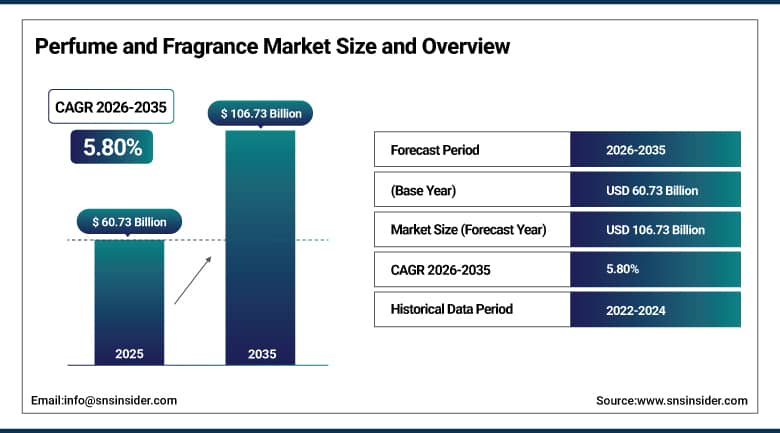
The Perfume and Fragrance Market was valued at USD 60.73 Billion in 2025 and is expected to reach USD 106.73 Billion by 2035, growing at a CAGR of 5.80% from 2026 to 2035.
The perfumes and fragrances are blends of aromatic chemicals that have been specially compounded using fixing agents and solvents in order to provide the consumer with the best smelling experience for a prolonged period of time. Perfumes and fragrances are applied either on the body or clothes and the ambient spaces. Fragrances and perfumes are available in various concentrations. The Parfum or Extrait de Parfum has 20 to 40 percent concentration of the perfume oil and provides the highest concentration of the aroma. The Eau de Parfum consists of 15 to 20 percent of the perfume oil. Eau de Toilette has 5 to 15 percent concentration while the Eau de Cologne contains 2 to 4 percent of the fragrance oil.
In August 2025, Miu Miu released its first luxury fragrance Miutine under the terms of a new license agreement with L'Oréal. This fragrance has a chypre formula enriched with wild strawberry and brown sugar. The product launch was in line with the ongoing trend in which luxury fashion houses were either getting into the fine fragrance segment or expanding their existing presence there. L'Originale Eau de Parfum from Moroccanoil was introduced in February 2025. It includes notes of velvet woods, spicy amber, and sweet flowers. Fastrack, the number one youth fashion brand in India, has entered the luxury mass fragrance category with the introduction of a new perfume line in December 2024.
To Get More Information On Perfume and Fragrance Market - Request Free Sample Report
Perfume and Fragrance Market Trends
-
Premiumization is driving consumer preference toward luxury and high-end fragrance products.
-
Niche and artisanal fragrance brands are gaining popularity through unique scent profiles and brand storytelling.
-
Rising demand for natural ingredients and sustainable packaging is reshaping fragrance product development.
-
E-commerce is accelerating fragrance sales through digital discovery and personalized shopping experiences.
-
Growing global adoption of oud and Middle Eastern fragrance profiles is expanding premium fragrance demand.
The U.S. Perfume and Fragrance Market Outlook
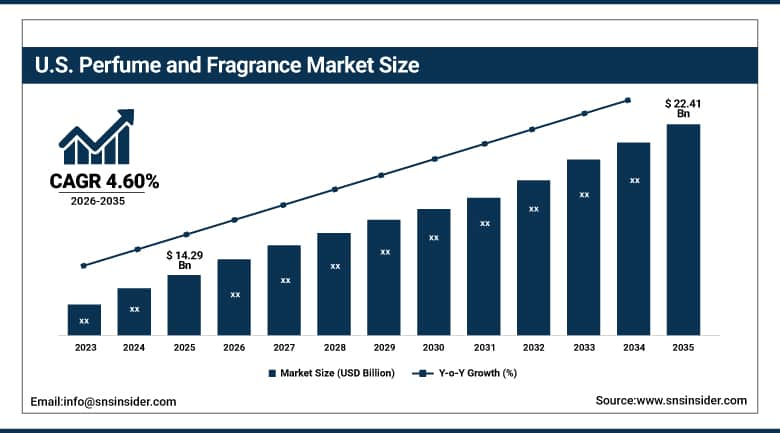
The U.S. Perfume and Fragrance Market was valued at approximately USD 14.29 Billion in 2025. It is expected to reach approximately USD 22.41 Billion by 2035, growing at a CAGR of approximately 4.60%.
The U.S. represents the largest national perfume market on the global level. The country represents an important center for innovation, celebrity licensing, and the creation of perfumes targeted directly to the consumer. Consumers in the U.S. represent a very branded market. More than 61% of all perfume purchases are driven by brand image and brand packaging. The niche segment of perfumes is highly developed in the U.S. Brand names like Le Labo, Byredo, and Maison Margiela already enjoy popularity among American consumers. Celebrity perfume is an important product segment from the commercial point of view. Ariana Grande, Billie Eilish, and Rihanna's Fenty Beauty reached success in their sales of perfumes in 2024 and 2025. Physical retailing is dominated by department stores and beauty boutiques like Sephora and Ulta Beauty.
In June 2024, Eze Perfumes diversified its portfolio by introducing 18ml travel-size perfumes. This line of products caters to consumers traveling frequently who require good-quality perfumes without purchasing an entire bottle of perfume. The travel-size perfume line includes various scents such as fresh, floral, wood, and citrus in both men, women, and unisex categories. The travel size line of perfumes is an ideal entry product to attract new consumers in the market towards the premium fragrances. In fiscal year 2025, Estée Lauder companies showed strong performance recovery in the portfolio of their fragrance. Tom Ford Beauty, which was acquired by Estée Lauder from PVH, made significant contributions to the growth of the prestige fragrance.
Perfume and Fragrance Market Segment Analysis
-
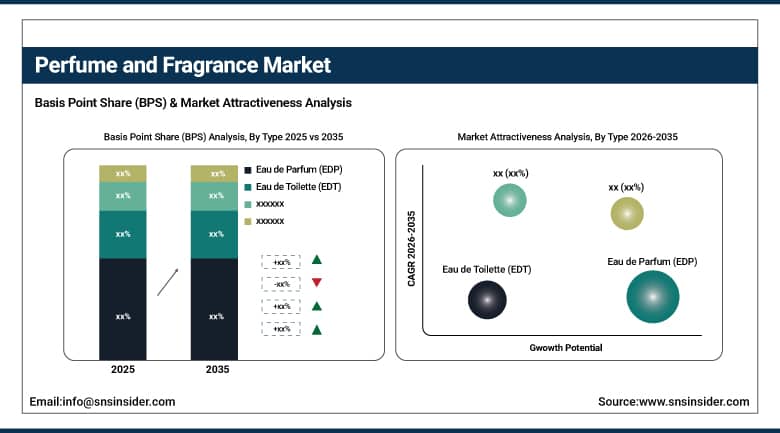
By Type, the Eau de Parfum segment dominated the perfume and fragrance market with 42.10% share in 2025. The Parfum/Extrait de Parfum segment is the fastest growing type, projected to grow at a CAGR of 5.90% during 2026 to 2035.
-
By Product, the mass segment held 48.70% of the perfume and fragrance market in 2025. The premium segment is growing faster at a CAGR of 6.90% and is expected to gain share through the forecast period.
-
By End User, the women segment dominated the perfume and fragrance market with 70.70% share in 2025. The men segment is growing fastest at a CAGR of 6.00% to 6.60% during 2026 to 2035.
-
By Distribution Channel, the department stores segment dominated the perfume and fragrance market with 32.80% share in 2025. Online retail is growing fastest at a CAGR of 6.90% and is expected to become the second largest channel by 2035.
By Type, EDP dominates, Parfum grows fastest
The market share of Eau de Parfum within the Perfume and Fragrance market was 42.10% in 2025. EDP is the optimal balance between fragrance concentration, cost, and longevity. The product is less expensive than Parfum but much more enduring than EDT. It is positioned as the go-to product for people looking for luxury daily fragrance. EDP concentrations fall in a range from 15 to 20 percent.
The CAGR of Parfum is the highest – 5.90%. People are demanding stronger and more enduring fragrances. People do not mind paying extra for the extrait de parfum concentration because fragrances are becoming an increasingly important element of one’s personality representation. Luxury brands such as Chanel, Dior, and Tom Ford have been increasing the number of parfum concentrations in their ranges.
By End User, women dominate, men grow fastest
Women retained 70.70% of Perfume and Fragrance market revenue in 2025. Women typically own multiple fragrances for different occasions. They show greater responsiveness to new launches, limited editions, and premium variants. Fragrance purchasing in this segment is often driven by emotional connection, self-confidence, and identity reinforcement.
Men's fragrance is growing fastest at a CAGR of 6.00% to 6.60%. Younger male consumer demographics are increasingly adopting fragrance as a grooming essential. Gen Z and younger millennials view fragrance as a form of self-expression rather than purely functional hygiene. Traditional woody and ambery profiles remain strong. However, florals, gourmands, and unisex profiles are gaining significant acceptance.
Regional Analysis
|
Region |
Major Country |
Share within Region, 2025 (%) |
|---|---|---|
|
North America |
United States |
84.73% |
|
Europe |
France |
27.84% |
|
Asia Pacific |
China |
38.47% |
|
Middle East & Africa |
UAE |
27.84% |
|
Latin America |
Brazil |
43.84% |
North America Perfume and Fragrance Market Insights
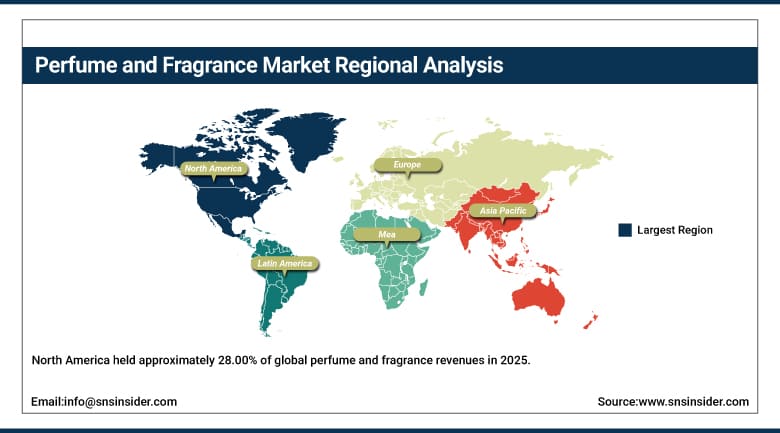
North America held approximately 28.00% of global perfume and fragrance revenues in 2025. The United States accounts for approximately 84.73% of regional revenue. The market is characterized by strong brand consciousness, celebrity fragrance influence, and a developed niche fragrance community. Canada contributes meaningful supplementary North American demand through its premium personal care consumption. The U.S. duty-free and travel retail sector at major airports is a significant channel for premium fragrance sales.
Get Customized Report as Per Your Business Requirement - Enquiry Now
Europe Perfume and Fragrance Market Insights
Europe dominated the global perfume and fragrance market in 2025, holding approximately 37.00% of global revenues. France accounts for approximately 27.84% of European revenues. France is the historic home of the world's leading fragrance houses, including Chanel, Dior, Hermès, and Guerlain. France's concentration of perfumery expertise and ingredient sourcing at Grasse positions it as the global centre of fine fragrance creation. Germany, Italy, and the United Kingdom are also significant European markets. The European premium fragrance segment is growing at above-regional-average rates.
Asia Pacific Perfume and Fragrance Market Insights
Asia Pacific is the fastest-growing regional Perfume and Fragrance market. The market is projected to grow at a CAGR of 3.70% through 2035 at the overall market level, with premium segments growing faster. China accounts for approximately 38.47% of Asia Pacific revenues. Rising disposable incomes, growing personal grooming awareness, and exposure to global fragrance culture through social media are driving Chinese fragrance demand. India is growing rapidly through its young, aspirational consumer base. Japan and South Korea contribute through their established premium personal care cultures.
MEA & Latin America Perfume and Fragrance Market Insights
The Middle East and Africa hold a decent share of global perfume and fragrance market revenue. The UAE leads MEA revenues of the regional total. Approximately 74% of UAE consumers use fragrances daily. Premium and luxury products represent approximately 58% of total regional consumption. Oud-based fragrances account for nearly 46% of regional demand. The Middle East's strong cultural affinity for fragrance creates per-capita spending levels among the highest globally. Brazil leads Latin American revenues of the regional total. Brazil has a distinct personal care culture with high fragrance usage rates across income levels.
Market Dynamics
Growth Drivers: Premiumization across consumer segments and e-commerce platform expansion enabling global fragrance discovery and purchase without physical retail access are the primary market demand drivers.
Premiumization is the single most commercially impactful growth driver in the global fragrance market. Consumers across demographics are devoting more discretionary spending to fragrance as a form of self-expression and personal identity. This trend is visible in the outperformance of Parfum and EDP concentration segments relative to EDT and Cologne. It is also visible in the growing share of prestige and niche fragrance brands relative to mass alternatives. Rising disposable incomes in China, India, Southeast Asia, and Latin America are expanding the addressable premium fragrance consumer base by hundreds of millions of new buyers. E-commerce removes geographic and retail access constraints. It allows consumers in markets without department store fragrance counters to discover and purchase global brands directly.
Restraints: Raw material price volatility for natural fragrance ingredients and increasing regulatory scrutiny of synthetic fragrance compounds under REACH and EU cosmetic regulations create formulation and margin challenges.
Natural sources of perfumery such as ambergris, musk, sandalwood, and oud face issues of shortage in supply. Global warming influences the production of natural substances like jasmine, rose, and ylang-ylang that form part of the high-end fragrances. Shortages in supply of these natural ingredients put price pressure on their acquisition. The EU’s Scientific Committee on Consumer Safety continuously places restrictions on certain chemicals that form part of synthetic perfumes that are known to cause allergies. Such restrictions force companies to re-formulate their perfumes. Re-formulation may result in changes to the smell of a perfume, which causes consumer dissatisfaction.
Opportunities: Personalized fragrance services through digital technology and clean-label natural fragrance ingredient development to meet consumer transparency preferences represent significant commercial growth opportunities.
AI-based fragrance recommendations engines are helping in revolutionizing online fragrance discovery. They solve the problem of purchase hesitations through aligning the scent preference of consumers with fragrance profiles through analysis without the need of physical trials. Personalization questions have been included in various digital fragrance companies and brand websites to create fragrance profiles of recommended fragrances. Sampling programs that are direct-to-consumer enable consumers to test multiple fragrances while paying minimal costs. Such programs solve the major issue of purchasing a fragrance online. Premium fragrance markets are being formed through clean label and natural fragrances. Fragrance brands that can substantiate the origin of their ingredients using certifications and traceability are enjoying price premiums due to conscious health consumers. Platforms like TikTok and Instagram have created an entirely new channel for fragrance discovery.
The niche and artisanal fragrance brands that lack traditional retail are experiencing sales through such communities where fragrance reviewers and influencers are creating fragrance communities on these platforms. The community on TikTok platform has brought about million viewers for brands that were not known before. Overnight viral fragrance discoveries are resulting in rapid sales growth on e-commerce stores for such brands.
Recent Developments:
-
2025: Miu Miu launched its first premium fragrance, Miutine, under a licensing agreement with L'Oréal, featuring a chypre fragrance structure with wild strawberry and brown sugar accords. L'Originale Eau de Parfum was launched by Moroccanoil, combining velvet woods, spicy amber, and sweet florals inspired by Moroccan landscapes.
-
2025: Coty reported 10% net revenue CAGR in prestige fragrance sales from fiscal year 2021 to 2025. L'Oréal identified fragrances as one of its fastest-growing portfolio categories. LVMH's Perfumes and Cosmetics division grew 4% organically in 2024.
-
2024: Fastrack entered the Indian mass premium fragrance market with a new affordable luxury perfume line. In June 2024, Eze Perfumes launched 18 ml travel-size perfume variants in fresh, floral, woody, and citrus profiles targeting on-the-go consumers seeking premium fragrance convenience.
Perfume and Fragrance Market Key Players are:
-
LVMH Moët Hennessy Louis Vuitton SE
-
Chanel SA
-
L'Oréal SA
-
Estée Lauder Companies Inc.
-
Coty Inc.
-
Puig SA
-
Shiseido Company Limited
-
Beiersdorf AG
-
Hermès International SA
-
Unilever PLC
-
Procter & Gamble Co.
-
Avon Products Inc. (Natura & Co.)
-
Revlon Inc.
-
Giorgio Armani SpA
-
Bulgari SpA (LVMH)
-
Givaudan SA
-
International Flavors & Fragrances (IFF)
-
Firmenich SA
-
Symrise AG
-
Robertet SA
Perfume and Fragrance Market Report Scope:
| Report Attributes | Details |
|---|---|
| Market Size in 2025 | USD 60.73 Billion |
| Market Size by 2035 | USD 106.73 Billion |
| CAGR | CAGR of 5.80% From 2026 to 2035 |
| Base Year | 2025 |
| Forecast Period | 2026-2035 |
| Historical Data | 2022-2024 |
| Report Scope & Coverage | Market Size, Segments Analysis, Competitive Landscape, Regional Analysis, DROC & SWOT Analysis, Forecast Outlook |
| Key Segments | • By Type (Parfum/Extrait de Parfum, Eau de Parfum (EDP), Eau de Toilette (EDT), Eau de Cologne (EDC), Eau Fraîche) • By Product (Premium/Luxury, Mass/Accessible) • By End User (Women, Men, Unisex) • By Distribution Channel (Department Stores, Specialty Stores, Online Retail, Supermarkets/Hypermarkets, Duty-Free & Travel Retail, Others) |
| Regional Analysis/Coverage | North America (US, Canada), Europe (Germany, UK, France, Italy, Spain, Russia, Poland, Rest of Europe), Asia Pacific (China, India, Japan, South Korea, Australia, ASEAN Countries, Rest of Asia Pacific), Middle East & Africa (UAE, Saudi Arabia, Qatar, South Africa, Rest of Middle East & Africa), Latin America (Brazil, Argentina, Mexico, Colombia, Rest of Latin America). |
| Company Profiles | LVMH Moët Hennessy Louis Vuitton SE, Chanel SA, L'Oréal SA, Estée Lauder Companies Inc., Coty Inc., Puig SA, Shiseido Company Limited, Beiersdorf AG, Hermès International SA, Unilever PLC, Procter & Gamble Co., Avon Products Inc. (Natura & Co.), Revlon Inc., Giorgio Armani SpA, Bulgari SpA (LVMH), Givaudan SA, International Flavors & Fragrances (IFF), Firmenich SA, Symrise AG, and Robertet SA |
Frequently Asked Questions
The Perfume and Fragrance Market was valued at USD 60.73 Billion in 2025.
The Perfume and Fragrance Market is expected to grow at a CAGR of 5.80% from 2026 to 2035.
The primary growth factors are premiumisation across consumer segments increasing average transaction value, e-commerce growth enabling global fragrance discovery without physical retail.
The Eau de Parfum segment dominated the Perfume and Fragrance Market with 42.10% share in 2025.
Europe dominated the Perfume and Fragrance Market in 2025, holding approximately 37.00% of global revenues.
