
Personal Finance Software Market Report Scope & Overview:
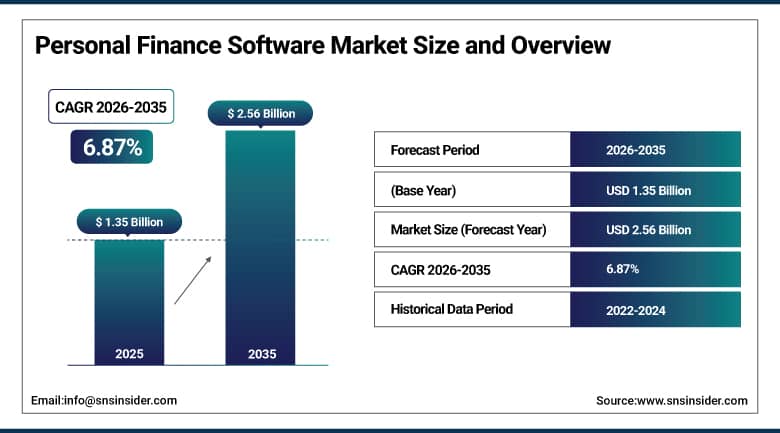
The Personal Finance Software Market was valued at USD 1.35 billion in 2025 and is expected to reach USD 2.56 billion by 2035, growing at a CAGR of 6.87% from 2026–2035.
Growth in the global personal finance software market is driven by the increasing adoption of digital financial management solutions, rising smartphone and internet penetration, and growing consumer awareness of personal financial planning. Individuals and small businesses are increasingly adopting personal finance software to manage budgeting, expense tracking, investment portfolios, tax planning, and savings efficiently. Furthermore, the integration of artificial intelligence (AI), cloud computing, open banking APIs, and advanced data analytics is enhancing software capabilities by delivering personalized financial insights, automated budgeting, and real-time financial monitoring. The growing preference for cloud-based and mobile-first financial applications is further accelerating market growth, enabling users to securely access and manage their financial information across multiple devices.
In 2025, Intuit Inc. enhanced its AI-powered personal finance platform by introducing advanced budgeting, cash flow forecasting, and personalized financial planning capabilities. The update leverages artificial intelligence to deliver real-time spending insights, automated savings recommendations, and investment guidance, enabling consumers and small businesses to manage their finances more efficiently.
To Get More Information On Personal Finance Software Market - Request Free Sample Report
Personal Finance Software Market Trends:
-
Growing adoption of AI-powered budgeting tools is improving personalized financial planning, automation, and real-time spending insights globally.
-
Increasing integration with open banking APIs is enabling secure account aggregation and seamless financial data synchronization.
-
Rising demand for cloud-based finance software is enhancing accessibility, scalability, and multi-device financial management capabilities.
-
Expanding use of predictive analytics is helping users optimize budgeting, savings, investments, and long-term financial planning.
-
Growing adoption of mobile-first finance applications is accelerating digital financial inclusion and personalized money management experiences.
U.S. Personal Finance Software Market Outlook:
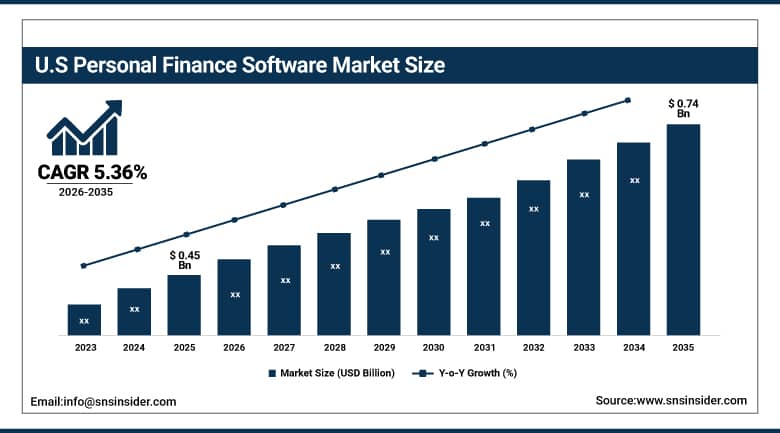
The U.S. Personal Finance Software Market was valued at USD 0.45 billion in 2025 and is expected to reach around USD 0.74 billion by 2035, growing at a CAGR of 5.36% from 2026–2035.
The U.S. personal finance software Market is expanding steadily due to the increasing adoption of digital financial management solutions, growing smartphone penetration, and rising consumer awareness of financial planning. The demand for budgeting, expense tracking, investment management, and tax planning applications is driving market growth among both individuals and small businesses. Furthermore, the integration of artificial intelligence (AI), cloud computing, and open banking technologies is enhancing personalized financial insights, automated budgeting, and real-time financial monitoring. Increasing investments in fintech innovation, cybersecurity, and cloud-based financial platforms are further accelerating the adoption of advanced personal finance software across the United States.
The company introduced an AI-powered personal finance platform with enhanced budgeting, expense tracking, investment monitoring, and automated savings features. The solution delivers real-time financial insights, personalized recommendations, and secure cloud synchronization, enabling users to manage their finances more efficiently across multiple devices.
Personal Finance Software Market Segment Analysis:
-
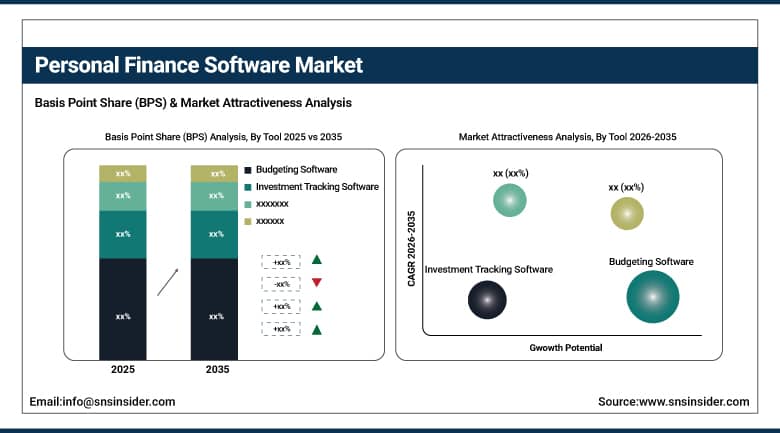
By Tool, budgeting software dominated the personal finance software market with a 30.00% share in 2025; while investment tracking software is the fastest-growing segment with a CAGR of 9.13% during 2026–2035.
-
By Platform, web-based dominated the personal finance software market with a 55.00% share in 2025; while mobile-based is the fastest-growing segment with a CAGR of 7.70% during 2026–2035.
-
By Deployment, cloud-based dominated the personal finance software market with a 62.00% share in 2025; while on-premise is the fastest-growing segment with a CAGR of 8.88% during 2026–2035.
-
By End User, individual consumers dominated the personal finance software market with a 56.00% share in 2025; while small business users are the fastest-growing segment with a CAGR of 12.51% during 2026–2035.
By Tool, budgeting software dominated the personal finance software market, while investment tracking software is expected to grow fastest
Budgeting software held the dominant market share in 2025 due to the increasing demand for effective expense tracking, budgeting, and financial planning among individuals and small businesses. The widespread adoption of digital budgeting tools, growing financial awareness, and the need for real-time monitoring of income and expenditures have strengthened the segment's leadership. Furthermore, the integration of AI-powered budgeting assistants, automated expense categorization, and personalized financial recommendations continues to support the adoption of budgeting software globally.
On the other hand, Investment Tracking Software is expected to register the highest growth rate during the forecast period owing to the increasing participation of retail investors, rising adoption of digital investment platforms, and growing demand for real-time portfolio management. The expansion of AI-driven investment insights, robo-advisory services, and seamless integration with brokerage and banking platforms is expected to accelerate the adoption of investment tracking solutions through 2035.
By Component, software dominated the personal finance software market, while services are expected to grow fastest
Software accounted for the largest market share in 2025 owing to the widespread adoption of personal finance applications for budgeting, expense tracking, investment management, retirement planning, and tax management. Growing consumer preference for digital financial management, increasing smartphone penetration, and continuous advancements in AI-powered financial insights, cloud integration, and automation have further strengthened the dominance of the software segment. Additionally, secure data synchronization and personalized financial recommendations continue to drive software adoption among individuals and small businesses.
Services are expected to witness the highest growth during the forecast period due to the increasing demand for implementation, customization, integration, consulting, and ongoing support services. As financial institutions, fintech companies, and enterprises expand their digital financial offerings, the need for professional services to ensure seamless deployment, user training, data security, and regulatory compliance is expected to accelerate. The continued growth of cloud-based personal finance platforms and AI-enabled financial solutions will further propel the services segment through 2035.
By Deployment, cloud dominated the personal finance software Market, while on-premises is expected to grow fastest
In 2025, cloud held the largest market share due to the high rate of cloud computing and enterprise digital transformation, as well as growing migration of critical applications and workloads into public cloud, private cloud, and hybrid cloud environments. Enterprises are using data migration solutions for cloud that offer improved scalability, lower infrastructure costs, higher operational agility, and faster application modernization. Increasing usage of AI, analytics, and cloud-native technologies is set to further increase the dominance of this segment.
On-premises will exhibit the highest CAGR over the forecast period, backed by rising demand from enterprises operating in highly regulated industry verticals like banking and finance, healthcare, government, and defense, wherein data sovereignty, security, and compliance continue to be essential concerns. Investments in infrastructure modernization, hybrid IT integration, and greater control over enterprise data will further fuel the growth of this segment till 2035.
Regional Analysis:
|
Region |
Major Country |
Share within Region, 2025(%) |
|---|---|---|
|
North America |
United States |
89.20% |
|
Europe |
Germany |
28.40% |
|
Asia Pacific |
China |
34.60% |
|
Middle East & Africa |
Saudi Arabia |
27.80% |
|
Latin America |
Brazil |
39.20% |
North America Personal Finance Software Market Insights.
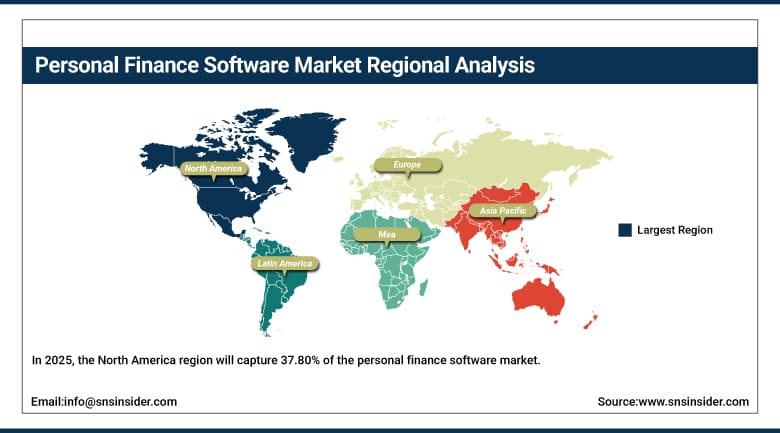
In 2025, the North America region will capture 37.80% of the personal finance software market owing to the extensive utilization of digital finance tools, significant smartphone and internet usage, and existence of a highly developed fintech market. The growing popularity of budgeting, spending, investing, and tax-planning apps among individuals and small organizations will fuel the expansion of the regional market. In 2025, the U.S. will be the dominant country in the region, occupying 89.20% of the North America Personal Finance Software market in 2025 due to the existence of prominent fintech players, high financial planning awareness among consumers, and utilization of AI-based personal finance software.
Get Customized Report as Per Your Business Requirement - Enquiry Now
Europe Personal Finance Software Market Insights
Europe continues to be an important market for personal finance software market owing to factors such as higher digital financial services penetration, rising demand for budgeting and financial investment management, and higher financial awareness among the masses. Germany stands out as the frontrunner of the region holding a share of 28.40% in the European market in 2025 due to innovative technologies in the fintech sector, extensive adoption of digital banking services, and adoption of personal finance software among consumers and small businesses.
With more advanced technologies such as artificial intelligence, cloud computing, and open banking becoming increasingly integrated, the experience of personalized financial management is further being improved across the region. Moreover, rising investments made in digital financial services, strict data protection regulations, and higher demand for secure and cloud-based financial management software will continue to drive the growth of personal finance software market in Europe through the forecast period.
Asia Pacific Personal Finance Software Market Insights
The Asia-Pacific region is expected to grow at the highest 9.18% CAGR during the forecast period due to higher smartphone usage, digitalization of financial services, robust fintech ecosystem, and high adoption of personal finance applications on cloud platform. The largest share of the market comes from China which accounts for 34.60% of the Asia-Pacific market in 2025, owing to the high usage of digital payment portals, innovation in fintech, and consumers' interest in AI-powered personal finance management tools.
Higher financial literacy levels, expansion in internet accessibility, along with artificial intelligence, open banking, and advanced analytics will provide huge growth prospects for the market in the region.
Middle East & Africa and Latin America Personal Finance Software Market Insights
The Middle East & Africa personal finance software market is growing at a constant rate, owing to the increasing popularity of online banking services, increasing usage of smartphones, and awareness about personal finance management. Saudi Arabia is the dominant country in the region, holding 27.80% share of the Middle East & Africa market in 2025, owing to the fast-growing pace of the fintech industry, digitalization efforts from the government, and increased demand for cloud-based financial software.
Personal Finance Software Market in Latin America is seeing continuous growth owing to rising financial inclusion, high digital payment adoption, and increasing need for budget and expenditure management applications. The largest contributor to the Personal Finance Software Market in Latin America is Brazil, which accounted for 39.20% of the total Latin American market share in 2025, backed by a growing fintech landscape, increased smartphone penetration, and high consumer inclination towards digital finance services.
Market Dynamics:
Growth Driver: Rising adoption of ai-powered financial management and cloud-based solutions
One of the main reasons that have contributed to the growth of the Personal Finance Software Market is the rising popularity of financial management solutions with AI capabilities and online personal finance platforms. Consumers and small enterprises are resorting to technology solutions to make budgeting, expense monitoring, saving, investment, and tax preparation much easier. Using the capabilities of AI and machine learning, personal finance software offers customized financial advice, automatic budgeting, and spending insights. Additionally, the rise in the popularity of mobile banking and payment platforms, as well as open banking systems, is fuelling the need for personal finance software solutions. The growing focus on investing in fintech innovations, cloud computing, and cybersecurity, in addition to consumers' growing understanding of financial management and data protection, is further propelling the market for personal finance software.
Restraint: Data privacy concerns and cybersecurity risks
Issues like data privacy concerns, cybersecurity risks, and compliance issues still act as major barriers for the expansion of the Personal Finance Software Market. Personal finance apps house very private financial information such as bank details, transaction records, investment portfolios, and personal information, which makes them vulnerable to cyber-attacks. The issue of complying with GDPR, CCPA, and other data protection laws is also a major hurdle for players in the market.
In addition, the consumers’ concerns about their financial data being hacked and misused can pose a hurdle to the uptake of digital personal finance solutions. High costs involved in using state-of-the-art security technology, establishing a safe cloud computing environment, compliance issues, and cybersecurity risks are among the challenges faced by the players in the market.
Opportunity: Growing adoption of AI-driven personal financial management and open banking
Rising use of AI technology, cloud computing, and open banking is providing considerable growth opportunities in the Personal Finance Software Market. Consumers and small enterprises have started using cloud-based personal finance software for budgeting, expense management, savings, investments, and tax planning. As a result, there are considerable investments being made in financial assistants, financial automation tools, and financial analysis platforms.
Growth in demand for financial digital transformation, real-time financial information, and integration with banking and investment software will drive further market opportunities in the coming years. Businesses are making use of AI technology for automating expense categorization, cash flow forecasting, personalized budgeting, and financial advice. Moreover, rising investments in cloud infrastructure, innovation in fintech, and open banking ecosystem are contributing to the growth of advanced personal finance software.
Rising popularity of software-as-a-service platform, mobile banking software, digital payment software, and predictive financial analytics software is providing further boost to the market demand. There is a focus on financial software providers on the factors such as data privacy, cyber security, regulatory compliance, and AI-driven financial planning capabilities, offering substantial opportunities in the next generation personal finance software.
Recent Developments:
-
2025: Intuit Inc. expanded its AI-powered QuickBooks and Credit Karma capabilities by introducing enhanced personalized budgeting, automated financial insights, and predictive cash flow management features for consumers and small businesses.
-
2024: Quicken Inc. enhanced its Simplifi by Quicken platform with AI-driven spending analysis, customizable budgeting tools, and expanded investment tracking capabilities to improve users' financial planning experience.
-
2024: Rocket Money introduced advanced subscription management, AI-powered bill negotiation, and personalized savings recommendations, helping users reduce recurring expenses and improve financial wellness.
-
2023: Plaid Inc. expanded its open banking platform by strengthening secure financial data connectivity and account aggregation capabilities, enabling personal finance applications to deliver more accurate real-time financial insights and seamless user experiences.
Personal Finance Software Market key players are:
-
Intuit Inc.
-
Quicken Inc.
-
Empower Finance, Inc.
-
YNAB (You Need A Budget LLC)
-
Rocket Money
-
Monarch Money, Inc.
-
PocketSmith Ltd.
-
Buxfer Inc.
-
Moneydance LLC
-
Simplifi by Quicken
-
Fidelity Investments
-
Charles Schwab Corporation
-
SoFi Technologies, Inc.
-
NerdWallet, Inc.
-
Credit Karma, LLC
-
Morningstar, Inc.
-
Plaid Inc.
-
MX Technologies, Inc.
-
Finicity Corporation
-
Personal Capital Corporation
Personal Finance Software Market Report Scope:
| Report Attributes | Details |
|---|---|
| Market Size in 2025 | USD 1.35 Billion |
| Market Size by 2035 | USD 2.56 Billion |
| CAGR | CAGR of 6.87% From 2026 to 2035 |
| Base Year | 2025 |
| Forecast Period | 2026-2035 |
| Historical Data | 2022-2024 |
| Report Scope & Coverage | Market Size, Segments Analysis, Competitive Landscape, Regional Analysis, DROC & SWOT Analysis, Forecast Outlook |
| Key Segments | • By Tool (Budgeting Software, Tax Management Software, Retirement Planning Software, Investment Tracking Software, Others) • By Platform (Web-based, Mobile-based) • By Deployment (Cloud-based, On-premise) • By End User (Individual Consumers, Small Business Users) |
| Regional Analysis/Coverage | North America (US, Canada), Europe (Germany, UK, France, Italy, Spain, Russia, Poland, Rest of Europe), Asia Pacific (China, India, Japan, South Korea, Australia, ASEAN Countries, Rest of Asia Pacific), Middle East & Africa (UAE, Saudi Arabia, Qatar, South Africa, Rest of Middle East & Africa), Latin America (Brazil, Argentina, Mexico, Colombia, Rest of Latin America). |
| Company Profiles | Intuit Inc., Quicken Inc., Empower Finance, Inc., YNAB (You Need A Budget LLC), Rocket Money, Monarch Money, Inc., PocketSmith Ltd., Buxfer Inc., Moneydance LLC, Simplifi by Quicken, Fidelity Investments, Charles Schwab Corporation, SoFi Technologies, Inc., NerdWallet, Inc., Credit Karma, LLC, Morningstar, Inc., Plaid Inc., MX Technologies, Inc., Finicity Corporation, Personal Capital Corporation. |
Frequently Asked Questions
Growth is driven by the increasing adoption of AI-powered personal finance solutions, cloud-based financial management platforms, digital banking, and rising consumer demand for automated budgeting, expense tracking, and investment management tools.
Budgeting Software dominated the market in 2025 with a 30.00% share.
North America dominated the Personal Finance Software Market in 2025 with a 37.80% share.
The Personal Finance Software Market is expected to grow at a CAGR of 6.87% from 2025 to 2035.
The Personal Finance Software Market was valued at USD 1.35 billion in 2025.
