
AI Prior Authorization Automation Market Report Scope & Overview:
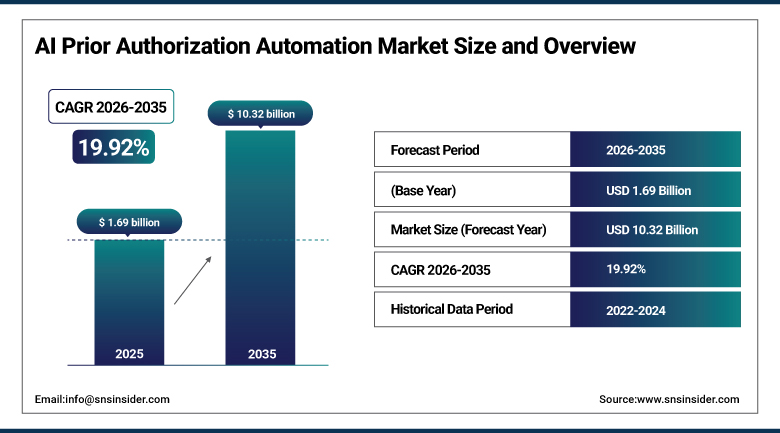
The AI Prior Authorization Automation Market was valued at USD 1.69 Billion in 2025 and is expected to reach USD 10.32 Billion by 2035, growing at a CAGR of 19.92% from 2026–2035.
The AI-Powered Healthcare Prior Authorization Market is driven by the increased complexity in authorizations and the growing administrative burden associated with it, the increased adoption of AI in healthcare operations, and the need to shorten the time required to process approvals. Documentation, communication with payers, and status monitoring are cumbersome tasks that slow down the process and increase costs and difficulties. AI solutions automate the processes and help with intelligent document management and analysis of clinical data.
In February 2026, Optum had rolled out new AI-powered tools aimed at streamlining the prior authorization process. The company had launched two platforms, namely, Digital Auth Complete and InterQual Auth Accelerator, both geared towards improving workflow efficiency. Digital Auth Complete was developed in partnership with Humata Health. It had interfaced with electronic health records to perform many functions related to authorizations and provide quick responses. According to Optum, the platform was interfacing with over 250 payer systems for identification of authorization needs and comparison of patient coverage against clinical documentation.
To Get more information AI Prior Authorization Automation Market - Request Free Sample Report
AI Prior Authorization Automation Market Trends:
-
The growing adoption of generative AI and large language models is enabling automated, accurate, and efficient prior authorization processes across healthcare systems.
-
The increasing integration of AI with electronic health records and payer systems is improving data exchange and streamlining authorization workflows.
-
The rising use of predictive analytics is helping organizations make faster, data-driven authorization decisions while reducing administrative delays and inefficiencies.
-
The expansion of cloud-based AI platforms is supporting scalable, flexible, and cost-effective prior authorization workflows across diverse healthcare settings.
-
The rising collaboration among payers, providers, and AI technology companies is accelerating innovation and improving prior authorization efficiency and outcomes.
U.S. AI Prior Authorization Automation Market Outlook:
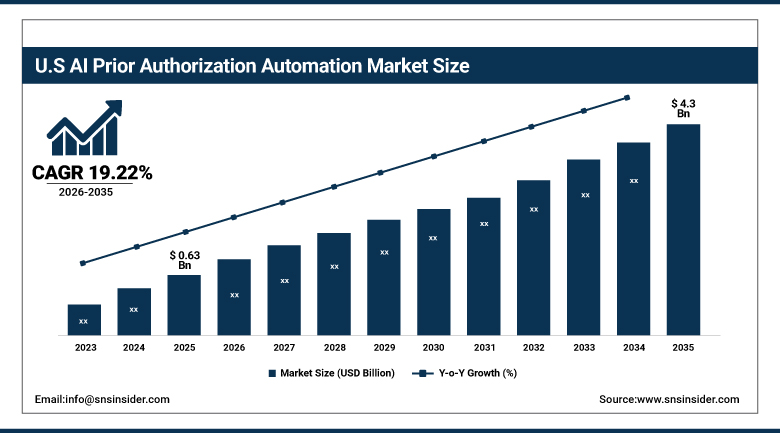
The U.S. AI Prior Authorization Automation Market was valued at approximately USD 0.63 Billion in 2025 and is expected to reach approximately USD 4.3 Billion by 2035, growing at a CAGR of approximately 19.22%.
The U.S. AI Prior Authorization Automation Market is growing due to regulatory changes that encourage greater transparency and faster response times along with the digitization of prior authorization processes. The healthcare sector is increasingly using AI technology to adhere to the changes in regulations and improve the efficiency of their operations. AI technology helps in automating redundant tasks, facilitates better decision-making, and reduces operational hassles, driving investments in healthcare automation systems.
In August 2025, Innovaccer Inc., a leading healthcare AI company introduced Flow Auth, an AI-based prior authorization solution that was a part of its Flow revenue cycle management solution. It had automated the whole process of prior authorization, from determining the need for authorization to writing appeals. According to the preliminary implementation of the product, Flow Auth was estimated to save clinicians 50% time in managing prior authorizations, increase productivity two times and generate up to five times return on investment.
AI Prior Authorization Automation Market Segment Analysis:
-
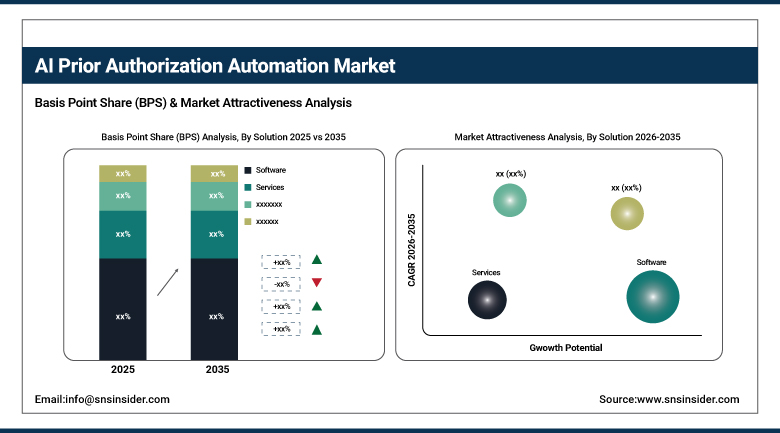
By Solution, the Software segment dominated the AI Prior Authorization Automation Market with approximately 52.45% share in 2025, while the Services segment is the fastest growing with a CAGR of approximately 20.70%.
-
By Deployment Mode, the Cloud-Based segment dominated the Market with approximately 56.23% share in 2025, and it also is the fastest growing segment with a CAGR of approximately 20.72%.
-
By Application, the Medical Prior Authorization segment dominated the Market with approximately 43.23% share in 2025, while the Pharmacy Prior Authorization segment is the fastest growing with a CAGR of approximately 20.47%.
-
By End-User, the Health Insurance Payers segment dominated Market with approximately 48.71% share in 2025, while the Healthcare Providers segment is the fastest growing with a CAGR of approximately 20.88%.
-
By Technology, the Natural Language Processing / Large Language Models segment dominated the Market with approximately 42.82% share in 2025, and it also is the fastest growing segment with a CAGR of approximately 21.13%.
-
By Enterprise Size, the Large Health Systems & National Payers segment dominated Market with approximately 42.64% share in 2025, while the Mid-Size Providers & Regional Health Plans segment is the fastest growing with a CAGR of approximately 20.83%.
By Solution, software segment dominates the market, services segment expected to grow fastest
Software segment dominated the market because of the increased use of platforms with AI capabilities in the automation of documentation, eligibility, medical necessity, and authorization. The seamless integration of the platforms with the EHRs and revenue cycle management systems, in addition to the cloud-based capabilities and predictive analytics as well as the electronic prior authorization, helped improve efficiency and increase the speed of processing claims.
Services segment is expected to record the highest growth during the forecast period due to high demands for implementation, system integration, consultancy, customization, training, and managed services. With the increasing adoption of advanced artificial intelligence solutions by healthcare organizations, there is the need for skilled professionals who can help integrate the solutions into their current IT framework, optimize operations, comply with regulations, and support performance improvement.
By Deployment Mode, Cloud-Based Segment leads the market and also shows fastest growth
Cloud-Based segment dominated the market as a result of high flexibility, low initial expenditure on infrastructure, and the capability of supporting real-time prior authorization processes in different healthcare institutions. It is important to note that cloud-based solutions allow integrating with EHR, payer platforms, AI applications, and offer remote access, automatic software updates, data analytics, and regulatory compliance. Cloud-Based segment is estimated to experience the fastest growth rate during the forecasted period due to the increased adoption of SaaS-based healthcare solution, rising digital transformation initiatives, and high demand for flexible and scalable AI platforms.
By Application, Medical Prior Authorization segment dominates the market, Pharmacy Prior Authorization expected to grow fastest
Medical Prior Authorization segment dominated the market with the highest revenue share owing to high demand for authorization related to diagnostic imaging, surgical interventions, specialty procedures, and inpatient and outpatient care. Healthcare providers increasingly adopted AI-powered automation to streamline documentation, reduce approval delays, improve compliance with payer requirements, minimize administrative burden, and accelerate patient access to medically necessary treatments, supporting the segment's market leadership.
Pharmacy Prior Authorization segment is expected to show the highest growth rate over the forecast period, owing to the increasing usage of specialty drugs, biologicals, and expensive medicines which require payer authorization. AI-powered automation helps in formulary validation, clinical documentation, medication validation, and e-prior authorization process, thus accelerating prescription approval process, decreasing treatment delay, and providing better results for the patients.
By End Users, Health Insurance Payers Segment leads the market, Healthcare Providers Segment expected to show fastest growth
Health Insurance Payers segment dominated the market due to the high volume of prior authorizations and increased utilization of AI-based Workflow Automation technology. In order to maintain consistency in the decision-making, reduce administrative costs, increase the speed of authorizing, detect fraudulent activities, and boost efficiency, the payers incorporated intelligent solutions for the automation of the medical necessity review process.
Healthcare Providers segment is expected to exhibit the highest growth rate over the forecast period because of the growing necessity to decrease clinician workload and ensure patients get timely access to treatment. Hospitals, physicians’ clinics, and specialists' clinics are now implementing artificial intelligence-based prior authorization solutions at an unprecedented rate to streamline documentation, cut down denied claims, reduce approvals time, optimize revenue cycle management, etc.
By Technology, NLP/LLMs segment dominate the market and also shows fastest growth
Natural Language Processing (NLP) / Large Language Models (LLMs) segment dominated the market with the highest revenue share because of its capability to analyze the unstructured clinical notes, derive important information related to the field of medicine, automate documentation, and generate appropriate prior authorization requests. Its easy integration with electronic health records, policies of the payer, and clinical workflow made it more efficient in terms of administration. Natural Language Processing (NLP) / Large Language Models (LLMs) segment is projected to witness the fastest growth during the forecast period driven by developments in generative AI technologies, greater use of clinical documentation intelligence solutions, and rising requirements for automated medical necessity reviews.
By Enterprise Size, the Large Health Systems & National Payers segment dominates, Mid-Size Providers segment grows fastest
Large Health Systems & National Payers segment dominated the market with the highest revenue share owing to its massive volumes of authorization procedures, big investments in information technology, and use of artificial intelligence-based automated software. Such organizations implemented advanced software to optimize complicated processes of authorization procedures, integrate with corporate EHR systems, cut down on costs, ensure compliance, and increase efficiency of operations.
Mid-Size Providers & Regional Health Plans segment is projected to witness the fastest during the forecast period because of growing investments in digital transformation initiatives and the presence of affordable cloud-based AI platforms. The organizations are implementing automation solutions for prior authorization to streamline their operations, improve turnaround time, optimize revenue cycle management, and provide better experience to patients and providers without making any major infrastructure changes.
Regional Insights:
|
Region |
Major Country |
Share within Region, 2025 (%) |
|---|---|---|
|
North America |
United States |
87.23% |
|
Europe |
Germany |
22.6% |
|
Asia Pacific |
China |
36.4% |
|
Middle East & Africa |
UAE |
27.1% |
|
Latin America |
Brazil |
48.5% |
North America AI Prior Authorization Automation Market Insights
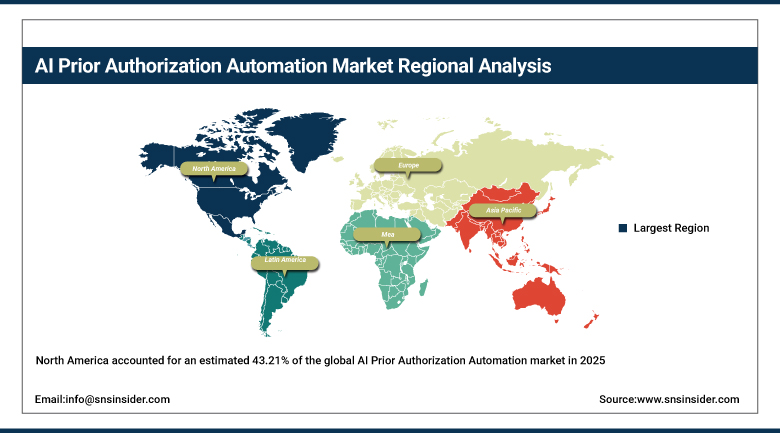
North America accounted for an estimated 43.21% of the global AI Prior Authorization Automation market in 2025, making it the leading regional market. The U.S. held an approximate 87.23% market share of the North American market, driven by its highly digitized healthcare ecosystem, extensive adoption of AI-powered revenue cycle management solutions, and strong presence of major health insurers, providers, and health IT vendors.
The region's growth is also being driven by growing numbers of prior authorizations, focus on interoperability in regulations, and implementation of electronic health records with AI-driven workflow automation solutions. Increased spending on healthcare, favourable digitization of reimbursement programs, and ongoing investments in generative AI and clinical decision support systems are contributing to market expansion for payers and providers alike.
Get Customized Report as per Your Business Requirement - Enquiry Now
Europe AI Prior Authorization Automation Market Insights
Europe AI-powered Prior Authorization Automation market is fuelled by increasing digitalization of the healthcare sector, growing need for streamlined operations, and usage of AI tools in the process of authorization. Germany was responsible for about 22.6% of the regional European market due to well-developed healthcare sector.
The European market is further propelled by government initiatives promoting healthcare interoperability, electronic health record adoption, and automation of payer-provider communications. Rising pressure to cut down healthcare costs and enhance operational efficiency and authorize in time is pushing hospitals and insurance companies to adopt prior authorizations systems driven by AI.
Asia Pacific AI Prior Authorization Automation Market Insights
Asia Pacific AI-powered Prior Authorization Automation market is experiencing growth with a CAGR of 21.38% on account of growing healthcare digitalization, increased use of artificial intelligence, growing expenditure on healthcare, and demand for automation in administration processes. China accounted for around 36.4% of the regional Asia Pacific market.
Market growth is due to digital health initiatives by the governments, investment in healthcare IT infrastructure, and increased use of electronic health records and cloud-based systems. Both healthcare organizations and insurance companies in the region are using AI-based automation to minimize the time taken, increase operational efficiencies, and deal with complexities involved in prior authorizations.
MEA & Latin America AI Prior Authorization Automation Market Insights
The Middle East & Africa AI-powered Prior Authorization Automation market is experiencing strong growth because of the modernization of the healthcare industry, efforts by governments to adopt digital transformation, and the growing use of AI-enabled healthcare services. Other factors fuelling the growth of this market include smart healthcare, cloud technology, and digital insurance. The market share of the UAE in this region is about 27.1%, owing to its well-developed healthcare industry.
Latin America's AI-powered Prior Authorization Automation market is expected to see growth due to the increased digitalization of the healthcare sector, adoption of automation technologies, and an increase in demand for greater administrative efficiency. Health IT investments and the use of electronic health record systems are enabling increased adoption of such technology by the healthcare providers and payers. Brazil held around 48.5% share in the regional market, backed by its large healthcare network.
Growth Drivers: Increasing Administrative Burden Driving AI Automation Adoption
The growing complexity of prior authorization processes, including extensive documentation requirements, manual verification procedures, and delayed approvals, is increasing administrative pressure on healthcare organizations. AI-enabled automation technologies are useful in streamlining the workflow, cutting down redundant work, and increasing the efficiency of the organization in terms of making authorization decisions.
There is an increasing trend in healthcare facilities towards the reduction of administrative costs through automation of tasks such as authorizations. Artificial intelligence technologies like natural language processing and machine learning make documentation and medical necessity evaluations more efficient for organizations to be more productive without any delay.
Restraint: Data Privacy and Security Concerns Restricting Market Adoption
The use of AI-driven prior authorization systems is dependent on access to significant amounts of confidential medical information about patients, thus posing challenges in terms of privacy issues, cyber security issues, and regulation compliance. Healthcare institutions need to ensure robust security and be compliant with the healthcare data protection laws.
Concerns regarding unauthorized data access, algorithm transparency, and compliance with evolving healthcare regulations may limit adoption, particularly among smaller healthcare organizations. Moreover, integration of AI technologies into already functioning healthcare system poses certain difficulties in terms of financial, technical and continuous monitoring resources required for implementation.
Opportunity: Growing Adoption of Generative AI Creating New Growth Opportunities
The rapid advancement of generative artificial intelligence presents significant opportunities for the AI prior authorization automation market by enabling more intelligent and automated workflows. Generative AI will be able to help with clinical documentation creation, payer policy understanding, appeal letter generation, and assistance for providers.
Healthcare organizations are increasingly the potential of utilizing the capabilities of generative AI technology to increase authorization effectiveness, ease the burden of administrative tasks, and increase communication between providers and payers. With the development of AI models in conjunction with the healthcare system, more automation solutions will be implemented and bring about market expansion opportunities.
Recent Developments:
-
2026: PrescriberPoint, the AI-powered point-of-care platform, had announced its agentic AI prior authorization (PA) solution along with the results of a clinical validation study. The healthcare provider solution had automated the full PA lifecycle, from script capture in the electronic medical record (EMR) through payer approval, appeals and pharmacy routing. Embedded directly into the prescribing workflow, it completes PA requirements within existing systems while providing life sciences brands with greater visibility into the patient access journey.
-
2026: Rubrum Advising had announced the launch of Rubrum Solutions, an AI-native platform designed to transform fragmented healthcare data into structured, decision-ready intelligence. The platform had enabled prior authorization, benefits verification, and clinical workflows by using AI to clean, organize, and interpret structured and unstructured data, including PDFs and images.
-
2026: Veradigm had announced the availability of Veradigm Health Network Architecture to early adopter customers. The platform had provided independent practices with a real-time view of clinical, financial, and operational performance by connecting data across EHR, practice management, clearinghouse, and patient portal systems, eliminating manual data stitching and delayed reporting.
AI Prior Authorization Automation Market Key Players:
-
Optum
-
Availity
-
Cohere Health
-
Olive AI
-
PriorAuthNow
-
CoverMyMeds (McKesson)
-
Myndshft Technologies
-
NaviMedix (WebMD Health Services)
-
MultiPlan Corporation
-
Rhyme
-
Waystar Health
-
Verata Health
-
Epic Systems
-
Cerner Corporation (Oracle Health),
-
Edifecs
-
Mphasis
-
Zelis Healthcare
-
Veradigm
AI Prior Authorization Automation Market Report Scope:
| Report Attributes | Details |
|---|---|
| Market Size in 2025 | USD 1.69 Billion |
| Market Size by 2035 | USD 10.32 Billion |
| CAGR | CAGR of 19.92% From 2026 to 2035 |
| Base Year | 2025 |
| Forecast Period | 2026-2035 |
| Historical Data | 2022-2024 |
| Report Scope & Coverage | Market Size, Segments Analysis, Competitive Landscape, Regional Analysis, DROC & SWOT Analysis, Forecast Outlook |
| Key Segments | • By Solution (Software, Services) • By Deployment (Cloud-Based, On-Premises) • By Application (Medical Prior Authorization,Pharmacy Prior Authorization,Dental & Behavioral Health Prior Authorization) • By End-User (Health Insurance Payers, Healthcare Providers,Pharmacy Benefit Managers) • By Technology (Natural Language Processing / Large Language Models,Machine Learning & Predictive Analytics, Robotic Process Automation (RPA), Blockchain-Enabled Audit Trails • By Enterprize Size (Large Health Systems & National Payers, Mid-Size Providers & Regional Health Plans, Small Practices & Independent Physician Groups)) |
| Regional Analysis/Coverage | North America (US, Canada), Europe (Germany, UK, France, Italy, Spain, Russia, Poland, Rest of Europe), Asia Pacific (China, India, Japan, South Korea, Australia, ASEAN Countries, Rest of Asia Pacific), Middle East & Africa (UAE, Saudi Arabia, Qatar, South Africa, Rest of Middle East & Africa), Latin America (Brazil, Argentina, Mexico, Colombia, Rest of Latin America). |
| Company Profiles | Optum, Availity, Cohere Health, Olive AI, PriorAuthNow, CoverMyMeds (McKesson), Infinx Healthcare, Myndshft Technologies, NaviMedix (WebMD Health Services), MultiPlan Corporation, Rhyme, Waystar Health, Verata Health, Epic Systems, Cerner Corporation (Oracle Health), Surescripts, Edifecs, Mphasis, Zelis Healthcare, Veradigm. |

Frequently Asked Questions
The AI Prior Authorization Automation Market is expected to grow at a CAGR of 19.92% from 2026 to 2035.
The AI Prior Authorization Automation Market was valued at USD 1.69 Billion in 2025.
The Natural Language Processing (NLP) / Large Language Models (LLMs) segment dominated the AI Prior Authorization Automation Market.
North America dominated the AI Prior Authorization Automation Market in 2025.
The major growth factor driving the AI Prior Authorization Automation market is the increasing demand for faster, automated, and efficient healthcare authorization processes.
