
Business Analytics Software Market Report Scope & Overview:
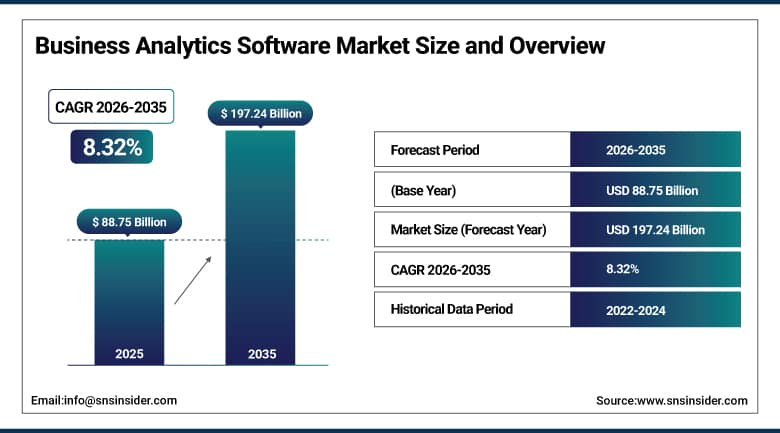
The Business Analytics Software Market was valued at USD 88.75 Billion in 2025 and is projected to reach USD 197.24 Billion by 2035, expanding at a CAGR of 8.32% during the forecast period 2026–2035.
The business analytics software market is witnessing considerable growth due to the rising emphasis by organizations on making decisions based on data, optimization, gaining insights into customers, and business forecasting. With rapid digital transformation in industries, there has been an increase in the production of structured and unstructured data, and thus, a rising need for sophisticated analytics software which can convert the data into valuable insights. There is an increased focus by organizations on investing in business analytics software for improving strategic planning, customer experience, supply chain optimization, and competitive advantage. Artificial intelligence, machine learning, automation, and cloud computing technologies have improved the features of business analytics software.
Large-scale investments by prominent software companies in generative AI-powered business analytics capabilities and intelligent decision support platforms.
To Get More Information On Business Analytics Software Market - Request Free Sample Report
Business Analytics Software Market Trends
-
Rapid adoption of AI-powered decision intelligence platforms across enterprises.
-
Growing deployment of cloud-native analytics and software-as-a-service business intelligence solutions.
-
Increasing utilization of predictive and prescriptive analytics for strategic planning.
-
Rising demand for self-service analytics and low-code analytical tools.
-
Expansion of real-time data visualization and dashboard technologies.
U.S. Business Analytics Software Market Size Outlook
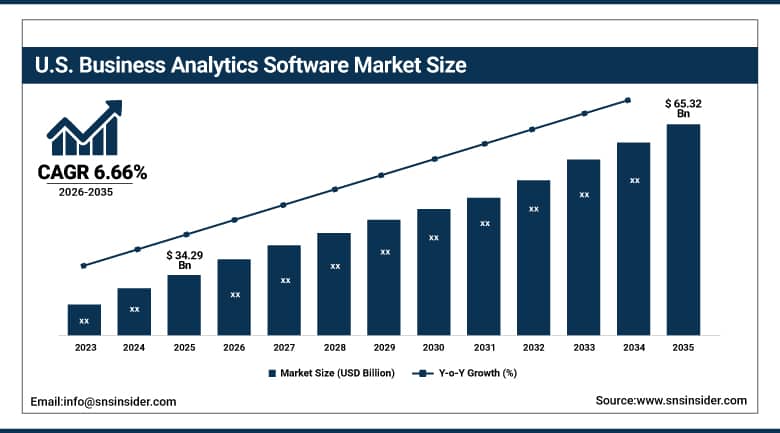
The U.S. Business Analytics Software Market was valued at USD 34.29 billion in 2025 and is expected to reach approximately USD 65.32 billion by 2035, expanding at a CAGR of 6.66% during 2026–2035.
The United States, there has been huge growth in the market owing to the increased focus on making decisions through data, optimization, customer intelligence, and predictive business planning. There are large amounts of structured and unstructured data being produced by rapid digital transformation activities across the various industries, hence there is increased need for more sophisticated analytics tools that will help convert data into insights. Organizations are increasingly relying on analytics tools to help with strategic planning, improving the experience of their customers, optimizing their supply chain, and gaining competitive advantage.
During 2026, some leading analytics software vendors in the U.S. have enhanced their business intelligence solutions using generative AI techniques, allowing businesses to produce automated insight, natural language reports, and predictive recommendations from the data environments.
Business Analytics Software Market Segment Analysis
-
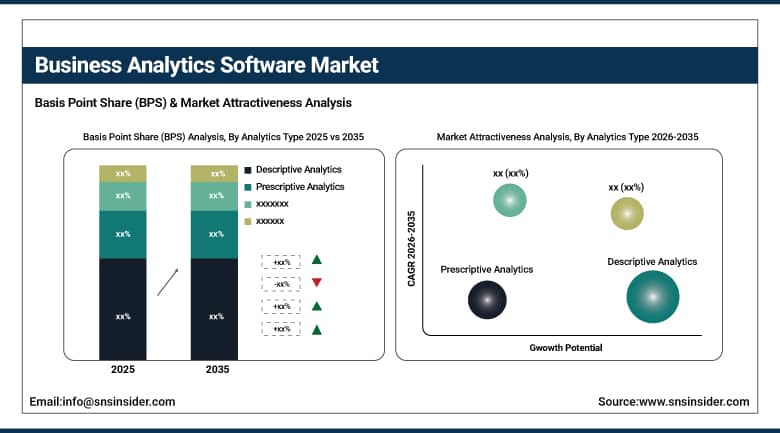
By Analytics Type, descriptive analytics dominated the market with a 30.00% share in 2025, while prescriptive analytics is projected to register the fastest CAGR of 13.08% during the forecast period.
-
By Function, data visualization & dashboards dominated the market with a 28.00% share in 2025, while AI-powered decision intelligence is projected to witness the fastest CAGR of 16.57% during the forecast period.
-
By Deployment Model, cloud-based analytics dominated the market with a 44.00% share in 2025 and is also projected to register the fastest CAGR of 11.35% during the forecast period.
-
By End User Industry, BFSI dominated the market with a 22.00% share in 2025, while healthcare & life sciences is projected to witness the fastest CAGR of 9.77% during the forecast period.
By Analytics Type, descriptive analytics dominated the market, while prescriptive analytics is fastest-growing.
The largest market share held by the descriptive analytics segment can be attributed to the extensive application of this type of solution for performance monitoring, reporting, business intelligence, and historical analysis of data. Enterprises from virtually all industry verticals use descriptive analytics software for converting large amounts of enterprise data into valuable insights using the means of dash boarding, score carding, reports, and visualization platforms.
During 2025 and 2026, leading analytics players improved their offerings with self-service reporting features and real-time dash boarding to improve operational visibility and enhance enterprise-wide data-based decision-making process.
The prescriptive analytics segment is expected to record the fastest CAGR of 13.08% over the forecast period due to the growing demand for smart decision optimization and business recommendations powered by artificial intelligence. Prescriptive analytics solutions employ advanced machine learning, simulation modeling, optimization, and artificial intelligence techniques to suggest optimal actions according to predictive insights and business goals. The deployment of such solutions enables businesses to optimize pricing, supply chain, resource management, risk management, and customer engagement. During 2026, some leading enterprise software vendors launched artificial intelligence-powered recommendation engines that can generate operational strategies and business optimization scenarios using real-time enterprise data input.
By Function, data visualization & dashboards dominated the market, while AI-powered decision intelligence is fastest-growing.
Market dominance was demonstrated by the data visualization and dashboards segment with a market share of 28.00% in 2025 owing to the significance of visual analytics in corporate decision-making. Modern companies need an intuitive way of interacting with their data, and visualization platforms are necessary parts of analytics ecosystems. Interactive dashboards provide executives, managers, and operational teams with the ability to track KPIs, detect trends, and assess the performance of the business. From 2025 to 2026, analytics leaders updated dashboards with the functionality of natural language queries and AI-assisted visualization in order to simplify enterprise data analysis.
AI-powered decision intelligence segment is expected to register the highest CAGR of 16.57% throughout the forecast period driven by the fast adoption of artificial intelligence solutions. Decision intelligence platforms include analytics, machine learning, predictive modeling, automation, and business rules engines in order to enhance decision-making processes. Organizations widely apply decision intelligence platforms for automating analytical processes, optimizing resource allocation, enhancing customer experience, and enabling predictive business planning. In 2026, several software vendors introduced decision intelligence platforms with generative AI assistants that allow for generating automated recommendations, forecasts, and optimization strategies using real-time corporate data.
By Deployment Model, cloud-based analytics dominated the market and is fastest-growing.
The cloud-based analytics segment captured the highest market share of 44.00% in 2025 and is expected to have the fastest CAGR of 11.35% during the forecast period. This is mainly due to the rising trend of enterprises adopting cloud-based analytics platforms that are highly flexible, scalable, and economical through SaaS models. From 2025 to 2026, some of the major cloud technology companies increased their offerings of enterprise analytics by incorporating features of generative AI, automated data prep tools, and forecasting engines in order to make business intelligence more efficient.
There has been significant growth in the cloud-based analytics space owing to growing investments in multi-cloud environments, industry-specific analytics solutions, and self-service business intelligence solutions. Cloud deployment is preferred by organizations as it offers better scalability and faster innovation cycles than the on-premise options. Furthermore, the increasing need for real-time analytics, predictive modeling, and data democratization across an entire organization is fueling its adoption by both large enterprises as well as small-to-medium businesses. In 2026, some of the major analytics software companies introduced their cloud-native analytics platforms with features like AI-powered data discovery and automated insights generation.
Regional Insights
|
Region |
Major Country |
Share within Region, 2025 (%) |
|---|---|---|
|
North America |
United States |
92.00% |
|
Europe |
Germany |
26.00% |
|
Asia Pacific |
China |
24.00% |
|
Middle East & Africa |
UAE |
4.00% |
|
Latin America |
Brazil |
4.00% |
North America Business Analytics Software Market Insights
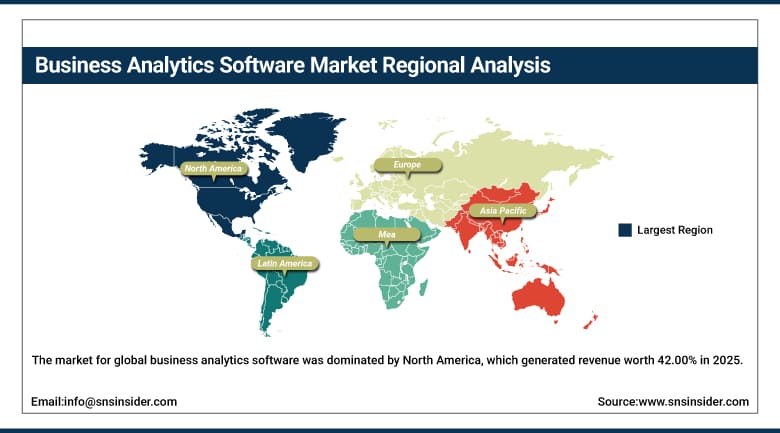
The market for global business analytics software was dominated by North America, which generated revenue worth 42.00% in 2025 owing to the highly developed technology environment, cloud computing adoption, advanced AI features, and high enterprise software spending in the region. The region receives an impetus owing to the presence of leading players in the market for analytics software, digital transformation activities, and the early adoption of new technologies. Firms operating in the banking, healthcare, retail, manufacturing, and telecom sectors are increasingly using business analytics platforms to improve their operations, engagement levels, and strategies. Moreover, increasing investments in decision intelligence, predictive analytics, and automation of enterprises have supported market growth.
In 2026, various software firms based in North America launched business intelligence platforms that could provide businesses with automated recommendations, conversational analytics, and predictions based on business intelligence generated through generative AI.
Get Customized Report as Per Your Business Requirement - Enquiry Now
Europe Business Analytics Software Market Insights
Europe emerges as one of the leading markets in terms of technological advancements in business analytics software with the help of enterprise digitization drives, implementation of cloud-based technologies, and investments in artificial intelligence and data governance systems. German, UK, French, Italian, Spanish, and Nordic enterprises are progressively adopting business analytics solutions that help improve their operations efficiency, customer interaction, financial planning, and regulatory compliance. Increasing attention towards data privacy policies and digital transformation trends in the region is driving enterprises towards using advanced analytics systems that provide valuable insight while being compliant with relevant laws. Increasing use of artificial intelligence and predictive business intelligence systems helps ensure the sustainable growth of the market.
Asia Pacific Business Analytics Software Market Insights
Asia Pacific is estimated to grow at a CAGR of 12.16% during the forecast period owing to high digital transformation, increased cloud penetration, increased expenditure on enterprise technology, and growing realization about data-driven decision-making. Advanced analytics solutions are being adopted by businesses in countries such as China, India, Japan, South Korea, Singapore, and Australia to enhance customer engagement, increase efficiency, and facilitate decision making. The growth of startups, adoption of advanced AI technologies, and growing digitalization in the private as well as public sector in the region present lucrative growth opportunities for providers of advanced analytics software solutions. In addition, investments made in smart manufacturing, financial technology, e-commerce, and telecommunications infrastructure generate significant demand for advanced BI solutions.
Middle East & Africa and Latin America Business Analytics Software Market Insights
The MEA region is gradually becoming a significant market for business analytics software as a result of investments in digital transformation initiatives, smart city projects, and modernization of enterprises. Enterprises from the sectors of finance, telecoms, energy, government, and healthcare are using analytics software to increase operational efficiency, deliver better services to their clients, and develop their strategy. Investments in the cloud computing infrastructure and AI technologies create a positive environment for adoption of analytics software. During 2026, a number of enterprises in the Middle East region increased enterprise analytics investments as a part of digital transformation initiatives aimed at improving operational intelligence and automation of operations.
Business analytics software adoption in Latin America is increasing steadily because companies understand how important data-driven decision-making becomes in this changing world. Companies from the banking sector, retail sector, telecoms, healthcare, and manufacturing sector are using analytics software to understand their customers’ better, increase operational efficiency, and to gain competitive advantage. Expansion of cloud infrastructure, digital transformation initiatives, and use of SaaS business solutions contribute to market development. During 2026, several Latin American enterprises intensified their investment in cloud-based analytics and BI software in order to implement digital transformation initiatives.
Growth Drivers: Growing adoption of artificial intelligence, machine learning and decision-making based on big data among companies.
One of the greatest growth drivers of the Business Analytics Software Market is the growing adoption of data-driven decision-making. Companies across sectors are producing tremendous amounts of structured and unstructured data from their digital operations, interaction with customers, internet of things devices, cloud services, and enterprise solutions. In a time when the level of competition increases, companies are using more and more analytics solutions to extract valuable insights from big data, which can be used in strategic planning, optimization, customer experience, and business development. In addition, the use of artificial intelligence, machine learning, predictive analytics, and automation in analytics solutions brings even greater added value to these platforms because they help identify trends, make predictions, and automate decision-making process.
In 2026, some of the leading analytics software providers rolled out generative AI-powered business intelligence platforms that can generate insights, recommendations, forecasts, and strategic scenarios based on enterprise data.
Restraints: Privacy, security issues, and integration complexity.
Though there is an evident trend of rapid growth in the market, the adoption of the business analytics software is impeded by various concerns associated with data security and privacy, as well as integration complexity. There is a need for companies to deal with confidential financial, operating, customer, and healthcare data which requires compliance with more and more rigid regulations. It is necessary to integrate analytics tools with many enterprise systems, databases, cloud infrastructure, and other applications; at the same time, it can be difficult to do this properly. Besides, there are worries about data security, cyber threats, and governance problems as well as the necessity to comply with GDPR and other privacy regulations.
In 2025-2026, companies working in heavily regulated areas such as finance and healthcare spent much money on the implementation of more secure architectures for analytics, data governance policies, and privacy-oriented BI solutions.
Opportunities: Generative AI and decision intelligence platforms expansion.
Generative artificial intelligence and decision intelligence tools provide enormous expansion potential for the business analytics software market. Modern businesses need analytics solutions not just for descriptive reports and predictions but also for autonomous insights and intelligent decisions. Generative AI allows users to analyze business information with the help of natural language, automate the process of report creation, summarize data, and make strategic decisions in real time. Decision intelligence tools allow making business decisions through the combination of analytics, machine learning, optimization models, and business rules. The growing need of enterprises to optimize operations and increase their efficiency and productivity in the era of digital transformation is expected to drive the demand for intelligent analytics platforms significantly.
In 2026, several enterprise software vendors offered analytics assistants powered by generative AI which could create dashboards, predict company performance, find out business risks, and propose corresponding actions on the basis of real-time enterprise information.
Recent Developments
-
2026: Microsoft expanded AI-powered analytics capabilities within its business intelligence ecosystem by integrating advanced generative AI features designed to automate insight generation, forecasting, and enterprise decision support.
-
2026: Salesforce enhanced its analytics and data cloud platform with expanded AI-driven business intelligence functionalities focused on customer intelligence, predictive analytics, and automated recommendations.
-
2025: SAP introduced next-generation analytics capabilities incorporating machine learning automation, predictive planning tools, and enterprise-wide data intelligence features to support digital transformation initiatives.
-
2025: Oracle strengthened its cloud analytics portfolio through expanded decision intelligence capabilities, advanced data visualization tools, and AI-assisted business performance management solutions.
Business Analytics Software Market Key Players
-
Microsoft Corporation
-
Salesforce Inc.
-
SAP SE
-
IBM Corporation
-
SAS Institute Inc.
-
Tableau Software LLC
-
Qlik Technologies Inc.
-
MicroStrategy Incorporated
-
TIBCO Software Inc.
-
Alteryx Inc.
-
Teradata Corporation
-
Domo Inc.
-
Sisense Ltd.
-
Zoho Corporation Pvt. Ltd.
-
Infor Inc.
-
Yellowfin BI
-
GoodData Corporation
-
Pyramid Analytics
Business Analytics Software Market Report Scope:
| Report Attributes | Details |
|---|---|
| Market Size in 2025 | USD 88.75 Billion |
| Market Size by 2035 | USD 197.24 Billion |
| CAGR | CAGR of 8.32% From 2026 to 2035 |
| Base Year | 2025 |
| Forecast Period | 2026-2035 |
| Historical Data | 2022-2024 |
| Report Scope & Coverage | Market Size, Segments Analysis, Competitive Landscape, Regional Analysis, DROC & SWOT Analysis, Forecast Outlook |
| Key Segments | • By Analytics Type (Descriptive Analytics, Diagnostic Analytics, Predictive Analytics, Prescriptive Analytics, Augmented Analytics) • By Function (Data Visualization & Dashboards, Reporting & Query Tools, Data Mining & Discovery, AI-Powered Decision Intelligence, Performance Management & Planning) • By Deployment Model (Cloud-Based Analytics, On-Premise Analytics, Hybrid Analytics, Embedded Analytics) • By End User Industry (BFSI, Retail & E-Commerce, Healthcare & Life Sciences, Manufacturing, IT & Telecom, Others) |
| Regional Analysis/Coverage | North America (US, Canada), Europe (Germany, UK, France, Italy, Spain, Russia, Poland, Rest of Europe), Asia Pacific (China, India, Japan, South Korea, Australia, ASEAN Countries, Rest of Asia Pacific), Middle East & Africa (UAE, Saudi Arabia, Qatar, South Africa, Rest of Middle East & Africa), Latin America (Brazil, Argentina, Mexico, Colombia, Rest of Latin America). |
| Company Profiles | Microsoft Corporation, Salesforce Inc., Oracle Corporation, SAP SE, IBM Corporation, SAS Institute Inc., Tableau Software LLC, Qlik Technologies Inc., MicroStrategy Incorporated, TIBCO Software Inc., Alteryx Inc., Teradata Corporation, Domo Inc., ThoughtSpot Inc., Sisense Ltd., Zoho Corporation Pvt. Ltd., Infor Inc., Yellowfin BI, GoodData Corporation, Pyramid Analytics |
Frequently Asked Questions
The Business Analytics Software Market was valued at USD 88.75 billion in 2025.
The market is projected to reach USD 197.24 billion by 2035.
North America dominated the market in 2025.
The Business Analytics Software Market is expected to expand at a CAGR of 8.31% during the forecast period.
Asia Pacific is projected to register the fastest CAGR of 8.51%.
