
Pharmacovigilance Automation Market Report Scope & Overview:
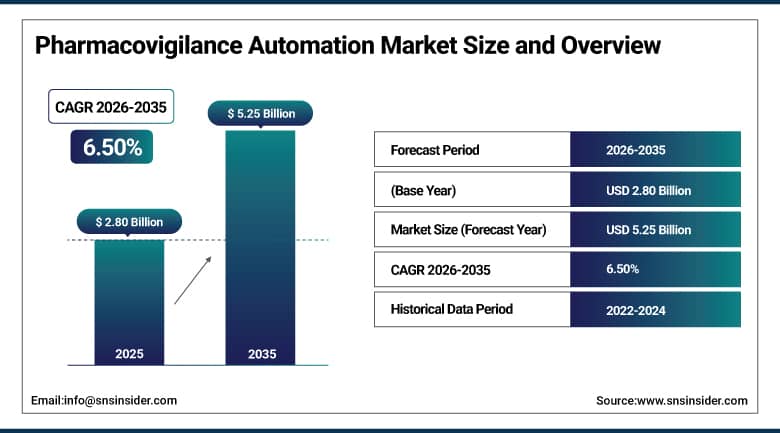
The Pharmacovigilance Automation Market was valued at USD 2.80 billion in 2025 and is expected to reach USD 5.25 billion by 2035, growing at a CAGR of 6.50% from 2026–2035.
The pharmacovigilance automation market is witnessing significant growth in the global market owing to increasing adoption of AI-enabled drug safety solutions. Rising regulatory requirements and growing adverse event reporting volumes are supporting market expansion. Organizations are focusing on deploying automated platforms to improve efficiency, compliance, and data accuracy. Growing use in case processing, signal detection, and regulatory submissions is creating new opportunities. Advancements in artificial intelligence, natural language processing, and cloud technologies are improving operational performance. Increasing investments in digital healthcare infrastructure and pharmaceutical research activities are further accelerating adoption of pharmacovigilance automation.
According to the World Health Organization Programme for International Drug Monitoring and the Uppsala Monitoring Centre, VigiBase contained more than 40 million individual case safety reports from over 170 participating countries in 2025, highlighting the increasing data burden on pharmacovigilance systems.
To Get More Information On Pharmacovigilance Automation Market - Request Free Sample Report
Pharmacovigilance Automation Market Trends:
-
Increasing outsourcing of pharmacovigilance activities to CROs is improving cost efficiency, scalability, and accelerating adoption of automated safety monitoring platforms globally.
-
Pharmaceutical companies are leveraging CRO expertise to manage complex regulatory compliance requirements and large volumes of adverse event reporting data.
-
Rapid adoption of artificial intelligence is transforming pharmacovigilance workflows by enabling faster detection of drug safety signals and risks.
-
Natural language processing is increasingly used to extract safety information from unstructured clinical notes, literature, and real-world evidence sources.
-
Cloud based pharmacovigilance systems are enabling real time global collaboration, centralized data access, and improved regulatory reporting efficiency.
-
Growing investment in digital transformation is driving demand for scalable, cost-effective automation solutions across pharmaceutical and biotechnology organizations.
U.S. Pharmacovigilance Automation Market Outlook:
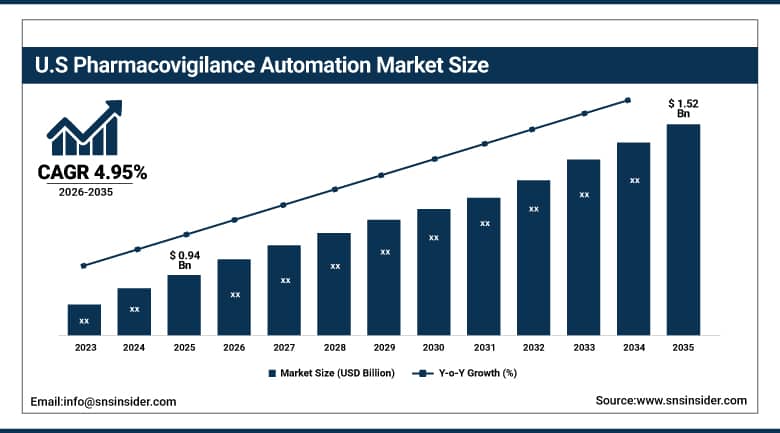
The U.S. Pharmacovigilance Automation Market was valued at USD 0.94 billion in 2025 and is expected to reach around USD 1.52 billion by 2035, growing at a CAGR of 4.95% from 2026–2035.
The U.S. pharmacovigilance automation market is growing consistently owing to rising adoption of AI-driven drug safety platforms across healthcare. Strong implementation among pharmaceutical companies, biotechnology firms, and service providers is supporting steady growth nationwide. The use of pharmacovigilance automation in adverse event processing, signal detection, and regulatory reporting has contributed to market expansion. Increasing focus on compliance efficiency and advanced data analytics has generated higher demand. Development of digital healthcare infrastructure, clinical research activities, and intelligent automation technologies is further driving market expansion.
As per the FAERS Public Dashboard of the United States Food and Drug Administration and the FDA Adverse Event Reporting System 2025, the database is reported to receive more than 2 million adverse event reports each year, resulting in the requirement for automation technology.
According to FDA and Office of the National Coordinator for Health Information Technology, around 96% of non-Federal acute care hospitals and close to 78% of physicians in their office use certified EHR system, which makes it possible to automate the process of safety signal generation, case management, and integration of real-world data in pharmacovigilance process.
Pharmacovigilance Automation Market Segment Analysis:
-
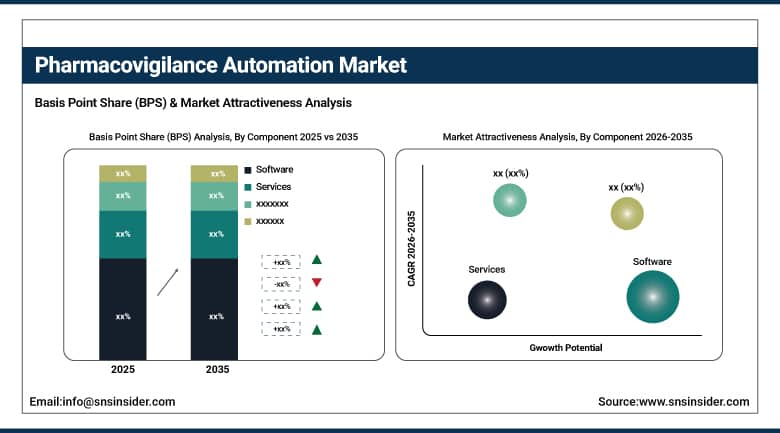
By Component, software dominated the market with 72.40% share in 2025; while services are the fastest growing segment with CAGR of 8.77% during 2026 to 2035.
-
By Deployment Mode, cloud-based dominated the market with 49.80% share in 2025; while software-as-a-service (SaaS) are the fastest growing segment with CAGR of 13.02% during 2026 to 2035.
-
By Technology, artificial intelligence (AI) dominated the market with 41.30% share in 2025; while natural language processing (NLP) is the fastest growing segment with CAGR of 13.73% during 2026 to 2035.
-
By End User, pharmaceutical companies dominated the market with 58.60% share in 2025; while biotechnology companies are the fastest growing segment with CAGR of 11.57% during 2026 to 2035.
By Component, software dominated the pharmacovigilance automation market, while services are the fastest growing segment.
Software segment has captured the dominated market share in the pharmacovigilance automation market due to the high usage of drug safety automation solutions by pharmaceutical companies. These solutions have been adopted by pharmaceuticals for processing adverse events, generating signals, and performing other regulatory activities. With the ability to increase efficiency, avoid errors, and streamline safety processes, software demand has grown steadily.
Services segment is projected to register the fastest CAGR during 2026-2035 due to increasing need for implementation, integration, validation, and pharmacovigilance services. Companies are increasingly outsourcing their operational activities in order to become more efficient and reduce their internal burden. Complex regulatory demands and growing adoption of artificial intelligence-based solutions are adding to the growth of this segment globally.
By Deployment Mode, cloud-based dominated the pharmacovigilance automation market, while software-as-a-service (SaaS) is the fastest growing segment.
Cloud-Based Segment is leading the pharmacovigilance automation market in terms of dominated revenue share in 2025. The leadership can be accounted to the increasing need for scalability and centralized pharmacovigilance systems globally. Companies are increasingly using cloud infrastructure in order to simplify adverse event reporting and regulatory compliance operations. Decreased costs, accessibility of data in real time, and easy integration with artificial intelligence technologies are enhancing their adoption globally.
Software-as-a-Service (SaaS) Segment is anticipated to register the fastest CAGR during 2026-2035. This can be attributed to the increasing adoption of the subscription-based deployment model amongst the pharmaceuticals and biotechnologies. The SaaS platform ensures faster implementation and automated software updates. In addition, increasing need for flexible, economical, and remotely accessible pharmacovigilance platforms will drive its adoption throughout the forecast period.
By Technology, artificial intelligence (AI) dominated the pharmacovigilance automation market, while natural language processing (NLP) is the fastest growing segment.
Artificial Intelligence (AI) segment held the dominated share of the pharmacovigilance automation market in terms of revenue in 2025, due to its growing usage in the automation of adverse event reporting and signal management process. Pharmaceutical organizations increasingly utilized AI solutions in order to enhance the level of accuracy in the detection process and decrease workload. AI helped organizations streamline their regulatory compliance process and make safety decisions faster.
Natural Language Processing (NLP) segment is projected to be the most rapidly growing segment, with the fastest CAGR during 2026-2035, due to rising demand for gaining insights from unstructured health care data sources. Companies are using NLP in order to analyze physicians' notes and scientific literature. Increased demand for social media monitoring and adverse events reporting in multiple languages is further boosting the growth.
By End User, pharmaceutical companies dominated the pharmacovigilance automation market, while biotechnology companies are the fastest growing segment.
Pharmaceutical Companies Segments held the major revenue share in the pharmacovigilance automation market in 2025 owing to their large portfolio of drugs and stringent regulatory requirements across the global regions. They have to deal with a higher volume of adverse event reports. The use of pharmacovigilance automation provides improved efficiency, lessens manual errors, and helps with regulatory submissions quickly. There is heavy investment in AI-based safety systems that facilitate pharmacovigilance automation.
Biotechnology Companies Segments will witness significant CAGR in the forecast period 2026-2035 owing to their quick growth in biologics and precision medicines pipelines. Their higher activity of clinical trials and complicated safety requirements will drive the adoption of pharmacovigilance automation solutions. There is reliance on pharmacovigilance automation by these companies for case processing and signal detection because of their limited infrastructure in pharmacovigilance.
Regional Analysis:
|
Region |
Major Country |
Share within Region, 2025(%) |
|---|---|---|
|
North America |
United States |
86.80% |
|
Europe |
Germany |
24.80% |
|
Asia Pacific |
China |
34.60% |
|
Middle East & Africa |
UAE |
17.20% |
|
Latin America |
Brazil |
42.50% |
North America Pharmacovigilance Automation Market Insights.
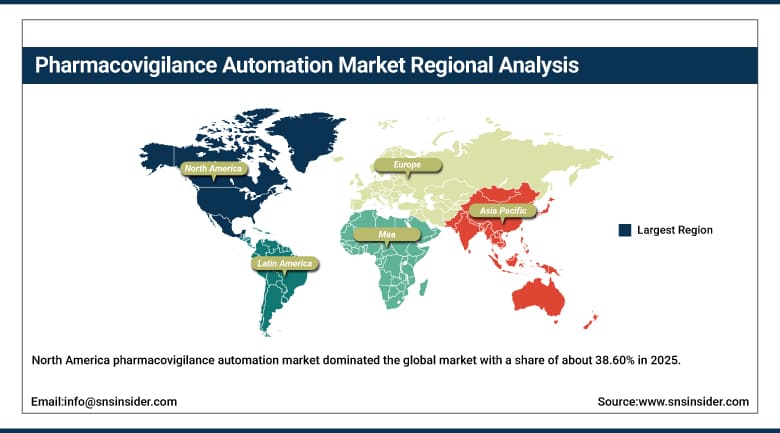
North America pharmacovigilance automation market dominated the global market with a share of about 38.60% in 2025 owing to increasing demand for advanced drug safety technologies. The region benefits from strong pharmaceutical presence and high regulatory compliance requirements across healthcare systems. Increasing use of AI based safety platforms in pharmaceutical companies and biotechnology firms is driving expansion across the United States and Canada. Rising adoption of automated adverse event reporting and signal detection systems is further supporting market growth. Strong digital healthcare infrastructure is strengthening innovation capabilities in pharmacovigilance automation technologies.
According to the U.S. Food and Drug Administration Sentinel Initiative 2025 program updates and Health Canada pharmacovigilance reporting requirements, over 90% of U.S. hospitals and large healthcare systems now submit adverse event data through electronic reporting systems integrated with automated safety. Additionally, the Centers for Disease Control and Prevention notes that over 95% of prescription drug dispensing in North America is now captured through electronic health record systems, supporting automation in pharmacovigilance workflows and real-time drug safety monitoring.
Get Customized Report as Per Your Business Requirement - Enquiry Now
Europe Pharmacovigilance Automation Market Insights.
Europe pharmacovigilance automation market is characterized by steady growth in 2025 owing to strict regulatory frameworks and increasing drug safety monitoring requirements. The major countries contributing towards the demand include Germany, France, United Kingdom, and Italy. Rising adoption of digital health technologies and automated safety reporting systems is fueling market growth. Increased use of pharmacovigilance automation in clinical research and post market surveillance is propelling usage rate. Strong focus on patient safety and compliance is supporting regional adoption.
According to the European Medicines Agency and the EudraVigilance 2025 pharmacovigilance activity reports, all centrally authorized medicinal products in the EU are required to be continuously monitored through the EudraVigilance database, which processes over 2 million individual case safety reports annually across member states.
As per the European Commission’s EudraVigilance statistics framework, electronic reporting compliance for adverse drug reactions exceeds 95% among EU marketing authorization holders. Additionally, EMA’s digital transformation roadmap indicates that over 70% of national competent authorities in Europe have integrated automated signal detection and AI-assisted pharmacovigilance workflows into regulatory safety monitoring systems by 2025
Asia Pacific Pharmacovigilance Automation Market Insights.
Asia Pacific pharmacovigilance automation market is positioned as the fastest growing region with a CAGR of about 8.92% during 2026–2035 owing to rapid expansion of pharmaceutical manufacturing and clinical research activities. Strong demand is emerging across China, Japan, India, South Korea, and Southeast Asia. Expanding healthcare investments and rising regulatory modernization are significantly boosting adoption. Growing demand for cost effective drug safety solutions is further accelerating market growth. Large scale digital transformation initiatives support strong regional outlook.
According to the World Health Organization Global Benchmarking Tool 2025 and national regulatory authority assessments across Asia Pacific, over 70% of member states in the region have implemented functional pharmacovigilance systems aligned with WHO safety monitoring standards.
As per the WHO Programme for International Drug Monitoring, more than 150 countries globally are enrolled, with Asia Pacific contributing a growing share of Individual Case Safety Reports, exceeding 25% of global submissions.
Middle East & Africa and Latin America Pharmacovigilance Automation Market Insights.
The Middle East & Africa along with Latin American regions are experiencing steady growth due to expanding healthcare infrastructure and increasing pharmaceutical investments. Key contributing countries include Brazil, Mexico, UAE, Saudi Arabia, and South Africa. Investments in healthcare digitization and regulatory modernization are supporting market growth. Rising demand for improved drug safety monitoring and compliance systems is driving adoption. Increasing clinical trial activities and pharmaceutical outsourcing are further supporting regional expansion.
According to WHO pharmacovigilance system performance indicators, the reporting of adverse drug reactions in developing and middle-income countries has gone up from less than 10 reports per million of the population in previous decades to improved reporting coverage through national electronic safety databases. Furthermore, WHO eHealth Observatory 2025 shows that more than 50% of the member states of these countries have adopted electronic health reporting systems for pharmacovigilance workflow automation.
Market Dynamics:
Growth Drivers: Rapid adoption of AI, NLP, and cloud-based technologies in drug safety monitoring systems
AI and natural language processing will transform the pharmacovigilance domain with increased adoption of these techniques. AI technology makes it possible to mine safety data quickly from unstructured text, such as patient notes or research papers. The cloud computing system helps in accessing the data timely to make reporting possible for global teams. It reduces manual work and assists in making decisions related to drug safety. There is much money that the pharmaceutical companies are investing in their digital transformation initiatives.
According to the U.S. Food and Drug Administration Sentinel Initiative and the European Medicines Agency 2025 Pharmacovigilance Guidance Updates, more than 90% of large pharma firms in the regulated market are using digital systems for adverse event reporting and connected digital safety databases. According to OECD Health Data 2025, more than 70% of member nations have a national level infrastructure for digital pharmacovigilance.
Restraints: Data privacy concerns and stringent regulatory compliance challenges across multiple regions
The storage of medical information of the patient that includes details about his/her safety during drug usage creates issues of confidentiality and security. There are many regulations depending on the country, which makes it difficult to implement any kind of system internationally. Compliance with certain standards such as GDPR and FDA regulations makes things even more difficult. Issues of consistency and security arise due to the integration of the data gathered from different sources. It requires huge amount of money to create a safe system.
Opportunities:Increasing outsourcing of pharmacovigilance activities to CROs and specialized service providers
The pharmaceutical companies are outsourcing their pharmacovigilance services to cut down operational costs and increase efficiency. The contract research organizations provide professional support with regard to safety and compliance issues. This trend creates an increasing need for the automation of pharmacovigilance services. With outsourcing it is possible to scale up and process the huge amount of safety information in a very quick way. The service providers are using sophisticated digital technologies to improve the accuracy and speed of reporting.
As per the World Health Organization global pharmacovigilance capacity assessment, more than 60% of member states rely on third-party support or regional centers for safety signal detection and reporting activities. Additionally, EMA indicate that over 75% of post-marketing safety data processing in regulated markets involves contracted pharmacovigilance service providers, reflecting strong outsourcing-driven automation adoption.
Recent Developments:
-
2026: Oracle Corporation innovated next-generation AI pharmacovigilance automation tools increasing speed and efficiency of safety case processing and global regulatory compliance.
-
2025: IQVIA Holdings Inc. innovated safety surveillance analytics platform leveraging AI and real-world data for improvement of pharmacovigilance signal detection globally.
-
2025: Accenture plc broadened its range of cloud services in life sciences for automation, AI implementation, and regulatory workflows transformation projects.
-
2024: Veeva Systems Inc. introduced new release of Veeva Safety increasing efficiency of case intake automation and signal management for clients.
Pharmacovigilance Automation Market Key Players are:
-
Oracle Corporation
-
Veeva Systems Inc.
-
IQVIA Holdings Inc.
-
ArisGlobal LLC
-
Accenture plc
-
Cognizant Technology Solutions Corporation
-
Tata Consultancy Services Limited
-
Infosys Limited
-
Wipro Limited
-
Tech Mahindra Limited
-
HCL Technologies Limited
-
Genpact Limited
-
Capgemini SE
-
Parexel International Corporation
-
ICON plc
-
EVERSANA
-
Ennov SAS
-
AB Cube SAS
-
RXLogix Corporation
-
Indegene Limited
Pharmacovigilance Automation Market Report Scope:
| Report Attributes | Details |
|---|---|
| Market Size in 2025 | USD 2.80 Billion |
| Market Size by 2035 | USD 5.25 Billion |
| CAGR | CAGR of 6.50% From 2026 to 2035 |
| Base Year | 2025 |
| Forecast Period | 2026-2035 |
| Historical Data | 2022-2024 |
| Report Scope & Coverage | Market Size, Segments Analysis, Competitive Landscape, Regional Analysis, DROC & SWOT Analysis, Forecast Outlook |
| Key Segments | • By Component (Software, Services) • By Deployment Mode (Cloud-Based, On-Premises, Hybrid, Software-as-a-Service (SaaS)) • By Technology (Artificial Intelligence (AI), Machine Learning (ML), Natural Language Processing (NLP), Robotic Process Automation (RPA), Others) • By End User (Pharmaceutical Companies, Biotechnology Companies, Contract Research Organizations (CROs), Others) |
| Regional Analysis/Coverage | North America (US, Canada), Europe (Germany, UK, France, Italy, Spain, Russia, Poland, Rest of Europe), Asia Pacific (China, India, Japan, South Korea, Australia, ASEAN Countries, Rest of Asia Pacific), Middle East & Africa (UAE, Saudi Arabia, Qatar, South Africa, Rest of Middle East & Africa), Latin America (Brazil, Argentina, Mexico, Colombia, Rest of Latin America). |
| Company Profiles | Oracle Corporation, Veeva Systems Inc., IQVIA Holdings Inc., ArisGlobal LLC, Accenture plc, Cognizant Technology Solutions Corporation, Tata Consultancy Services Limited, Infosys Limited, Wipro Limited, Tech Mahindra Limited, HCL Technologies Limited, Genpact Limited, Capgemini SE, Parexel International Corporation, ICON plc, EVERSANA, Ennov SAS, AB Cube SAS, RXLogix Corporation, Indegene Limited |
Frequently Asked Questions
The pharmacovigilance automation market was valued at USD 2.80 billion in 2025.
The pharmacovigilance automation market is expected to grow at a CAGR of 6.50% from 2026 to 2035.
North America dominated the pharmacovigilance automation market in 2025 due to strong pharmaceutical presence, AI adoption, digital infrastructure, regulatory compliance requirements.
The major growth factors include AI adoption, rising adverse event reporting, regulatory compliance, clinical trials expansion, outsourcing to CROs, and advancements in AI, NLP, RPA, and cloud-based automation technologies.
The Software segment dominated the market in 2025 due to widespread use in case processing, signal detection, regulatory automation workflows.
