
Healthcare Large Language Models Market Report Scope & Overview:
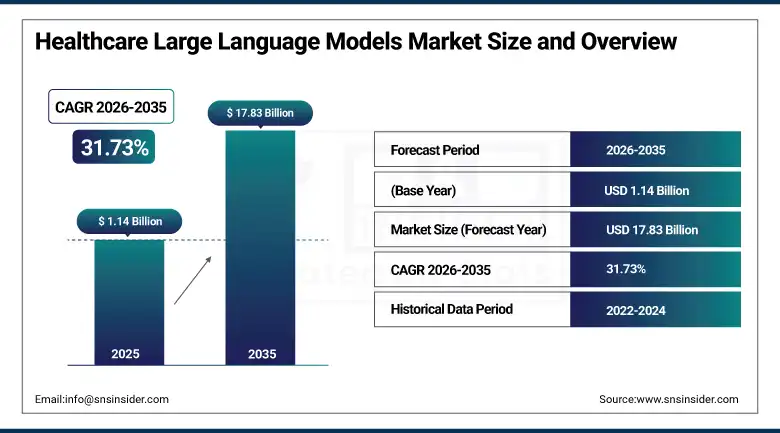
The Healthcare Large Language Models Market was valued at USD 1.14 Billion in 2025 and is projected to reach USD 17.83 Billion by 2035, expanding at a CAGR of 31.73% during the forecast period 2026–2035.
There is very quick commercialization of large language models in the field of healthcare because healthcare organizations are using AI systems dedicated to the healthcare industry in order to automate clinical documentation, help with decision-making on diagnostics, support drug discovery initiatives, and facilitate medical knowledge management. Large Language Models in healthcare are embedded in the EHR system, clinical workflow tools, research databases, and doctor's tools in order to make work easier and more efficient. There are many opportunities for scaling AI use cases in healthcare because of investments made by healthcare providers, pharmaceutical companies, and IT vendors.
From 2025 to 2026, healthcare technology companies started to develop healthcare LLM solutions capable of performing clinical reasoning, ambient documentation, medical coding, drug discovery, and workflow automation in the enterprise healthcare environment.
To Get more information On Healthcare Large Language Models Market - Request Free Sample Report
Healthcare Large Language Models Market Trends
-
Increasing adoption of clinical-grade generative AI platforms across hospitals.
-
Growing deployment of healthcare-specific LLMs for medical documentation automation.
-
Rising investments in AI-assisted drug discovery and biomedical research workflows.
-
Expansion of cloud-based healthcare AI infrastructure globally.
-
Growing integration of LLMs with EHR, clinical decision support, and knowledge management systems.
The U.S. Healthcare Large Language Models Market Size Outlook
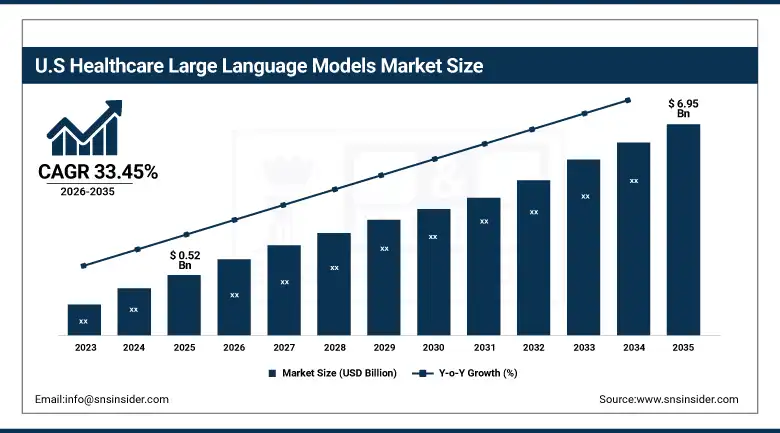
The U.S. Healthcare Large Language Models Market was valued at USD 0.52 billion in 2025 and is expected to reach approximately USD 6.95 billion by 2035, expanding at a CAGR of 33.45% during 2026–2035.
The United States remains the dominant country in the healthcare LLM market on account of its superior healthcare IT infrastructure, wide use of EHRs, significant investments into healthcare AI, and the early implementation of generative AI solutions by health systems and life sciences firms. More hospitals, medical schools, pharmaceuticals, and healthcare technology companies start to implement healthcare-focused LLMs for optimizing business processes, boosting doctor productivity, and enhancing decision-making abilities. Good availability of healthcare data, an innovation ecosystem, and growing investments in digital health transformation programs are also contributing to market leadership. The presence of prominent AI developers, research institutes, and healthcare technology players is also spurring innovation and implementations.
In 2026, several U.S. healthcare organizations introduced enterprise-scale healthcare LLM solutions that combine the use of clinical documentation automation, ambient AI technology, and healthcare knowledge management systems.
Healthcare Large Language Models Market Segment Analysis
-
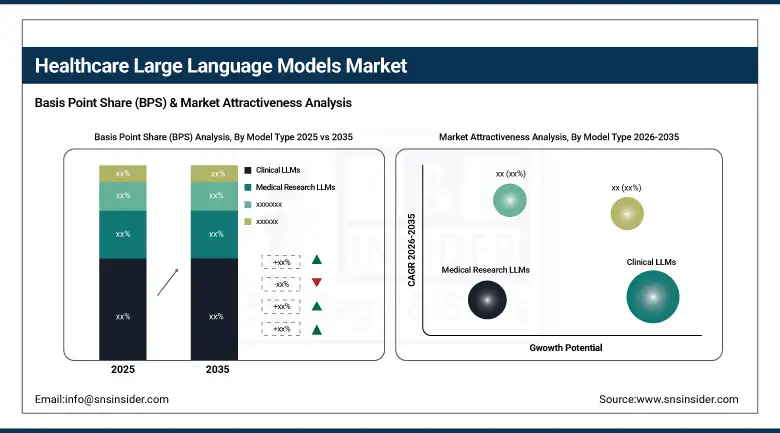
By Model Type, clinical LLMs dominated the market with 42.00% share in 2025, while drug discovery & life sciences LLMs are projected to witness the fastest growth with 34.35% CAGR during the forecast period.
-
By Deployment Mode, cloud-based LLM platforms dominated the market with 56.00% share in 2025, while hybrid deployments are projected to witness the fastest growth with 34.48% CAGR during the forecast period.
-
By Application, drug discovery, research & medical knowledge management dominated the market with 38.00% share in 2025, while clinical documentation & medical scribing is projected to witness the fastest growth with 32.24% CAGR during the forecast period.
-
By End User, healthcare providers dominated the market with 46.00% share in 2025, while pharmaceutical & biotechnology companies are projected to witness the fastest growth with 34.43% CAGR during the forecast period.
By Model Type, clinical LLMs dominated, while drug discovery & life sciences LLMs are fastest-growing.
The market for clinical LLMs was dominated by 42.00%, since it is being increasingly adopted for hospital, network of physicians, and healthcare provider applications in areas such as clinical documentation, summarization of patient records, clinical workflows, and physician efficiency. Specialized LLMs trained on medical data sets are increasingly used by the healthcare organizations for improving document quality, enhancing operational efficiency, and minimizing clinician's administrative workload. In addition, the use of such models is being implemented in the electronic health record systems, clinical decision support software, and patient engagement platforms for streamlining data access and enhancing collaboration.
The drug discovery & life sciences LLMs segment is anticipated to witness the highest CAGR of 34.35% throughout the forecast period due to the growing usage of generative artificial intelligence platforms for molecular research, target identification, clinical trials improvement, and biomedical data analytics. Pharmaceutical firms are investing in developing domain-specific LLM infrastructure for boosting research and development process productivity. The use of such models allows scientists to analyze large amounts of scientific data, discover new opportunities for treatment and streamline the complex process of drug development. Several life sciences companies extended their drug discovery collaborations through AI-driven technology in 2025-2026.
By Deployment Mode, cloud-based LLM platforms dominated, while hybrid deployments are fastest-growing.
The cloud-based LLM platforms segment dominated the market in 2025 with a 56.00% market share owing to its scalability features, centralization of model management, reduced infrastructure needs, and rapid deployment capabilities. Many healthcare enterprises have been using cloud-based healthcare AI environments for enterprise-level deployment of generative AI applications. With the help of cloud-based computing power, many healthcare organizations can leverage AI tools without making large infrastructure investments in addition to updating their models at any point and working collaboratively within the entire organization. The ability to scale up resources on an as-needed basis and integration with multiple healthcare applications continues to make it popular among healthcare organizations.
It is estimated that the hybrid deployments segment will post the highest CAGR of 34.48% through the forecast period on account of increasing demand for meeting healthcare data governance concerns along with scalable AI processing capabilities. Enterprises and healthcare providers are implementing hybrid deployments in which they can have full control over their data while executing AI models in the cloud environment. By adopting such hybrid deployment architectures, they can ensure that they can be in compliance with strict healthcare privacy guidelines and can benefit from cloud environments at the same time.
Regional Analysis
|
Region |
Major Country |
Share within Region, 2025 (%) |
|---|---|---|
|
North America |
United States |
95.00% |
|
Europe |
Germany |
24.00% |
|
Asia Pacific |
China |
20.00% |
|
Middle East & Africa |
UAE |
4.00% |
|
Latin America |
Brazil |
4.00% |
North America Healthcare Large Language Models Market Insights
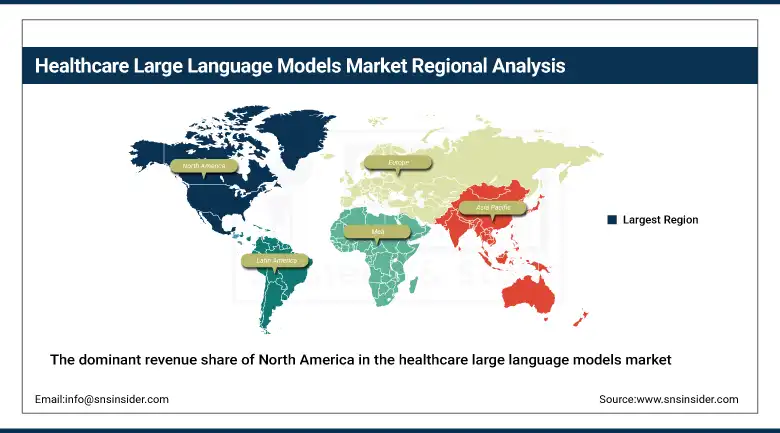
The dominant revenue share of North America in the healthcare large language models market stood at about 48.00% in 2025. Leadership in the market is attributed to the presence of high levels of healthcare digitization, healthcare AI investment activity, adoption of electronic health record (EHR) systems, and deployment of generative AI. Hospitals, health systems, life sciences companies, and healthcare technology firms are leveraging healthcare LLMs to improve their efficiency and innovation capacity. The region is characterized by well-established digital health ecosystem, venture capital investments, favorable rate of technology adoption, and collaborations between healthcare providers and AI technology developers.
Several North American healthcare technology firms increased the use of healthcare-oriented generative AI in 2025-2026. They were leveraging healthcare LLMs in physician work flow, patient engagement, medical coding, and healthcare analytics systems.
Get Customized Report as per Your Business Requirement - Enquiry Now
Europe Healthcare Large Language Models Market Insights
Europe constituted about 24.00% of the total market revenue in 2025 owing to various reasons such as the rise in healthcare digital transformation initiatives, the increase in AI usage in healthcare delivery systems, and the increase in investments in biomedical research facilities. There has been an increased use of language models in the field of healthcare within the region, especially in countries like Germany, the U.K., France, and Nordic countries to increase efficiency in clinical processes and research. The focus of the region on innovation in healthcare, patient safety, and compliance has resulted in the adoption of AI-based healthcare solutions. Multilingual applications for health care, automation of documentation systems, and smart health-care decision support systems have experienced a rise in demand.
Some healthcare organizations from Europe have expanded their AI-powered health care systems for multilingual applications in clinical intelligence and biomedicine during 2025-2026.
Asia Pacific Healthcare Large Language Models Market Insights
According to the study, the APAC region is expected to register the fastest growth rate of 36.71%. This can be attributed to the fast growth of healthcare digitalization efforts in the region, higher AI investments in the region, improvements in the healthcare infrastructure, and government initiatives that encourage innovation in the use of AI. The use of healthcare-specific generative AI solutions has grown significantly in the region, particularly in China, Japan, India, and South Korea. The rise in healthcare spending, increase in number of patients, and need for more efficient ways of providing healthcare services create ample opportunities for implementing LLMs.
In 2026, there have been many applications of healthcare LLMs by some healthcare organizations in Asia Pacific for purposes such as clinical documentation, medical research, and improving healthcare workflow processes.
Middle East & Africa and Latin America Healthcare Large Language Models Market Insights
In addition, the Middle East & Africa market will experience consistent growth owing to modernization of the healthcare sector, AI innovations initiatives, and investment in digital health infrastructure in UAE, Saudi Arabia, and South Africa. Healthcare organizations are slowly implementing healthcare AI technologies to enhance their operational performance and care delivery process. In addition, market growth is attributed to increasing government support for digital transformation, increase in smart healthcare facilities, and high demands for advanced clinical technology. Healthcare providers are looking forward to utilizing healthcare AI technologies such as automation of documentation, patient engagement, and clinical decision support within their healthcare modernization initiative.
The Latin America market was valued at approximately 4.00% of the global market share in 2025 due to increasing healthcare digital transformation initiative, adoption of cloud-based healthcare technology, and investment in AI enabled healthcare solution in Brazil, Mexico, Argentina, and Chile. All the healthcare organizations in the region have been investing in digital platform to increase efficiency and streamlining of clinical workflows as well as improving accessibility to healthcare. Increasing awareness about the capability of generative AI, investment in healthcare IT infrastructure, and high demands for effective healthcare delivery solutions are promoting the adoption of the technology.
Market Dynamics
Growth Drivers: Increased use of generative AI in healthcare workflows.
The rapid implementation of generative AI technologies within healthcare delivery, clinical documentation, diagnosis, and life science research is fueling growth prospects of healthcare large language models. Health care organizations are adopting LLMs specifically built for the industry in order to automate the processes, make clinical procedures efficient, speed up research functions, and aid decision making. The ability of health care LLMs to process the unstructured information of the industry and derive actionable insights has been the major reason for the adoption of LLMs by enterprise companies around the world.
Increasing pressure on physicians, growing healthcare information, and the need for intelligent automation are also contributing to the adoption of healthcare LLMs in hospitals, health systems, pharmaceuticals, and research organizations. Healthcare EHR systems, clinical decision support systems, and digital health systems are also providing more business opportunities for LLMs in the healthcare industry around the globe.
In 2025-2026, various healthcare tech companies have introduced commercial products of health care-specific foundation models that can automate clinical workflows and manage medical knowledge.
Restraints: Regulations, model explain ability, and healthcare privacy issues.
Although the industry is expected to have numerous growth prospects, healthcare providers are still facing challenges pertaining to patient privacy issues, explain ability of the model, regulation, and governance related to the use of AI. The deployment of generative AI models in the healthcare field demands a lot of validation, secure environment, and clinical guidance in order to ensure effective performance and compliance with the regulations. Concerns relating to patient privacy, accuracy of the results, bias problems, and data of the patients still continue to pose major challenges. Moreover, different regulations in different regions make deployment more complicated for multi-national healthcare companies. Compatibility with existing legacy systems and continuous monitoring are also additional barriers to overcome.
Regulatory agencies and industry associations of healthcare continued working on the development of the framework for the governance of AI technologies in healthcare in 2026.
Opportunities: Expansion of foundation models for clinical intelligence and drug discovery.
Healthcare-focused foundation models are generating vast opportunities in clinical intelligence, healthcare research, precision medicine, and pharmaceutical innovation. Many organizations are making investments in advanced LLM solutions that can be used for clinical decision-making, biomedical discoveries, and automation of healthcare processes. With more and more data being generated and computational technologies improving, opportunities for commercialization of specialized healthcare LLM solutions will be increasing rapidly. Rising interest in personalized medicine and advanced capabilities of clinical intelligence and healthcare research is driving organizations to experiment with innovative AI solutions. The combination of healthcare data, cloud computing, and generative AI technologies creates an environment where market can grow successfully for the long term.
In 2025–2026, several healthcare AI vendors released advanced healthcare foundation models that are used for clinical analytics, biomedical knowledge creation, and acceleration of life sciences research.
Recent Developments
-
2026: Microsoft expanded healthcare-focused generative AI capabilities through Azure AI and clinical workflow automation initiatives.
-
2026: Google enhanced MedLM deployments supporting healthcare documentation, clinical intelligence, and healthcare knowledge management.
-
2025: Oracle Health expanded healthcare AI integrations supporting clinical workflow optimization and healthcare data intelligence.
-
2025: NVIDIA expanded collaborations with healthcare organizations to accelerate deployment of healthcare foundation models and biomedical AI platforms.
Healthcare Large Language Models Market Key Players are:
-
Microsoft Corporation
-
Google LLC
-
Oracle Corporation
-
NVIDIA Corporation
-
Amazon Web Services, Inc.
-
OpenAI, LLC
-
Anthropic PBC
-
Meta Platforms, Inc.
-
IBM Corporation
-
NVIDIA BioNeMo
-
Abridge AI, Inc.
-
Suki AI, Inc.
-
Hippocratic AI
-
Nabla Technologies
-
DeepScribe Inc.
-
John Snow Labs Inc.
-
GSK plc
-
IQVIA Holdings Inc.
-
Tempus AI, Inc.
-
PathAI, Inc.
Healthcare Large Language Models Market Report Scope:
| Report Attributes | Details |
|---|---|
| Market Size in 2025 | USD 1.14 Billion |
| Market Size by 2035 | USD 17.831 Billion |
| CAGR | CAGR of 31.73% From 2026 to 2035 |
| Base Year | 2025 |
| Forecast Period | 2026-2035 |
| Historical Data | 2022-2024 |
| Report Scope & Coverage | Market Size, Segments Analysis, Competitive Landscape, Regional Analysis, DROC & SWOT Analysis, Forecast Outlook |
| Key Segments | • By Model Type (Clinical LLMs, Medical Research LLMs, Drug Discovery & Life Sciences LLMs) • By Deployment Mode (Cloud-Based LLM Platforms, On-Premise LLM Deployments, Hybrid Deployments) • By Application (Clinical Documentation & Medical Scribing, Clinical Decision Support & Diagnostics, Drug Discovery, Research & Medical Knowledge Management) • By End User (Healthcare Providers, Pharmaceutical & Biotechnology Companies, Others) |
| Regional Analysis/Coverage | North America (US, Canada), Europe (Germany, UK, France, Italy, Spain, Russia, Poland, Rest of Europe), Asia Pacific (China, India, Japan, South Korea, Australia, ASEAN Countries, Rest of Asia Pacific), Middle East & Africa (UAE, Saudi Arabia, Qatar, South Africa, Rest of Middle East & Africa), Latin America (Brazil, Argentina, Mexico, Colombia, Rest of Latin America). |
| Company Profiles | Microsoft Corporation, Google LLC, Oracle Corporation, NVIDIA Corporation, Amazon Web Services, Inc., OpenAI, LLC, Anthropic PBC, Meta Platforms, Inc., IBM Corporation, NVIDIA BioNeMo, Abridge AI, Inc., Suki AI, Inc., Hippocratic AI, Nabla Technologies, DeepScribe Inc., John Snow Labs Inc., GSK plc, IQVIA Holdings Inc., Tempus AI, Inc., PathAI, Inc. |
Frequently Asked Questions
The Healthcare Large Language Models Market was valued at USD 1.14 Billion in 2025.
The market is projected to reach USD 17.83 Billion by 2035.
The market is expected to expand at a CAGR of 31.73% during the forecast period.
North America dominated the global market with a 48.00% revenue share in 2025.
Clinical LLMs accounted for the largest revenue share of 42.00% in 2025.
