
Healthcare Technology Market Report Scope & Overview:
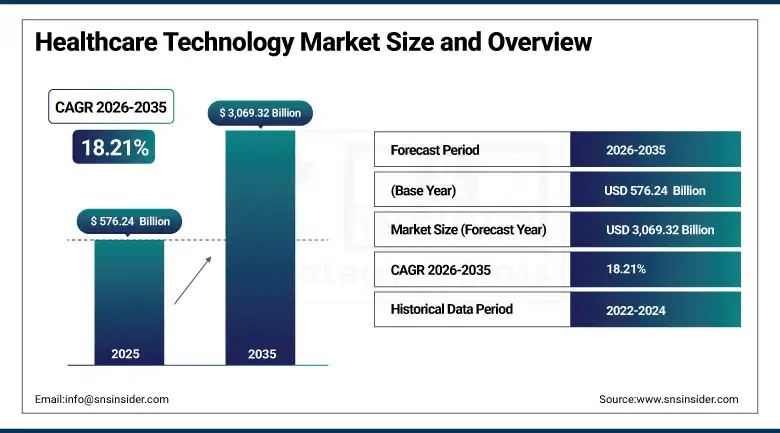
The Healthcare Technology Market was valued at USD 576.24 Billion in 2025 and is projected to reach USD 3,069.32 Billion by 2035, expanding at a CAGR of 18.21% during the forecast period 2026–2035.
The rapid commercialization of the global healthcare technology market is being propelled by rising integration of AI-enabled clinical platforms, cloud-based healthcare infrastructure, digital health ecosystems, and predictive healthcare analytics in hospitals and healthcare networks. To improve patient outcomes, optimize operational efficiency, and support value-based healthcare delivery models, healthcare organizations are investing in electronic health records, AI-assisted diagnostics, telehealth ecosystems, cloud-connected clinical management systems, and intelligent healthcare automation technologies. Moreover, the increasing adoption of smart hospital infrastructure, RFID-based healthcare asset monitoring systems and real-time healthcare workflow automation is also aiding the long-term growth of the market across the globe.
In 2025-2026, a number of healthcare technology providers launched AI-powered healthcare management platforms that embedded predictive analytics, intelligent clinical decision support systems, cloud-enabled healthcare data environments, and automated patient monitoring solutions across enterprise healthcare ecosystems.
To Get more information On Healthcare Technology Market - Request Free Sample Report
Healthcare Technology Market Trends
-
Rising deployment of AI-enabled clinical decision support platforms across hospitals.
-
Increasing investments in cloud-connected healthcare infrastructure and digital ecosystems.
-
Growing adoption of RFID-enabled healthcare asset tracking and workflow automation systems.
-
Expansion of smart hospital infrastructure integrated with predictive healthcare analytics.
-
Increasing commercialization of telehealth platforms and real-time patient monitoring technologies.
The U.S. Healthcare Technology Market Size Outlook
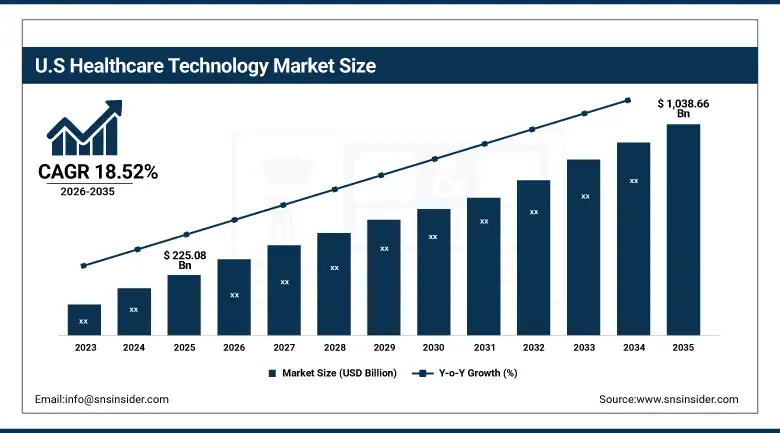
The U.S. Healthcare Technology Market was valued at USD 225.08 billion in 2025 and is expected to reach approximately USD 1,038.66 billion by 2035, expanding at a CAGR of 18.52% during 2026–2035.
The U.S. remains the leader in the healthcare technology market due to its advanced digital healthcare infrastructure, increasing adoption of AI across hospital systems, and strong investment in enterprise healthcare IT modernization. Healthcare providers are rapidly embracing cloud-based healthcare management platforms, AI-enabled diagnostic systems, predictive analytics platforms and connected healthcare ecosystems to enhance clinical efficiency and patient engagement. The commercialization prospects for RFID solutions are further rising across healthcare facilities across the country with growing adoption of RFID-enabled medical asset tracking systems, UDI-compliant healthcare monitoring solutions, and automated workflow management systems.
In 2026, several U.S. health tech companies fast-tracked the rollout of healthcare automation systems, including AI-powered predictive diagnostics, cloud-based patient monitoring and smart clinical workflow management across multiple hospital settings.
Healthcare Technology Market Segment Analysis
-
By Technology Category, healthcare information systems dominated the market with 41.00% share in 2025, while AI, analytics & clinical decision support technologies are projected to witness the fastest growth with 20.33% CAGR during the forecast period.
-
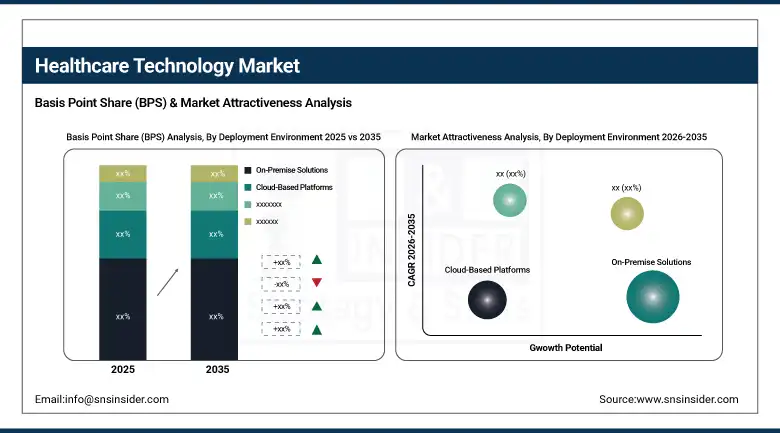
By Deployment Environment, on-premise solutions dominated the market with 44.00% share in 2025, while cloud-based platforms are projected to witness the fastest growth with 21.50% CAGR during the forecast period.
-
By End User, healthcare providers dominated the market with 58.00% share in 2025, while life sciences & research organizations are projected to witness the fastest growth with 20.27% CAGR during the forecast period.
By Technology Category, healthcare information systems dominated, while ai, analytics & clinical decision support technologies are fastest-growing.
The healthcare information systems segment held the largest revenue share of 41.00% in 2025 due to the increasing adoption of hospital information systems, electronic health records, healthcare workflow management platforms, and enterprise clinical data integration technologies across healthcare networks. Hospitals and health systems are increasing investments in interoperable health infrastructure linked to cloud-based patient management systems and real-time clinical analytics platforms to drive improvements in operational efficiency and regulatory compliance. The global segment growth is further boosted by the growing adoption of smart hospital ecosystems that are integrated with RFID-enabled healthcare asset tracking and UDI-compliant healthcare management systems.
The AI, analytics & clinical decision support technologies segment is projected to witness the fastest CAGR of 20.33% over the forecast period, owing to the rising commercialization of AI-assisted diagnostics, predictive healthcare analytics, automated clinical workflow optimization, and intelligent patient monitoring systems. Machine learning algorithms, cloud-based analytics environments and AI-powered healthcare automation platforms are increasingly being implemented by healthcare organizations to increase diagnostic accuracy, boost efficiency in clinical operations and manage patient outcomes. During 2025-2026, some of the healthcare technology vendors introduced AI-enabled clinical decision support systems that included predictive analytics, automated healthcare alerts, and intelligent population health management capabilities.
By Deployment Environment, on-premise solutions dominated, while cloud-based platforms are fastest-growing.
The on-premise solutions segment held the largest market share of 44.00% in 2025 due to a strong adoption by large hospitals and healthcare institutions that need high-level healthcare data security, control over internal infrastructure, and compliance-driven healthcare information management environments. Healthcare organizations keep spending money on enterprise-grade on-premise healthcare management systems that integrate with clinical workflow optimization, patient record management, and secure healthcare data processing capabilities. Increasing regulatory focus on patient data protection, healthcare cyber security, and compliance with healthcare information governance frameworks is driving continued adoption across major healthcare systems.
The cloud-based platforms segment is anticipated to register the fastest CAGR of 21.50% during the forecast period owing to increasing demand for scalable healthcare IT infrastructure, remote healthcare accessibility, and integrated healthcare data management systems. Healthcare providers are increasingly implementing cloud-connected healthcare ecosystems that enable telehealth integration, predictive analytics, AI-enabled diagnostics and real-time healthcare workflow monitoring capabilities. In 2026, multiple healthcare IT vendors commercialized cloud-native healthcare platforms with intelligent automation, RFID-enabled healthcare asset tracking and interoperable patient data exchange systems.
By End User, healthcare providers dominated, while life sciences & research organizations are fastest-growing.
The healthcare providers segment accounted for the largest revenue share of 58.00% in 2025, owing to the growing investments by hospitals, clinics, and integrated healthcare systems in digital healthcare transformation initiatives. Healthcare providers are accelerating the deployment of AI-enabled healthcare management systems, predictive patient monitoring platforms, cloud-based clinical data ecosystems, and automated healthcare workflow technologies to enhance operational efficiency and patient care delivery. Increasing adoption of RFID based medical device tracking systems, smart healthcare logistics platforms and smart hospital infrastructure are also driving the provider market growth.
The life sciences & research organizations segment is expected to witness the highest growth rate with a CAGR of 20.27% over the forecast period, driven by the increasing adoption of AI-enabled healthcare analytics, real-time clinical research data management systems, and cloud-enabled drug discovery platforms. Research institutions and pharmaceutical companies are increasingly adopting advanced healthcare technologies for precision medicine research, clinical trial optimization, predictive biomarker analysis, and healthcare data automation. 2025-2026: Several life sciences technology companies accelerated the adoption of AI-based research platforms that facilitate predictive clinical analytics, automated research workflows and intelligent healthcare data processing environments.
Regional Analysis
|
Region |
Major Country |
Share within Region, 2025 (%) |
|---|---|---|
|
North America |
United States |
93.00% |
|
Europe |
Germany |
27.00% |
|
Asia Pacific |
China |
23.00% |
|
Middle East & Africa |
UAE |
4.00% |
|
Latin America |
Brazil |
4.00% |
North America Healthcare Technology Market Insights
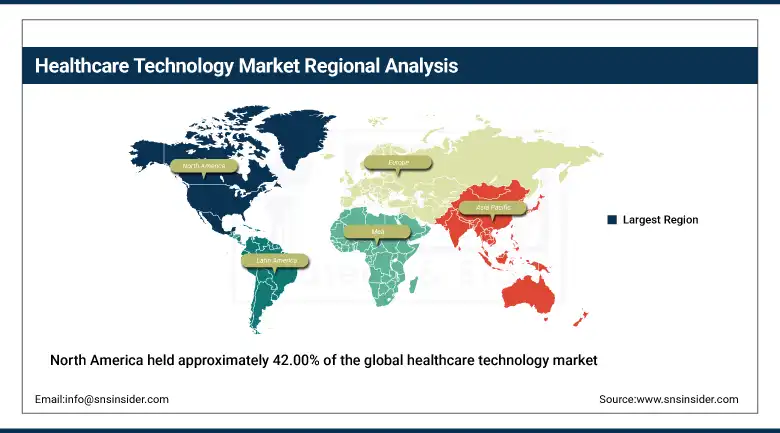
North America held approximately 42.00% of the global healthcare technology market revenue in 2025, owing to the developed healthcare IT infrastructure, strong commercialization of AI-powered healthcare platforms, and increasing deployment of cloud-connected clinical ecosystems across the U.S. and Canada. Healthcare institutions across the region are heavily investing in predictive healthcare analytics, enterprise healthcare management systems, RFID-enabled healthcare tracking technologies, and intelligent workflow automation platforms to improve patient care delivery and operational scalability. The rapid growth of smart hospital infrastructure and the increasing adoption of UDI-compliant healthcare asset monitoring systems are aiding the long-term market growth across the region.
Between 2025 and 2026, many of the North American healthcare technology companies increased deployment of AI-enabled clinical automation systems integrated with predictive diagnostics, intelligent healthcare analytics, and cloud-based environments for patient management across enterprise healthcare networks.
Get Customized Report as per Your Business Requirement - Enquiry Now
Europe Healthcare Technology Market Insights
In 2025, Europe accounted for a market share of almost 27.00% on the back of increasing healthcare digitalization initiatives, rising investments in healthcare interoperability infrastructure, and increasing adoption of AI-enabled healthcare management platforms across Germany, the U.K., France, and Italy. Healthcare organizations are increasingly leveraging cloud-based healthcare ecosystems, predictive clinical analytics systems, and intelligent healthcare automation technologies to optimize healthcare operations and enhance patient outcomes. Increasing regulatory scrutiny around healthcare cyber security, patient data protection and modernization of healthcare workflows are also fueling regional market growth.
In 2025–2026, multiple European healthcare providers expanded deployment of AI-enabled healthcare data management systems that deliver predictive diagnostics, automated clinical decision support, and real-time patient monitoring capabilities across connected healthcare environments.
Asia Pacific Healthcare Technology Market Insights
Asia Pacific is expected to witness the fastest CAGR of 22.18% during the forecast period owing to the increasing healthcare digitalization, rising smart hospital investments and the growing adoption of AI-powered healthcare technologies across China, Japan, India, South Korea and South-east Asia. Increasing focus of governments and healthcare organizations towards cloud-connected healthcare ecosystems, telehealth infrastructure, predictive healthcare analytics, and RFID-enabled healthcare automation technologies to improve the accessibility of healthcare and operational efficiency. The increasing burden of chronic diseases, rising healthcare costs, and rapid modernization of healthcare IT are driving commercialization opportunities across the region.
In 2026, a number of healthcare technology companies in Asia Pacific commercialized AI-enabled healthcare management platforms that integrate predictive analytics, intelligent clinical automation, and cloud-connected healthcare monitoring systems, enabling scalable digital healthcare transformation.
Middle East & Africa and Latin America Healthcare Technology Market Insights
The Middle East & Africa market is witnessing steady growth, driven by increased investments in smart healthcare infrastructure, the growing deployment of cloud-enabled healthcare systems, and the rising adoption of AI-assisted healthcare management technologies in UAE, Saudi Arabia, and South Africa. Healthcare providers are increasingly deploying predictive analytics platforms, intelligent healthcare automation systems and RFID-integrated healthcare asset monitoring technologies to improve hospital operational efficiency and patient management capabilities. Regional commercialization opportunities continue to be supported by government-driven healthcare modernization and digital healthcare transformation initiatives.
Latin America Market, By Region Latin America held a market share of over 4.00% in 2025 attributed to the increasing healthcare IT investments, rising telehealth adoption and growing commercialization of AI-powered healthcare technologies in Brazil, Mexico and Argentina. Healthcare institutions are increasingly implementing cloud-connected healthcare ecosystems, predictive healthcare analytics platforms and intelligent healthcare workflow systems to improve the efficiency of healthcare delivery and capabilities of chronic disease management. Increasing digitalization of healthcare and demand for remote healthcare access are supporting long-term regional market growth.
Market Dynamics
Growth Drivers: Growing AI-enabled healthcare ecosystem and smart hospital infrastructure.
The rapid advancement of AI-driven healthcare ecosystems, predictive healthcare analytics platforms, and smart hospital infrastructure is a significant driver of growth in the global healthcare technology market. Hospitals and healthcare networks are investing heavily in cloud-connected healthcare systems, AI-assisted diagnostics, RFID-enabled healthcare asset tracking technologies, and intelligent patient management platforms to improve operational efficiency, reduce healthcare costs, and optimize patient outcomes. The rising integration of real-time healthcare monitoring systems, UDI-compliant healthcare management solutions and automated clinical workflow technologies is further supporting the global commercialization opportunities. Healthcare organizations and hospitals are turning to AI-powered predictive analytics platforms, intelligent scheduling systems, cloud-based electronic health records, and digital patient engagement technologies to improve healthcare operations and clinical productivity.
In 2025-2026, several healthcare technology vendors launched AI-enabled healthcare automation platforms that provide predictive clinical analytics, intelligent healthcare operations, cloud-connected patient monitoring and automated healthcare decision-support capabilities to enterprise healthcare environments.
Restraints: Healthcare cyber security challenges and integration complexity.
Despite the rapid technological advancement, healthcare cyber security risks, healthcare data interoperability challenges and high integration costs of infrastructure continue to restrict adoption across healthcare organizations globally. Enterprise healthcare technology environments require significant investments in cloud migration, cyber security compliance, healthcare workflow integration, enterprise analytics systems, and regulatory management infrastructure to ensure secure healthcare operations and protect patient data. Smaller hospitals, independent healthcare providers, and emerging healthcare facilities often face operational and financial challenges in deploying AI-enabled healthcare ecosystems, connected healthcare infrastructure, and advanced digital healthcare management systems, which can act as a barrier.
In 2026, healthcare regulatory bodies made compliance frameworks for healthcare cyber security, patient data governance, interoperability standards and the implementation of AI-enabled healthcare technology across connected healthcare ecosystems more robust, enhancing healthcare system resilience and operational security.
Opportunities: Commercialization of health care analytics and predictive automation platforms linked to the cloud.
The continued rapid pace of technological development, healthcare cyber security risks, healthcare data interoperability challenges and high integration costs of infrastructure continue to limit adoption across healthcare organizations globally. The increasing commercialization of cloud-connected healthcare ecosystems and predictive healthcare analytics platforms presents considerable long-term growth opportunities for global healthcare technology vendors. Healthcare organizations are fast to invest in AI powered healthcare automation systems, intelligent patient engagement platforms, cloud-native healthcare infrastructure, and predictive clinical management technologies to improve operational scalability and healthcare accessibility. With cloud-based healthcare ecosystems, healthcare organizations can monitor patients in real-time, centralize healthcare analytics, automate healthcare workflows and enable intelligent clinical decision-making across distributed healthcare networks.
In 2026, the resilience of the healthcare system has improved through stronger compliance frameworks for healthcare cyber security, patient data governance, interoperability standards and the implementation of AI-enabled healthcare technology across connected healthcare ecosystems by healthcare regulatory bodies.
Recent Developments
-
2026: Oracle Health expanded AI-powered healthcare data intelligence capabilities integrated with predictive clinical analytics and cloud-connected hospital management systems.
-
2026: Microsoft strengthened commercialization of generative AI healthcare solutions supporting intelligent clinical workflow optimization and healthcare analytics automation.
-
2025: GE HealthCare introduced advanced AI-enabled imaging analytics platforms integrated with real-time healthcare data management capabilities.
-
2025: Philips expanded deployment of connected healthcare ecosystems supporting cloud-based patient monitoring and predictive healthcare analytics technologies.
Healthcare Technology Market Key Players are:
-
Oracle Corporation
-
Microsoft Corporation
-
GE HealthCare Technologies Inc.
-
Koninklijke Philips N.V.
-
Siemens Healthineers AG
-
Medtronic plc
-
Epic Systems Corporation
-
Cerner Corporation
-
IBM Corporation
-
Cisco Systems Inc.
-
Athenahealth Inc.
-
Veradigm Inc.
-
eClinicalWorks LLC
-
NVIDIA Corporation
-
SAP SE
-
Salesforce Inc.
-
Teladoc Health Inc.
-
Cognizant Technology Solutions Corporation
-
McKesson Corporation
-
Allscripts Healthcare Solutions Inc.
Healthcare Technology Market Report Scope:
| Report Attributes | Details |
|---|---|
| Market Size in 2025 | USD 576.24 Billion |
| Market Size by 2035 | USD 3,069.32 Billion |
| CAGR | CAGR of 18.21% From 2026 to 2035 |
| Base Year | 2025 |
| Forecast Period | 2026-2035 |
| Historical Data | 2022-2024 |
| Report Scope & Coverage | Market Size Analysis, Revenue Forecasting, Segment Analysis, Competitive Landscape, Regional Analysis, Retail Automation Assessment, Smart Checkout Technology Trends, AI-Enabled Retail Infrastructure Analysis, DROC & SWOT Analysis, Investment Trends, Supply Chain Evaluation, Consumer Transaction Technology Assessment, and Future Market Opportunity EvaluationChain Evaluation, Industrial Packaging Demand Analysis, Sustainability Assessment, DROC & SWOT Analysis, Regulatory Framework Analysis, Innovation Benchmarking, and Future Market Opportunity Evaluation |
| Key Segments | • By Technology Category (Healthcare Information Systems, Digital Health & Telehealth Technologies, AI, Analytics & Clinical Decision Support Technologies) • By Deployment Environment (Cloud-Based Platforms, On-Premise Solutions, Hybrid Platforms) • By End User (Healthcare Providers, Healthcare Payers, Life Sciences & Research Organizations) |
| Regional Analysis/Coverage | North America (US, Canada), Europe (Germany, UK, France, Italy, Spain, Russia, Poland, Rest of Europe), Asia Pacific (China, India, Japan, South Korea, Australia, ASEAN Countries, Rest of Asia Pacific), Middle East & Africa (UAE, Saudi Arabia, Qatar, South Africa, Rest of Middle East & Africa), Latin America (Brazil, Argentina, Mexico, Colombia, Rest of Latin America). |
| Company Profiles | Oracle Corporation, Microsoft Corporation, GE HealthCare Technologies Inc., Koninklijke Philips N.V., Siemens Healthineers AG, Medtronic plc, Epic Systems Corporation, Cerner Corporation, IBM Corporation, Cisco Systems Inc., Athenahealth Inc., Veradigm Inc., eClinicalWorks LLC, NVIDIA Corporation, SAP SE, Salesforce Inc., Teladoc Health Inc., Cognizant Technology Solutions Corporation, McKesson Corporation, Allscripts Healthcare Solutions Inc. |
Frequently Asked Questions
The Healthcare Technology Market was valued at USD 576.24 billion in 2025.
The market is projected to reach USD 3069.32 billion by 2035.
The market is expected to expand at a CAGR of 18.21% during the forecast period.
North America dominated the global market owing to advanced healthcare IT infrastructure and increasing deployment of AI-enabled healthcare ecosystems.
Healthcare Information Systems accounted for the largest revenue share of 41.00% in 2025.
