
Silicon Anode Materials Market Report Scope & Overview:
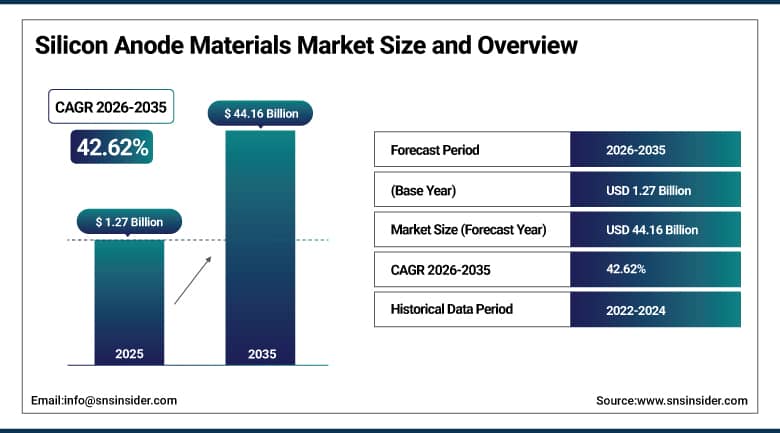
The Silicon Anode Materials Market was valued at USD 1.27 Billion in 2025 and is expected to reach USD 44.16 Billion by 2035, growing at a CAGR of 42.62% from 2026-2035.
Graphite has been the standard choice for anode material in lithium-ion batteries for many years and has worked well enough, but it has silently constrained the amount of energy that the batteries are capable of holding. By weight, silicon can theoretically hold about ten times as much lithium as graphite, which explains why it is currently one of the most intensely studied materials in the whole battery sector, where there is significant promise in terms of substantially increasing the driving range of EVs or reducing the thickness of consumer gadgets without a change in battery design. The only thing is that silicon expands significantly when charged and absorbing lithium, often swelling up by as much as 300%, which causes cracking in the electrodes and kills off the battery quickly unless it becomes possible to somehow contain that swelling. That is precisely the technological problem that has a growing number of promising startups and materials firms working on right now, with the tech finally getting ready for production at gigawatt scale.
In September 2025, Sila Nanotechnologies opened its factory in Moses Lake, Washington, which the company describes as the first auto-scale silicon anode plant in the United States, financed in part by a $375 million capital raise. Getting a facility like this from construction to operational status after nearly two years of building is a genuine milestone for an industry that has, until now, mostly existed as pilot lines and lab-scale demonstrations, and it signals that silicon anode technology is finally crossing the threshold from promising science project into something automakers can actually plan around at meaningful volume.
To Get More Information On Silicon Anode Materials Market - Request Free Sample Report
Silicon Anode Materials Market Trends
-
Rising commercial-scale factory construction as leading developers move from pilot lines to gigawatt-scale production.
-
Growing preference for silicon-carbon composite formulations balancing energy density with cycle stability.
-
Expanding automaker partnerships integrating silicon anode materials directly into next-generation EV battery platforms.
-
Increasing government funding supporting domestic silicon anode manufacturing capacity in the United States and South Korea.
-
Rising investment in silane gas supply chains addressing a key raw material bottleneck for silicon anode production.
-
Growing adoption of silicon anode materials in premium consumer electronics seeking thinner, longer-lasting batteries.
U.S. Silicon Anode Materials Market Outlook
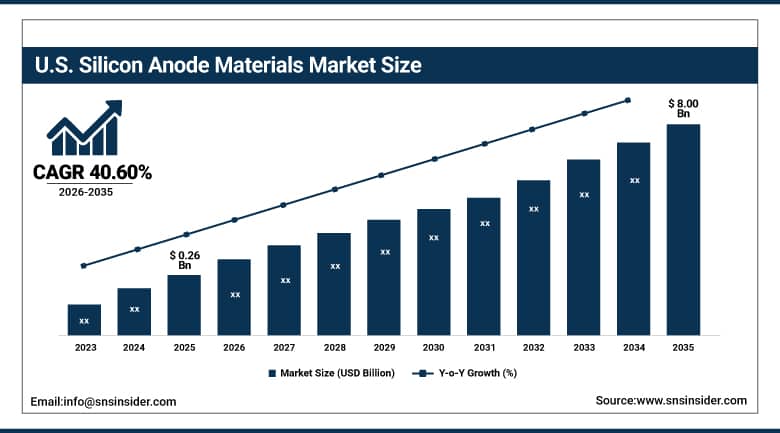
The U.S. Silicon Anode Materials Market was valued at USD 0.26 Billion in 2025 and is expected to reach USD 8.00 Billion by 2035, growing at a CAGR of 40.60% from 2026-2035.
The United States has become the epicenter of silicon anode commercialization, home to the three companies, Group14 Technologies, Sila Nanotechnologies, and Amprius Technologies, that collectively raised nearly half a billion dollars in late 2022 alone to push their materials toward commercial scale. The early funding wave, which included $250 million from the U.S. Department of Energy, has since translated into actual factories breaking ground in places like Moses Lake, Washington, which offers cheap hydropower, abundant land, and proximity to silane gas suppliers, giving the domestic industry a genuine geographic cluster advantage. Domestic automakers and technology companies continue signing supply agreements and integration partnerships with these silicon anode specialists, reflecting a bet that the country can build a meaningful, home-grown position in next-generation battery materials rather than ceding the category entirely to Asian manufacturers.
Group14 Technologies, headquartered in Woodinville, Washington, secured $463 million in new investment in August 2025, even as the company simultaneously delayed the start of production at its flagship Moses Lake battery materials plant by more than a year. CEO Rick Luebbe described the raise as powerful validation that investors are doubling down on Group14's role in shaping the future of energy storage, and the round followed an earlier $200 million U.S. Department of Energy grant to help the company build a dedicated silane gas plant, a critical raw material input that has historically been a supply chain bottleneck for the entire silicon anode industry.
Silicon Anode Materials Market Segment Analysis
-
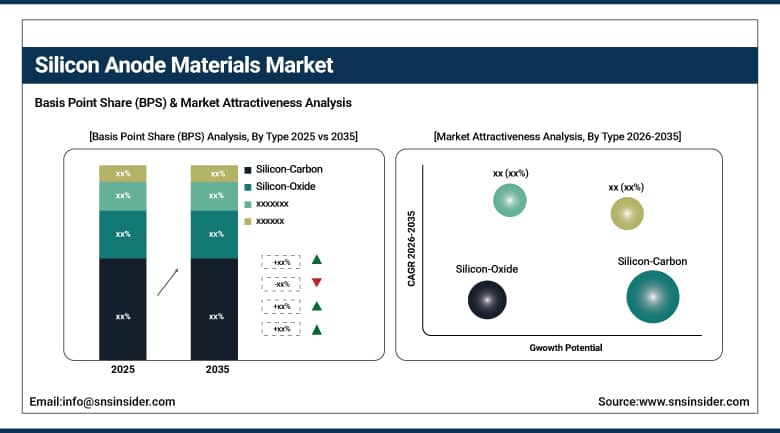
By Type, the Silicon-Carbon segment dominated the Silicon Anode Materials Market with approximately 64.60% share in 2025, and is also the fastest growing with a CAGR of approximately 44.60%.
-
By Application, the Electric Vehicles segment dominated the Silicon Anode Materials Market with approximately 44.60% share in 2025, while the Energy Storage Systems segment is the fastest growing with a CAGR of approximately 46.60%.
-
By Production Process, the Chemical Vapor Deposition segment dominated the Silicon Anode Materials Market with approximately 48.60% share in 2025, while the Ball Milling segment is the fastest growing with a CAGR of approximately 43.60%.
By Type, Silicon-Carbon Dominates the Silicon Anode Materials Market and Also Grows Fastest
Silicon-carbon composites dominate this market because they strike a genuinely practical balance that pure silicon formulations struggle to match, meaningfully higher energy density than graphite alone, paired with enough structural stability from the carbon component to keep the material from degrading too quickly during repeated charge cycles. That balance has made silicon-carbon the material of choice for companies including Group14, whose SCC55 product now ships to more than 100 EV and battery makers worldwide, positioning this approach as the practical bridge between conventional graphite and the higher-silicon-content chemistries still working toward commercial maturity.
Silicon-carbon is also the fastest-growing type, as continued material innovation keeps improving the cost and performance profile of these composites just as automakers accelerate their qualification timelines for next-generation battery chemistries. With expanding electric vehicle production and rising battery capacity requirements pushing automakers to seek every available energy density gain, silicon-carbon's combination of demonstrated performance and manufacturing scalability continues reinforcing its position as both the largest and fastest-growing segment of the broader silicon anode materials category.
By Application, Electric Vehicles Dominates the Silicon Anode Materials Market and Energy Storage Systems Grows Fastest
Electric vehicles represent the dominating application segment for silicon anode materials, driven by automakers' relentless pursuit of longer range and faster charging times as EV adoption continues expanding worldwide. Every incremental gain in battery energy density translates directly into either more range or a smaller, lighter battery pack, and that direct connection between material performance and a benefit consumers genuinely notice continues to make automotive the primary demand driver pulling silicon anode materials from pilot lines into commercial-scale production.
Energy storage systems represent the fastest-growing application, as grid-scale and stationary storage operators increasingly look toward next-generation battery chemistries capable of delivering higher energy density within the same physical footprint. As renewable energy integration continues expanding and grid operators seek more compact, efficient storage solutions to manage intermittent solar and wind generation, demand for silicon anode materials suited to stationary applications is climbing faster than the broader market, extending silicon's reach well beyond its traditional automotive and consumer electronics origins.
By Production Process, Chemical Vapor Deposition Dominates the Silicon Anode Materials Market and Ball Milling Grows Fastest
Chemical vapor deposition holds the dominating share among production processes, as this method continues to deliver the precise control over silicon particle structure and coating uniformity that high-performance anode materials require. Companies pursuing premium, high-energy-density formulations, particularly those targeting demanding applications like aerospace and premium EVs, continue favoring CVD-based production despite its relatively higher cost, given the superior material consistency and performance the process delivers.
Ball milling is the fastest-growing production process, offering a genuinely more cost-effective and scalable manufacturing route as silicon anode producers work to bring down costs enough to compete with conventional graphite on a broader basis. As the industry moves from proving the technology works toward proving it can be made affordably at real volume, lower-cost production methods like ball milling are capturing an increasing share of new capacity investment, particularly among producers targeting mass-market rather than premium applications.
Regional Analysis
|
Region |
Major Country |
Share within Region, 2025 (%) |
|---|---|---|
|
Asia Pacific |
China |
44.60% |
|
North America |
United States |
84.60% |
|
Europe |
Germany |
29.60% |
|
Latin America |
Brazil |
27.60% |
|
Middle East & Africa |
United Arab Emirates |
24.60% |
Asia Pacific Silicon Anode Materials Market Insights
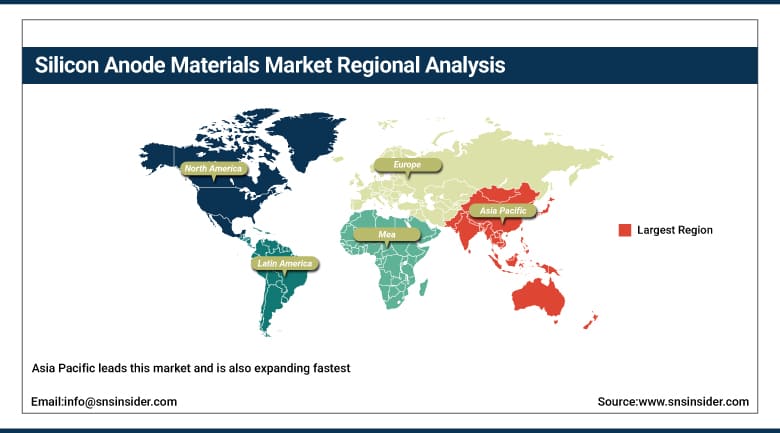
Asia Pacific leads this market and is also expanding fastest, anchored by South Korea's genuine technological leadership in the category, exemplified by POSCO Group's completion of a 550-ton annual capacity silicon anode material facility in Pohang. Group14's joint venture with SK Materials, which has been shipping SCC55 material to more than 100 customers worldwide since September 2024, further reinforces the region's position as a genuine production and export hub for silicon anode materials, not merely a future demand center.
China's massive domestic battery manufacturing base, led by producers including BTR New Material Group, continues anchoring regional supply, with China holding an early, substantial lead in overall silicon anode material production volume. Japan contributes additional depth through established materials science expertise, while the broader region's concentration of battery cell manufacturers, EV producers, and materials suppliers keeps Asia Pacific positioned as both the largest and fastest-growing market through the forecast period.
Get Customized Report as Per Your Business Requirement - Enquiry Now
North America Silicon Anode Materials Market Insights
North America constitutes a considerable portion of the global market for silicon anode materials owing to the presence of key manufacturers of silicon anode in the US, along with continuous financial backing from the government through the Bipartisan Infrastructure Act and other such initiatives. The emerging manufacturing hub of Moses Lake, Washington that has the advantage of inexpensive hydroelectric power generation and proximity to silane gas producers is gaining considerable investment in the form of domestic and foreign battery material manufacturers.
The contribution from Canada towards the regional demand has been growing steadily in light of the development of battery materials and EV manufacturing industry in Canada. Domestic expansion of capacity along with financial investments from both governmental funding and private investors is expected to maintain the position of North America as a significant market for silicon anode materials globally.
Europe Silicon Anode Materials Market Insights
Europe represents a growing share of the global silicon anode materials market, with attention focused on sustainable battery manufacturing and circular economy policies driven by stringent EU emissions rules. European automakers, including several premium manufacturers, continue evaluating silicon anode integration into next-generation EV platforms as part of broader efforts to extend range and reduce charging times.
Germany's substantial automotive manufacturing base continues anchoring regional demand, while regional battery cell manufacturers increasingly explore partnerships with silicon anode material developers to secure early access to next-generation battery chemistries. Continued EU policy support for domestic battery supply chain development is expected to support steady regional growth through the forecast period.
MEA & Latin America Silicon Anode Materials Market Insights
The Middle East & Africa market remains at an early stage of development, with moderate growth led by rising industrialization and renewable energy initiatives across the region. Regional governments continue exploring battery materials investment as part of broader economic diversification strategies, though the market here remains considerably earlier-stage relative to Asia Pacific and North America.
Latin America's market is similarly nascent, with moderate growth reflecting the region's early-stage engagement with next-generation battery materials development. Regional governments continue focusing on increasing production and developing silicon anode technologies as global demand for high-capacity, long-life batteries continues rising, though commercial-scale production remains concentrated elsewhere for now.
Market Dynamics
Growth Drivers: Electric Vehicle Range Demand and Battery Innovation Investment
Surging demand for high energy-density batteries in electric vehicles represents the primary driver of silicon anode materials market growth, as automakers continue racing to deliver longer-range, faster-charging vehicles that can compete more directly with the convenience of conventional gasoline refueling. Silicon's dramatically higher theoretical lithium storage capacity compared to graphite continues making it one of the most promising near-term paths to meaningful battery performance improvement without requiring an entirely new battery architecture.
Substantial capital inflows across the battery value chain represent a second major growth driver, as global incentives for zero-emission transport and renewable energy integration continue catalyzing investment in silicon anode technology development and commercialization. Government-backed funding programs, including significant grants from the U.S. Department of Energy and comparable initiatives in South Korea and elsewhere, continue accelerating the transition from pilot-scale demonstration to genuine commercial manufacturing capacity.
Restraints: Electrode Swelling Challenges and High Production Costs
The significant expansion and contraction experienced by silicon throughout charging cycles are a considerable limitation to the development of the market because this swelling effect, which is often greater than 300%, still keeps causing problems by cracking electrodes and diminishing the battery life if not effectively controlled using complex material engineering. The core technical challenge described above constitutes the most pressing issue that every silicon anode manufacturer has to solve more efficiently, while partial solutions keep restricting the amount of silicon that can be used without reducing the battery life cycle.
In addition, high cost and difficulties related to the scaling up of silicon anode manufacturing are other limitations because the special manufacturing process and the quality control system used in producing such material still keep driving its price higher compared to that of traditional graphite. Consequently, this limitation keeps restricting its usage in cases when it makes sense, which is likely to slow down the process of bringing the prices to parity.
Opportunities: Gigawatt-Scale Manufacturing and Silane Supply Chain Development
Continued transition from pilot lines to gigawatt-scale commercial factories represents a substantial opportunity, as developers that can successfully bring large-scale production online are positioned to capture disproportionate market share as automotive and consumer electronics customers increasingly demand proven, reliable supply at meaningful volume rather than pilot-scale sampling quantities alone.
The continued development of dedicated silane gas supply chains offers a further avenue for growth, as this critical raw material input has represented a persistent bottleneck for silicon anode manufacturers seeking to scale production. Companies that can secure reliable, cost-competitive silane supply, whether through direct investment in production facilities or long-term supply agreements, are positioned to reduce a key source of production risk and cost volatility as the broader industry continues its transition toward commercial-scale manufacturing.
Recent Developments:
-
2024: Group14 received a $200 million U.S. Department of Energy grant to build a Moses Lake, Washington plant producing silane gas, an essential ingredient for silicon battery materials.
-
2023: Amprius Technologies reported a silicon anode battery with a record-high certified energy density of 500 watt-hours per kilogram, roughly twice that of typical EV batteries.
-
2023: Amprius continued ramping production at its 5-gigawatt factory in Boulder, Colorado, aiming to bring down costs for commercial applications including drones and air taxis.
Silicon Anode Materials Market Key Players
-
Sila Nanotechnologies Inc.
-
Group14 Technologies, Inc.
-
Amprius Technologies, Inc.
-
Enevate Corporation
-
NanoGraf Corporation
-
OneD Battery Sciences
-
NEO Battery Materials Ltd.
-
Nexeon Ltd.
-
Sicona Battery Technologies
-
BTR New Material Group Co., Ltd.
-
Shin-Etsu Chemical Co., Ltd.
-
POSCO Future M Co., Ltd.
-
Daejoo Electronic Materials Co., Ltd.
-
XG Sciences, Inc.
-
NanoXplore Inc.
-
California Lithium Battery Inc.
-
Shenzhen BAK Power Battery Co., Ltd.
-
GS Yuasa Corporation
-
Panasonic Holdings Corporation
-
Advano
Silicon Anode Materials Market Report Scope:
| Report Attributes | Details |
|---|---|
| Market Size in 2025 | USD 1.27 Billion |
| Market Size by 2035 | USD 44.16 Billion |
| CAGR | CAGR of 42.62% From 2026 to 2035 |
| Base Year | 2025 |
| Forecast Period | 2026-2035 |
| Historical Data | 2022-2024 |
| Report Scope & Coverage | Market Size, Segments Analysis, Competitive Landscape, Regional Analysis, DROC & SWOT Analysis, Forecast Outlook |
| Key Segments | • By Type (Silicon-Carbon, Silicon-Oxide, Pure Silicon/Nanowire) • By Application (Electric Vehicles, Consumer Electronics, Energy Storage Systems, Others) • By Production Process (Chemical Vapor Deposition, Ball Milling, Carbonization, Others) |
| Regional Analysis/Coverage | North America (US, Canada), Europe (Germany, UK, France, Italy, Spain, Russia, Poland, Rest of Europe), Asia Pacific (China, India, Japan, South Korea, Australia, ASEAN Countries, Rest of Asia Pacific), Middle East & Africa (UAE, Saudi Arabia, Qatar, South Africa, Rest of Middle East & Africa), Latin America (Brazil, Argentina, Mexico, Colombia, Rest of Latin America). |
| Company Profiles | Sila Nanotechnologies Inc., Group14 Technologies, Inc., Amprius Technologies, Inc., Enevate Corporation, NanoGraf Corporation, OneD Battery Sciences, NEO Battery Materials Ltd., Nexeon Ltd., Sicona Battery Technologies, BTR New Material Group Co., Ltd., Shin-Etsu Chemical Co., Ltd., POSCO Future M Co., Ltd., Daejoo Electronic Materials Co., Ltd., XG Sciences, Inc., NanoXplore Inc., California Lithium Battery Inc., Shenzhen BAK Power Battery Co., Ltd., GS Yuasa Corporation, Panasonic Holdings Corporation, Advano |
Frequently Asked Questions
Key players include Sila Nanotechnologies Inc., Group14 Technologies, Inc., Amprius Technologies, Inc., Enevate Corporation, NanoGraf Corporation, and BTR New Material Group Co., Ltd., among other battery materials developers.
The continued transition from pilot lines to gigawatt-scale commercial factories and continued development of dedicated silane gas supply chains represent the biggest opportunities for material developers.
Growth is driven mainly by surging demand for high energy-density batteries in electric vehicles, combined with substantial capital inflows and government funding across the battery value chain.
By Type, Silicon-Carbon held approximately 64.60% share in 2025, reflecting its practical balance of higher energy density and structural stability compared with pure silicon alternatives.
Asia Pacific led with approximately 44.60% share in 2025, anchored by South Korea's technological leadership and China's substantial domestic battery manufacturing base.
