
Data Center Liquid Cooling Fluids Market Report Scope & Overview:
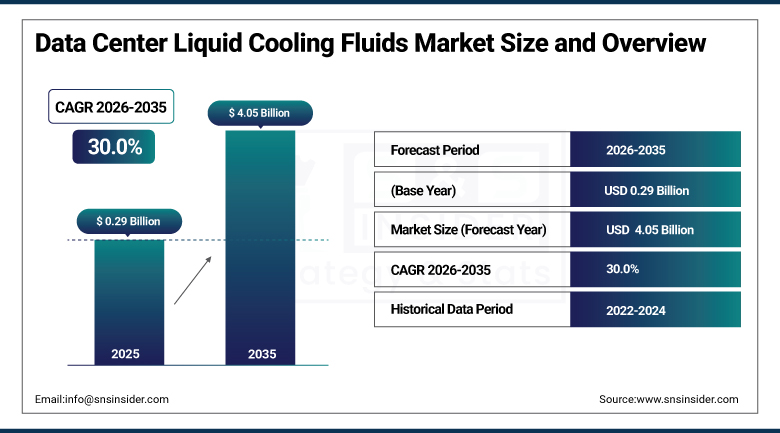
The Data Center Liquid Cooling Fluids Market was valued at USD 0.29 Billion in 2025 and is expected to reach USD 4.05 Billion by 2035, growing at a CAGR of 30.0% from 2026–2035.
The Data Center Liquid Cooling Fluids Market is undergoing a structural reset triggered by the phase-out of fluorinated dielectric chemistries. Rising rack power densities driven by AI accelerators and GPU clusters have pushed liquid cooling from a niche technology to a mainstream architectural requirement, but the fluids underpinning two-phase immersion systems face an unprecedented supply disruption. 3M's exit from PFAS-based manufacturing has forced operators, fluid suppliers, and hardware vendors to simultaneously qualify replacement chemistries while regulators tighten global warming potential and fluorosurfactant restrictions. Water-glycol mixtures continue to anchor single-phase deployments, while synthetic hydrocarbons and hydrofluoroolefin fluids compete to fill the two-phase gap left by discontinued Novec-series products.
In 2025, Chemours introduced Opteon 2P50, a hydrofluoroolefin dielectric fluid engineered specifically for two-phase immersion cooling with substantially lower global warming potential than incumbent fluorinated fluids. The launch targets the vacuum left by 3M's Novec withdrawal, positioning Chemours as a qualified alternative ahead of tightening EU F-Gas Regulation compliance deadlines.
To Get more information On Data Center Liquid Cooling Fluids Market - Request Free Sample Report
Data Center Liquid Cooling Fluids Market Trends
-
3M's Novec withdrawal is forcing an industry-wide requalification of two-phase immersion fluid chemistries.
-
EU F-Gas Regulation deadlines are pushing operators toward fluids with global warming potential below 150.
-
Synthetic hydrocarbon fluids are gaining share as PFAS-free alternatives validated by major chipmakers.
-
Water-glycol mixtures remain the default coolant for direct-to-chip retrofits of existing air-cooled facilities.
-
Fluid suppliers are bundling filtration, testing, and take-back services alongside coolant sales contracts.
U.S. Data Center Liquid Cooling Fluids Market Outlook
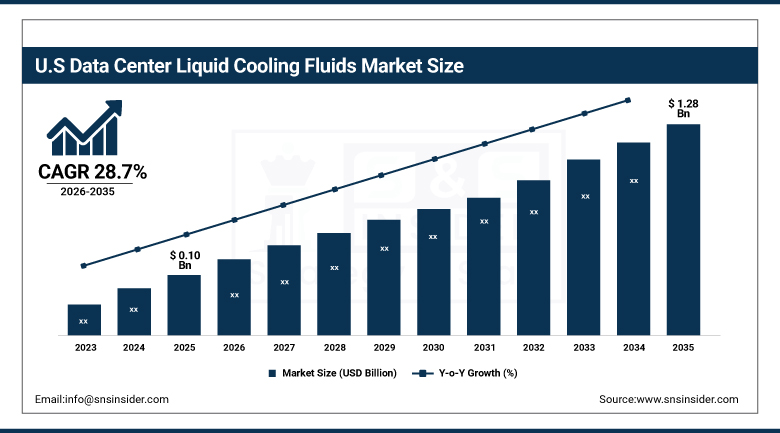
The U.S. Data Center Liquid Cooling Fluids Market was valued at USD 0.10 Billion in 2025 and is projected to reach USD 1.28 Billion by 2035, growing at a CAGR of 28.7% during 2026-2035.
The U.S. Data Center Liquid Cooling Fluids Market is the largest globally, anchored by concentrated hyperscale and AI infrastructure build-out across Virginia, Texas, and the Pacific Northwest. Domestic fluid suppliers including Chemours and Castrol are racing to qualify PFAS-free and low global warming potential alternatives as 3M completes its Novec manufacturing exit. California SB 1013 refrigerant disclosure requirements and voluntary chipmaker validation programs from Intel, AMD, and Nvidia are shaping which fluid chemistries gain enterprise-scale adoption. Water-scarce regions are simultaneously accelerating closed-loop retrofits to reduce evaporative water consumption.
In 2026, Shell DLC S3 and 3M Novec 7000 remained the two most widely specified fluids for regulatory-compliant single-phase immersion deployments in the United States, even as operators began qualifying synthetic hydrocarbon alternatives from Shell Diala and TotalEnergies Voltess ahead of anticipated federal PFAS restrictions.
Data Center Liquid Cooling Fluids Market Segment Analysis
-
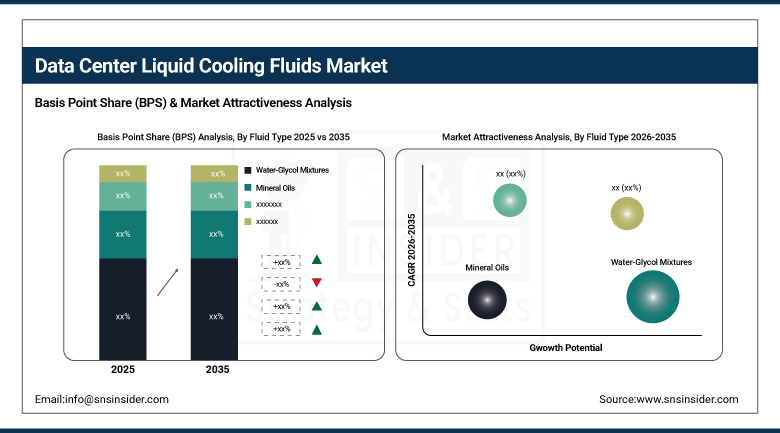
By Fluid Type, the Water-Glycol Mixtures segment dominated the Data Center Liquid Cooling Fluids Market with approximately 45.4% share in 2025, while the Synthetic Hydrocarbons segment is the fastest growing with a CAGR of approximately 34.8%.
-
By Cooling Method, the Single-Phase segment dominated the Data Center Liquid Cooling Fluids Market with approximately 63.7% share in 2025, while the Two-Phase segment is the fastest growing with a CAGR of approximately 33.2%.
-
By Cooling Technology, the Direct-to-Chip segment dominated the Data Center Liquid Cooling Fluids Market with approximately 46.9% share in 2025, while the Immersion Cooling segment is the fastest growing with a CAGR of approximately 32.6%.
-
By Data Center Type, the Hyperscale segment dominated the Data Center Liquid Cooling Fluids Market with approximately 48.2% share in 2025, while the Edge segment is the fastest growing with a CAGR of approximately 33.9%.
By Fluid Type, Water-Glycol Mixtures Dominate the Data Center Liquid Cooling Fluids Market While Synthetic Hydrocarbons Grow Fastest
Water-glycol mixtures dominated the Data Center Liquid Cooling Fluids Market in 2025 because they deliver dependable heat transfer, freeze protection, and corrosion resistance at low cost, making them the default coolant for direct-to-chip and single-phase systems already integrated with existing chilled-water infrastructure. Operators favor water-glycol formulations for retrofit projects since they require no major changes to established cooling loops or heat exchanger equipment. Wide chemical familiarity, straightforward maintenance, and compatibility across climate and operational conditions continue to anchor this fluid type across hyperscale, colocation, and enterprise facilities converting from air to liquid cooling.
Synthetic hydrocarbons are the fastest-growing fluid type as operators seek PFAS-free alternatives validated against Intel, AMD, and Nvidia reference designs for immersion and two-phase applications. Products such as Shell Diala and TotalEnergies Voltess offer high flash points, biodegradability, and stability exceeding fifteen years in closed-loop operation, addressing regulatory concerns tied to fluorinated dielectric fluids. As 3M completes its Novec exit and EU F-Gas Regulation compliance deadlines approach, synthetic hydrocarbons are becoming the preferred qualification pathway for new immersion cooling deployments across regulated markets.
By Cooling Method, Single-Phase Systems Dominate the Data Center Liquid Cooling Fluids Market While Two-Phase Fluids Record the Fastest Growth
Single-phase cooling dominated the Data Center Liquid Cooling Fluids Market in 2025 because direct-to-chip and single-phase immersion architectures require simpler fluid management, lower capital investment, and fewer regulatory qualification hurdles than boiling two-phase systems. Single-phase fluids, whether water-glycol or synthetic hydrocarbon, circulate without changing state, reducing vapor containment engineering requirements and simplifying deployment across retrofit and greenfield facilities alike. This operational simplicity has made single-phase cooling the default entry point for operators transitioning away from air cooling as rack densities climb past forty kilowatts.
Two-phase cooling is the fastest-growing method as hyperscale and AI infrastructure operators pursue the superior heat removal efficiency that boiling and recondensing fluid delivers for extreme-density GPU clusters. Despite the disruption caused by 3M's Novec withdrawal, suppliers including Chemours and Zutacore are accelerating qualification of hydrofluoroolefin and interim lower-fluorine alternatives to sustain two-phase deployment momentum. Chip-level thermal loads exceeding seven hundred watts are increasingly justifying the added engineering complexity that two-phase systems require.
By Cooling Technology, Direct-to-Chip Dominates the Data Center Liquid Cooling Fluids Market While Immersion Cooling Grows Fastest
Direct-to-chip cooling dominated the Data Center Liquid Cooling Fluids Market in 2025 because cold plates mounted directly on processors and GPUs remove sixty to eighty percent of component heat before it enters the airstream, making this the most widely deployed and easiest-to-retrofit liquid cooling architecture. Hyperscale and colocation operators favor direct-to-chip systems for their compatibility with existing rack designs and an incremental deployment path, allowing facilities to convert dense racks without redesigning entire data halls. This retrofit-friendly profile keeps direct-to-chip the leading consumer of water-glycol and engineered coolant volume.
Immersion cooling is the fastest-growing technology as full-rack and full-server submersion delivers superior thermal uniformity for the highest-density AI training clusters. Growing chipmaker validation of PFAS-free synthetic hydrocarbon and mineral oil fluids is removing a key adoption barrier, while fluid suppliers increasingly bundle filtration, dielectric testing, and end-of-life fluid take-back services with immersion coolant contracts. Regulatory pressure to eliminate fluorinated fluids is simultaneously accelerating qualification cycles for next-generation immersion chemistries across hyperscale deployments.
By Data Center Type, Hyperscale Facilities Dominate the Data Center Liquid Cooling Fluids Market While Edge Data Centers Grow Fastest
Hyperscale facilities dominated the Data Center Liquid Cooling Fluids Market in 2025 because cloud service providers and AI infrastructure operators are deploying liquid cooling fluid at a scale no other data center category matches, driven by concentrated GPU cluster build-out for large language model training and inference workloads. Hyperscale operators also possess the technical resources and long-term capital planning horizons needed to manage fluid qualification, PFAS transition risk, and regulatory compliance directly, giving them outsized influence over which fluid chemistries gain broad industry validation and eventual supply chain scale.
Edge data centers are the fastest-growing data center type as distributed AI inference, telecommunications densification, and localized content delivery push compact, liquid-cooled facilities into space-constrained urban and industrial locations. These smaller sites favor pre-qualified, low-maintenance fluid formulations that minimize on-site servicing requirements. Rising edge computing deployment tied to autonomous systems and real-time analytics is expanding demand for compact immersion and direct-to-chip fluid packages engineered for unattended or minimally staffed operation.
Regional Analysis
|
Region |
Major Country |
Share within Region, 2025 (%) |
|
North America |
United States |
76.0% |
|
Europe |
Germany |
23.0% |
|
Asia Pacific |
China |
41.0% |
|
Middle East & Africa |
UAE |
32.0% |
|
Latin America |
Brazil |
36.0% |
North America Data Center Liquid Cooling Fluids Market Insights
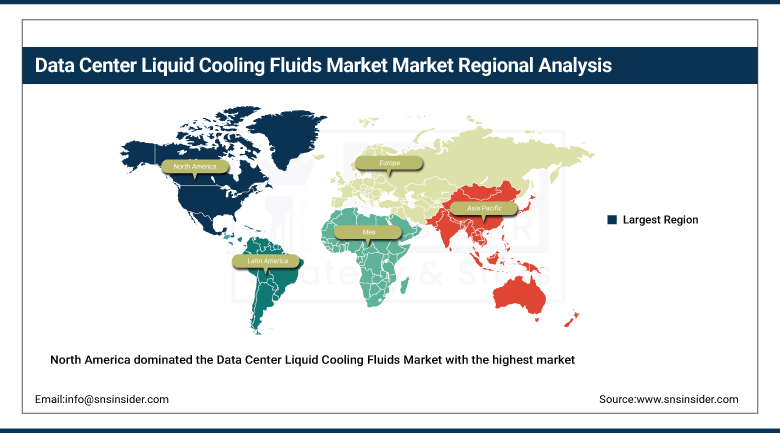
North America dominated the Data Center Liquid Cooling Fluids Market with the highest market share of about 41.2% in 2025, driven by concentrated hyperscale and AI infrastructure investment across the United States. Virginia, Texas, and the Pacific Northwest anchor demand through continuous data center capacity expansion tied to large language model training and cloud service growth. Domestic fluid suppliers are racing to qualify PFAS-free alternatives as 3M completes its Novec manufacturing exit, while California's refrigerant disclosure requirements are shaping procurement decisions among operators seeking long-term regulatory certainty.
Canada contributes through growing hyperscale investment in Quebec and Ontario, where renewable electricity availability supports sustainability-focused liquid cooling adoption. Mexico's market remains nascent but is expanding as nearshoring investment drives new data center construction in northern industrial corridors, with fluid supply currently dependent on U.S. and multinational suppliers rather than domestic production capacity.
Get Customized Report as per Your Business Requirement - Enquiry Now
Europe Data Center Liquid Cooling Fluids Market Insights
Europe is the fastest-growing Data Center Liquid Cooling Fluids Market, projected to expand at a CAGR of approximately 31.0% through 2035. Regulatory pressure is the defining regional driver, with the EU F-Gas Regulation and a proposed universal PFAS restriction forcing operators toward fluids with global warming potential below 150 well ahead of comparable mandates elsewhere. Germany, France, and the Nordic countries lead regional adoption, combining strict sustainability commitments with dense hyperscale and colocation development. Regional suppliers including Syensqo are positioning fluorinated alternatives while facing the same regulatory trajectory that drove 3M's exit.
The United Kingdom, Netherlands, and Ireland contribute substantial colocation-driven demand, with Dublin and Amsterdam data center clusters increasingly required to demonstrate water and energy efficiency credentials to secure local planning approval. This regulatory intensity is accelerating early adoption of synthetic hydrocarbon and low-global-warming-potential hydrofluoroolefin fluids across the region relative to less regulated markets.
Asia Pacific Data Center Liquid Cooling Fluids Market Insights
Asia Pacific is expanding rapidly as China, Japan, and South Korea scale domestic AI infrastructure and hyperscale capacity to support national computing sovereignty initiatives. China's data center operators are adopting liquid cooling fluids at pace with GPU cluster deployment, though supply remains split between imported dielectric fluids and emerging domestic engineered coolant production. Japan and South Korea contribute through established electronics and specialty chemical manufacturing bases capable of supplying qualified immersion fluids to regional hyperscale and colocation operators.
India's data center construction boom, concentrated around Mumbai, Chennai, and Hyderabad, is creating substantial incremental demand for cost-effective water-glycol and mineral oil coolants as operators prioritize rapid deployment over premium fluid chemistries. Australia contributes through renewable-powered hyperscale campuses that increasingly specify sustainability-certified fluid formulations to support corporate carbon reduction commitments.
Middle East & Africa and Latin America Data Center Liquid Cooling Fluids Market Insights
The Middle East & Africa market is expanding as Saudi Arabia and the UAE pursue sovereign AI computing ambitions backed by substantial capital investment in hyperscale campuses across Riyadh and Abu Dhabi. Extreme ambient temperatures make liquid cooling technically necessary rather than optional across the region, driving early adoption of both single-phase and immersion fluid systems. South Africa contributes modest colocation-driven demand concentrated in Johannesburg and Cape Town data center clusters.
Latin America remains an emerging market shaped by growing cloud infrastructure investment in Brazil and Mexico. Brazil's hyperscale campus development around São Paulo is beginning to specify liquid cooling for AI-focused facilities, though fluid supply depends heavily on imports from North American and European suppliers. Limited domestic engineered coolant manufacturing capacity continues to constrain the pace of regional adoption relative to underlying data center construction growth.
Market Dynamics
Growth Drivers: AI-driven rack densities and PFAS phase-out accelerating fluid qualification cycles
Rack power densities exceeding forty kilowatts, driven by GPU-intensive AI training and inference workloads, have made air cooling physically inadequate for modern hyperscale infrastructure, converting liquid cooling fluid from an optional upgrade into a core architectural requirement. Every gigawatt of new AI computing capacity commissioned represents a substantial, recurring fluid procurement event, since coolant volumes scale directly with rack count and cooling loop design across direct-to-chip and immersion deployments alike.
3M's PFAS manufacturing exit is simultaneously forcing an industry-wide requalification cycle that is expanding the addressable fluid supplier base. Operators previously dependent on a single dominant fluorinated fluid source are now qualifying multiple alternative chemistries in parallel, creating near-term demand volatility but longer-term structural growth as newly validated suppliers including Chemours capture share across both replacement and new-build fluid contracts.
Restraints: Regulatory uncertainty and incomplete PFAS alternatives constraining fluid qualification confidence
Post-Novec candidate fluids face an unresolved regulatory trajectory, since perfluoropolyether alternatives such as Galden PFPE remain classified as PFAS under the EU's proposed universal restriction despite offering competitive dielectric performance. Operators qualifying replacement fluids today risk deferring rather than eliminating future requalification exposure, complicating long-term procurement decisions and discouraging large-scale capital commitment to any single fluid chemistry until regulatory clarity improves.
Multi-year qualification timelines for new immersion and two-phase fluid chemistries against chipmaker material compatibility and warranty requirements are slowing the pace at which alternative fluids can achieve commercial scale. Fluid replacement cycles of five to seven years further limit near-term replacement demand at already-deployed sites, while incomplete supply chain buildout for engineered low-global-warming-potential fluids continues to constrain availability outside North America and Europe.
Opportunities: Regulatory-compliant fluid chemistries and bundled service models opening new revenue channels
Suppliers achieving early qualification of low-global-warming-potential and PFAS-free fluids stand to capture durable, defensible, multi-year supply positions as operators standardize procurement ahead of tightening EU F-Gas Regulation and anticipated U.S. state-level PFAS restrictions. Synthetic hydrocarbon and hydrofluoroolefin chemistries validated against major chipmaker reference designs offer a clear differentiation path for suppliers able to demonstrate both thermal performance and regulatory compliance simultaneously across global markets.
Bundled service models present a second durable opportunity, as fluid suppliers increasingly combine coolant sales with filtration, dielectric strength testing, batch traceability, and end-of-life fluid take-back to address operator concerns about long-term fluid degradation and regulatory disposal requirements. This service-attached approach converts fluid supply from a commodity transaction into a recurring, contracted revenue relationship tied directly to installed liquid cooling capacity growth.
Recent Developments:
-
2025: 3M continued its phased exit from PFAS-based manufacturing, discontinuing Novec 7000-series fluids and disrupting established two-phase immersion cooling fluid supply chains globally.
-
2026: Zutacore advanced plans to eliminate PFAS from its direct-to-chip two-phase systems, adopting Chemours' Opteon SF33 as an interim lower-fluorine solution ahead of a full PFAS-free transition.
-
2026: MarketsandMarkets published updated Data Center Liquid Cooling Fluids Market forecasts segmenting demand by fluid type, cooling method, and data center type through 2032.
-
2025: BestSolv introduced Zulu Engineered Fluid as a chemically identical hydrofluoroether replacement for discontinued 3M Novec 649, targeting operators requiring drop-in dielectric fluid continuity.
Data Center Liquid Cooling Fluids Companies are:
-
The Chemours Company
-
Shell plc
-
TotalEnergies SE
-
Castrol Limited
-
ExxonMobil Corporation
-
Syensqo SA
-
AGC Inc.
-
Dow Inc.
-
BASF SE
-
Engineered Fluids Inc.
-
KLEA (Koura)
-
Fuchs Petrolub SE
-
Chevron Corporation
-
Petro-Canada Lubricants Inc.
-
Solvay S.A.
-
Envirotech Vapor Corp.
-
GRC (Green Revolution Cooling) Inc.
-
LiquidStack Holding B.V.
-
Submer Technologies SL
-
Iceotope Technologies Ltd.
Data Center Liquid Cooling Fluids Market Report Scope:
| Report Attributes | Details |
|---|---|
| Market Size in 2025 | USD 0.29 Billion |
| Market Size by 2035 | USD 4.05 Billion |
| CAGR | CAGR of 30.0% From 2026 to 2035 |
| Base Year | 2025 |
| Forecast Period | 2026-2035 |
| Historical Data | 2022-2024 |
| Report Scope & Coverage | Market Size, Segments Analysis, Competitive Landscape, Regional Analysis, DROC & SWOT Analysis, Forecast Outlook |
| Key Segments | • By Fluid Type (Water-Glycol Mixtures, Synthetic Hydrocarbons, Mineral Oils & Fluorocarbon-Based Dielectric Fluids) • By Cooling Method (Single-Phase, Two-Phase) • By Cooling Technology (Direct-to-Chip, Immersion Cooling & Rear-Door Heat Exchanger) • By Data Center Type (Hyperscale, Colocation, Enterprise & Edge) |
| Regional Analysis/Coverage | North America (US, Canada), Europe (Germany, UK, France, Italy, Spain, Russia, Poland, Rest of Europe), Asia Pacific (China, India, Japan, South Korea, Australia, ASEAN Countries, Rest of Asia Pacific), Middle East & Africa (UAE, Saudi Arabia, Qatar, South Africa, Rest of Middle East & Africa), Latin America (Brazil, Argentina, Mexico, Colombia, Rest of Latin America). |
| Company Profiles | The Chemours Company, Shell plc, TotalEnergies SE, Castrol Limited, ExxonMobil Corporation, Syensqo SA, AGC Inc., Dow Inc., BASF SE, Engineered Fluids Inc., KLEA (Koura), Fuchs Petrolub SE, Chevron Corporation, Petro-Canada Lubricants Inc., Solvay S.A., Envirotech Vapor Corp., GRC (Green Revolution Cooling) Inc., LiquidStack Holding B.V., Submer Technologies SL, Iceotope Technologies Ltd. |
Frequently Asked Questions
Key players include The Chemours Company, Shell plc, TotalEnergies SE, Castrol Limited, ExxonMobil Corporation, and Syensqo SA, among others.
Key opportunities include PFAS-free fluid qualification, low-global-warming-potential chemistries, bundled filtration and take-back services, and edge data center fluid packages engineered for unattended operation.
Rising AI-driven rack power densities exceeding air cooling limits, combined with the industry-wide fluid requalification triggered by 3M's PFAS manufacturing exit.
Direct-to-Chip dominated with approximately 46.9% share in 2025, while Immersion Cooling is the fastest growing segment with a CAGR of approximately 32.6%.
North America dominated the Data Center Liquid Cooling Fluids Market in 2025 with approximately 41.2% share, while Europe is the fastest-growing region.
