
Plastic Alternative Packaging Market Report Scope & Overview:
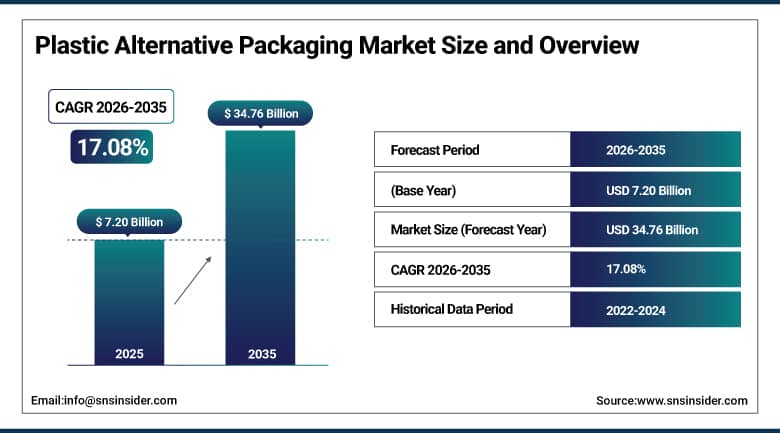
The Plastic Alternative Packaging Market was valued at USD 7.20 billion in 2025 and is expected to reach USD 34.76 billion by 2035, growing at a CAGR of 17.08% from 2026-2035.
The Plastic Alternative Packaging Market is witnessing rapid growth as a result of the increasing demand for sustainable and environmentally friendly packaging solutions from the food, beverages, personal care, pharmaceutical, and consumer goods industries. The increasing focus on the problems of plastic pollution and environmental degradation is leading companies to switch to paper packaging, biodegradable packaging solutions, composting films, and bio-polymer packaging. The regulations that are implemented with the aim to reduce single-use plastics are also contributing to the adoption of new packaging options. The increased awareness among consumers and their preferences for sustainable and eco-friendly products is another factor that is motivating brands to use sustainable packaging solutions.
The EU's new Packaging and Packaging Waste Regulation began applying on 12 August 2026, introducing requirements covering packaging manufacturing, composition, reuse, and recoverability; some single-use formats will face bans from 2030 where alternatives exist.
To Get More Information On Plastic Alternative Packaging Market - Request Free Sample Report
Plastic Alternative Packaging Market Trends:
-
Rising environmental concerns are driving demand for sustainable packaging alternatives across food, beverage, healthcare, and consumer goods industries.
-
Increasing restrictions on single-use plastics are accelerating adoption of paper-based, biodegradable, compostable, and bio-based packaging materials.
-
Growing consumer preference for eco-friendly products is encouraging brands to adopt sustainable packaging solutions and materials.
-
Advancements in biodegradable polymers and material technologies are improving packaging performance, durability, and environmental sustainability.
-
Increasing investments in recyclable and compostable packaging are expanding alternatives across diverse packaging applications.
U.S. Plastic Alternative Packaging Market Outlook:
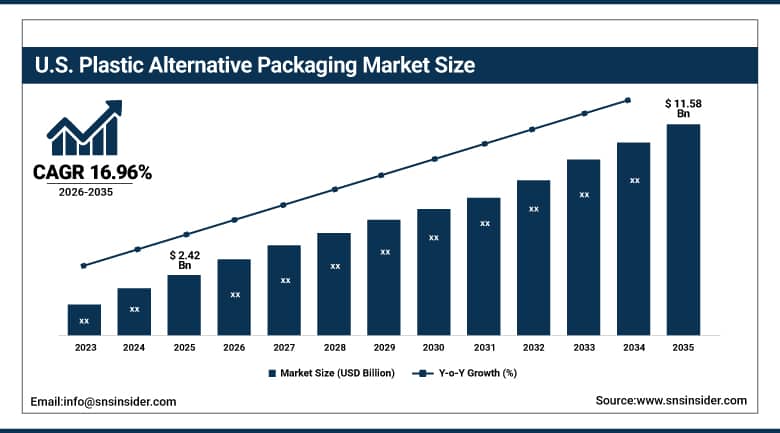
The U.S. Plastic Alternative Packaging Market was valued at USD 2.42 billion in 2025 and is expected to reach USD 11.58 billion by 2035, growing at a CAGR of 16.96% from 2026-2035.
The U.S. Plastic Alternative Packaging Market is witnessing rapid growth as a result of the rising need for sustainable packaging materials for use in the food, beverages, personal care, and consumer goods industries. Increasing worries over the problem of plastic waste and environmental contamination are motivating companies to explore options for using different kinds of packaging such as paper-based packaging, biodegradable materials, compostable films, and bio-based polymers. Rising regulatory pressure on minimizing the use of plastic is contributing to the shift toward sustainable packaging forms. Furthermore, increasing consumer consciousness about eco-friendly packaging is motivating companies to develop other forms of packaging solutions. Improvements in material science, barrier technologies, coating, and packaging are making plastic alternatives viable.
Oregon became the first U.S. state to implement a statewide packaging and paper EPR system, requiring companies selling covered packaging to help fund recycling-system improvements.
Plastic Alternative Packaging Market Segment Analysis:
-
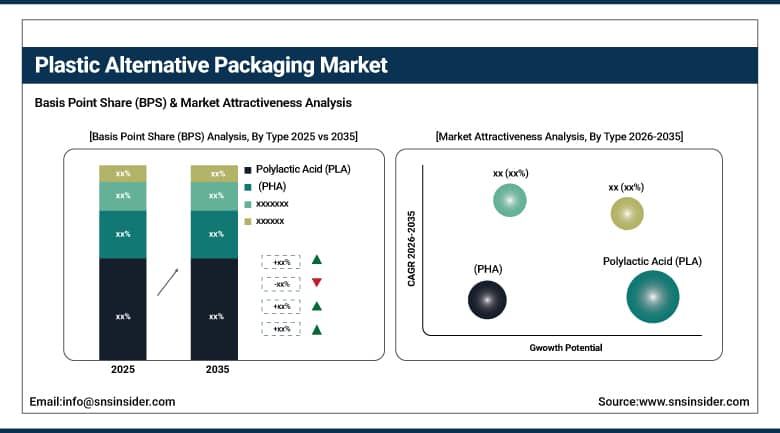
By Type, Polylactic Acid (PLA) dominates the Plastic Alternative Packaging Market with 31% share in 2025; Polyhydroxyalkanoates (PHA) are expected to grow at the fastest CAGR of 19.74% from 2026–2035.
-
By Process, Biodegradable dominates the Plastic Alternative Packaging Market with 62% share in 2025; Biodegradable is expected to grow at the fastest CAGR of 17.36% from 2026–2035.
-
By Application, Food and Beverage dominates the Plastic Alternative Packaging Market with 48% share in 2025; Health Care is expected to grow at the fastest CAGR of 19.65% from 2026–2035.
By Type, Polylactic Acid (PLA) dominates the Plastic Alternative Packaging Market, Polyhydroxyalkanoates (PHA) grow fastest.
Polylactic Acid (PLA) dominated the Plastic Alternative Packaging Market with the highest revenue share of about 31% in 2025, due to its commercial availability, compostability, good processing attributes, and utilization in packaging products. PLA is extensively used in food packaging products such as containers, trays, and films, whereas an increasing requirement for renewable material adds fuel to the market growth.
Polyhydroxyalkanoates (PHA) are expected to grow at the fastest CAGR of 19.74% from 2026–2035, Based on their biodegradable nature, bio-based composition, and applicability to environments that need sustainable packaging, they have been supported. The increased investments in the production and technologies of PHA, along with the rising demands for sustainable packaging in place of traditional plastics, are supporting the commercialization process.
By Process, Biodegradable dominates the Plastic Alternative Packaging Market, Biodegradable grows fastest.
Biodegradable packaging dominated the Plastic Alternative Packaging Market with the highest revenue share of about 62% in 2025, motivated by rising environmental awareness and the need for waste management programs that would encourage the use of packaging that could decompose in appropriate conditions. Initiatives aimed at lowering the use of traditional plastics and an increase in the use of sustainable packaging have created high market demand.
Biodegradable packaging is expected to grow at the fastest CAGR of 17.36% from 2026–2035, through stringent regulations and greater focus from companies towards sustainable practices. The development of biodegradable packaging materials, better performance of these materials, and more availability is making it possible to replace regular plastic with biodegradable alternatives in different uses. Consumer inclination towards green products is pushing this process further.
By Application, Food and Beverage dominates the Plastic Alternative Packaging Market, Health Care grows fastest.
Food and Beverage dominated the Plastic Alternative Packaging Market with the highest revenue share of about 48% in 2025, The use of biodegradable and bio-packaging is stimulated by high consumption of packaging material for fresh produce, beverages, ready-to-eat meals, snacks, and takeaways. Increased need to minimize plastic usage and the desire by consumers for sustainability is leading to adoption of biodegradable and bio-based packaging.
Health Care is expected to grow at the fastest CAGR of 19.65% from 2026–2035, backed by the rising need for sustainable packaging that does not hinder hygiene, protection, and product integrity. The healthcare industry is looking into using biodegradable and bio-based packaging materials for certain packaging uses as the need for sustainability increases.
Regional Analysis:
|
Region |
Major Country |
Share within Region, 2025 (%) |
|---|---|---|
|
North America |
United States |
91.0% |
|
Europe |
Germany |
25.0% |
|
Asia Pacific |
China |
30.0% |
|
Middle East & Africa |
UAE |
18.0% |
|
Latin America |
Brazil |
35.0% |
North America Plastic Alternative Packaging Market Insights
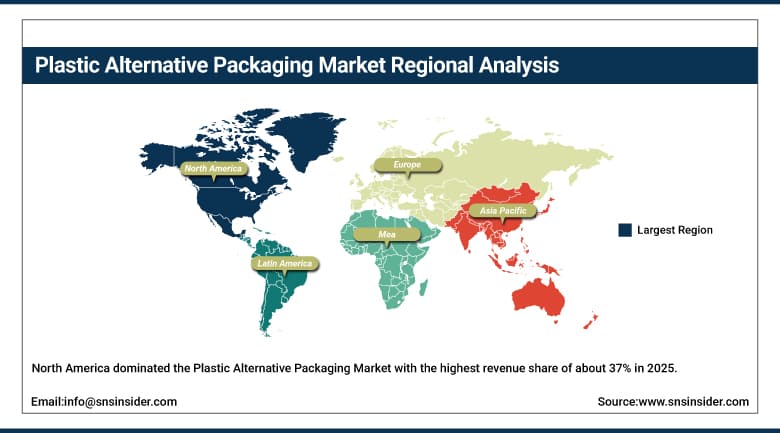
North America dominated the Plastic Alternative Packaging Market with the highest revenue share of about 37% in 2025, Motivated by rising demand for sustainable packaging, strict environmental laws, and increasing consumer inclination toward recyclable and biodegradable packaging materials. Presence of established companies in the packaging industry, sustainability initiatives, innovative material technologies, and robust retail and food service sectors bolster regional market dominance.
The U.S. Plastic Alternative Packaging Market accounted for a market share of 91.0%, backed by robust sustainability programs, rising consumer awareness about eco-friendly packaging, and the drive toward limiting plastic usage. Large-scale presence of packaging companies, material innovations, and availability of recycled, compostable, paper-based, and biodegradable materials across food and beverages, retail, and consumer goods industry is driving market growth.
Get Customized Report as Per Your Business Requirement - Enquiry Now
Europe Plastic Alternative Packaging Market Insights
Europe is witnessing strong growth in the Plastic Alternative Packaging Market, supported by stringent packaging and waste-management regulations, ambitious sustainability targets, and increasing adoption of recyclable and compostable materials. Environmental concerns such as plastic waste, circular economy models, and innovations in the form of paper-based, biodegradable, and fiber-based packing materials are compelling companies to come up with environmentally sustainable options for their products.
The Germany Plastic Alternative Packaging Market accounted for a market share of 25.0%, supported by stringent environmental regulations, strong recycling infrastructure, and growing consumer preference for sustainable packaging. Circular-economy initiatives, plastic reduction targets, and investments in recyclable, compostable, paper-based, and fiber-based materials are encouraging manufacturers to replace conventional plastics across food, beverage, retail, and consumer goods applications.
Asia Pacific Plastic Alternative Packaging Market Insights
Asia Pacific is expected to grow at the fastest CAGR of about 18.35% from 2026–2035, driven by rapid urbanization, expanding e-commerce, rising packaged food consumption, and increasing environmental awareness. Increased regulatory focus on reducing conventional plastics, advancements in manufacturing, and developments in packaging materials that are biodegradable, compostable, paper-based, and bio-based are speeding up the acceptance process in emerging and consumer markets.
The China Plastic Alternative Packaging Market accounted for a market share of 30.0%, supported by rapid urbanization, expanding e-commerce, large packaged food and beverage industries, and increasing environmental awareness. Government efforts to reduce plastic waste, combined with growing investments in biodegradable, compostable, paper-based, and bio-based packaging technologies, are accelerating adoption across manufacturing, retail, foodservice, and consumer goods sectors.
Middle East & Africa and Latin America Plastic Alternative Packaging Market Insights
Middle East & Africa and Latin America are experiencing increasing adoption of plastic alternative packaging, supported by growing environmental awareness, expanding packaged food and beverage industries, and rising sustainability initiatives. Growing urbanization, development of modern retail stores, the rise of the online market, and policies intended to minimize plastic waste are prompting manufacturing companies to use eco-friendly packing materials like recycling, biodegradable, compostable, paper, and others.
The UAE Plastic Alternative Packaging Market accounted for a market share of 18.0%, supported by increasing sustainability initiatives, environmental awareness, and efforts to reduce single-use plastic consumption. Expanding retail, foodservice, tourism, and packaged food industries are creating demand for recyclable, biodegradable, compostable, and paper-based alternatives. Government sustainability programs and modern distribution infrastructure further encourage adoption of environmentally friendly packaging.
Market Dynamics:
Growth Drivers: Growing plastic waste concerns are accelerating adoption of alternative packaging materials across industries.
The increasing number of concerns related to plastic pollution, waste generation, and environmental damage is motivating brands and manufacturers to adopt paper, paperboard, molded fiber, biodegradable material, and other forms of packaging in place of traditional plastic packaging. In food and beverages, e-commerce, personal care, and consumer goods, packaging that decreases the use of virgin plastic is increasingly being considered. This shift is being encouraged by legislation as well, with the EU Packaging and Packaging Waste Regulation coming into effect in August 2026, which emphasizes recyclable packaging and circular economy practices.
Restraints: Limited recycling and composting infrastructure can restrict effective end-of-life management for alternatives.
The advantages of alternative packaging are highly reliant on proper collection, sorting, and recycling or composting of those packages. Improper waste management infrastructure can hinder recycling of recyclable materials and make compostable packaging ineffective. For instance, India is still creating infrastructure to handle compostable packaging waste, while EU's 2026 guidance highlights the need to ensure compostable packaging ends up in the right waste treatment system. Even the difference in industrial and household composting could create misunderstanding among consumers. Packaging companies should therefore look into material selection and realistic ways of handling packaging after use.
Opportunities: Advances in biodegradable materials create opportunities for high-performance sustainable packaging solutions.
The evolution of biodegradable and compostable packaging material offers prospects to serve applications where regular paper is not capable of offering adequate flexibility, sealing properties, moisture resistance, or barriers. Compostable film and pouches are some of the fastest-growing segments in the Indian biodegradable packaging industry, and efforts from both the governments and the private sector are making way for developing plastic-free and biodegradable products. Mechanical strength, barrier capabilities, heat resistance, shelf-life performance, and sustainable end-of-life certification can be offered as distinguishing features by the suppliers. The increasing trend of lifecycle sustainability also provides prospects of designing the materials around particular recycling systems.
Recent Developments:
-
2026 : Tetra Pak invested €60 million in a new pilot plant in Sweden to advance paper-based barrier technology, replacing aluminium foil in aseptic cartons and increasing renewable content.
-
2026 : Amcor showcased expanded recycling capabilities for PE and PP packaging, including recycled polymers and advanced recycling technologies supporting more circular packaging solutions.
-
2026 : Mondi introduced and advanced paper-based packaging solutions designed to replace conventional plastic formats, including its re/cycle HiProtex Paper high-barrier packaging.
-
2025 : NatureWorks launched Ingeo™ Extend 4950D, a PLA grade designed to improve BOPLA film production efficiency and enable compostable packaging to replace persistent plastic films.
Plastic Alternative Packaging Market key players are:
-
BASF SE
-
Amcor plc
-
Tetra Pak International S.A.
-
Sealed Air Corporation
-
Evergreen Packaging LLC
-
Rengo Co., Ltd.
-
International Paper Company
-
Mondi plc
-
Futamura Chemical Co., Ltd.
-
SECOS Group Ltd.
-
Huhtamäki Oyj
-
BioPak Pty Ltd.
-
SIG Group AG
-
Greatview Aseptic Packaging Co., Ltd.
-
Nampak Limited
-
Mpact Limited
-
Klabin S.A.
-
Constantia Flexibles
-
Smurfit Westrock plc
-
NatureWorks LLC
Plastic Alternative Packaging Market Report Scope:
| Report Attributes | Details |
|---|---|
| Market Size in 2025 | USD 7.20 Billion |
| Market Size by 2035 | USD 34.76 Billion |
| CAGR | CAGR of 17.08% From 2026 to 2035 |
| Base Year | 2025 |
| Forecast Period | 2026-2035 |
| Historical Data | 2022-2024 |
| Report Scope & Coverage | Market Size, Segments Analysis, Competitive Landscape, Regional Analysis, DROC & SWOT Analysis, Forecast Outlook |
| Key Segments | • By Type (Starch-Based Plastic, Cellulose-Based Plastics, Polylactic Acid (PLA), Polyhydroxyalkanoates (PHA), Other Types) • By Process (Bio-Based or Non-Biodegradable, Biodegradable) • By Application (Food and Beverage, Personal Care, Health Care, Other Applications) |
| Regional Analysis/Coverage | North America (US, Canada), Europe (Germany, UK, France, Italy, Spain, Russia, Poland, Rest of Europe), Asia Pacific (China, India, Japan, South Korea, Australia, ASEAN Countries, Rest of Asia Pacific), Middle East & Africa (UAE, Saudi Arabia, Qatar, South Africa, Rest of Middle East & Africa), Latin America (Brazil, Argentina, Mexico, Colombia, Rest of Latin America). |
| Company Profiles | BASF SE, Amcor plc, Tetra Pak International S.A., Sealed Air Corporation, Evergreen Packaging LLC, Rengo Co., Ltd., International Paper Company, Mondi plc, Futamura Chemical Co., Ltd., SECOS Group Ltd., Huhtamäki Oyj, BioPak Pty Ltd., SIG Group AG, Greatview Aseptic Packaging Co., Ltd., Nampak Limited, Mpact Limited, Klabin S.A., Constantia Flexibles, Smurfit Westrock plc, and NatureWorks LLC. |
Frequently Asked Questions
Key players in the Plastic Alternative Packaging Market include BASF SE, Amcor plc, Tetra Pak International S.A., Sealed Air Corporation, and Mondi plc, among others.
Key opportunities in the Plastic Alternative Packaging Market include growing adoption of biodegradable and compostable materials, expansion of paper-based alternatives, and increasing demand for recyclable and mono-material packaging solutions.
The market is driven by rising environmental concerns, stricter regulations on single-use plastics, growing consumer preference for sustainable packaging, and increasing adoption of biodegradable alternatives.
The Polylactic Acid (PLA) segment dominated the Plastic Alternative Packaging Market, accounting for approximately 31.50% market share.
The North America region dominated the Plastic Alternative Packaging Market in 2025 with a 37.00% share, driven by rising demand for sustainable packaging and growing restrictions on single-use plastics.
