
Processed Meat Market Report Scope & Overview:
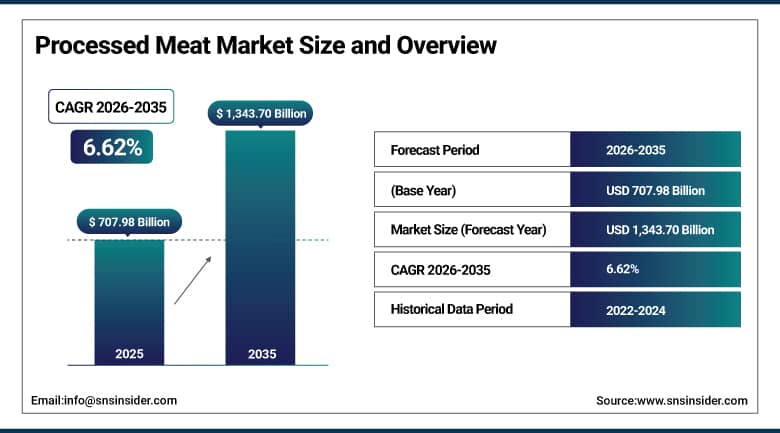
The global Processed Meat Market was valued at USD 707.98 Billion in 2025 and is expected to reach USD 1,343.70 Billion by 2035, growing at a CAGR of 6.62% from 2026 to 2035.
The increase in the world’s appetite for meat, coupled with the fast-paced life in the cities and growing demands for shelf-stable meat, is expected to continue to fuel growth in the category. The meat products manufacturers have started to make changes to product formulation to accommodate the changing preferences towards clean label, low-sodium/nitrate, and simpler ingredient list products.
A definitive agreement was signed between ITC and Prasuma in 2025, which is an established player in frozen meat manufacturing in India, under ITC's 'ITC Next' strategy to strengthen its portfolio of branded meat products, owing to increasing investments from diversified consumer goods companies in the category.
To Get More Information On Processed Meat Market - Request Free Sample Report
Processed Meat Market Trends
-
Growing clean-label reformulation is reshaping product development, with manufacturers marketing 'no nitrates' and 'minimally processed' positioning.
-
Rising demand for meat-based snacks and jerky is expanding processed meat consumption beyond traditional meal-occasion product formats.
-
Increasing regulatory and public health scrutiny of red and processed meat consumption is accelerating reformulation toward poultry-based alternatives.
-
Expanding online retail and direct-to-consumer distribution is broadening processed meat brand accessibility beyond traditional grocery channels.
-
Growing blending of processed meats with plant-based proteins is helping manufacturers address both health and environmental sustainability consumer concerns.
U.S. Processed Meat Market Outlook
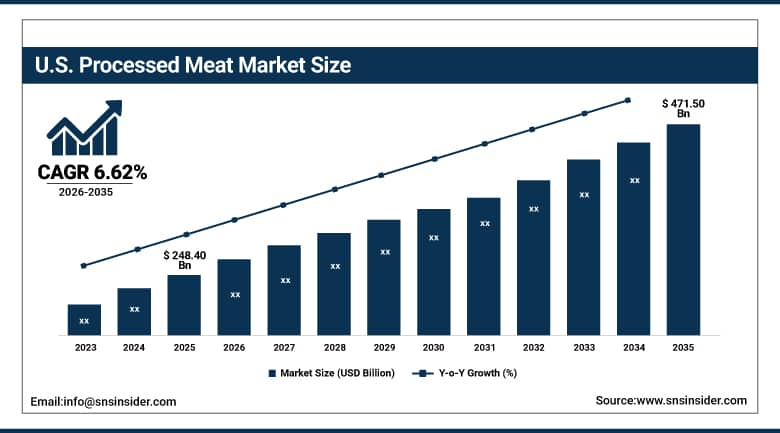
The U.S. Processed Meat Market was valued at USD 248.40 Billion in 2025 and is projected to reach USD 471.50 Billion by 2035, growing at a CAGR of 6.62% during 2026-2035.
Continuous consumer demand for convenient and protein-packed food products keeps fueling healthy growth of the processed meat category in the US market. The top players keep offering more clean-label and premium-branded product offerings to attract both value-conscious families and young consumers looking for convenience. The increased investment of retailers in expanding their sections of deli, frozen and refrigerated processed meat products, as well as the increased popularity of direct-to-consumer shopping and e-grocery models, will contribute to further category accessibility and volume growth through both conventional and emerging distribution channels.
In 2026, Tyson Foods rolled out the clean-label reformulation of its Jimmy Dean and Hillshire Farm brands, with an emphasis on minimal use of additives and clear ingredient lists, following the increasing consumer demands.
Processed Meat Market Segment Analysis
-
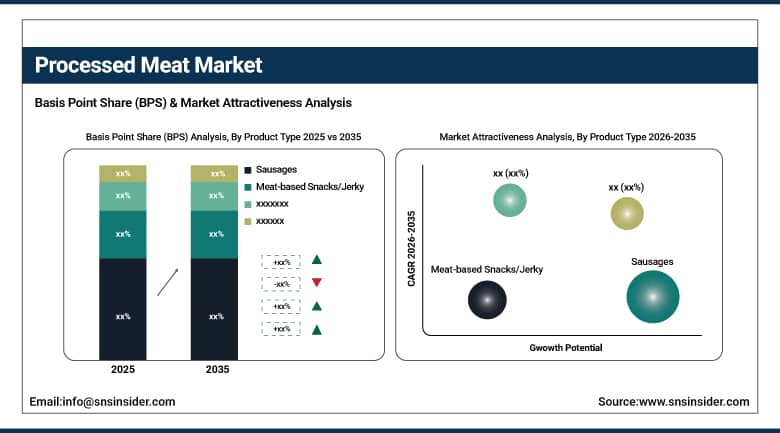
By Product Type, Sausages led the Processed Meat Market with a 32.60% share in 2025, while Meat-based Snacks/Jerky is the fastest-growing product type segment with a CAGR of 9.40% from 2026-2035.
-
By Meat Source, Poultry led the Processed Meat Market with a 39.44% share in 2025, while Poultry is the fastest-growing meat source segment with a CAGR of 7.90% from 2026-2035.
-
By Processing Technique, Cured led the Processed Meat Market with a 38.60% share in 2025, while Fermented is the fastest-growing processing technique segment with a CAGR of 8.70% from 2026-2035.
-
By Distribution Channel, Supermarkets & Hypermarkets led the Processed Meat Market with a 58.48% share in 2025, while Online Retail is the fastest-growing distribution channel segment with a CAGR of 11.60% from 2026-2035.
By Product Type, Sausages Dominated the Market While Meat-based Snacks/Jerky Is the Fastest-Growing Segment
Sausages accounted for the largest share of 32.60% of the Processed Meat Market in 2025 on account of its popularity around the world, wide application in breakfasts, lunches, and dinners, and well-established retail and foodservice distribution channels. The Sausages category enjoys a plethora of regional flavors and styles in the form of breakfast links, bratwurst, and chorizo; all of which are contributing to its continued demand and dominance in most major processed meat retail lineups across the globe.
The Meat-based Snacks/Jerky category is estimated to witness the highest CAGR of 9.40% during the forecast period of 2026-2035, due to the growing consumer preference for protein-rich and convenient snacking products amid active lifestyles and low-carb diets. The increasing space available on retail shelves to premium jerky and meat snacks is bolstering the superior growth of this category as compared to other meal-occasion processed meats.
By Meat Source, Poultry Dominated the Market While Poultry Is Also the Fastest-Growing Segment
The Poultry segment dominated the Processed Meat Market, accounting for a market share of 39.44% in 2025 due to the versatile use of poultry, cost-effective production process, and superior positioning vis-à-vis red meat due to health consciousness. Products of poultry have the advantage of widespread acceptance on cultural and religious grounds in almost all global markets, as well as cost-effective production compared to beef, making poultry a leader in the global processed meat market.
The Poultry segment is estimated to experience the fastest CAGR of 7.90% among meat types in the coming decade 2026-2035 on account of increasing health and regulatory recommendations to reduce consumption of red and processed meat. The recommendation for reduced consumption of red meat by health agencies of various countries has resulted in increased demand for poultry-based products over red meat products such as beef and pork.
By Processing Technique, Cured Dominated the Market While Fermented Is the Fastest-Growing Segment
The Cured category accounted for the largest market share of 38.60% in the Processed Meat Market in 2025 owing to curing being one of the oldest and most common methods of preservation used in the global processed meat market. Sodium nitrite curing not only increases shelf-life but also avoids any kind of growth of dangerous bacteria, making it the most common preservation technique for bacon, ham, and many types of deli meats despite the increasing tendency towards reducing nitrates due to clean label movement.
The Fermented category is projected to be the fastest-growing CAGR at 8.70% over the forecast period 2026-2035 on account of the increasing preference among consumers for traditionally made processed meats, like salami, and fermented sausages which are considered healthier and less industrially manufactured. The premiumization trend in the processed meat segment remains favorable towards fermentation techniques.
By Distribution Channel, Supermarkets & Hypermarkets Dominated the Market While Online Retail Is the Fastest-Growing Segment
The Supermarkets & Hypermarkets segment accounted for the largest revenue share of 58.48% in the Processed Meat Market in 2025, due to the wide variety of SKUs carried and the cold chain required to store processed meat products. Retailers are continuing to upgrade their store layout to include separate deli and packaged meat aisles, making supermarkets & hypermarkets the first choice for processed meat sales from the majority of households.
The Online Retail segment is expected to grow at the highest CAGR of 11.60% between 2026 and 2035, because of the increased comfort among consumers in purchasing refrigerated and frozen foods through online channels. Dedicated subscription services offering premium processed meats are gaining traction, targeting consumers that look for specialty products not available at regular grocery retail stores.
Regional Insights
|
Region |
Major Country |
Share within Region, 2025 (%) |
|---|---|---|
|
North America |
United States |
84.80% |
|
Europe |
Germany |
22.60% |
|
Asia Pacific |
China |
37.80% |
|
Middle East & Africa |
Saudi Arabia |
26.40% |
|
Latin America |
Brazil |
33.60% |
North America Processed Meat Market Insights
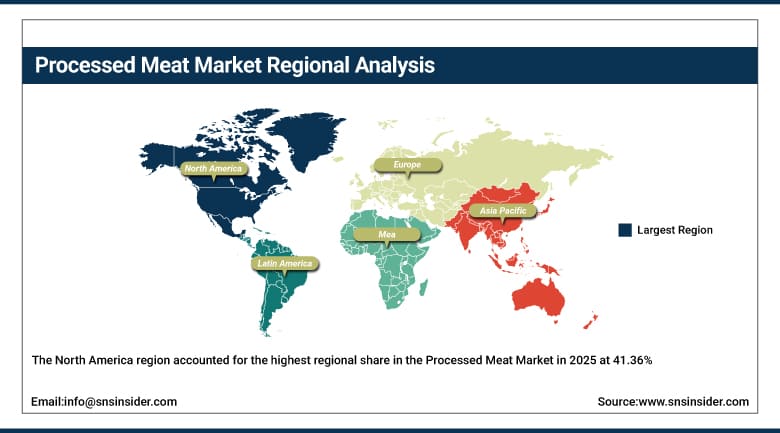
The North America region accounted for the highest regional share in the Processed Meat Market in 2025 at 41.36% of global revenues due to factors such as high meat consumption per capita, advanced processing infrastructure for processed meat products, and extensive distribution within the region through retail and food service outlets. In addition, continued advancements in clean label and premium brand processed meat products further strengthen the region’s position as a center for innovation in the category.
The United States accounted for around 84.80% of the North American Processed Meat Market in 2025 due to its large population base and advanced infrastructure for processed meats through retail and food service segments. The Canadian market in the region contributes to regional growth through retail expansion and increasing consumer preference for premium and clean label processed meat products.
Get Customized Report as Per Your Business Requirement - Enquiry Now
Europe Processed Meat Market Insights
The European region constituted an important part of the global Processed Meat Market in 2025 due to the rich history of charcuterie and cured meat food culture, along with the widespread retail penetration of the product in the Western European countries. The increasing concern over health claims of processed meats will drive the efforts on reformulation and premiumization among manufacturers.
Germany was the leader in the European region with its regional share of 22.60% in 2025, thanks to the long-standing food production tradition of sausages and cured meat and the extensive retail network in the country. The contribution from France, Italy, and Spain cannot be overlooked, since these countries have rich charcuterie food culture and exports of premium processed meat products.
Asia Pacific Processed Meat Market Insights
The Asia Pacific region is expected to demonstrate the highest CAGR for the forecast period of 2026-2035 on account of factors such as increasing urbanization, increasing disposable income, and increasing modern retail infrastructure in China, India, and Southeast Asia. Increasing working population owing to increased work pressure in the region will further support its above average growth rate than developed North America and Europe processed meat markets.
In 2025, China accounted for around 37.80% of the total Asia Pacific market owing to its large urban population and modern and increasing retail infrastructure. Other countries that are driving the growth of the region are Japan, South Korea, and India. In case of Japan, there is high demand for premium products while in case of India, there is rapid expansion of frozen meat manufacturing facilities.
Middle East & Africa and Latin America Processed Meat Market Insights
The Middle East & Africa region is exhibiting steady growth supported by halal certification alignment and retail modernization across the Gulf states, while Latin America continues to benefit from growing urban consumer demand and expanding modern retail penetration. Rising disposable income and changing dietary patterns continue to support processed meat category growth across both regions.
Saudi Arabia led the Middle East & Africa market with a 26.40% regional share in 2025, supported by strong halal-certified processed meat demand and expanding modern retail infrastructure. Brazil represented 33.60% of the Latin American market in 2025, driven by its large domestic meat production base and growing urban retail penetration, with Mexico also contributing to regional growth through rising processed meat consumption.
Growth Drivers: Rising Convenience Demand and Protein Consumption Driving Market Growth
Rising meat consumption across the globe, hectic urban lives that prefer processed protein products and constant development of packaging technology that increases shelf-life and quality of products – all this contributes to the growth of the Processed Meat Market. Modern consumers consider processed meat as an efficient way to prepare their food in limited periods of time, which is caused by the general change in the way of consuming products towards more convenient one in developed and developing countries where more people start working. The increase in manufacturer efforts to create healthier products via clean-label reformulation and premiumization attracts new consumers who refused from processed meat products earlier due to the presence of additives in the composition. Smart packaging and automation in the processes increases effectiveness and decreases waste in the production process.
Restraints: Health Concerns and Regulatory Scrutiny Limiting Market Expansion
Despite favorable underlying demand, the market faces meaningful restraints related to growing public health scrutiny of red and processed meat consumption, with health agencies and dietary guidelines in multiple countries actively encouraging reduced consumption. Some jurisdictions have introduced advertising restrictions targeting processed meat products, reflecting mounting institutional pressure that could meaningfully constrain category growth in health-conscious developed markets over the coming decade.
Increasing prices of raw material inputs, packing materials, and cold chain logistics will keep squeezing profit margins, especially for manufacturers of high-end and clean label products that need expensive ingredients and re-formulation of products. Competition from plant-based and hybrid meats as well as consumer distrust with highly processed food items will always be a challenge for manufacturers.
Opportunities: Clean-Label Innovation and Emerging Market Expansion Creating New Growth Avenues
Substantial opportunity exists in continued clean-label reformulation toward reduced-sodium, nitrate-free, and minimally processed product formulations that address consumer health concerns while retaining the convenience and flavor profiles that define the category. Manufacturers that successfully differentiate through transparent ingredient sourcing and simplified labeling are well positioned to capture disproportionate share of category value growth over the coming decade.
Growing retail and cold-chain infrastructure expansion across the Middle East & Africa, Latin America, and Asia Pacific represents a further significant growth avenue, as rising incomes and urbanization create new consumer bases for processed meat products. Continued innovation in meat-blended and hybrid plant-protein processed meat formats is also opening new opportunity for manufacturers seeking to address both health and environmental sustainability consumer concerns simultaneously.
Recent Developments
-
2025: ITC signed a definitive agreement with Prasuma, a leading Indian frozen meat manufacturer, as part of its 'ITC Next' strategy to expand its branded processed meat portfolio.
-
2025: JBS S.A. announced a USD 70 million investment in Paraguay, including the acquisition of Pollos Amanecer, strengthening its poultry processing footprint in South America.
-
2026: Tyson Foods expanded clean-label reformulation across its Jimmy Dean and Hillshire Farm brands, emphasizing reduced additives and simplified ingredient lists.
-
2026: Hormel Foods expanded new product activity across its Spam, Jennie-O, and Planters brands, supported by increased investment in data-driven marketing and distribution.
Processed Meat Market Key Players
-
Tyson Foods, Inc.
-
JBS S.A.
-
WH Group Limited (Smithfield Foods)
-
Danish Crown A/S
-
BRF S.A.
-
Conagra Brands, Inc.
-
The Kraft Heinz Company
-
Nestlé S.A.
-
Cargill, Incorporated
-
Marfrig Global Foods S.A.
-
Maple Leaf Foods Inc.
-
Perdue Farms, Inc.
-
Foster Farms
Processed Meat Market Report Scope:
| Report Attributes | Details |
|---|---|
| Market Size in 2025 | USD 707.98 Billion |
| Market Size by 2035 | USD 1343.70 Billion |
| CAGR | CAGR of 6.62% From 2026 to 2035 |
| Base Year | 2025 |
| Forecast Period | 2026-2035 |
| Historical Data | 2022-2024 |
| Report Scope & Coverage | Market Size, Segments Analysis, Competitive Landscape, Regional Analysis, DROC & SWOT Analysis, Forecast Outlook |
| Key Segments | • By Product Type (Sausages, Bacon & Ham, Deli/Luncheon Meats, Canned Meat, Meat-based Snacks/Jerky) • By Meat Source (Poultry, Pork, Beef, Others) • By Processing Technique (Cured, Smoked, Fermented, Dried) • By Distribution Channel (Supermarkets & Hypermarkets, Convenience Stores, Online Retail, Foodservice) |
| Regional Analysis/Coverage | North America (US, Canada), Europe (Germany, UK, France, Italy, Spain, Russia, Poland, Rest of Europe), Asia Pacific (China, India, Japan, South Korea, Australia, ASEAN Countries, Rest of Asia Pacific), Middle East & Africa (UAE, Saudi Arabia, Qatar, South Africa, Rest of Middle East & Africa), Latin America (Brazil, Argentina, Mexico, Colombia, Rest of Latin America). |
| Company Profiles | Tyson Foods, Inc., JBS S.A., WH Group Limited (Smithfield Foods), Hormel Foods Corporation, Danish Crown A/S, BRF S.A., Conagra Brands, Inc., The Kraft Heinz Company, Nestlé S.A., OSI Group, LLC, Cargill, Incorporated, Marfrig Global Foods S.A., Maple Leaf Foods Inc., Perdue Farms, Inc., Foster Farms |

Frequently Asked Questions
The Processed Meat Market is expected to grow at a CAGR of 6.62% from 2026 to 2035.
The Processed Meat Market was valued at USD 707.98 Billion in 2025.
The market is driven by rising global meat consumption, busy urban lifestyles favoring convenient protein options, and continued innovation in processing and packaging technology.
The Sausages segment dominated the Processed Meat Market in 2025, accounting for approximately 32.60% market share.
The North America region dominated the Processed Meat Market in 2025, accounting for approximately 41.36% market share.
