
Protein Supplements Market Report Scope & Overview:
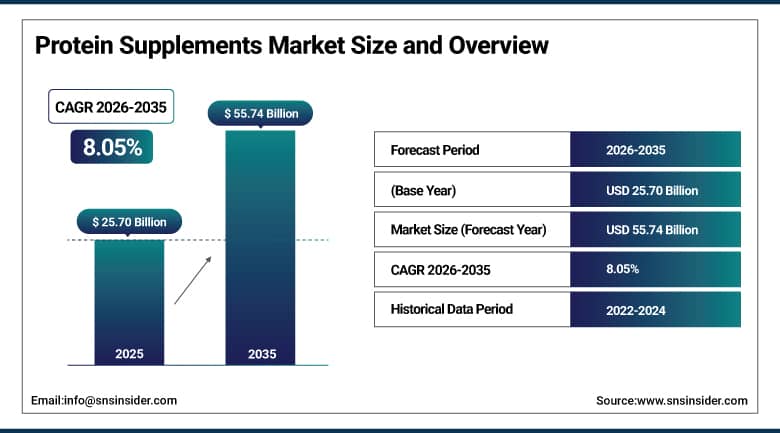
The Protein Supplements Market was valued at USD 25.70 Billion in 2025 and is expected to reach USD 55.74 Billion by 2035, growing at a CAGR of 8.05% from 2026 to 2035.
Protein Supplements Market is witnessing strong growth due to high health awareness, increased involvement in organized workout schedules, and mainstream use of protein supplements apart from the bodybuilding and sports community. Rising sales of protein bars, shakes, and powders by people indulged in casual exercise, elderly people, and those trying to manage their weight have increased the scope of this market. The development of new protein formulations such as blend proteins which help in sustained release of protein and novel proteins like collagen are widening the applications of these products. Apart from this, factors like growing presence of e-commerce and digital marketing, increased demand for alternative sources of protein, and expanding retail network are supporting this trend.
In April 2026, Optimum Nutrition, part of Glanbia Performance Nutrition, introduced Creatine Gummies and a 40G Protein Shake under its Optimum Advantage platform, reflecting continued innovation among leading sports nutrition brands in convenient, everyday-use product formats.
To Get More Information On Protein Supplements Market - Request Free Sample Report
Protein Supplements Market Trends
- Growing consumer preference for ready-to-drink protein shakes is broadening the category’s reach among convenience-focused, on-the-go consumers.
- Rising demand for plant-based protein supplements is expanding as consumers seek dairy-free and environmentally conscious alternatives to whey-based products.
- Expanding use of blended protein formulations combining multiple sources is improving absorption profiles and consumer acceptance across product categories.
- Increasing adoption of personalized nutrition technology is enabling brands to develop AI-driven, tailored protein supplement recommendations.
- Growing partnerships between protein supplement brands and fitness centers are creating exclusive product lines and strengthening brand loyalty.
U.S. Protein Supplements Market Outlook
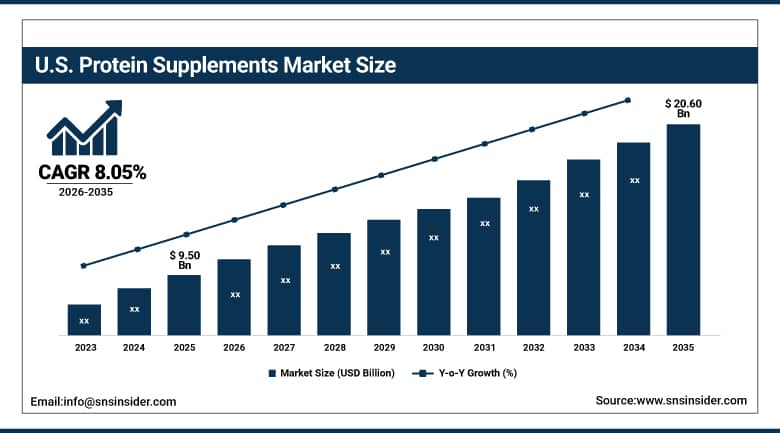
The U.S. Protein Supplements Market was valued at USD 9.50 Billion in 2025 and is projected to reach USD 20.60 Billion by 2035, growing at a CAGR of 8.05% during 2026-2035.
The U.S. Protein Supplements Market is experiencing steady growth due to the largest sports nutrition expenditures in the world and good digital and e-commerce retail sales channels for selling supplements. The trend towards the increasing consumption of protein supplements among the wider range of consumers not limited to bodybuilders is boosting the development of the market. Companies have expanded their product ranges from powders to shakes and bars due to the growing consumer demand for convenient, high-protein nutrition. The innovations in terms of improved taste and convenience are stimulating consumer choice. The distribution channels for the products through supermarkets, specialty stores, gyms, and e-commerce channels are improving. In addition, the investments of manufacturers and changing consumer preferences towards blended and plant-based proteins create additional growth opportunities for the market.
In 2025, Glanbia plc announced plans to divest its online sports nutrition business while acquiring an ingredients business, reflecting continued portfolio realignment among leading protein supplement manufacturers to focus on core growth categories amid elevated whey protein input costs.
Protein Supplements Market Segment Analysis
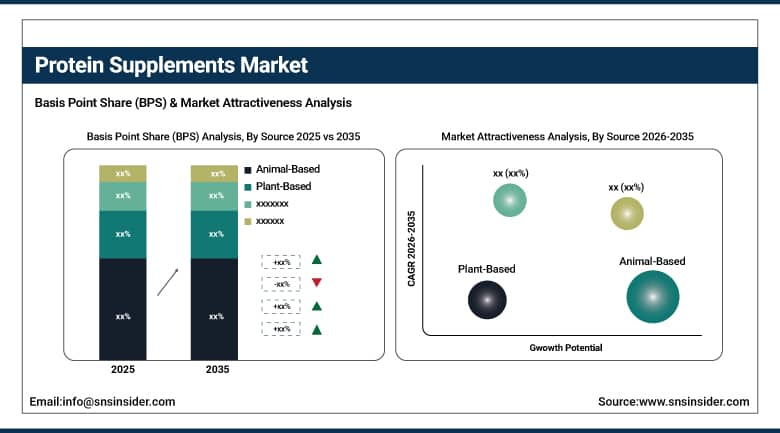
- By Source, Animal-Based segment dominated the Protein Supplements Market in 2025 with 60% share; Plant-Based segment is the fastest-growing segment.
- By Product, Protein Powder segment dominated the market in 2025 with 49% share; Ready-to-Drink Shakes segment is the fastest-growing segment.
- By Application, Sports Nutrition & Fitness segment dominated the market in 2025 with 52% share; General Wellness & Weight Management segment is the fastest-growing segment.
- By Distribution Channel, Online segment dominated the market in 2025 with 44% share; Supermarkets & Hypermarkets segment is the fastest-growing segment.
By Source, Animal-Based Dominates the Protein Supplements Market While Plant-Based Registers the Fastest Growth
Animal-Based dominates the Protein Supplements Market owing to whey and casein protein’s well-established complete amino acid profile, rapid absorption characteristics, and long-standing position as the preferred choice among athletes and bodybuilders. Animal-based protein supplements benefit from extensive manufacturing infrastructure, established brand recognition, and decades of clinical research supporting their efficacy for muscle recovery and performance. The wide availability, established supply chains, and strong consumer trust in animal-based proteins are reinforcing the segment’s market leadership.
Plant-Based is experiencing rapid growth driven by increasing consumer adoption of vegan and flexitarian diets alongside rising environmental awareness surrounding animal-based protein production. Plant-based protein supplements have found strong favor among consumers seeking dairy-free alternatives without compromising on protein content or functional benefits. Growing innovation in taste and texture improvement, along with multi-source blending to enhance amino acid completeness, is driving adoption among mainstream health-conscious consumers beyond dedicated vegans.
By Product, Protein Powder Dominates the Protein Supplements Market While Ready-to-Drink Shakes Emerge as the Fastest-Growing Product
Protein Powder holds the highest position in the Protein Supplements Market on account of its flexibility, cost-effectiveness, and the option to tailor-make it in form of shakes, smoothies, and baked goods. In powdered form, they have the advantage of long shelf-life and efficient manufacturing and distribution logistics through sports nutrition retail stores as well as conventional grocery chains. The availability, brand reputation, and versatility of applications associated with protein powders are driving this market segment’s leadership position.
The rapid growth of Ready-to-Drink Shakes can be attributed to the rise in consumer preference for convenience products that do not require any mixing or preparation time. This trend is being witnessed due to high adoption rate among professionals, athletes, and consumers looking for post-exercise recovery without any hassle of mixing the powder. Leading companies are increasingly expanding their range of ready-to-drink products and household reach.
By Application, Sports Nutrition & Fitness Dominates the Protein Supplements Market While General Wellness & Weight Management Experiences the Fastest Growth
Sports Nutrition & Fitness dominates the Protein Supplements Market due to the widespread use of protein supplements among athletes, bodybuilders, and fitness enthusiasts seeking muscle recovery, performance enhancement, and post-workout nutrition. The growing popularity of structured fitness routines and gym membership growth, alongside rising awareness regarding the role of protein in exercise recovery, is driving consumption. Widespread retail and e-commerce availability, along with an expanding range of sports-nutrition-focused product formats, are further fueling demand in this application space.
General Wellness & Weight Management is growing rapidly on account of increasing adoption of protein supplements among general health-conscious consumers beyond dedicated athletes, driven by rising awareness of protein’s role in satiety, metabolic health, and healthy aging. Growing consumer interest in protein supplementation for broader health reasons, including addressing age-related muscle loss among elderly populations, is expanding the addressable consumer base. Advances in flavor and formulation innovation are opening up several opportunities for commercial utilization in this segment.
By Distribution Channel, Online Dominates the Protein Supplements Market While Supermarkets & Hypermarkets Register the Fastest Growth
Online channels dominate the Protein Supplements Market based on the convenience of ordering, buying through subscriptions, and availability of a broad range of specialty and niche protein supplement brands which might not be found at brick-and-mortar stores. Customers are able to compare the ingredients of various products, prices and customer feedback prior to their purchases in order to make an informed decision. Direct-to-consumer brands’ proliferation, effective digital marketing campaigns and increasing customer acceptance of e-commerce as a method of health and wellness products purchasing further reinforce market leadership of this channel.
Supermarkets & Hypermarkets is one of the fastest-growing channels since more and more mainstream retailers are increasing their share of shelf space devoted to protein supplements in response to the rising demand for this type of products among the mainstream consumers as opposed to specialty sports nutrition consumers. Increasing awareness of these products as well as the opportunity to make impulse purchases of them is driving the development of this channel.
Regional Analysis
|
Region |
Country |
Share (2025) |
|
North America |
United States |
83.20% |
|
Asia Pacific |
China |
34.60% |
|
Europe |
Germany |
22.20% |
|
Middle East & Africa |
UAE |
17.60% |
|
Latin America |
Brazil |
24.10% |
North America Protein Supplements Market Insights
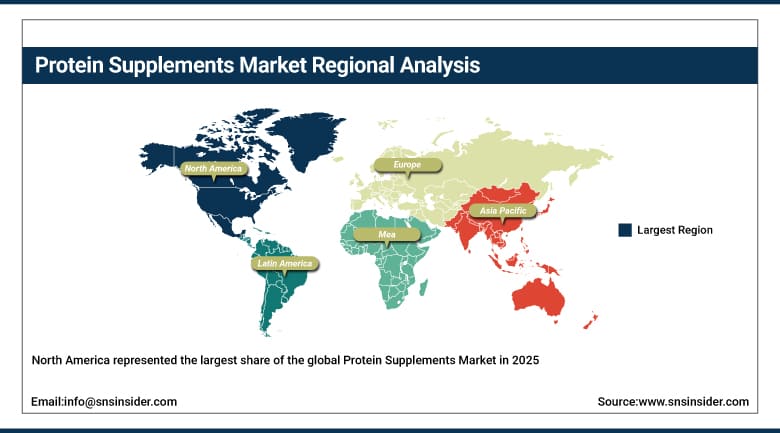
North America represented the largest share of the global Protein Supplements Market in 2025, supported by a large base of fitness-conscious consumers, the world’s most developed sports nutrition retail infrastructure, and strong adoption of protein powders and bars by both athletes and general wellness seekers. Increasing mainstream adoption of protein supplementation beyond traditional bodybuilding communities is reinforcing consumption across broader consumer demographics. Growing consumer interest in convenient, ready-to-drink formats is encouraging manufacturers to expand product lines. Well-established supplement manufacturing and e-commerce infrastructure across the United States and Canada is also improving product accessibility and sustaining regional market development.
The United States accounted for approximately 83.20% of the North American market in 2025, reflecting the highest sports nutrition spending globally and strong digital and e-commerce retail channels for supplement distribution. Canada is contributing to regional growth through steady demand for fitness-oriented and general wellness protein products.
Get Customized Report as Per Your Business Requirement - Enquiry Now
Europe Protein Supplements Market Insights
Europe held a significant share of the Protein Supplements Market in 2025, supported by strong consumer demand for sports nutrition and functional wellness products alongside well-established retail and e-commerce distribution infrastructure. Rising demand for protein-enriched functional foods across Germany, the United Kingdom, and France is supporting product innovation. Increasing regulatory clarity around health claims and growing emphasis on clean-label formulations are further reinforcing Europe’s market position.
Germany led the European market with a 22.20% regional share in 2025, supported by its strong fitness culture and well-established sports nutrition retail infrastructure. The United Kingdom and France are also contributing meaningfully to regional growth, supported by leading protein supplement brands headquartered across the region.
Asia Pacific Protein Supplements Market Insights
Asia Pacific is forecast to exhibit the highest CAGR in the Protein Supplements Market over 2026–2035 due to increasing disposable incomes, high participation in the fitness sector, and greater awareness about health and well-being among the large population pool in the region. The growth in China and India can be attributed to the rise in middle-class consumers and their increasing involvement in organized fitness regimens and protein-rich diets. Increasing innovations in the product and the rise in e-commerce reach are also adding impetus to growth in the market. Increasing consumption of animal and plant-based proteins in the region is driving the positive growth trend in the region over mature markets.
China contributed to around 34.60% share of the market in the Asia Pacific in 2025 due to increasing fitness industry and higher consumption of sports nutrition products in the country.
Middle East & Africa and Latin America Protein Supplements Market Insights
The Middle East & Africa region is exhibiting steady growth as fitness and wellness awareness expands across the Gulf states, supported by growing modern retail and gym infrastructure. Latin America is similarly benefiting from expanding urban health-conscious consumption and growing consumer interest in sports nutrition and general wellness protein products across major regional urban centers.
The UAE led the Middle East & Africa market with a 17.60% regional share in 2025, supported by growing health-conscious consumer demand and expanding modern retail penetration. Brazil represented 24.10% of the Latin American market in 2025, driven by expanding fitness industry participation, with Mexico also contributing to regional growth through rising interest in sports nutrition products.
Market Dynamics
Growth Drivers: Health Consciousness and Mainstream Fitness Adoption Driving Market Growth
The major driving forces for the growth of the Protein Supplements Market are growing health awareness, increasing involvement in organized physical training sessions, and increasing use of protein supplementation by the general population beyond the usual sporting athletes. As more consumers come to realize the importance of protein for muscle recovery, satiety, and aging well, growth opportunities have emerged in several categories including sports nutrition, wellness, and weight management, leading to the growth of the Protein Supplements Market worldwide.
Innovations in formulations, especially in the creation of blends of proteins for slow absorption and specialized proteins like collagen and insect protein, continue to grow as brands strive to differentiate themselves amid competition in this increasingly congested market. Growing consumer demand for alternative sources of protein from plants is shaping product innovation in the protein supplements market.
Restraints: Elevated Input Costs and Market Saturation Challenges Limiting Market Expansion
Even with good demand from the consumer side, there is still competition in terms of restraints such as increased costs of whey protein ingredient owing to high demand and limited supply, which affects the cost structure of manufacturing and hence retail pricing. The differences in regulations in various regions in regard to supplement labeling, allowable health claims, and acceptable ingredients still continue to affect the entry time of the product into the market. Market saturation in mature product categories like whey protein powder is causing stiff competition for both the existing and new brands.
Also, there are high costs involved in innovation and product marketing, which makes the operational costs increase and thus limits the profitability of small manufacturers amid their struggle with well-funded incumbents. Besides, there is growing price sensitivity among mainstream consumers, making price pressures more challenging. The mature stage requires careful balancing of cost, taste, and differentiation.
Opportunities: Personalized Nutrition and Convenient Format Innovation Creating New Growth Avenues
There is great potential in developing personalized nutrition technologies, diversifying convenient product forms, and penetrating new markets in health and wellness. AI-assisted development of personalized protein supplements recommendation could be a way to cater to the emerging demand among consumers for personalized nutrition programs depending on individual fitness goals and health characteristics. Companies can take advantage of the growing popularity of such convenient products as ready-to-drink shakes, gummies, and individual serving packets that eliminate preparation difficulties for busy consumers. Penetration of general wellness and healthy aging consumer groups besides dedicated athletes can also be used for gaining product presence and frequency of use.
Developing innovation in multi-source proteins could provide for unique product positioning and attraction of consumers who seek for slow-absorbing protein supplements. Partnerships of protein supplement companies and fitness clubs could give rise to co-branded and more loyal product lines. Increasing accessibility of protein supplements via e-commerce can also play its role in differentiation.
Recent Developments:
- 2026: Optimum Nutrition introduced Creatine Gummies and a 40G Protein Shake under its Optimum Advantage platform, expanding convenient product formats for strength and recovery.
- 2025: Glanbia plc announced plans to divest its online sports nutrition business while acquiring an ingredients business, reflecting continued portfolio realignment amid elevated whey protein input costs.
- 2025: BellRing Brands reported strong growth for its Premier Protein and Dymatize brands, driven by expanded ready-to-drink shake distribution and household penetration gains.
Protein Supplements Market key players are:
- Glanbia plc
- Abbott Laboratories
- Amway Corporation
- Herbalife Nutrition Ltd.
- Nestlé S.A.
- BellRing Brands, Inc.
- CytoSport, Inc. (Muscle Milk)
- Quest Nutrition, LLC
- GNC Holdings, LLC
- Iovate Health Sciences International Inc.
- Optimum Nutrition (Glanbia Performance Nutrition)
- Bio-Engineered Supplements and Nutrition, Inc. (BSN)
- NOW Health Group, Inc.
- United States Nutrition, Inc.
- RSP Nutrition
- BRF S.A.
- The Hut Group (Myprotein)
- Naked Nutrition
- Vital Proteins LLC (Nestlé S.A.)
- Post Holdings, Inc. (Premier Nutrition)
Protein Supplements Market Report Scope:
| Report Attributes | Details |
|---|---|
| Market Size in 2025 | USD 25.70 Billion |
| Market Size by 2035 | USD 55.74 Billion |
| CAGR | CAGR of 8.05% From 2026 to 2035 |
| Base Year | 2025 |
| Forecast Period | 2026-2035 |
| Historical Data | 2022-2024 |
| Report Scope & Coverage | Market Size, Segments Analysis, Competitive Landscape, Regional Analysis, DROC & SWOT Analysis, Forecast Outlook |
| Key Segments | • By Source (Animal-Based, and Plant-Based) • By Product (Protein Powder, Ready-to-Drink Shakes, Protein Bars, and Others) • By Application (Sports Nutrition & Fitness, General Wellness & Weight Management, and Others) • By Distribution Channel (Online, and Supermarkets & Hypermarkets) |
| Regional Analysis/Coverage | North America (US, Canada), Europe (Germany, UK, France, Italy, Spain, Russia, Poland, Rest of Europe), Asia Pacific (China, India, Japan, South Korea, Australia, ASEAN Countries, Rest of Asia Pacific), Middle East & Africa (UAE, Saudi Arabia, Qatar, South Africa, Rest of Middle East & Africa), Latin America (Brazil, Argentina, Mexico, Colombia, Rest of Latin America). |
| Company Profiles | Glanbia plc; Abbott Laboratories; Amway Corporation; Herbalife Nutrition Ltd.; Nestlé S.A.; BellRing Brands, Inc.; CytoSport, Inc. (Muscle Milk); Quest Nutrition, LLC; GNC Holdings, LLC; Iovate Health Sciences International Inc.; Optimum Nutrition (Glanbia Performance Nutrition); Bio-Engineered Supplements and Nutrition, Inc. (BSN); NOW Health Group, Inc.; United States Nutrition, Inc.; RSP Nutrition; BRF S.A.; The Hut Group (Myprotein); Naked Nutrition; Vital Proteins LLC (Nestlé S.A.); Post Holdings, Inc. (Premier Nutrition). |
Frequently Asked Questions
Some of the major companies that operate in the global protein supplements market are Glanbia plc, Abbott Laboratories, Amway Corporation, Herbalife Nutrition Ltd., Nestlé S.A., BellRing Brands, Inc., CytoSport, Inc. (Muscle Milk), Quest Nutrition, LLC.
Personalized Nutrition and Convenient Format Innovation Creating New Growth Avenues
The market is driven by increasing health consciousness, rising participation in structured fitness routines, and growing mainstream adoption of protein supplementation.
The Animal-Based segment dominated the Protein Supplements Market in 2025.
The North America region dominated the Protein Supplements Market in 2025, accounting for approximately 40% of global market share.
