
Proteogenomics Market Report Scope and Overview:
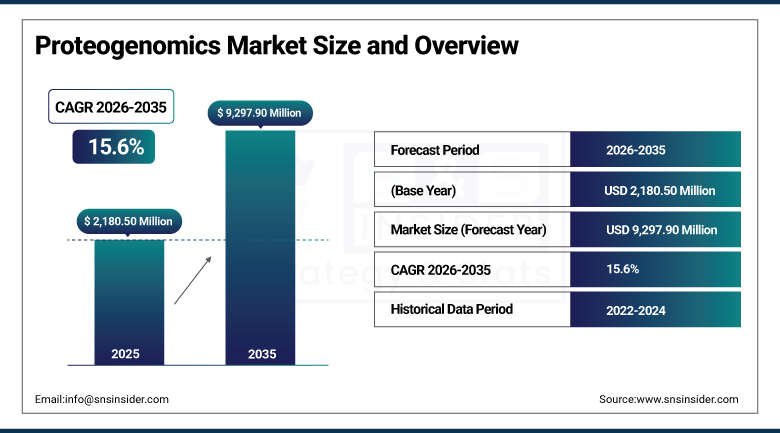
The Proteogenomics Market was valued at USD 2,180.50 Million in 2025 and is projected to reach USD 9,297.90 Million by 2035, registering a CAGR of 15.6% from 2026 to 2035.
The Proteogenomics Market is revolutionizing the fields of precision medicine and cancer research through its application of genomic sequencing data with protein data generated using mass spectrometry techniques, thereby allowing the translation of genetic mutations into protein-level effects responsible for the disease development. The market features an increase in government and university funding of pan-cancer proteogenomic maps, increasing use of integrated omics technology platforms by pharma companies for validating drug targets, and high demand for bioinformatics software used to analyze increasingly complex genomic and proteomic data sets. There is substantial growth in cloud-based integration platforms, AI-based variant-to-protein matching algorithms, and contract research services among other services.
In 2025, Thermo Fisher Scientific expanded integration between its Orbitrap Astral mass spectrometry platform and next-generation sequencing workflows, enabling more efficient proteogenomic variant-to-protein matching for cancer research applications across academic and pharmaceutical research laboratories worldwide.
To Get more information On Proteogenomics Market - Request Free Sample Report
Proteogenomics Market Trends
-
Rising government and academic investment in pan-cancer proteogenomic atlases continues expanding the volume of publicly available combined genomic and protein-level datasets.
-
Growing pharmaceutical adoption of integrated multi-omics platforms continues accelerating drug target validation and biomarker discovery timelines.
-
Expanding cloud-based bioinformatics infrastructure continues improving researchers' ability to manage and analyze increasingly complex combined omics datasets.
-
Increasing use of AI-assisted variant-to-protein matching algorithms continues improving the accuracy and speed of proteogenomic data interpretation.
-
Rising contract research organization investment in proteogenomic service offerings continues expanding outsourced access to integrated multi-omics analysis capability.
U.S. Proteogenomics Market Outlook
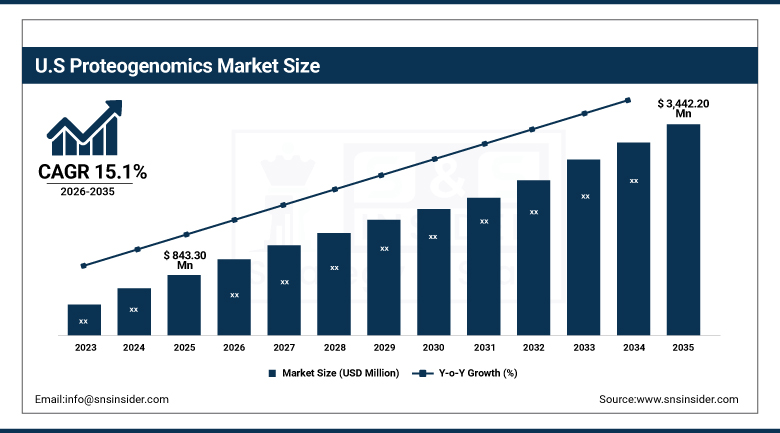
The U.S. Proteogenomics Market was valued at approximately USD 843.30 Million in 2025 and is projected to reach approximately USD 3,442.20 Million by 2035, registering a CAGR of approximately 15.1% from 2026 to 2035.
Demand across the United States continued to be shaped by substantial National Institutes of Health funding for large-scale proteogenomic research initiatives, alongside a dense concentration of leading instrument manufacturers and academic research institutions. Rising pharmaceutical industry adoption of integrated multi-omics platforms for oncology drug development continued reinforcing the country's position as both the largest and most research-intensive market for proteogenomics technology. Growing investment in cloud-based bioinformatics infrastructure and expanding academic-industry research collaborations added further layers of sustained domestic demand extending well beyond federally funded consortia into commercial biopharmaceutical research nationwide.
In 2025, the National Cancer Institute's Clinical Proteomic Tumor Analysis Consortium launched a new pan-cancer proteogenomic atlas, expanding combined genomic and protein-level data coverage to additional rare tumor types and strengthening the national precision oncology research infrastructure.
Proteogenomics Market Segment Analysis
-
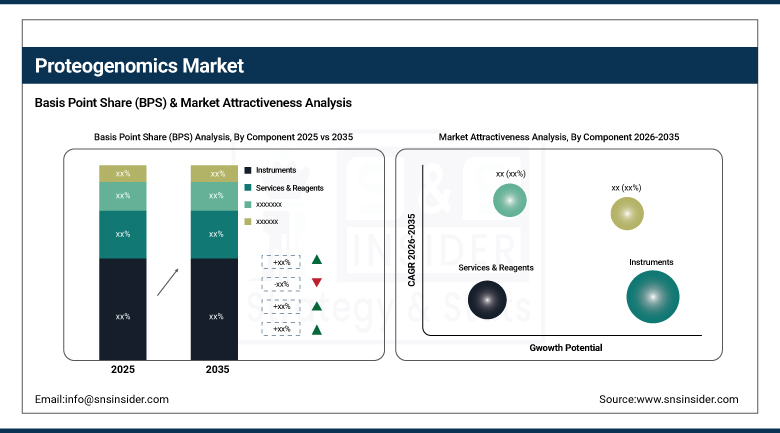
By Component, Instruments segment dominated the Proteogenomics Market in 2025 with 48.60% share; Software & Bioinformatics Tools segment is the fastest growing segment, registering a CAGR of 17.1% from 2026 to 2035.
-
By Technology, Mass Spectrometry-Based Proteogenomics segment dominated the market in 2025 with 54.30% share; Integrated Multi-Omics Platforms segment is the fastest growing segment, registering a CAGR of 17.4% from 2026 to 2035.
-
By Application, Cancer/Oncology Research segment dominated the market in 2025 with 51.70% share; Personalized/Precision Medicine segment is the fastest growing segment, registering a CAGR of 17.0% from 2026 to 2035.
-
By End User, Academic & Research Institutes segment dominated the market in 2025 with 44.90% share; Pharmaceutical & Biotechnology Companies segment is the fastest growing segment, registering a CAGR of 16.8% from 2026 to 2035.
By Component, Instruments Lead the Market While Software and Bioinformatics Tools Post the Fastest Growth
The Instruments segment dominated the Proteogenomics Market in 2025, reflecting the substantial capital investment required for mass spectrometry and next-generation sequencing platforms that form the analytical foundation of any proteogenomic research program. Large academic consortia and pharmaceutical research divisions continued investing in high-resolution instrumentation capable of generating the deep, high-throughput datasets required for meaningful genomic-to-protein correlation studies. Established relationships between major instrument manufacturers and leading proteogenomic research programs further reinforced this segment's position as the largest revenue-generating component category.
The Software & Bioinformatics Tools segment is the fastest growing in the Proteogenomics Market as researchers increasingly recognize that data integration and interpretation capability, rather than raw instrument output alone, represents the primary bottleneck in extracting meaningful biological insight from combined genomic and proteomic datasets. Growing investment in cloud-based analysis platforms, AI-assisted variant-to-protein matching algorithms, and standardized data-sharing frameworks continues accelerating software segment growth as research programs scale dataset complexity beyond what manual analysis can reasonably manage.
By Technology, Mass Spectrometry Dominates While Integrated Multi-Omics Platforms Record the Fastest Growth
Mass Spectrometry-Based Proteogenomics accounted for the biggest share in the Proteogenomics Market in 2025 on the back of the fact that this technique is considered to be the standard gold technique for identifying, quantifying, and analyzing proteins' post-translational modifications. Improvements in high-resolution mass spectrometry equipment in terms of sensitivity and speed have also made this technique more important in producing protein-level data that confirms genomic results.
Integrated Multi-Omics Platforms is the fastest-growing segment of the Proteogenomics Market due to the increasing requirement for a unified approach to the analysis of the genomic, transcriptomic, and proteomic data in one process. The realization of the fact that a single-omics approach gives a partial view of the biological processes of the disease makes researchers tend to use multi-omics platforms for their research projects.
By Application, Cancer Research Dominates While Personalized Medicine Emerges as the Fastest-Growing Application
The Cancer/Oncology Research segment dominated the Proteogenomics Market in 2025, anchored by large-scale, government-funded initiatives that have established proteogenomics as a central methodology for understanding tumor biology beyond genomic mutation data alone. Rising global cancer incidence and sustained research funding for precision oncology programs continued reinforcing this indication's position as the largest application driving current proteogenomics platform and service demand.
The Personalized/Precision Medicine segment is experiencing the highest growth rate within the Proteogenomics Market segment because there is an increasing number of demands for individual patient molecular profiling that combines both genomic and protein data. The increasing interest from the pharmaceutical industry in utilizing proteogenomics to stratify clinical trial patients and to predict drug responsiveness continues to expand the scope of this application.
By End User, Academic Institutes Dominate While Pharmaceutical Companies Post the Fastest Growth
The Academic & Research Institutes segment dominated the Proteogenomics Market in 2025 due to the concentration of large, government-funded proteogenomic consortia and university research programs that have historically led foundational methodology development in this field. Sustained public research funding for large-scale cancer atlases and basic biology research programs reinforced this segment's position as the largest end-user category, supported by deep institutional expertise accumulated through years of foundational proteogenomic research.
The Pharmaceutical & Biotechnology Companies segment is the fastest growing in the Proteogenomics Market as drug developers increasingly adopt integrated multi-omics approaches for target identification, biomarker discovery, and clinical trial patient stratification. Growing industry recognition that proteogenomic evidence improves drug development success rates continues driving pharmaceutical investment in both in-house proteogenomic capability and outsourced contract research services.
Regional Analysis
|
Region |
Major Country |
Share within Region, 2025 (%) |
|
North America |
United States |
85.00% |
|
Europe |
Germany |
23.90% |
|
Asia Pacific |
China |
30.40% |
|
Middle East and Africa |
UAE |
25.80% |
|
Latin America |
Brazil |
33.70% |
North America Proteogenomics Market Insights
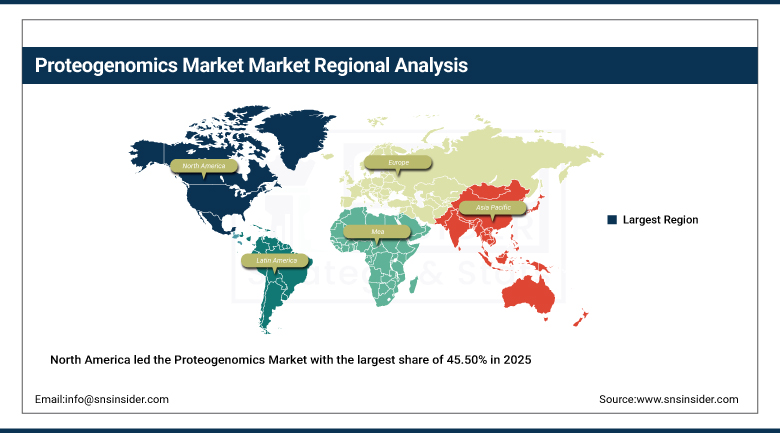
North America led the Proteogenomics Market with the largest share of 45.50% in 2025. Substantial National Institutes of Health funding for large-scale proteogenomic research consortia, a dense concentration of leading instrument manufacturers, and extensive academic research infrastructure continued reinforcing this dominant regional position. Strong pharmaceutical industry adoption of integrated multi-omics platforms for oncology drug development, combined with well-established data-sharing frameworks across federally funded research programs, further supported sustained regional demand throughout the current forecast period.
The dominance of the United States is anchored by the National Cancer Institute-funded initiatives, alongside a concentration of leading academic medical centers and pharmaceutical research divisions. Canada added further regional demand through the Canadian National Proteomics Network and steady public research funding for combined genomic and proteomic research, and that combined strength kept the continent the largest addressable market for proteogenomics vendors through the forecast period.
Get Customized Report as per Your Business Requirement - Enquiry Now
Europe Proteogenomics Market Insights
Europe held a meaningful share of global revenue, supported by well-established biotechnology clusters, strong academic research capabilities, and growing public-private research partnerships that increasingly incorporate proteogenomic methodology into precision medicine initiatives. Continued national health system engagement with large-scale biobank and proteome-mapping programs reinforced sustained demand for proteogenomics instruments, software, and services across the region's leading research economies.
Germany led the demand supported by its strong precision-instrument manufacturing base and deep academic research infrastructure. The United Kingdom and France contributed substantial additional demand through national biobank programs and public research funding for combined genomic and proteomic disease research, and continued European clinical research network expansion should keep regional demand for proteogenomics technology climbing through the forecast period.
Asia Pacific Proteogenomics Market Insights
Asia Pacific is advancing at the fastest pace among all regions tracked in this report, growing at a CAGR of 18.90% through 2035, driven by rapidly expanding life sciences research funding, growing domestic instrument manufacturing capability, and rising government investment in genomics and proteomics research infrastructure across the region's largest economies. Growing academic-industry collaboration and expanding contract research capacity kept the region's growth trajectory well ahead of every other region tracked in this report.
China led the pack supported by substantial government investment in biotechnology research infrastructure and rapidly expanding domestic proteogenomics manufacturing and service capability. Japan and India contributed meaningful additional demand, with India's growing contract research hub development and Japan's advanced healthcare research infrastructure both reinforcing the region's position as the fastest-growing market tracked in this report.
MEA and Latin America Proteogenomics Market Insights
The Middle East and Africa and Latin America both showed steady growth, driven by expanding academic research infrastructure investment, growing government focus on precision medicine research capability, and rising demand for advanced genomic and proteomic analysis capacity across both areas. As these markets continued building out modern research infrastructure, proteogenomics offered a genuinely effective way to accelerate disease biology understanding beyond conventional single-omics research approaches alone.
The UAE led Middle East and Africa demand supported by the country's advanced academic medical research infrastructure and substantial genomics research investment. Saudi Arabia contributed further demand through its own precision medicine research programs. In Latin America, Brazil accounted for significant share of regional revenue, with growing academic and pharmaceutical research investment continuing to anchor regional demand for proteogenomics technology.
Market Dynamics
Growth Drivers: Rising Precision Oncology Research and Multi-Omics Integration Demand
The industry is driven by rising government and academic investment in large-scale precision oncology research programs, growing pharmaceutical recognition that combined genomic and protein-level data improves drug target validation, and expanding demand for comprehensive disease biology understanding beyond single-omics analysis alone. As research programs increasingly recognize that genomic mutation data alone provides an incomplete picture of disease mechanisms, the clinical and commercial value of integrated proteogenomic evidence continues driving sustained platform and service demand.
Growing pharmaceutical industry adoption of multi-omics platforms for clinical trial patient stratification continues reinforcing this driver, as proteogenomic biomarkers increasingly inform treatment selection and predict therapeutic response with greater precision than genomic data alone. Rising availability of cloud-based bioinformatics infrastructure continues lowering barriers to complex multi-omics data analysis, and that combination of clinical validation and improving analytical accessibility is exactly what keeps research institution and pharmaceutical demand climbing at such a sustained, steady pace.
Restraints: High Instrumentation Costs and Data Integration Complexity
The substantial capital investment required for mass spectrometry and next-generation sequencing instrumentation continues posing a genuine restraint on faster market-wide expansion, particularly for smaller academic institutions and research programs without the capital budgets that large, federally funded consortia can commit. That cost profile has kept advanced proteogenomic capability concentrated among comparatively well-resourced research institutions and pharmaceutical companies.
Data integration complexity continues posing a further restraint, as combining genomic and proteomic datasets generated on different platforms with different data structures requires specialized bioinformatics expertise that remains in short supply across the research community. That analytical bottleneck keeps some research programs reliant on outsourced data analysis services rather than developing in-house proteogenomic interpretation capability.
Opportunities: AI-Driven Data Integration and Emerging Market Research Capacity Expansion
Advancing artificial intelligence and machine learning capability for automated variant-to-protein matching represents a genuinely significant opportunity, as improved algorithmic interpretation could substantially reduce the specialized bioinformatics expertise currently required for proteogenomic data analysis. Vendors positioned early with strong AI-assisted software platforms stand to capture meaningful share as research programs seek to reduce analytical bottlenecks limiting broader proteogenomics adoption.
Expanding life sciences research infrastructure across emerging markets offers a second substantial opportunity, as government research investment programs across Asia Pacific, Latin America, and the Middle East continue creating fresh demand for accessible genomic and proteomic analysis capacity. Vendors with proven, cost-competitive instrument and service offerings stand to capture meaningful share as developing research systems build out modern multi-omics analysis capability from a comparatively low existing base.
Recent Developments:
-
2024: Bruker Corporation expanded its proteogenomics-focused contract research partnership with Biognosys AG, integrating Bruker's timsTOF mass spectrometry platform with Biognosys' proteomic data analysis pipelines.
-
2025: Seer, Inc. advanced commercial rollout of its Proteograph XT platform, designed to enable deep, unbiased plasma proteome profiling for integration with genomic sequencing data in large-scale biomarker discovery studies.
-
2026: Biognosys introduced Spectronaut 21 and SpectroMine 6 with AI-powered proteomics analysis, improved PTM detection, expanded protein coverage, and increased speed of data handling for multiomics studies.
Proteogenomics Market key players are:
-
Thermo Fisher Scientific Inc.
-
Bruker Corporation
-
Agilent Technologies, Inc.
-
Danaher Corporation (SCIEX)
-
Bio-Rad Laboratories, Inc.
-
Waters Corporation
-
Illumina, Inc.
-
Revvity, Inc.
-
Merck KGaA
-
Bio-Techne Corporation
-
Biognosys AG
-
Standard BioTools Inc.
-
Creative Proteomics
-
GenScript Biotech Corporation
-
QIAGEN N.V.
-
Charles River Laboratories International, Inc.
-
Seer, Inc.
-
Twist Bioscience Corporation
-
PTM BioLabs, Inc.
-
Cell Signaling Technology, Inc.
Proteogenomics Market Report Scope:
| Report Attributes | Details |
|---|---|
| Market Size in 2025 | USD 2,180.50 Million |
| Market Size by 2035 | USD 9,297.90 Million |
| CAGR | CAGR of 15.6 From 2026 to 2035 |
| Base Year | 2025 |
| Forecast Period | 2026-2035 |
| Historical Data | 2022-2024 |
| Report Scope & Coverage | Market Size, Segments Analysis, Competitive Landscape, Regional Analysis, DROC & SWOT Analysis, Forecast Outlook |
| Key Segments | • By Component (Instruments, Software & Bioinformatics Tools, Services & Reagents) • By Technology (Mass Spectrometry-Based Proteogenomics, Next-Generation Sequencing-Based Proteogenomics, Integrated Multi-Omics Platforms) • By Application (Cancer/Oncology Research, Drug Discovery & Biomarker Development, Personalized/Precision Medicine, Others) • By End User (Academic & Research Institutes, Pharmaceutical & Biotechnology Companies, Clinical Diagnostic Laboratories, Contract Research Organizations) |
| Regional Analysis/Coverage | North America (US, Canada), Europe (Germany, UK, France, Italy, Spain, Russia, Poland, Rest of Europe), Asia Pacific (China, India, Japan, South Korea, Australia, ASEAN Countries, Rest of Asia Pacific), Middle East & Africa (UAE, Saudi Arabia, Qatar, South Africa, Rest of Middle East & Africa), Latin America (Brazil, Argentina, Mexico, Colombia, Rest of Latin America). |
| Company Profiles | Thermo Fisher Scientific Inc., Bruker Corporation, Agilent Technologies, Inc., Danaher Corporation (SCIEX), Bio-Rad Laboratories, Inc., Waters Corporation, Illumina, Inc., Revvity, Inc., Merck KGaA, Bio-Techne Corporation, Biognosys AG, Standard BioTools Inc., Creative Proteomics, GenScript Biotech Corporation, QIAGEN N.V., Charles River Laboratories International, Inc., Seer, Inc., Twist Bioscience Corporation, PTM BioLabs, Inc., Cell Signaling Technology, Inc. |

Frequently Asked Questions
Key Players include Thermo Fisher Scientific Inc., Bruker Corporation, Agilent Technologies, Inc., Danaher Corporation (SCIEX), and Bio-Rad Laboratories, Inc., among others.
Key opportunities include expanding precision medicine applications, increasing multi-omics integration, advances in AI-driven data analysis, growing cancer research, and rising demand for biomarker discovery.
The major growth factor is rising government and academic investment in precision oncology research, expanding pharmaceutical adoption of multi-omics platforms, and growing bioinformatics software demand.
The Instruments segment dominated the Proteogenomics Market by component, representing the largest share of revenue in 2025.
North America dominated the Proteogenomics Market in 2025, holding an estimated 45.50% share of total global market revenue.
