
Surgical Instruments Tracking Systems Market Report Scope & Overview:
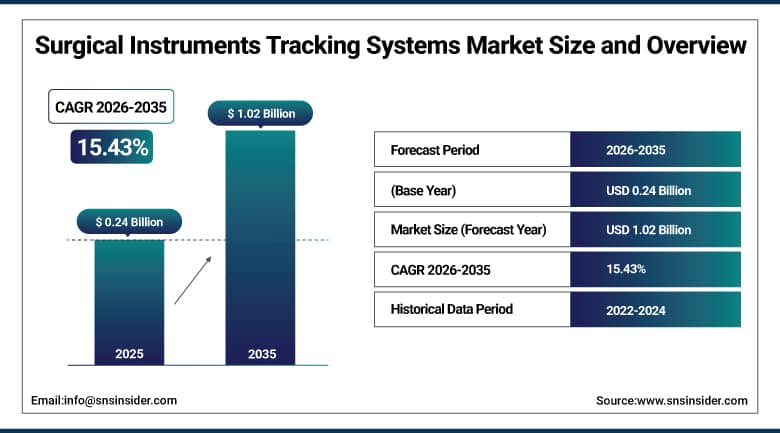
The Surgical Instruments Tracking Systems Market was valued at USD 0.24 Billion in 2025 and is expected to reach USD 1.02 Billion by 2035, growing at a CAGR of 15.43% from 2026–2035.
Market has continued to witness continued growth due to factors such as increased number of surgeries being conducted, increased compliance measures in hospitals, increased number of facilities using RFID/bar code system, and increased requirement for reducing surgical errors and losses. Adoption of technology that facilitates real time sterilization management, inventory management, workflow optimization, and improvement in patient safety has been responsible for market growth. Market growth has been driven by the trend in the regulatory requirements. Rapid changes witnessed in this market have been facilitated by the shift from the use of paper documents in the management of surgery-related information.
Several healthcare systems across North America expanded deployment of AI-enabled RFID surgical instrument tracking platforms integrated with predictive sterilization analytics to improve operating room efficiency, reduce tray assembly errors, and strengthen compliance with UDI-based instrument traceability requirements.
Market Size and Forecast
-
Market Size 2026E: USD 0.28 Billion
-
Market Size 2035: USD 1.02 Billion
-
CAGR (2026–2035): 15.43%
-
Fastest Growing Region: Asia Pacific
-
Largest Region: North America
To Get More Information On Surgical Instruments Tracking Systems Market - Request Free Sample Report
Surgical Instruments Tracking Systems Market Trends
-
Rising adoption of RFID-enabled sterilization systems is enhancing surgical workflow automation and real-time instrument tracking.
-
Increasing deployment of AI-powered predictive maintenance platforms is improving inventory utilization and minimizing instrument downtime.
-
Growing integration of cloud-based asset management solutions is accelerating centralized monitoring of surgical instrument lifecycles.
-
Strengthening regulatory emphasis on UDI compliance is driving demand for traceable surgical instrument management systems.
-
Expansion of smart hospitals and connected operating rooms is boosting investment in automated perioperative workflow technologies.
U.S. Surgical Instruments Tracking Systems Market Size Outlook
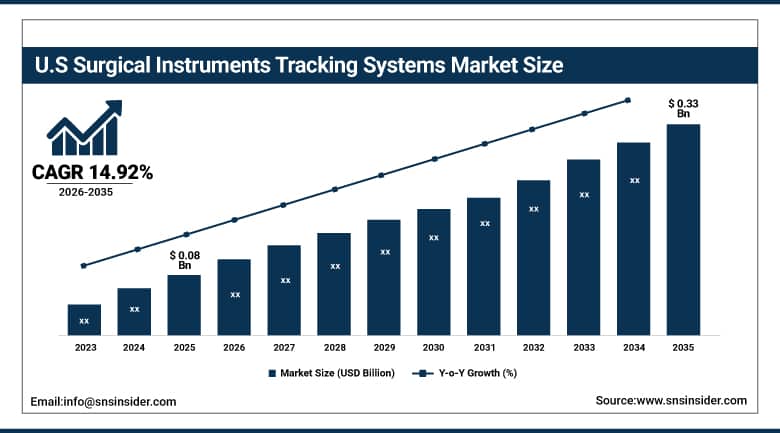
The U.S. Surgical Instruments Tracking Systems Market was valued at USD 0.08 Billion in 2025 and is expected to reach around USD 0.33 Billion by 2035, growing at a CAGR of 14.92% from 2026–2035.
The key drivers for the US domination of the surgical instruments tracking system market consist of advanced health care IT infrastructure, regulatory compliance capabilities, high number of procedures performed on a regular basis, as well as increased investment in smart hospitals projects. An increasing focus on digital instrument tracking due to FDA-mandated device identification guidelines and hospital accreditation standards combined with the widespread adoption of robot-assisted surgery systems will drive the demand for instrument lifecycle management systems with high levels of precision. Moreover, the ongoing trend towards minimal invasive surgeries is expected to boost demand for instrument management systems.
Major U.S. healthcare networks expanded adoption of AI-enabled RFID surgical instrument tracking systems integrated with centralized sterile processing software to improve operating room efficiency, strengthen FDA UDI compliance, and reduce instrument loss. Several academic medical centers also implemented cloud-based perioperative asset management platforms supporting real-time tray tracking, predictive sterilization monitoring, and automated workflow optimization across multi-hospital surgical facilities.
Surgical Instruments Tracking Systems Market Segment Analysis
-
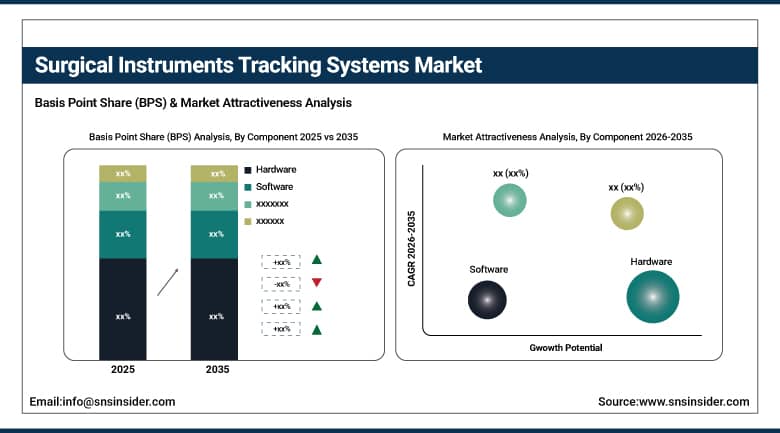
By Component, hardware accounted for nearly 45.00% of market revenue in 2025, supported by rising deployment of scanners, RFID tags, and tracking devices. Software is expected to register the highest CAGR owing to growing adoption of AI-powered and cloud-based tracking platforms.
-
By Technology, barcode tracking dominated the market with a 65.00% share in 2025, driven by its cost-efficiency and widespread hospital adoption. RFID tracking is projected to witness the fastest CAGR due to increasing demand for real-time instrument visibility and automation.
-
By End User, hospitals led the market with around 65.00% share in 2025 due to high surgical volumes and compliance requirements. Ambulatory Surgical Centres (ASCs) are anticipated to grow at the fastest CAGR with increasing outpatient surgical procedures.
By Component, hardware dominated; software grows fastest
The hardware segment turned out to be the biggest source of earnings in the year 2025 with the market share of nearly 45.00%, owing to widespread adoption of such devices as barcode scanners, RFID readers, surgical instruments tags, and sterilization tracking systems. Hospitals have been regularly procuring hardware because of better visualization, increased workflow efficiency, and easier surgical tool management. Widespread adoption rates of RFID-based smart cabinets, tray assembly systems, and mobile scanner systems will further boost growth prospects for this segment in the immediate future.
The software segment will exhibit the fastest growth rate in the years ahead due to growing adoption rates of artificial intelligence-powered analytics platforms, cloud-based asset management solutions, and predictive sterilization tracking systems. Adoption of more advanced technologies to facilitate surgical tools' tracking at hospitals will contribute to software segment's growth prospects in the coming years. Integration of software into EHR and hospital enterprise resource planning systems will ensure future growth.
By Technology, Barcode tracking dominated, RFID tracking grows fasters
Bar code tracking emerged as the most lucrative segment of the global surgical instruments tracking systems market, accounting for almost 65.00% revenue share in 2025, due to its low cost of implementation, simple deployment, and extensive utilization within hospitals and ambulatory surgery centers. The bar code tracking system is widely used as an economical method of tracking medical devices, recording sterilization processes, and managing inventory. These tracking systems have been found to integrate seamlessly with the existing IT systems at hospitals and do not need complex infrastructure for their operation.
Radio frequency identification tracking technology is expected to witness the highest CAGR in the coming decade due to increasing needs for real-time tracking of surgical equipment, tray verification, and optimization of high-throughput sterilization procedures. Heat-resistant tags and improved non-line-of-sight RFID readers help hospitals increase the accuracy of inventory management and streamline their operations. Integration of RFID-based systems with artificial intelligence-driven analytical solutions drives the overall market development even faster.
By End User, hospitals dominated; ambulatory surgical centres (ASCs) grows fastest
Hospitals had a major share in the surgical instruments tracking systems market in the global industry in 2025 accounting for approximately 65.00%. This was owing to the numerous surgeries conducted at such institutions, the presence of centralized sterilization processing facilities, and stringent regulations concerning operations. Big hospitals as well as academic healthcare centres have been increasingly using tracking systems of surgical instruments in order to reduce the turnover time and avoid loss of tools.
The ambulatory surgical centres (ASC) segment is likely to record a relatively higher CAGR in the forecast period from 2026 to 2035 owing to the increased number of outpatient surgeries and a growing need for effective surgical procedures management. Cloud-based surgical instrument tracking systems have become increasingly popular among ambulatory surgical centres for efficient sterilization procedures and resource management.
Regional Analysis:
|
Region |
Major Country |
Share within Region, 2025 (%) |
|---|---|---|
|
North America |
United States |
82.15% |
|
Europe |
Germany |
27.84% |
|
Asia Pacific |
China |
42.37% |
|
Middle East & Africa |
UAE |
24.18% |
|
Latin America |
Brazil |
36.42% |
North America Surgical Instruments Tracking Systems Market Insights
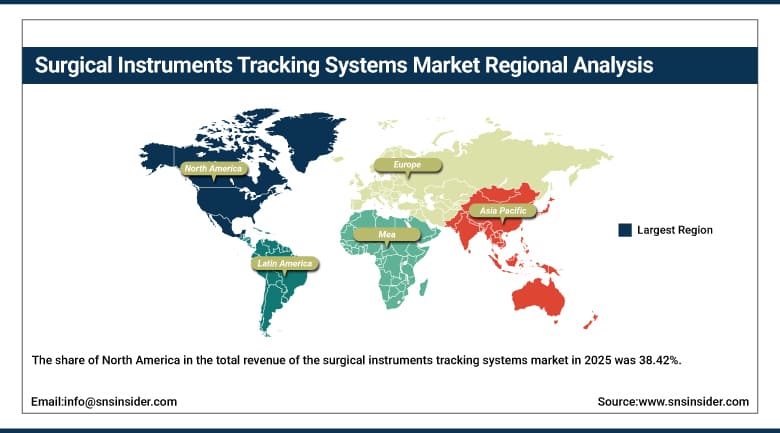
The share of North America in the total revenue of the surgical instruments tracking systems market in 2025 was 38.42%, owing to advanced digitization in the health care industry, increased use of RFID technology, and growing investments in AI-driven perioperative process automation. Cloud-based surgical instrument management systems combined with predictive sterilization technology, as well as real-time monitoring systems, have seen a rise in installation by hospitals within the U.S. and Canada due to growing regulations related to UDI, infection control, and the construction of smart operating rooms.
More than USD 2.5 billion of healthcare infrastructure modernization investments had been made in smart hospital and perioperative process automation initiatives in North America during 2025.
Several U.S. and Canadian hospital networks expanded AI-enabled RFID surgical instrument tracking deployments integrated with predictive sterilization analytics and cloud-based perioperative workflow platforms to improve operating room efficiency and UDI compliance.
Get Customized Report as Per Your Business Requirement - Enquiry Now
Europe Surgical Instruments Tracking Systems Market Insights
With regard to technological advancement in the deployment of surgical instrumentation monitoring devices, the Europe region emerges as an ideal market based on the strict regulations related to the quality of healthcare, increased investment in digitalization of hospitals and deployment of sterilization centers within Germany, UK, France, Italy, and the Nordic countries. With rising focus on infections, accountability in surgery, and operational efficiencies, healthcare organizations in the Europe region have been deploying intelligent surgical workflow management solutions embedded with RFID and cloud-based analytical technologies.
Healthcare providers across Germany, the UK, and Nordic countries increased investments in centralized sterile processing automation and RFID-enabled instrument traceability systems to strengthen infection prevention compliance and surgical workflow optimization.
Asia Pacific Surgical Instruments Tracking Systems Market Insights
It is predicted that the Asia Pacific region will have the highest CAGR of 16.21% from 2026 to 2035 in the global surgical instruments tracking system market because of rising infrastructure in health care, high number of surgeries, greater adoption of automation technology in hospitals, and increased utilization of digital health care services in countries like China, India, Japan, South Korea, Southeast Asia, and Australia. With fast growth in private hospitals, medical tourism centers, and minimally invasive surgeries, the use of barcode and RFID-enabled surgical instrument management software is rising at a fast pace in the Asia Pacific region.
Hospital groups across China, India, Japan, and Southeast Asia accelerated deployment of barcode and RFID-based surgical instrument tracking platforms integrated with smart operating room infrastructure and AI-driven sterilization monitoring systems.
Latin America, Middle East & Africa (LAMEA) Surgical Instruments Tracking Systems Market Insights
The LAMEA surgical instruments tracking systems market has been experiencing steady growth due to the increasing developments in healthcare infrastructure, the emergence of many private hospitals chains, implementation of efficient sterilization practices, and high awareness related to the surgical management in countries such as Brazil, Mexico, UAE, Saudi Arabia, South Africa, among others. There has been an increase in the investments made by healthcare facilities in surgical instruments management solutions in order to achieve greater compliance, reduced losses, and improved efficiency of operating rooms.
Between2025-2026, healthcare facilities from Saudi Arabia, UAE, and Brazil made further investments in RFID surgical instrument tracking solutions as well as cloud-based sterile processing solutions as part of their healthcare digitization initiatives.
Healthcare facilities across Brazil, UAE, and Saudi Arabia expanded adoption of cloud-based surgical instrument tracking systems and RFID-enabled sterile processing solutions to improve operating room productivity, compliance management, and instrument visibility.
Growth Drivers: Rising healthcare digitalization and demand for surgical workflow efficiency are driving adoption of surgical instruments tracking systems.
The increasing demand for efficiency in operations, sterilization tracking capability, and surgical assets tracking in real time is driving the adoption rate of surgical instruments tracking systems. Healthcare providers are increasingly adopting AI-integrated perioperative management systems that can optimize the accuracy of surgical trays, minimize loss of instruments, and enhance healthcare quality standards. The increase in the number of procedures being conducted and their complexities is generating strong demand for automated systems. The increased adoption of technologies such as RFID, Internet of Things (IoT), and big data in the healthcare industry is reshaping market dynamics.
Restraints: High implementation costs and integration complexity are limiting large-scale deployment across budget-sensitive healthcare facilities
The substantial initial capital outlay involved in implementing RFID infrastructure, integration of enterprise software, sterilization-friendly tracking devices, and hospital IT upgrading still presents an important impediment, especially among small hospitals and developing healthcare industries. Some hospitals still operate using old sterilization procedures and scattered inventory management systems that need considerable changes before achieving digital integration. Also, issues such as interoperability with hospital information systems, cyber security threats, employee training needs, and system maintenance have been impeding widespread implementation within certain healthcare settings.
Opportunities: Expansion of AI-enabled smart hospitals and cloud-based perioperative analytics platforms is creating significant growth opportunities
The fast pace of evolution in artificial intelligence technology, predictive analytics, cloud computing, and other IoT-based automated medical technologies is providing significant openings for the upcoming generation of surgical instrument tracking systems. The rapid growth in the number of smart hospitals, operating room connectivity, robotics-assisted surgery, and healthcare analytics platforms is anticipated to boost demand for surgical tracking technologies. Furthermore, growing investments in out-patient surgery facilities are opening new growth avenues in the area.
Recent Developments
-
2026: North American healthcare systems expanded adoption of AI-enabled RFID surgical tracking platforms integrated with predictive sterilization analytics to improve operating room efficiency and minimize tray assembly errors.
-
2026: Hospital technology providers launched cloud-native perioperative asset management platforms enabling centralized instrument lifecycle monitoring and real-time inventory visibility across healthcare networks.
-
2025: European healthcare providers increased investments in centralized sterile processing automation integrated with RFID-based instrument traceability to strengthen infection prevention and compliance management.
-
2025: Asia-Pacific hospital groups accelerated deployment of barcode and RFID-enabled surgical inventory tracking systems to support smart operating room modernization and cloud-based workflow optimization.
Surgical Instruments Tracking Systems Market key players are:
-
STERIS plc
-
Fortive Corporation
-
Haldor Advanced Technologies
-
Mobile Aspects Inc.
-
TGX Medical Systems
-
Scanlan International Inc.
-
Case Medical Inc.
-
Xerafy Singapore Pte Ltd.
-
Vizinex RFID
-
Stanley Healthcare
-
Terso Solutions Inc.
-
Aesculap Inc.
-
Infor Inc.
-
Surgi-Sys Inc.
-
SpaTrack Medical Limited
-
Intellitrack Systems
-
GAO RFID Inc.
Surgical Instruments Tracking Systems Market Report Scope:
| Report Attributes | Details |
|---|---|
| Market Size in 2025 | USD 0.24 Billion |
| Market Size by 2035 | USD 1.02 Billion |
| CAGR | CAGR of 15.41% From 2026 to 2035 |
| Base Year | 2025 |
| Forecast Period | 2026-2035 |
| Historical Data | 2022-2024 |
| Report Scope & Coverage | Market Size, Segment Analysis, Competitive Landscape, Regional Analysis, Growth Trends, Technology Assessment, DROC Analysis, Regulatory Landscape, Strategic Developments, Forecast Outlook |
| Key Segments | • By Component (Hardware, Software, Services) • By Technology (Barcode Tracking, RFID Tracking) • By End User (Hospitals, Ambulatory Surgical Centres (ASCs), Other End Users) |
| Regional Analysis/Coverage | North America (US, Canada), Europe (Germany, UK, France, Italy, Spain, Russia, Poland, Rest of Europe), Asia Pacific (China, India, Japan, South Korea, Australia, ASEAN Countries, Rest of Asia Pacific), Middle East & Africa (UAE, Saudi Arabia, Qatar, South Africa, Rest of Middle East & Africa), Latin America (Brazil, Argentina, Mexico, Colombia, Rest of Latin America) |
| Company Profiles | Becton, Dickinson and Company, STERIS plc, Getinge AB, Fortive Corporation, Haldor Advanced Technologies, Censis Technologies Inc., Mobile Aspects Inc., TGX Medical Systems, Scanlan International Inc., Case Medical Inc., Xerafy Singapore Pte Ltd., Vizinex RFID, Stanley Healthcare, Terso Solutions Inc., Aesculap Inc., Infor Inc., Surgi-Sys Inc., SpaTrack Medical Limited, Intellitrack Systems, GAO RFID Inc. |
Frequently Asked Questions
The Surgical Instruments Tracking Systems Market was valued at USD 0.24 Billion in 2025.
The market is expected to grow at a CAGR of 15.43% during the forecast period 2026–2035.
North America dominated the market in 2025.
RFID Tracking is projected to register the fastest growth owing to increasing demand for real-time instrument visibility.
Hospitals accounted for the largest share in 2025 by 65%.
Get in Touch
