
Refurbished Smartphone Market Report Scope & Overview:
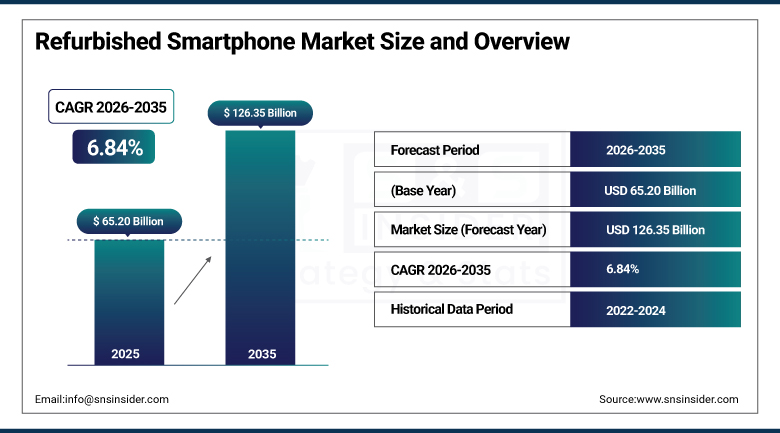
The Refurbished Smartphone Market size was valued at USD 65.20 Billion in 2025 and is expected to reach USD 126.35 Billion by 2035, growing at a CAGR of 6.84% from 2026 to 2035.
The Refurbished Smartphone Market continues to expand as flagship device prices climb well beyond USD 1,300, pushing price-sensitive buyers toward certified alternatives that deliver comparable performance at thirty to forty percent lower cost. Rapid 5G upgrade cycles keep recycling a steady flow of near-new handsets into the secondary channel, and online marketplaces have meaningfully streamlined grading, warranty, and returns processes that once limited consumer trust in buying a pre-owned device sight unseen. In emerging economies, refurbished imports often represent the only financially viable path to 5G connectivity, turning persistent new-device price inflation into a genuinely structural growth catalyst for the secondary smartphone market worldwide.
Back Market reported surpassing seventeen million active users globally in September 2025, driven by a curated selection of certified pre-owned smartphones backed by comprehensive buyer protections, while the company separately advocated for the European Union's Ecodesign Directive earlier in 2025, leveraging regulatory tailwinds to expand its network of certified refurbishers and promote device repairability.
Market Size and Forecast
-
Market Size in 2026E: USD 69.66 Billion
-
Market Size by 2035: USD 126.35 Billion
-
CAGR: 6.84% from 2026 to 2035
-
Fastest Growing Region: Asia Pacific
-
Largest Region: Asia Pacific
To Get more information On Refurbished Smartphone Market - Request Free Sample Report
Refurbished Smartphone Market Trends
-
OEM certification programs are resetting quality expectations and narrowing the trust gap that once limited secondary market growth.
-
Rising flagship device prices continue pushing price-sensitive buyers toward certified refurbished alternatives.
-
Online marketplaces are streamlining grading, warranty, and returns processes to build consumer confidence.
-
Enterprise lease-return fleets are providing uniform, high-grade refurbished stock supporting corporate sustainability targets.
-
AI-based diagnostic kiosks are enabling faster, more transparent device grading and trade-in processes.
U.S. Refurbished Smartphone Market Size Outlook
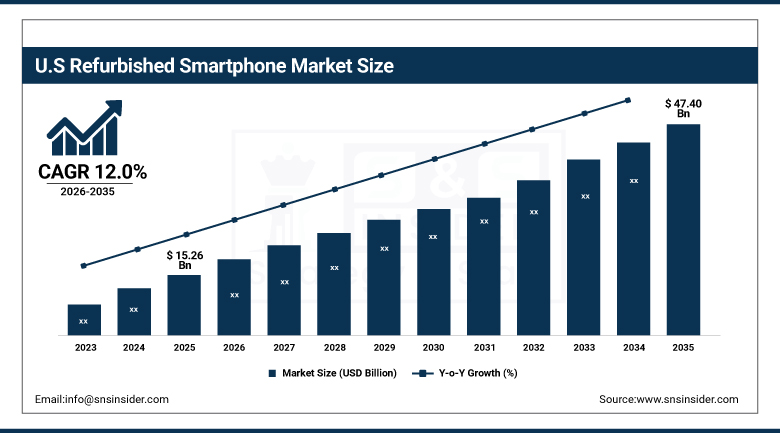
The U.S. Refurbished Smartphone Market was valued at USD 15.26 Billion in 2025 and is expected to reach USD 47.40 Billion by 2035, growing at a CAGR of 12.0% from 2026 to 2035.
USA maintained its dominant standing in terms of North American refurbished phone demand due to increasing environmental sustainability awareness, increasing number of enterprises that have introduced their trade-in programs, and increasing development of technologies related to assurance of quality in the process of refurbishing. Continuous increase in the number of buyers interested in budget-friendly products along with increasing availability of certification programs offered by popular manufacturers kept USA among the fastest-growing national markets for such products, with people viewing refurbished phones as a legitimate alternative to the purchase of flagships.
Amazon Renewed introduced its range of available products in August 2025 in order to diversify its portfolio and include a greater variety of refurbished phones produced not only by popular manufacturers but also by less known brands.
Refurbished Smartphone Market Segment Analysis
-
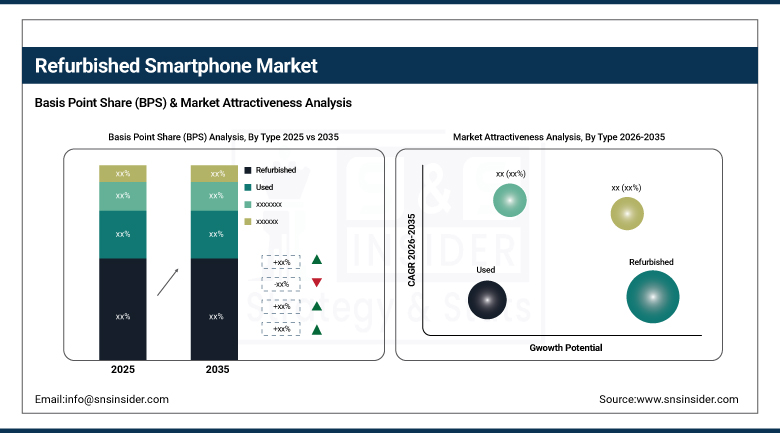
By Type, the Refurbished segment held approximately 62% share in 2025, while the Used segment is the fastest growing.
-
By Sales Channel, the Online Platforms segment held approximately 38.22% share in 2025, while the OEM Stores segment is the fastest growing.
-
By Price Band, the USD 200 to USD 599 segment held approximately 41.55% share in 2025, while the Above USD 600 segment is the fastest growing.
By Type, Refurbished led the market, Used grew fastest
The Refurbished segment dominated the type category in 2025, holding approximately 62% of total revenue, supported by the thorough diagnosis, repair, component replacement, and quality grading process that gives buyers meaningfully greater confidence than an unrefurbished used device can offer. Institutional and corporate buyers in particular gravitate toward refurbished devices specifically because they fit cleanly into corporate device management, security, and warranty standards, and that combination of quality assurance and enterprise suitability keeps the refurbished category firmly ahead of simple used device resale across nearly every major sales channel.
The Used segment is projected to grow at the fastest CAGR during the forecast period, driven by rising demand from the most price-sensitive buyers, including first-time smartphone adopters and students in emerging economies who prioritize absolute lowest cost over the added assurance a full refurbishment process provides. As secondary market infrastructure continues maturing in these price-sensitive regions, growing consumer comfort with peer-to-peer and marketplace-based used device transactions continues pushing this segment's growth rate ahead of the broader type segmentation.
By Sales Channel, Online Platforms led the market, OEM Stores grew fastest
The Online Platforms segment held the largest sales channel share in 2025, at approximately 38.22%, reflecting consumer preference for click-to-door convenience and transparent return policies that online marketplaces have worked hard to establish. Carrier trade-in desks continue feeding substantial inventory into these online pipelines, and that steady supply chain, combined with the convenience online shopping offers, keeps this channel firmly in the lead across the broader sales channel segmentation worldwide.
The OEM Stores segment is projected to grow at the fastest CAGR during the forecast period, as device manufacturers increasingly monetize secondary market demand directly rather than ceding that revenue entirely to third-party refurbishers and marketplaces. Brands pursuing this strategy can simultaneously protect their premium image and capture incremental revenue from price-sensitive customers who might otherwise buy from an unaffiliated third party, a combination that continues pushing OEM-operated storefronts ahead of the broader sales channel category.
By Price Band, USD 200 to USD 599 led the market, Above USD 600 grew fastest
The USD 200 to USD 599 price band held the largest share in 2025, at approximately 41.55%, reflecting its position as the most strategically important price point in the secondary smartphone market given the drastic savings involved relative to comparably specified new devices. This mid-price segment proves especially effective in emerging markets where consumers seek flagship-level specifications at a considerably more achievable resale price, keeping this band firmly at the center of overall refurbished smartphone demand across both mature and developing markets.
The Above USD 600 price band is projected to grow at the fastest CAGR during the forecast period, as warranties and strict grading standards continue bolstering buyer confidence in higher-ticket secondary purchases. A steady influx of recent flagship 5G models flowing into the secondary channel keeps expanding the pool of premium devices available for resale, and that growing supply of near-new, high-specification handsets continues pushing this price band's growth rate well ahead of the broader price segmentation.
Regional Analysis
|
Region |
Major Country |
Share within Region, 2025 (%) |
|---|---|---|
|
Asia Pacific |
China |
37.0% |
|
North America |
United States |
84.0% |
|
Europe |
Germany |
27.0% |
|
Middle East & Africa |
UAE |
26.0% |
|
Latin America |
Brazil |
39.0% |
Asia Pacific Refurbished Smartphone Market Insights
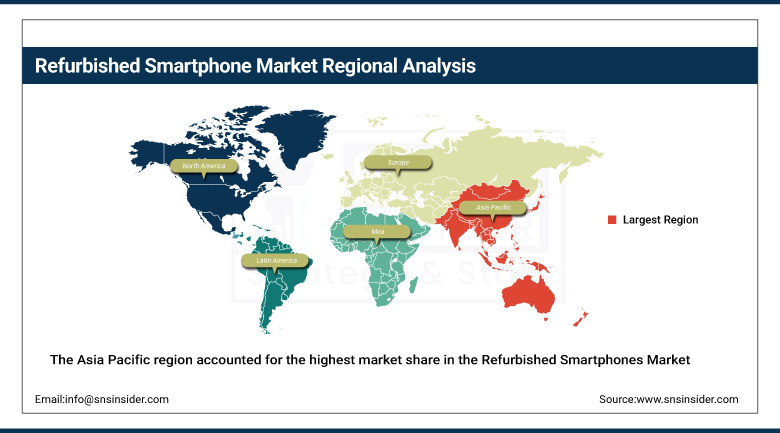
The Asia Pacific region accounted for the highest market share in the Refurbished Smartphones Market on a global scale during 2025 with approximately 41.05%. Furthermore, this region is expected to witness growth at a faster pace over the forecast period, due to factors such as high prices of new smartphones, rising number of trade-in program offered by OEMs, and environmental issues related to disposal of e-waste.
China was the dominant country in the Asia Pacific region accounting for nearly 37% share of the regional revenue, owing to the huge user base for smartphones and a robust infrastructure for refurbishing smartphones. In addition, other major countries of the region such as India and Southeast Asia have added substantially to the regional demand due to rapid rise in the penetration of smartphones and sensitivity towards prices.
Get Customized Report as per Your Business Requirement - Enquiry Now
North America Refurbished Smartphone Market Insights
North America comprised an important market share within the Refurbished Smartphone Market of the world in 2025, owing to existing certification schemes, higher consumer trust for key retailers, and efficient trade-ins by the carriers within the region. Higher environmental consciousness and the development of certification schemes by top brands helped maintain consistent regional demand through the year.
The United States contributed nearly 84% of the total revenue for the region, owing to its presence of key retailers, carriers, and certified refurbishment schemes offered by top device makers. The contribution of Canada to the revenue earned by the region was less in comparison to the United States but kept growing owing to its own development of certified refurbishment schemes.
Europe Refurbished Smartphone Market Insights
Europe was a significant contributor to the global Refurbished Smartphone Market in 2025 since it was one of the oldest markets in the world when it comes to refurbished smartphones, owing to the presence of robust policies related to sustainability and circular economy. Around 27% of the regional market revenue was contributed by Germany due to high consumer acceptance of refurbished units because of heightened environmental concerns and supportive government policies that facilitate electronic recycling and reuse.
The UK and France were following a similar trend, especially France, which imposed laws relating to clear labeling of refurbished devices to enable the buyer with clear information about his/her purchase. Such regulatory focus on repairability and circular economy is anticipated to drive demand from Europe during the remaining forecast period.
MEA & Latin America Refurbished Smartphone Market Insights
The Middle East and Africa region recorded steady growth in refurbished smartphone adoption in 2025, driven by rising smartphone penetration and growing cost sensitivity among consumers across the Gulf states and broader African markets. The UAE accounted for roughly 26% of regional revenue, supported by rising enterprise and consumer demand for cost-effective device alternatives.
Latin America is emerging as a promising market for refurbished smartphones, led by Brazil at roughly 39% of regional revenue, where rising smartphone penetration and a cost-sensitive consumer base continued to drive demand alongside Mexico as a key contributor. Increasing demand for budget-friendly smartphones is expected to keep supporting steady growth across both regions through the remainder of the forecast period.
Growth Drivers: Rising flagship device prices and expanding OEM certification programs
Ever-increasing prices of new mobile phones, particularly flagship devices now priced well above USD 1,300, continue to be the central force behind refurbished smartphone market growth. Certified units of the same premium models frequently sell thirty to forty percent lower than their new counterparts, widening the value gap that keeps pulling budget-conscious consumers, students, and first-time smartphone buyers toward the secondary market rather than stretching to afford a brand-new device.
Expanding OEM certification programs from major manufacturers continue resetting quality expectations and narrowing the trust gap that once limited secondary market growth substantially. Enterprise buyers increasingly recognize that reusing a single smartphone avoids a meaningful amount of carbon emissions on average, and that sustainability case, combined with lease-return fleets that provide uniform, high-grade device stock, continues reinforcing corporate demand for certified refurbished devices as part of broader emissions-reduction commitments.
Restraints: Battery health concerns and limited warranty coverage
Issues relating to batteries and inadequate warranties still keep back further growth in the used smart phone market as many consumers choose not to buy such phones because of the risks of hardware defects or lack of proper support services. The issue is especially relevant to relatively expensive refurbished cell phones that consumers will buy on risk.
Lack of availability of the parts for old devices and high risks of failures at the cheapest price levels still put refurbishers in difficult positions where it becomes necessary to compromise between pricing and brand image. As a result, it may become impossible for refurbishers to certify some phones because it will be too expensive to replace parts in these devices.
Opportunities: Expanding enterprise adoption and AI-driven grading technology
Growing enterprise adoption of refurbished smartphones for cost-efficient workforce mobility and sustainability goals presents substantial opportunity for suppliers positioned to serve corporate lease-return and trade-in programs at scale. As more corporations formalize hardware lifecycle policies tied to environmental, social, and governance reporting requirements, demand for uniform, certified, enterprise-grade refurbished device fleets continues widening well beyond the market's traditional individual consumer base.
Continued advancement in AI-based diagnostic and grading technology is opening further opportunity for refurbishers capable of delivering faster, more transparent, and more consistent quality assessment than manual inspection processes can achieve. Manufacturers and refurbishers capable of deploying automated self-service kiosks and AI-powered grading tools stand to capture a growing share of demand across both developed and emerging markets as consumer trust in algorithmically graded devices continues to build through 2035.
Recent Developments:
-
2025: Swappa announced a partnership with a leading logistics firm to enhance its shipping capabilities, aiming to improve delivery times and customer satisfaction while reinforcing its position as a preferred marketplace for refurbished smartphones.
-
2025: Gazelle launched a new quality certification program aimed at ensuring that all refurbished devices meet stringent performance standards, enhancing consumer trust and differentiating its offerings in a crowded marketplace.
-
2025: Swappie extended its rollout of AI-based diagnostic kiosks throughout Northern Europe, allowing consumers to complete swift smartphone exchanges through automated self-service diagnostics that boost transparency and business efficiency.
Refurbished Smartphone Companies are:
-
Samsung Electronics Co., Ltd.
-
Apple Inc.
-
Amazon.com, Inc.
-
AT&T Inc.
-
Back Market SAS
-
Swappa LLC
-
Gazelle Inc.
-
Swappie Oy
-
Asurion LLC
-
Decluttr Inc.
-
musicMagpie plc
-
CeX Ltd.
-
Recommerce Group
-
Foxway Group
-
Renewd BV
-
Assurant, Inc.
-
T-Mobile US, Inc.
-
Walmart Inc.
Refurbished Smartphone Market Report Scope:
| Report Attributes | Details |
|---|---|
| Market Size in 2025 | USD 65.20 Billion |
| Market Size by 2035 | USD 126.35 Billion |
| CAGR | CAGR of 6.84% From 2026 to 2035 |
| Base Year | 2025 |
| Forecast Period | 2026-2035 |
| Historical Data | 2022-2024 |
| Report Scope & Coverage | Market Size, Segments Analysis, Competitive Landscape, Regional Analysis, DROC & SWOT Analysis, Forecast Outlook |
| Key Segments | • By Type (Refurbished, Used) • By Sales Channel (Online Platforms, OEM Stores, Physical Retail) • By Price Band (Below USD 200, USD 200 to USD 599, Above USD 600) • By End User (Individual Consumers, Enterprises) |
| Regional Analysis/Coverage | North America (US, Canada), Europe (Germany, UK, France, Italy, Spain, Russia, Poland, Rest of Europe), Asia Pacific (China, India, Japan, South Korea, Australia, ASEAN Countries, Rest of Asia Pacific), Middle East & Africa (UAE, Saudi Arabia, Qatar, South Africa, Rest of Middle East & Africa), Latin America (Brazil, Argentina, Mexico, Colombia, Rest of Latin America). |
| Company Profiles | Samsung Electronics Co., Ltd., Apple Inc., Amazon.com, Inc., Verizon Communications Inc., AT&T Inc., Back Market SAS, Swappa LLC, Gazelle Inc., Reebelo Inc., Swappie Oy, Asurion LLC, Decluttr Inc., musicMagpie plc, CeX Ltd., Recommerce Group, Foxway Group, Renewd BV, Assurant, Inc., T-Mobile US, Inc., Walmart Inc. |
Frequently Asked Questions
The Refurbished Smartphone Market is expected to grow at a CAGR of 6.84% from 2026 to 2035.
The Refurbished Smartphone Market was valued at USD 65.20 Billion in 2025.
Rising flagship device prices combined with expanding OEM certification programs and growing sustainability awareness are the major growth factors.
The Refurbished segment held approximately 62% share in 2025.
Asia Pacific held the largest share of the Refurbished Smartphone Market in 2025, at approximately 41.05%, and was also the fastest-growing region.
