
Remote Desktop Software Market Report Scope & Overview:
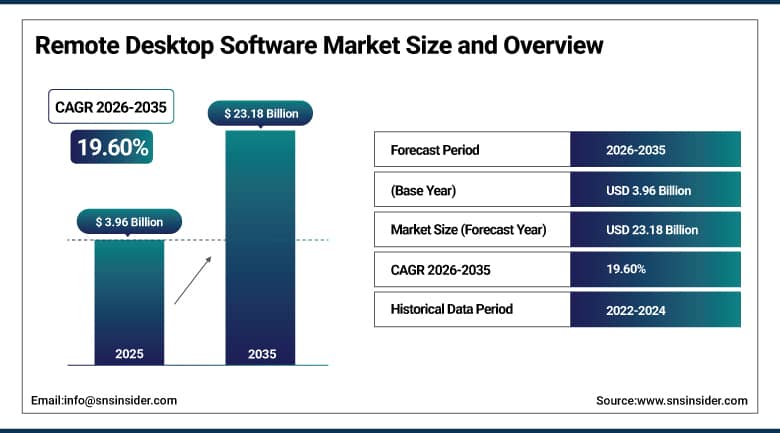
The Remote Desktop Software Market was valued at USD 3.96 Billion in 2025 and is expected to reach USD 23.18 Billion by 2035, growing at a CAGR of 19.60% from 2026 to 2035.
The Remote Desktop Software Market has continued to grow rapidly because companies across virtually all industry segments are beginning to transform the manner in which IT is provided into a more hybrid or distributed approach. Enterprises have begun relying more and more on remote desktop and remote access software solutions to provide their employees, contractors, and third parties with reliable and seamless access to centralized applications, virtual desktops, and other resources irrespective of geographic location and endpoint. This trend is further bolstered by the rapid phasing out of traditional and outdated forms of remote access based on VPN connectivity towards an approach based on Zero Trust architecture.
TeamViewer and Splashtop both expanded their AI-assisted remote support and unattended access platforms in 2026 to meet rising enterprise demand for secure, agentless connectivity amid growing adoption of hybrid work models and Zero Trust security frameworks across IT, healthcare, and BFSI organizations worldwide.
To Get More Information On Remote Desktop Software Market - Request Free Sample Report
Remote Desktop Software Market Trends:
-
Rising integration of Zero Trust security architectures is reshaping enterprise remote access product roadmaps industry-wide.
-
Growing adoption of AI-driven session monitoring and automated issue remediation is improving IT help desk efficiency.
-
Expanding use of agentless and browser-based remote connections is reducing endpoint deployment friction for IT teams.
-
Broadening deployment of remote access tools in industrial and OT environments is extending use cases beyond office IT.
-
Deepening vendor partnerships with ITSM, endpoint security, and email-security platforms are accelerating tool consolidation trends.
U.S. Remote Desktop Software Market Outlook:
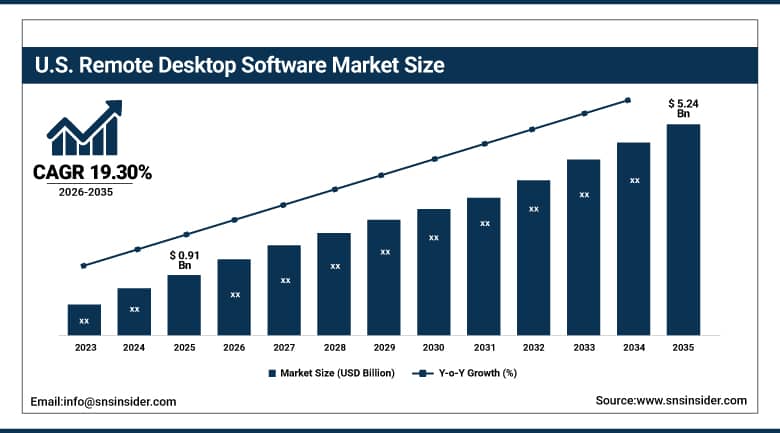
The U.S. Remote Desktop Software Market was valued at USD 0.91 Billion in 2025 and is projected to reach USD 5.24 Billion by 2035, growing at a CAGR of 19.30% during 2026–2035.
The United States is the most significant market for remote desktop products in terms of being a country, because of its substantial number of enterprises in the financial, healthcare, technological and telecommunication sectors that require secure, centrally controlled remote access as a means of protecting their distributed staff members and subcontractors. Increasing demands from government agencies and states for cybersecurity compliance which involve breach notification and identity verification requirements are driving firms to migrate to remote desktop solutions that incorporate Zero Trust access management, session recordings, and audit logs.
BeyondTrust expanded its Remote Support platform in 2026 with bulk endpoint import for automation workflows, real-time audio sharing, and expanded FIDO2 multi-factor authentication, reinforcing its position with compliance-driven U.S. service desk, healthcare and financial-services customers requiring auditable privileged remote access.
Remote Desktop Software Market Segment Analysis:
-
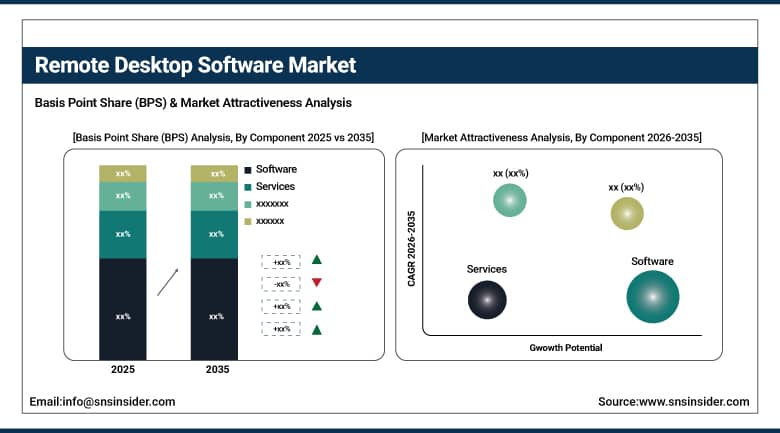
By Component, Software dominated the Remote Desktop Software Market with a 67.50% share in 2025, while Services is the fastest-growing component segment with a CAGR of 22.40% from 2026–2035.
-
By Deployment, Cloud dominated the Remote Desktop Software Market with a 63.50% share in 2025, and continues as the fastest-growing deployment segment with a CAGR of 21.20% from 2026–2035.
-
By Enterprise Size, Large Enterprises dominated the Remote Desktop Software Market with a 58.60% share in 2025, while Small & Medium Enterprises is the fastest-growing segment with a CAGR of 20.90% from 2026–2035.
-
By End-User, IT & Telecom dominated the Remote Desktop Software Market with a 21.80% share in 2025, while Education is the fastest-growing end-user segment with a CAGR of 24.00% from 2026–2035.
By Component, Software leads adoption while Services scales fastest.
The Software segment held the leading position with a 67.50% revenue share in 2025, owing to continued adoption of fundamental remote desktop, remote support, and virtual desktop technologies forming the base of enterprise digital workspace solutions. The leading position of the segment has been bolstered by an increasing richness of built-in capabilities, such as session recording, endpoint automation, AI-based diagnostics and Zero Trust-based access control, making vendors possible to increase average deal sizes without compelling customers to purchase additional standalone solutions.
The Services segment is projected to register the fastest CAGR of 22.40% during the forecast period 2026–2035, due to the growing need of enterprises in implementation, integration, managed monitoring and support services regarding increasing complexity of remote access systems. As the companies implement multi-platform, multi-cloud remote desktop solution based on virtual desktop infrastructure on-premise and SaaS-delivered access solutions, they often do not possess the necessary internal know-how to set up Zero Trust policies, automate patch management process and maintain compliance documentation, forcing them to seek assistance from vendors or third-party managed service providers, a trend that is supposed to fuel services growth faster than software licensing through the decade.
By Deployment, Cloud remains dominant and the fastest-growing mode.
The Cloud segment accounted for a 63.50% share of the Remote Desktop Software Market in 2025, as organizations increasingly favor subscription-based, browser-accessible remote access platforms that eliminate the need for dedicated on-premises gateway infrastructure. Cloud-delivered remote desktop solutions allow IT teams to provision new users within minutes, automatically apply security patches and feature updates across the entire user base, and scale capacity up or down in line with fluctuating headcount, making them particularly attractive to organizations managing seasonal or distributed workforces. The rapid proliferation of hyperscale cloud infrastructure and improving global network latency have further narrowed the performance gap with traditional on-premises deployments, accelerating enterprise willingness to migrate mission-critical remote access workloads to the cloud.
Cloud deployment is also projected to remain the fastest-growing category, expanding at a CAGR of 21.20% between 2026 and 2035, driven by cloud migration efforts, increasing familiarity with software-as-a-service delivered security solutions, and vendors’ efforts to develop cloud-native ZTAA solutions. The On-Premises category, which remains relevant to those enterprises that belong to regulated industries and require complete data residency, is expected to grow at a moderate CAGR of 17.10%, due to the fact that some of these enterprises implement hybrid solutions that integrate on-premises identity control and cloud-based session brokering.
By Enterprise Size, Large Enterprises leads adoption while SMEs scales fastest.
Large Enterprises accounted for the majority 58.60% revenue share in 2025, considering the scope and intricacy of their IT ecosystem, comprising thousands of endpoints, several business departments, and different regulatory regions where a centrally managed and auditable system of remote access is needed. Such companies attach great importance to fine-grained delegation of administrative rights, integration with single sign-on mechanisms, and session logging to meet the needs of their internal risk and compliance departments and are usually willing to pay premium costs for licenses for enterprise-class platforms with technical account management services included. The dominance of the large multinational clients in the BFSI, healthcare, government, and tech verticals keeps this segment the leader in the industry.
Small & Medium Enterprises are expected to register the fastest CAGR of 20.90% during 2026–2035 due to the fact that cloud-based and subscription-based remote desktop solutions reduce the expenses and the technological difficulties which prevented the adoption of remote access products in the past in such companies. SMEs are currently using remote access solutions to facilitate the operations of their dispersed or partially remote teams, outsource IT functions to managed service providers, and offer customer technical support without having their own help desk.
By End-User, IT & Telecom leads adoption while Education adoption scales fastest.
The IT & Telecom segment led the market with a 21.80% revenue share in 2025, as telecom operators and technology service providers rely extensively on remote desktop tools to manage globally distributed network infrastructure, deliver 24/7 technical support and maintain uninterrupted service across data centers and edge locations. The ongoing rollout of 5G networks and expanding cloud service portfolios have further increased the number of remote endpoints and systems that IT and telecom organizations must monitor and service remotely sustaining strong platform demand across both internal IT operations and external customer support functions within this vertical.
Education is projected to register the fastest CAGR of 24.00% during the forecast period, propelled by continued growth in e-learning, hybrid classroom models and remote IT support for distributed student and faculty devices across school districts and universities. Educational institutions are increasingly deploying remote desktop platforms to give students equitable access to specialized software and computing labs from home while IT departments use the same tools to remotely troubleshoot devices across widely dispersed campuses, a pattern that accelerated sharply during pandemic-era distance learning and has since become a permanent fixture of institutional IT strategy.
Regional Analysis:
|
Region |
Major Country |
Share within Region, 2025 (%) |
|
North America |
United States |
74.60% |
|
Europe |
Germany |
16.80% |
|
Asia Pacific |
China |
25.80% |
|
Middle East & Africa |
Saudi Arabia |
33.50% |
|
Latin America |
Brazil |
42.30% |
North America Remote Desktop Software Market Insights
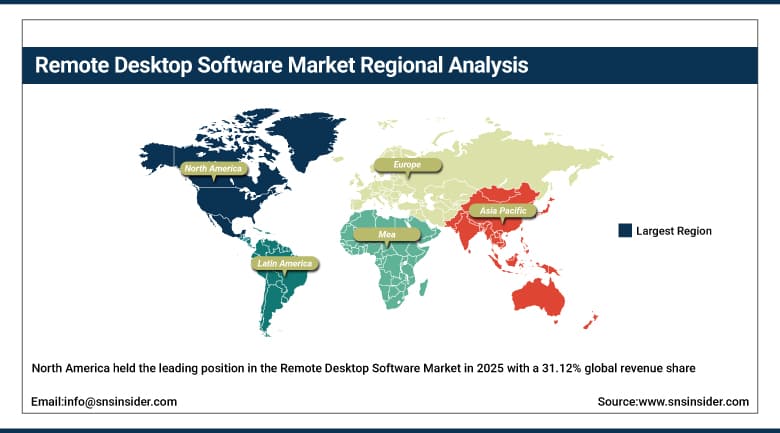
North America held the leading position in the Remote Desktop Software Market in 2025 with a 31.12% global revenue share, valued at approximately USD 1.22 Billion owing to its technologically advanced IT infrastructure, presence of numerous large enterprises, and adoption of the hybrid/remote working approach by institutions in almost all industry verticals. The presence of a number of hyperscale cloud vendors operating out of this region has facilitated cloud-based remote desktop software solutions to become more readily available in North America, whereas strict regulations related to data privacy, financial services, and healthcare information have compelled enterprises to opt for remote access software.
The United States accounted for roughly 74.60% of the North America Remote Desktop Software Market in 2025, driven by extensive enterprise IT modernization initiatives, a large base of federal and state government agencies adopting Zero Trust access mandates and the domestic presence of several leading remote access vendors that continue to prioritize the home market for early feature rollouts. Canada is contributing to regional growth through its own expanding managed IT services sector and rising adoption of cloud-based remote support tools among mid-sized enterprises in finance, healthcare and public-sector organizations seeking to modernize legacy on-premises access infrastructure.
Get Customized Report as Per Your Business Requirement - Enquiry Now
Europe Remote Desktop Software Market Insights
Europe represented a significant share of the Remote Desktop Software Market in 2025, valued at approximately USD 1.01 Billion, and is projected to grow at a CAGR of 19.20%, due to the presence of stringent regulations for data protection in the region and constant modernization of enterprise IT infrastructure in industries such as manufacturing, financial services and public administration. With the introduction of GDPR and other cybersecurity policies by nations, vendors have started focusing on developing consent management features, EU-residency capabilities for data storage and access logging features to cater to the unique needs of the European market.
Germany represented approximately 16.80% of the Europe Remote Desktop Software Market in 2025, supported by its large industrial and manufacturing sector, strong presence of enterprise software vendors, and early regulatory emphasis on secure remote industrial access. Both the United Kingdom and France have been found to be major contributors in this respect. The reason for that is the contributions made by companies involved in finance in London as well as digitization of the public sector in France, which ensure constant investments in remote access platforms that meet compliance requirements.
Asia Pacific Remote Desktop Software Market Insights
Asia Pacific is projected to register the fastest CAGR of 21.40% during the forecast period 2026–2035, reaching a market valuation of approximately USD 0.93 Billion in 2025 owing to the fast pace of digital revolution in various industries such as IT-BPM, manufacturing, and education. Rapidly growing nations like India, China and Southeast Asian countries have seen increased enterprise cloud adoption, as well as an increase in the number of SMEs looking for affordable ways to access remote desktops through subscription-based offerings. Governments in the region have made substantial investments in broadband and data centers, reducing the gap in connectivity that once hindered cloud-based remote desktop adoption in the emerging markets of Asia Pacific.
China represented approximately 25.80% of the Asia Pacific Remote Desktop Software Market in 2025, due to the wide range of IT outsourcing business in China, coupled with the increased demands of enterprises to centrally manage their manufacturing and logistics operations. India stands out as one of the markets that will experience high growth due to its vast labor force in the IT-BPM sector along with the rising need for remotely supporting the globally dispersed service teams.
Middle East & Africa and Latin America Remote Desktop Software Market Insights
The Middle East & Africa region has been recording the second highest CAGR in the market due to various digital transformation projects undertaken by the governments of individual countries, such as the Vision 2030 of Saudi Arabia and Smart Government initiatives of the United Arab Emirates, which have led to significant investments in secure remote access systems based on the cloud. Saudi Arabia formed about 33.50% of the Middle East & Africa market in 2025 due to extensive spending on the modernization of IT infrastructure in the country along with growing Managed IT services sector providing services to mid-sized companies operating in the region, whereas the UAE continues to become attractive to foreign multinationals for establishing regional headquarters for their GCC operations.
Latin America has been growing steadily due to gradual movement from on-premise access solutions to cloud-based remote desktop platforms by companies from the region that is also boosted by increasing broadband penetration rates and investments into building IT outsource centers in the area. Brazil constituted about 42.30% of the Latin America Remote Desktop Software Market in 2025 due to its highly developed technology-services industry and growing number of remote support tool users in the mid-size manufacturing and financial services sector, whereas Mexico and Argentina add up to regional growth through growing nearshoring IT services business serving North American companies.
Market Dynamics:
Growth Drivers: Hybrid work adoption and Zero Trust security investment driving market growth
The continuous and persistent transformation to hybrid and remote workplace models emerges as the most important factor pushing the Remote Desktop Software Market, with organizations across various industries redesigning their IT delivery models in order to ensure secure connectivity for distributed workers based at home, satellite locations, or customer premises on a regular basis. Remote desktop solutions ensure the necessary security and centrally managed connectivity that allow companies to enable access to enterprise applications, documents, and systems from any place, substituting physical offices with remote desktops as a point of entry to corporate resources.
On the other hand, increasing investment in Zero Trust architecture across the enterprises provides another important stimulus for growth of the market, as companies start to abandon perimeter-based VPN model of remote access in favor of zero trust model based on continuous verification of user identity and authentication status. Leading vendors of remote access solutions respond to this demand by incorporating multi-factor authentication, device posture checks, and fine-grained role-based access control features into their platforms, thus turning their products into one of the key building blocks of enterprise Zero Trust strategy.
Restraints: Data security exposure and integration complexity limiting market expansion
Persistent concerns around unauthorized access and data security exposure remain among the most significant restraints facing the Remote Desktop Software Market, as remote access tools, by design, create pathways into core enterprise systems that can become high-value targets for cybercriminals if not properly configured and monitored. Highly publicized ransomware and credential-theft incidents that have exploited poorly secured remote access software have made some risk-averse enterprises, particularly in regulated industries handling sensitive financial or health information, more cautious about expanding remote access deployments without extensive security review, vendor due diligence, and ongoing penetration testing, all of which lengthen enterprise sales and deployment cycles for platform vendors.
The growing technical complexity of integrating remote desktop platforms with existing identity providers, security information and event management systems, and ITSM ticketing platforms is also constraining faster market expansion, particularly among mid-sized organizations lacking dedicated security engineering resources. Many enterprises operate a fragmented mix of legacy on-premises virtual desktop infrastructure alongside newer cloud-delivered remote access tools, and reconciling these environments under a single consistent access policy framework requires significant implementation effort.
Opportunities: AI-driven automation and expanding industrial remote access use cases creating new growth avenues
The growing integration of artificial intelligence into remote desktop and remote support platforms is opening substantial new growth opportunities for vendors able to differentiate on intelligent automation rather than connectivity alone. AI-assisted features such as automated device diagnostics, predictive issue detection, natural-language session summaries and intelligent ticket routing are allowing IT help desks to resolve a growing share of support requests without direct technician intervention, creating a compelling upgrade incentive for enterprises evaluating platform renewals. Vendors that successfully embed these capabilities into existing remote access workflows, rather than offering them as separate standalone tools, are well positioned to capture disproportionate share of enterprise IT budgets as organizations consolidate their digital workplace technology stacks around fewer, more capable platforms.
Expanding remote access use cases beyond traditional office IT into industrial, operational technology, and edge-device environments represent a further significant opportunity, as manufacturers, utilities, and logistics operators increasingly require secure remote connectivity to programmable logic controllers, human-machine interfaces, and distributed field equipment without installing full endpoint software on constrained industrial hardware. The continued expansion of small and medium-sized enterprises adopting cloud-based, subscription-priced remote access tools in emerging economies across Asia Pacific and Latin America is also creating a large underpenetrated customer base, particularly as regional broadband infrastructure investment continues to narrow historic connectivity gaps and government-led digitalization programs actively encourage secure remote-work technology adoption among domestic small businesses.
Recent Developments:
-
July 2026: ConnectWise launched the unified ConnectWise Platform, embedding its ScreenConnect remote access tool alongside AI agents that classify support tickets, route requests, and automate routine remediation tasks for managed service provider technicians.
-
April 2026: BeyondTrust released Remote Support 26.1, adding bulk endpoint import for Endpoint Automation workflows, real-time audio sharing between technicians and end users, and expanded administrative delegation controls for large service desk teams.
-
March 2026: SysAid partnered with Splashtop to embed secure attended and unattended remote support sessions directly into its AI-driven ITSM ticketing platform, enabling technicians to launch remote sessions without leaving the SysAid console.
-
January 2026: Splashtop announced a strategic partnership with KIWONTECH to integrate its remote access and autonomous endpoint management platform with KIWONTECH's email security suite for hybrid-work enterprise customers.
-
November 2025: TeamViewer introduced Agentless Access within TeamViewer Tensor, allowing technicians to securely connect to industrial PLCs and HMIs without installing endpoint software, reducing deployment complexity on constrained OT hardware.
-
September 2025: Omnissa upgraded its Horizon and Workspace ONE platforms with AI-driven performance monitoring and automated remediation tools, adding deeper Nutanix and NVIDIA infrastructure integrations for graphics-intensive virtual desktop workloads.
-
March 2025: Microsoft retired the legacy Windows Remote Desktop Store app, directing Windows 365, Azure Virtual Desktop, and Microsoft Dev Box users to migrate to its unified Windows App for continued remote desktop access.
Remote Desktop Software Market Key Players:
-
TeamViewer Germany GmbH
-
Microsoft Corporation
-
GoTo, Inc.
-
Omnissa, LLC
-
Cloud Software Group, Inc. (Citrix)
-
AnyDesk Software GmbH
-
Splashtop Inc.
-
Zoho Corporation Pvt. Ltd.
-
ConnectWise, LLC
-
BeyondTrust Corporation
-
RealVNC Ltd.
-
Parallels International GmbH
-
NinjaOne, LLC
-
Kaseya Limited
-
N-able, Inc.
-
Ivanti, Inc.
-
SolarWinds Corporation
-
IDrive Inc.
-
Google LLC
-
Devolutions Inc
Remote Desktop Software Market Report Scope:
| Report Attributes | Details |
|---|---|
| Market Size in 2025 | USD 3.96 Billion |
| Market Size by 2035 | USD 23.18 Billion |
| CAGR | CAGR of 19.60% From 2026 to 2035 |
| Base Year | 2025 |
| Forecast Period | 2026-2035 |
| Historical Data | 2022-2024 |
| Report Scope & Coverage | Market Size, Segments Analysis, Competitive Landscape, Regional Analysis, DROC & SWOT Analysis, Forecast Outlook |
| Key Segments | • By Component (Software, Services) • By Deployment (Cloud, On-Premises) • By Enterprise Size (Large Enterprises, Small & Medium Enterprises) • By End User (BFSI, Healthcare, IT & Telecom, Government, Manufacturing, Education, Others) |
| Regional Analysis/Coverage | North America (US, Canada), Europe (Germany, UK, France, Italy, Spain, Russia, Poland, Rest of Europe), Asia Pacific (China, India, Japan, South Korea, Australia, ASEAN Countries, Rest of Asia Pacific), Middle East & Africa (UAE, Saudi Arabia, Qatar, South Africa, Rest of Middle East & Africa), Latin America (Brazil, Argentina, Mexico, Colombia, Rest of Latin America). |
| Company Profiles | TeamViewer Germany GmbH, Microsoft Corporation, GoTo, Inc., Omnissa, LLC, Cloud Software Group, Inc. (Citrix), AnyDesk Software GmbH, Splashtop Inc., Zoho Corporation Pvt. Ltd., ConnectWise, LLC, BeyondTrust Corporation, RealVNC Ltd., Parallels International GmbH, NinjaOne, LLC, Kaseya Limited, N-able, Inc., Ivanti, Inc., SolarWinds Corporation, IDrive Inc., Google LLC, Devolutions Inc. |

Frequently Asked Questions
Key players in the Remote Desktop Software Market include TeamViewer Germany GmbH, Microsoft Corporation, GoTo, Inc., Omnissa, LLC, among others.
Key opportunities include AI-driven diagnostics and automated remediation, expansion into industrial and edge environments, and growing SME adoption across Asia Pacific and Latin America.
Hybrid work, Zero Trust adoption, BYOD needs, and regulatory demands for encrypted access are driving remote desktop market growth.
The Software segment dominated the Remote Desktop Software Market, accounting for approximately 67.50% market share in 2025.
North America led the market in 2025 with 31.12% share, driven by advanced infrastructure, hybrid work, regulations, and managed IT services.
